
Moon Phase Today Kolkata
On Saturday, October 10, 2026, the moon in Kolkata is a New Moon with 0% illumination. Moon age: 28.9 days.
☽ Best Places to View the Moon in Kolkata
Kolkata sits at 22.6° North on the flat delta of the Hooghly River, a city where colonial-era stonework meets the humid, riverine air of the Bengal plain. The Moon climbs at a fairly noticeable angle across the sky here, into a mix of the warm sodium glow of the old city and the wide, dark stretch of the river itself. It rises somewhere along the eastern horizon — the exact point shifts through the year — and tracks across a skyline defined by Palladian arches, temple spires, and cantilever steel rather than glass towers. Kolkata rewards the observer who uses its riverside ghats and open maidan lawns to watch the moon clear a skyline built more from history than height.
Prinsep Ghat
The absolute #1 viewpoint in the city. The moon often rises over the Hooghly River from here, and on the right night can be aligned behind the ghat's white Palladian arches or the distant span of the Vidyasagar Setu bridge. Tip: check the tide — low tide can expose wet mud that sometimes creates attractive reflections.
Victoria Memorial Gardens
The Maidan's southern lawns give an unobstructed sweep of open sky. On the right date, the moon can be photographed tracking near the Victoria Memorial's white marble dome for a classic colonial-era foreground, and the garden's ponds pick up its shimmer against the surrounding city glow.
Howrah Bridge (Rabindra Setu)
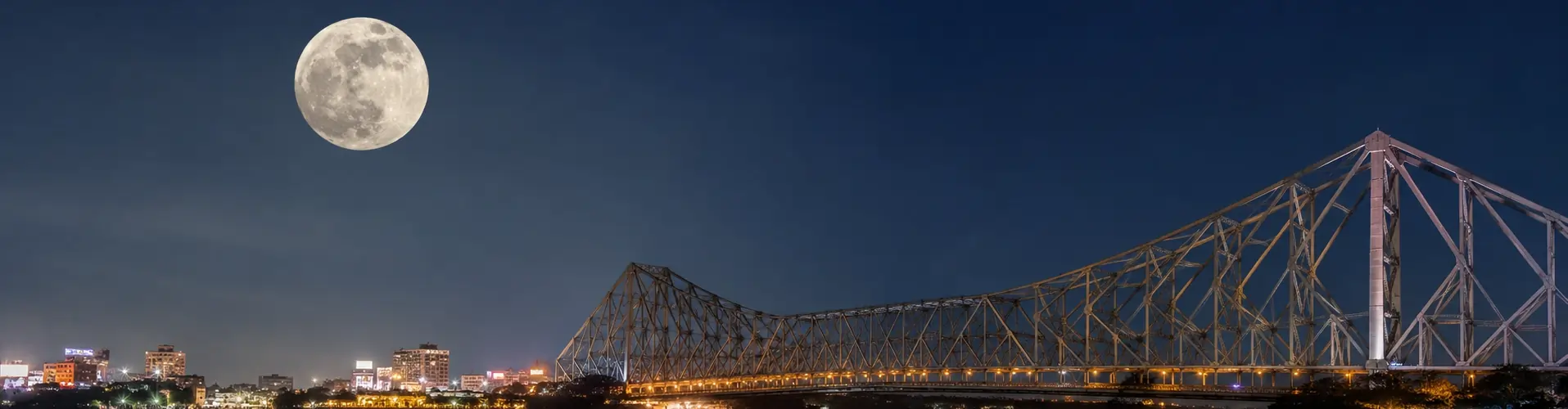
For a harder, industrial silhouette, shoot from the pedestrian walkways or the nearby ghats on the Kolkata bank. When the moon can be aligned behind the world's busiest cantilever bridge, with Howrah Station lit up beyond it, it gives a high-contrast, graphic composition.
Eco Park, New Town
Out in the newer part of the city, Eco Park's central lake sits well clear of high-rises, so the moon rises cleanly over open water. It's a quieter, nature-first alternative to the central ghats, with calmer reflections. Logistics: entry is roughly INR 30–50.
Millennium Park
Running along Strand Road, this riverside park offers the same wide Hooghly frontage as Prinsep Ghat but with fewer crowds. It's a good central option for watching the moon clear the water and the distant bridge silhouettes without fighting for a spot.
Dakshineswar Kali Temple Ghats
North of the city center, this temple complex adds a spiritual backdrop to moonrise. On nights when the moon can be aligned behind the ornate Navaratna-style spires, with both reflected in the river below, it's a favorite composition for photographers willing to travel a little further out.
◉ Best Times for Moon Photography
📷 Quick Photography Tips
Timezone: Kolkata operates on Indian Standard Time (IST, UTC+5:30) year-round. India does not observe daylight saving time, so moonrise tracking stays consistent through the seasons.
Best season: October through March gives the clearest air and sharpest lunar detail; the summer monsoon (roughly June–September) brings the heaviest haze and cloud cover.
◐ What the Experience Actually Feels Like
There's a particular stillness to a moonrise at Prinsep Ghat. As the sun drops behind the maidan, the sound of the city softens into the lap of the river against the ghat steps, the distant horn of a ferry, and the murmur of families out for the evening. The air carries the damp mineral smell of the Hooghly and, often, woodsmoke drifting from a riverside stall. When the moon finally clears the flat eastern horizon, it catches the white stone arches first, turning them silver against the darkening sky.
In the winter dry season, the sky stays a deep, clean indigo, and the moon rises bright enough to throw soft shadows across the marble of the Victoria Memorial. From the open lawns of the Maidan, the city feels unusually calm for its size — on the right night the moon tracks near the dome, and the ponds catch its light in long, quiet streaks. It's a contrast to the daytime crush of the city: for twenty minutes or so, everything slows down to the pace of the rising moon.
Around Kojagari Lakshmi Puja, the full moon becomes part of the city's own rhythm rather than just a backdrop to it — homes and courtyards stay lit long after dark, and the moonrise is something people are already watching for. Down at the ghats, ripples from a passing ferry catch the light in scattered gold lines on the black water, and on nights when the moon lines up behind Howrah Bridge or the Dakshineswar temple spires, an ordinary evening walk turns into something worth stopping for.
"For twenty minutes, the city's daytime crush gives way to something slower — a silver light settling over stone arches, temple spires, and the wide, dark curve of the Hooghly."
✓ Your Kolkata Moon Chase Checklist
Before You Go
- Check the moonrise time on this page and note it against sunset — twilight passes relatively quickly compared with higher latitudes
- Check tide times if heading to Prinsep Ghat — low tide is what exposes the reflective mud-flat mirror
- Download PhotoPills or Stellarium to line up the moonrise with the Vidyasagar Setu or Victoria Memorial dome
- Check the seasonal forecast; monsoon humidity can soften or hide the moon near the horizon
- Charge your gear fully — Kolkata's heat and humidity drain batteries faster than usual
What to Bring
- A telephoto lens (200–400mm) to compress the moon behind the Vidyasagar Setu or Howrah Bridge from the ghats
- Humidity protection: a lens cloth is essential, since damp river air fogs glass quickly after dark
- A remote shutter release or a 2-second timer to avoid shake on your tripod during longer exposures
- Insect repellent, especially at Eco Park or Dakshineswar where mosquitoes pick up after sunset
- Light, breathable clothing — even at night, Kolkata rarely cools much below 20°C (68°F) outside winter
- A friend or local guide for the less-lit stretches of riverbank if shooting late
On the Night
- Arrive at your spot at least 30–40 minutes early; the blue-hour transition over the Hooghly goes quickly
- Focus manually on the moon's edge — streetlight and temple lighting can throw off autofocus after dark
- Bracket your exposures: one for the bright lunar disc, one for the darker riverbank and bridge structure
- At the ghats, step away from the main floodlights to cut down on lens flare in your shots
- Stick around for the "Magic Ten" just after moonrise, when the disc looks largest and least washed out
? Kolkata Moon Phase — Frequently Asked Questions
Q. What is the moon phase in Kolkata today?
The current moon phase in Kolkata today is a New Moon with 0% illumination (moon age: 28.9 days). You can see the exact moonrise, moonset, and calendar in the widget at the top of this page. Kolkata's coordinates (22.5726° N, 88.3639° E) and its Indian time zone are already factored in, so the phase and times shown are accurate for the city without any adjustment needed.
Q. What time does the moon rise and set in Kolkata today?
Moonrise and moonset both change daily and are calculated live for Kolkata in the info grid above. The Ganges Delta is flat with essentially no natural elevation, so the horizon is set almost entirely by the city's own rooftops and river frontage. Tap any date on the calendar to see the phase and rise/set times for that specific day.
Q. Where is the best place to view the moon in Kolkata?
Prinsep Ghat is the absolute #1 viewpoint, where the moon rises over the Hooghly River and can align behind the ghat's white Palladian arches or the distant Vidyasagar Setu span. Victoria Memorial Gardens gives an unobstructed sweep of open sky over the white marble dome, Howrah Bridge offers a harder, industrial silhouette from the pedestrian walkways, and Eco Park, Millennium Park, or the Dakshineswar Kali Temple ghats add further quiet-lake, less-crowded-riverside, or spiritual-spire alternatives.
Q. Is there anything to check before shooting at Prinsep Ghat?
Yes — it's worth checking the tide beforehand, since low tide can expose reflective riverbank mud that acts as a dark mirror for the moon's light. Eco Park's entry runs roughly INR 30–50 if heading there instead for a quieter, high-rise-free lake setting.
Q. When is the next full moon in Kolkata?
The date of the next full moon is calculated live and shown in the "Next Full Moon" card above, already adjusted for Kolkata's time zone.
Q. What is Kojagari Lakshmi Puja and why does it matter for moon viewing?
Kojagari Lakshmi Puja is Bengal's own full-moon festival (Sharad Purnima), usually falling in September or October, when the full moon becomes part of the city's own rhythm rather than just a backdrop — homes and courtyards stay lit long after dark, and the moonrise is something people are already watching for.
Q. Does Kolkata observe daylight saving time?
No. Kolkata operates on Indian Standard Time (IST, UTC+5:30) year-round — India does not observe daylight saving time. The times shown on this page are already correct for Kolkata in every season, with no seasonal clock changes to account for.
Q. What's the best time of year for moon photography in Kolkata?
October through March is the winter dry season, bringing the lowest humidity and clearest skies, though even then urban air pollution haze can soften distant skylines. The first 10–20 minutes after moonrise — sometimes called the "Magic Ten" — is when the disc appears unusually large near the horizon before city lights take over. Whatever the season, the riverside along the ghats can turn surprisingly breezy, so a weighted tripod is worth bringing.
Q. Does this page work for cities besides Kolkata?
This page is set up specifically for Kolkata, India. For the moon phase in any other city or location worldwide, use the Dynamic Moon Phase Calculator on the moonphase.today home page.
✦ Explore Further
Moon Phase Today: Dhaka
Check tonight's moon phase and best viewpoints just across the delta in Dhaka, Bangladesh.
🌍World Moon Phase Directory
Browse the moon phase today in hundreds of other cities and locations around the world.
📐Looney 11 Exposure Calculator
Dial in the exact f-stop, ISO, and shutter speed for a full moon — the same rule used in our Prinsep Ghat tips.
🌆Blue Hour Calculator
Find tonight's exact blue hour window to time your Hooghly River moonrise shots.
NASA Moon Phase & Libration Gallery
NASA's Scientific Visualization Studio's daily renders of the moon's exact phase, libration, and orientation, straight from official mission data.