
Moon Phase Today Gilbert
On Friday, October 9, 2026, the moon in Gilbert is a New Moon with 0% illumination. Moon age: 28.9 days.
☽ Best Places to View the Moon in Gilbert, AZ
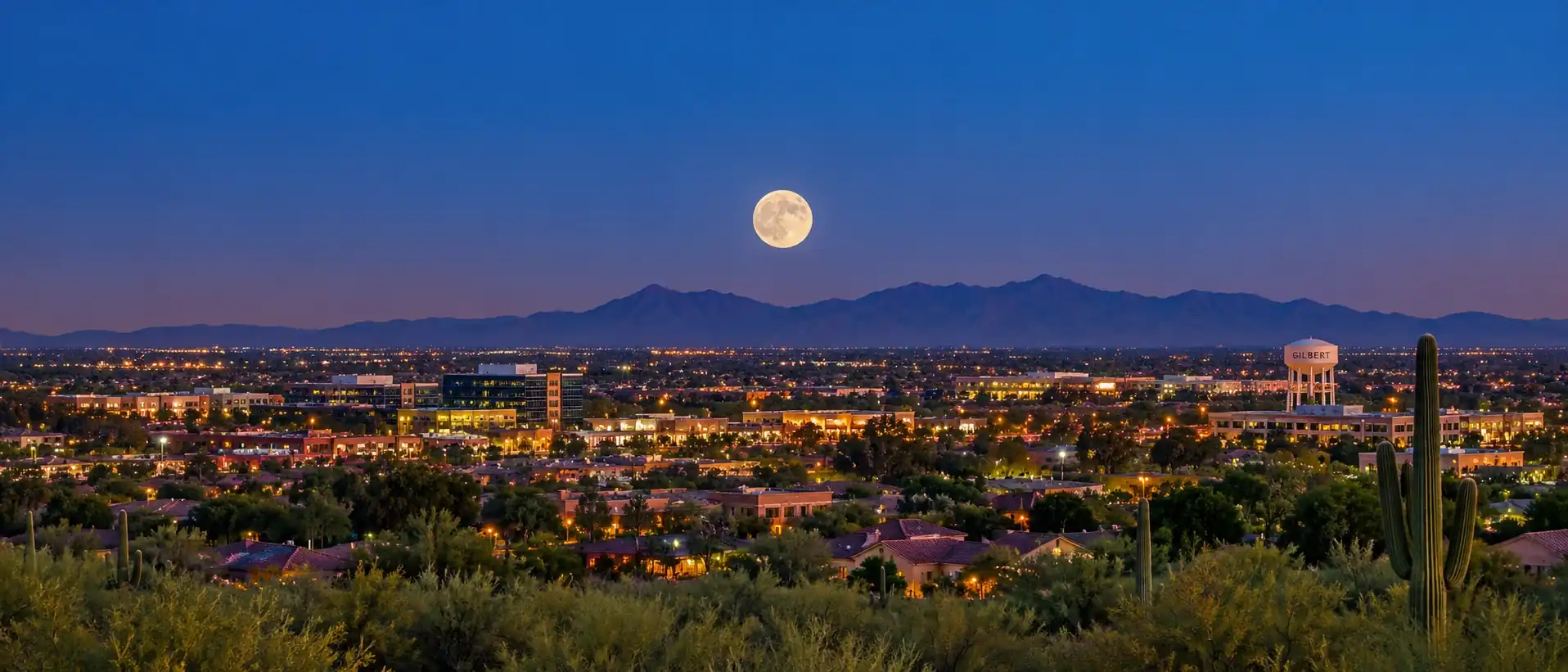
Gilbert is flat Sonoran Desert like the rest of the southeast Phoenix Valley, but it has an unusual advantage: a real public observatory sitting inside one of its largest parks. Skies run moderately bright given the size of the Phoenix metro, but several of Gilbert's district parks stay open late and give wide, unobstructed sightlines toward the horizon. The main planning variables are the moon's rise time and azimuth, plus its altitude at the moment it lines up with the landscape you want in frame — and, in a desert climate, watching for monsoon dust and heat. Here are six of the town's strongest viewpoints.
Gilbert Rotary Centennial Observatory
A real public observatory inside the Riparian Preserve, housing a 16-inch computer-controlled telescope operated by the East Valley Astronomy Club. Free public viewing runs Friday and Saturday evenings from sunset to 9:30 p.m., weather permitting, with a Public Star Party on the second Friday of each month; suggested donation is a few dollars per family. Small private group sessions (up to six people) can also be booked Sunday–Thursday for a fee. The surrounding park closes at 10 p.m. Address: 2757 E Guadalupe Rd.
Riparian Preserve at Water Ranch
A 110-acre preserve built around seven ponds and a community fishing lake, with about 4.5 miles of paved and unpaved trails through desert and wetland habitat — genuinely one of the quieter, more natural settings in the area, and home to the observatory above. Reported park hours run roughly 5:30 a.m.–10 p.m., though some sources describe the habitat area itself as dawn to dusk — check current signage if you're planning a late visit outside the observatory's own hours. Address: 2757 E Guadalupe Rd.
Freestone Park
Gilbert's original district park, with 88 developed acres, two fishing lakes (Freestone and Discovery), a miniature railroad, and wide grassy areas well away from tall obstructions. Park hours are 5:30 a.m.–10 p.m. daily, not affected by holidays. Address: 1045 E Juniper Rd.
Gilbert Regional Park
A newer park in southeast Gilbert, reported at 272 acres, with views toward the San Tan Mountains, a fishing lake, a landmark hillside playground, and miles of paved trails across genuinely open terrain. Hours run 5:30 a.m.–10 p.m. daily. Address: 3005 E Queen Creek Rd.
Crossroads Park
A central Gilbert district park built around a 3.74-acre lake, with an amphitheater, sports fields, and community gardens — also home to AZ Ice Gilbert. Hours run 5:30 a.m.–10 p.m. daily. Address: 2155 E Knox Rd.
Downtown Gilbert (Heritage District)
Gilbert's small, walkable historic downtown, with restaurant patios, a farmers market, and public streets and sidewalks rather than a single park with posted closing hours — a livelier, more social alternative to the town's larger parks. Individual restaurants and shops keep their own hours. Centered near Gilbert Rd & Page Ave.
◉ Best Times for Moon Photography
📷 Quick Photography Tips
Gilbert runs on Mountain Standard Time (UTC−7) year-round — Arizona is one of the few U.S. states that does not observe daylight saving time (the Navajo Nation in the state's northeast is an exception). PhotoPills or Stellarium will handle the moon's exact rise azimuth for any of these spots automatically.
The moon phase today in Gilbert is shown in detail above — complete with exact illumination percentage, moonrise/set times, and the best local spots to see it. For the moon phase today in any other city worldwide, visit our Dynamic Moon Phase Calculator on the home page.
◐ What the Experience Actually Feels Like
The observatory can be a lively evening destination, with East Valley Astronomy Club volunteers providing public telescope viewing when conditions permit — sometimes pointed at the moon itself, sometimes at Saturn's rings or a distant nebula. Kids are often among the most enthusiastic visitors in line.
Out at Gilbert Regional Park, evenings tend to be quieter once the hillside playground crowd thins, and the open terrain toward the San Tan Mountains can give the moon a clean, low horizon to climb above, without much competing light beyond the park's own paths.
Down in the Heritage District, the mood leans social — restaurant patios filling in, a farmers market on weekend mornings, and a moon that has to share the frame with string lights and storefronts rather than open desert. It's a livelier, more urban way to catch a moonrise than any of the parks offer.
"The observatory can be a lively evening destination, with East Valley Astronomy Club volunteers providing public telescope viewing when conditions permit — sometimes pointed at the moon itself, sometimes at Saturn's rings or a distant nebula."
✓ Your Gilbert Moon Chase Checklist
Before You Go
- Check the moonrise time and rise azimuth for your date — alignment with a specific landmark depends on the date, not just the location
- Verify Site Access: the Rotary Centennial Observatory's public viewing only runs Friday and Saturday nights, weather permitting — check its calendar before making a special trip
- If you want an actual telescope view of the moon rather than just a photo, the observatory is the one spot on this list specifically designed for public telescope observing
- Use PhotoPills or Stellarium to check whether the moon will align with a specific landmark on your date
- Check the forecast for monsoon activity (June 15–September 30, Arizona's official monsoon season) — dust storms and fast-building thunderstorms can cancel a moonrise with little notice
- Confirm current rules on tripods and photography at your chosen park, especially for anything beyond personal use
What to Bring
- A telephoto lens, often 200mm or longer, can help compress the moon behind a park landmark or distant tree line
- Water — Gilbert's desert evenings cool down, but daytime heat much of the year means dehydration risk lingers into the evening
- A remote shutter release or a 2-second timer to avoid shake on tripod shots
- A small donation (cash) if you're visiting the Rotary Centennial Observatory's public viewing nights
- A flashlight or headlamp — desert parks get genuinely dark once you're away from the parking areas
On the Night
- Arrive at your viewpoint at least 30–45 minutes early, especially at the observatory on clear Friday and Saturday nights
- Focus manually on the moon's edge — parking-lot and pathway lighting can confuse autofocus at dusk
- Bracket your exposures — one for the bright lunar disc, one for the darker lake, field, or building below
- If the moon looks soft or hazy right at moonrise, consider waiting until it climbs higher above the horizon, when atmospheric effects are often less pronounced
- Plan to be back at your vehicle before each park's 10 p.m. closing time — don't count on staying past it
? Gilbert Moon Phase — Frequently Asked Questions
Q. What is the moon phase today in Gilbert, Arizona?
The moon phase today in Gilbert is a New Moon with 0% illumination. The next full moon is in 17 days, on Oct 25. Moonrise is at 5:35 AM and moonset at 5:30 PM.
Q. Where is the best place to view the moon in Gilbert?
For a real telescope view, the Gilbert Rotary Centennial Observatory inside the Riparian Preserve at Water Ranch offers free public viewing on Friday and Saturday evenings from sunset to 9:30 p.m., weather permitting, with a Public Star Party on the second Friday of each month. For photography, Gilbert Regional Park has views toward the San Tan Mountains and open terrain, Freestone Park and Crossroads Park give wide grassy areas and lakes, and the Riparian Preserve's ponds are one of the quieter, more natural settings in the area. Downtown Gilbert's Heritage District is a livelier, more social alternative with restaurant patios.
Q. Where does the moon rise and set in Gilbert, and how high does it climb?
At about 33.4°N, Gilbert's moonrise and moonset points swing across the horizon each month, from roughly northeast to southeast for rising and northwest to southwest for setting. A winter full moon climbs very high in the south, to roughly 80° above the horizon, while a summer full moon stays lower, peaking near 33°. Gilbert is flat Sonoran Desert, so the horizon is low in every direction, and Gilbert Regional Park's open terrain toward the San Tan Mountains can give the moon a clean, low horizon to climb above. Check the azimuth for your date and exact viewpoint, since the rising point changes through the moon's orbit.
Q. Is light pollution a problem for moon observing in Gilbert?
The moon is bright enough to observe and photograph from almost anywhere in Gilbert, so light pollution rarely limits the lunar disc itself. It does wash out earthshine on a thin crescent and any faint sky detail. Skies run moderately bright given the size of the Phoenix metro, and parking-lot and pathway lighting can confuse autofocus at dusk, so focus manually on the moon's edge. Gilbert Regional Park and the Riparian Preserve offer open terrain with little competing light beyond the park's own paths, while Downtown Gilbert has string lights and storefronts in the frame.
Q. What camera settings and phases work best for moon photography in Gilbert?
For a full moon, start with Looney 11 (f/11, ISO 100, 1/100 s) and refine using your histogram, since it is a baseline rather than a guarantee. The moon is much brighter than the surrounding park or desert landscape, so shoot RAW and bracket or blend exposures to keep both crater detail and the foreground. A full moon rises around sunset, and the days before full see it rise later each evening. A 200 mm or longer lens helps compress the moon behind a park landmark or distant tree line, and a tripod with a remote release or 2-second timer avoids shake. Gilbert's parks generally allow tripods for personal, non-commercial photography, but check posted rules at each location.
Q. How do Arizona's monsoon season, dust and heat affect moon viewing in Gilbert?
Arizona's official monsoon season runs from June 15 through September 30, and dust storms (haboobs) and fast-building thunderstorms can obscure a moonrise or make observing difficult with little warning, so check the forecast. Desert evenings cool down, but daytime heat much of the year means dehydration risk lingers into the evening, so bring water. Desert parks also get genuinely dark once you are away from the parking areas, so carry a flashlight or headlamp. If the moon looks soft or hazy right at moonrise, wait until it climbs higher above the horizon.
Q. Can I visit Gilbert's moon viewpoints after dark?
Access varies by site. Freestone Park, Gilbert Regional Park and Crossroads Park are open 5:30 a.m. to 10 p.m. daily, and the Riparian Preserve is reported at roughly 5:30 a.m. to 10 p.m., though some sources describe its habitat area as dawn to dusk, so check signage for a late visit outside the observatory's own hours. The Rotary Centennial Observatory's public viewing only runs Friday and Saturday nights, weather permitting, and small private groups can book Sunday through Thursday for a fee. Downtown Gilbert is made up of public streets, with individual restaurants and shops keeping their own hours.
✦ Explore Further
Moon Phase Today: Chandler
Check tonight's moon phase in Chandler, just west of Gilbert in the East Valley.
🌵Moon Phase Today: Mesa
See the moon over Mesa, just north of Gilbert in the East Valley.
🇺🇸Moon Phase in the United States
Browse moon phase pages for cities across the United States, from Seattle to Miami.
🌍World Moon Phase Directory
Find the moon phase, rise and set times for cities in every region of the world.