
Moon Phase Today Fort Worth
On Friday, October 9, 2026, the moon in Fort Worth is a New Moon with 0% illumination. Moon age: 28.9 days.
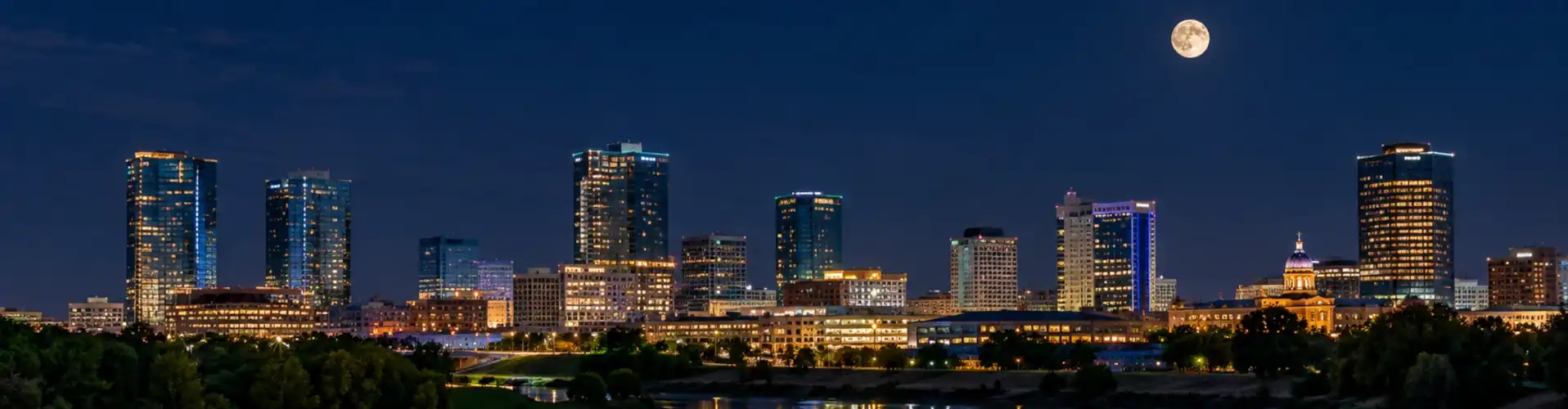
☽ Best Places to View the Moon in Fort Worth, TX
Fort Worth is flat, river-cut North Texas prairie, so the best local viewpoints come from open water, downtown plazas, and parks rather than any real elevation. The date and your observing location together determine the moon's rise time and direction; your viewpoint determines how much of that horizon is actually unobstructed. Here are six Fort Worth locations that offer different ways to experience or photograph the moon.
Trinity Park & Trinity Trails
A 252-acre riverside park along the Trinity River in the Cultural District, with a duck pond, mature tree cover, and the Trinity Trails network running right through it — one of the more genuinely open, unobstructed stretches of horizon in the city. Free, open daily 5 a.m. to 11:30 p.m. Address: 2401 University Dr.
Fort Worth Water Gardens
Philip Johnson's 1974 downtown plaza of terraced concrete pools — the Active, Aerating, and Quiet Pools — sunk below street level next to the Convention Center. The reflective Quiet Pool in particular can work well for a moon-and-water composition. Free; some sources list it as open around the clock, others cite roughly 10 a.m.–10 p.m., so confirm current hours before a late visit. Address: 1502 Commerce St.
Fort Worth Botanic Garden
The oldest botanic garden in Texas, with 23 specialty gardens including the nation's only public Japanese Garden. General admission (around $14–15 for adults) covers the entire Garden — the Japanese Garden is not a separate ticket. Open daily 8 a.m.–6 p.m., last entry 5 p.m., which suits an early-evening moonrise rather than a late-night visit. Address: 3220 Botanic Garden Blvd.
Panther Island Pavilion
An outdoor riverfront event venue on the Trinity River just north of downtown, with the only waterfront stage in Texas and a sand beach giving public access to the water, downtown Fort Worth's skyline as backdrop. Access and hours vary with scheduled events and activities rather than following a fixed daily window, so check the venue's current schedule before planning a visit. Address: 395 Purcey St.
Fort Worth Stockyards & Mule Alley
The historic Stockyards National Historic District, centered on E. Exchange Ave and Mule Alley's restored 1912 horse-and-mule barns, now lined with restaurants, bars, and shops. The district stays active into the evening, though individual businesses keep their own hours — check your specific destination rather than assuming the whole area runs late. Near E. Exchange Ave & N. Main St.
Sundance Square Plaza
Downtown Fort Worth's central public plaza along Main St between 3rd and 4th, with fountains, open-air seating, and restaurants and bars — often described locally as "Fort Worth's living room." Live music typically runs Thursday–Sunday evenings and fountain viewing extends into the night, but confirm current hours rather than assuming unrestricted access. Address: 420 Main St.
◉ Best Times for Moon Photography
📷 Quick Photography Tips
Fort Worth runs on Central Time — CST (UTC−6) in winter and CDT (UTC−5) in summer, following the standard U.S. daylight saving schedule. PhotoPills or Stellarium will handle the moon's exact rise azimuth for any of these spots automatically, as long as your device's clock is correct.
The moon phase today in Fort Worth is shown in detail above — complete with exact illumination percentage, moonrise/set times, and the best local spots to see it. For the moon phase today in any other city worldwide, visit our Dynamic Moon Phase Calculator on the home page.
◐ What the Experience Actually Feels Like
At the Water Gardens, evening brings a different crowd than daytime — couples on the sunken walkways, the Aerating Pool lit from below, downtown's office towers rising just beyond the tree line. The sound of falling water mostly drowns out the traffic on I-30 just south of the park, which is part of why it works as well as it does after dark.
Out at the Stockyards, Mule Alley's restored barns keep the district lit and busy well past sunset, with restaurant patios spilling onto the brick streets. It's a livelier late-evening option than most of this list, though it's worth remembering that's a function of its restaurants and bars staying open individually, not a guarantee that the whole district is accessible at any hour.
At Trinity Park, the appeal is the quiet — joggers and cyclists finishing up on the Trinity Trails, the duck pond settling for the night, and enough open sky along the river that the moon doesn't have to compete with much. Confirm current hours before heading out late, since 11:30 p.m. is the posted close.
"At the Stockyards, Mule Alley's restored barns keep the district lit and busy well past sunset — a livelier late-evening option than most of this list."
✓ Your Fort Worth Moon Chase Checklist
Before You Go
- Check the moonrise time and rise azimuth for your date — the date and your observing location together determine the moon's rise time and direction, while your viewpoint determines how much of that horizon is unobstructed
- Verify Site Access: the Botanic Garden (Japanese Garden included) requires paid general admission and closes at 6 p.m. — Trinity Park and the Stockyards district are the more reliable options for a later visit
- Use PhotoPills or Stellarium to check whether the moon will align with a specific landmark on your date
- Check the forecast for wind along the river and, in summer, heat and humidity — both are routine in North Texas
- Confirm current rules on tripods and photography at your chosen venue, especially for anything beyond personal use
What to Bring
- A telephoto lens, often 200mm or longer, can help frame the moon tightly with the downtown skyline or a Stockyards landmark
- Light layers outside of winter — Fort Worth summer evenings often stay warm well after sunset
- A remote shutter release or a 2-second timer to avoid shake on tripod shots
- Spare batteries, particularly for long sessions or extended time outdoors
- A flashlight or headlamp for the less-lit stretches of Trinity Park or the trail network after dark
On the Night
- As a general recommendation, arrive at your viewpoint at least 30–45 minutes early, especially at Sundance Square or the Stockyards on weekend evenings
- Focus manually on the moon's surface detail or terminator (the light/dark boundary) — plaza lighting and building floodlighting can confuse autofocus at dusk
- Bracket your exposures — one for the bright lunar disc, one for the darker river, garden, or plaza below
- If the moon looks soft or hazy right at moonrise, consider waiting until it climbs higher above the horizon, when atmospheric effects are often less pronounced
- Plan to be back at your vehicle before your chosen venue's posted closing time — don't count on staying past it
? Fort Worth Moon Phase — Frequently Asked Questions
Q. What is the moon phase today in Fort Worth?
The moon phase today in Fort Worth is a New Moon with 0% illumination. The next full moon is in 17 days, on Oct 25. Moonrise is at 6:35 AM and moonset at 6:31 PM.
Q. Where is the best place to view the moon in Fort Worth?
Fort Worth is flat, river-cut North Texas prairie, so the best viewpoints come from open water, downtown plazas and parks rather than elevation. Trinity Park and the Trinity Trails along the Trinity River give one of the more open, unobstructed stretches of horizon in the city and stay open until 11:30 p.m. Downtown, the Fort Worth Water Gardens' reflective Quiet Pool suits a moon-and-water composition, and Sundance Square Plaza is a lively central option. The Stockyards and Mule Alley stay active into the evening for a livelier night out, Panther Island Pavilion offers riverfront views with the downtown skyline as backdrop, and the Botanic Garden suits an early-evening moonrise.
Q. Where does the moon rise and set in Fort Worth, and how high does it climb?
At about 32.8°N, Fort Worth's moonrise and moonset points swing across the horizon each month, from roughly northeast to southeast for rising and northwest to southwest for setting. A winter full moon climbs very high in the south, to roughly 81° above the horizon, while a summer full moon stays lower, peaking near 34°. The city sits on flat prairie, so the horizon is low in every direction, and downtown towers, buildings and mature trees are the main obstruction. Open stretches of Trinity Park and the river give the clearest sightlines. Check the azimuth for your date and exact viewpoint.
Q. Is light pollution a problem for moon observing in Fort Worth?
The moon is bright enough to observe and photograph from almost anywhere in Fort Worth, so light pollution rarely limits the lunar disc itself. It does wash out earthshine on a thin crescent and any faint sky detail. Downtown plazas, Sundance Square and the Stockyards carry substantial artificial lighting, and plaza lighting and building floodlighting can confuse autofocus at dusk, so focus manually on the moon's surface detail or terminator. Trinity Park along the river has enough open sky that the moon doesn't have to compete with much.
Q. What camera settings and phases work best for moon photography in Fort Worth?
For a full moon, start with Looney 11 (f/11, ISO 100, 1/100 s) and refine using your histogram, since it is a baseline rather than a guarantee. The moon is much brighter than the surrounding skyline, water or park landscape, so shoot RAW and bracket or blend exposures to keep both crater detail and the foreground. A full moon rises around sunset, and the days before full see it rise later each evening. A 200 mm or longer lens helps frame the moon tightly with the downtown skyline or a Stockyards landmark, and a tripod with a remote release or 2-second timer avoids shake. PhotoPills or Stellarium can check whether the moon will line up with a landmark on your date.
Q. How do North Texas heat, humidity and wind affect moon viewing in Fort Worth?
North Texas summer evenings can remain hot and humid well after sunset, so check the forecast and bring light layers outside of winter. Wind along the river and in exposed locations can pick up, so a sturdy tripod helps, and spare batteries are worth carrying for long sessions outdoors. If the moon looks soft or hazy right at moonrise, wait until it climbs higher above the horizon, when atmospheric effects are often less pronounced.
Q. Can I visit Fort Worth's moon viewpoints after dark?
Access varies by site. Trinity Park is free and open daily 5 a.m. to 11:30 p.m. The Water Gardens are free, but sources differ, with some listing it as open around the clock and others citing roughly 10 a.m. to 10 p.m., so confirm current hours before a late visit. The Botanic Garden requires paid general admission and closes at 6 p.m., so it suits an early-evening moonrise. Panther Island Pavilion's access follows scheduled events, so check its current schedule. The Stockyards and Sundance Square stay active into the evening, though individual businesses keep their own hours.
✦ Explore Further
Moon Phase Today: Dallas
Check tonight's moon phase in Dallas, just east of Fort Worth across the Metroplex.
🏙️Moon Phase Today: Arlington
See the moon over Arlington, between Fort Worth and Dallas.
🇺🇸Moon Phase in the United States
Browse moon phase pages for cities across the United States, from Seattle to Miami.
🌍World Moon Phase Directory
Find the moon phase, rise and set times for cities in every region of the world.