
Moon Phase Today Dallas
On Friday, October 9, 2026, the moon in Dallas is a New Moon with 0% illumination. Moon age: 28.9 days.
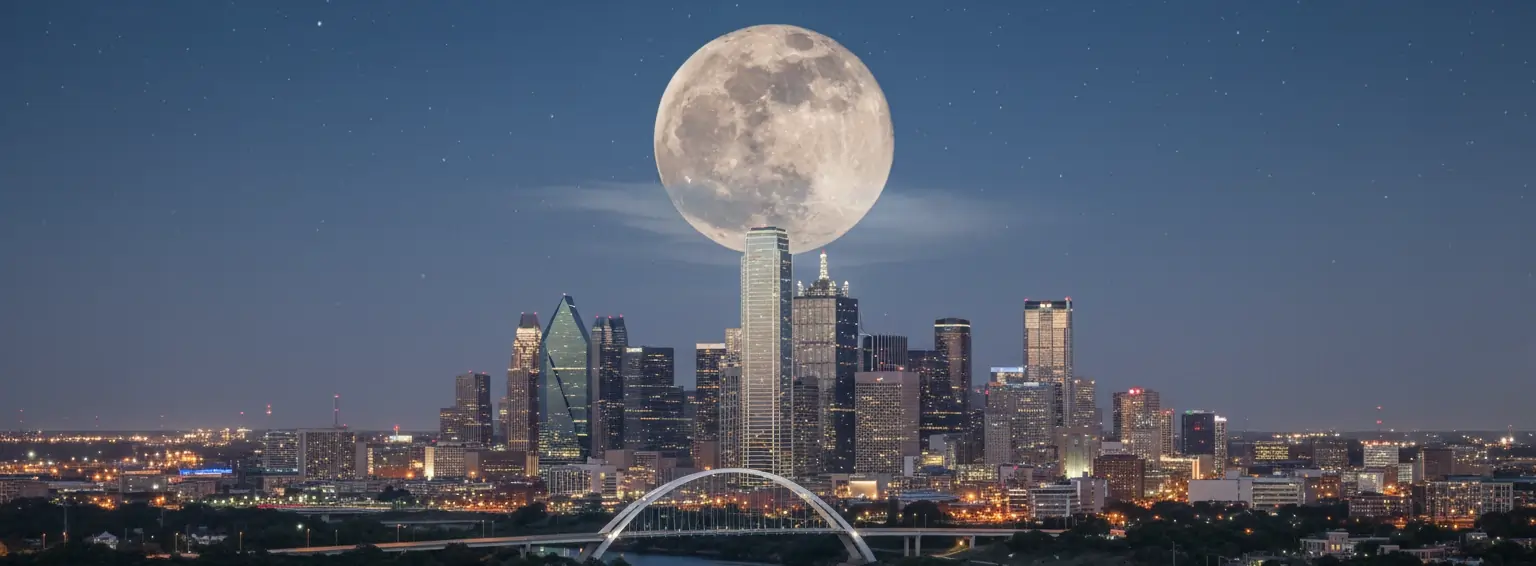
☽ Best Places to View the Moon in Dallas
Dallas sits at 32° North on the flat blackland prairie of North Texas, with no mountains, no coastline, and almost nothing between you and the horizon in any direction. That geography, which can feel like a liability in daylight, becomes an asset at night: the moon rises into an enormous, unobstructed sky and the compact downtown skyline — Reunion Tower's glowing geodesic ball, the Bank of America green tower, the Margaret Hunt Hill Bridge cables — stands out in clean silhouette against it. The Trinity River and White Rock Lake add water reflections that most visitors do not expect from a landlocked Texas city. Dallas rewards the photographer who knows where to stand: the flat horizon means moonrise is fast and undramatic unless you have the skyline in frame, so positioning matters more here than almost anywhere else.
White Rock Lake – Bath House & Dreyfuss Point
The classic Dallas moon shot. From the eastern shore of White Rock Lake, the moon rises over the water and the downtown skyline — Bank of America's green tower, Reunion Tower's ball, and the Margaret Hunt Hill Bridge — lines up in the middle distance. On calm nights the lake surface doubles the entire scene in reflection. The historic Bath House Cultural Center adds foreground interest; Dreyfuss Point gives an open western view across the full lake width. Free, open 24/7; the paved loop road allows multiple stopping points without a long walk.
Trinity Overlook Park & Ronald Kirk Pedestrian Bridge
The Trinity Overlook Park and the adjacent Ronald Kirk Pedestrian Bridge give an elevated vantage point above the Trinity River floodplain with the Margaret Hunt Hill Bridge cables and the full downtown cluster directly behind. The moon rises over the skyline and the bridge's white cables catch the city glow — the most graphic, architectural Dallas composition. The Trinity River below reflects the neon skyline on still nights. Free, open 24/7; parking off Singleton Boulevard in West Dallas.
Klyde Warren Park – East Lawn
Klyde Warren Park is a deck park built over Woodall Rodgers Freeway in the middle of downtown. From the east lawn, the moon rises directly over the skyline from an urban vantage point — Reunion Tower and the Bank of America building frame it closely, and the food trucks, string lights, and fountains below create a lively foreground entirely unlike the lakefront and river spots. Best on weekday evenings when crowds thin; the park stays lit and active late. Walkable from the Arts District and Uptown.
Lakeside Park – Turtle Creek & Lee Park Hillside
Lee Park and the Turtle Creek corridor in Uptown are a quieter alternative to the downtown spots. The hillside above the creek gives a slightly elevated view of the towers through a tree canopy, with the creek's narrow channel providing a reflection below. The framing is tighter and more intimate than White Rock Lake — better for compositions that emphasize the relationship between the skyline and the green urban landscape. Free, open daily; darker than Klyde Warren with noticeably less ambient light pollution.
Continental Avenue Bridge – West Dallas Gateway
The Continental Avenue Pedestrian Bridge runs parallel to the Margaret Hunt Hill Bridge and gives a wide-open view of both structures simultaneously — the cable bridge to the north and the skyline to the east, with the Trinity River floodplain below. The moon rises over the downtown cluster with the two bridges as bookends on either side of the frame. Very easy access and parking; the bridge is lit at night and open year-round. One of the most symmetrical and graphic compositions in the city.
Cedar Ridge Preserve – Southwest Dallas County
Cedar Ridge Preserve in southwest Dallas County sits on the Escarpment — the highest terrain near the city at around 800 feet elevation — and offers noticeably darker skies than anywhere closer in. The moon rises over the open prairie with the distant Dallas–Fort Worth skyline visible on the horizon to the northeast. A short hike reaches the main overlooks. The preserve gates close at dusk, but roadside pull-offs along Wheatland Road give access to the ridge views. Best for photographers who want the moon in a darker, more rural context rather than against the downtown skyline.
◉ Best Times for Moon Photography
📷 Quick Photography Tips
Dallas operates on CST (UTC−6) in winter and CDT (UTC−5) during daylight saving time. Clocks go forward on the second Sunday in March and back on the first Sunday in November. Texas observes DST statewide. Apps like PhotoPills or Stellarium set to Dallas handle the offset automatically — useful for calculating exact moonrise times against the skyline geometry throughout the year.
For the moon phase in any other city worldwide, visit our Dynamic Moon Phase Calculator for instant lunar data tailored to wherever you are.
The moon phase today in Dallas, TX is shown in detail above — complete with exact illumination percentage, moonrise/set times, and the best local spots to see it. For the moon phase today in any other city or location worldwide, visit our Dynamic Moon Phase Calculator on the home page.
◐ What the Experience Actually Feels Like
There is a particular quality to moonrise in Dallas that takes most visitors by surprise. You expect the flat Texas landscape to make it ordinary — no mountains to climb, no dramatic coastline, nothing to frame the sky. And then you stand on the eastern shore of White Rock Lake on a still October evening, the water completely flat, and the moon comes up over the tree line beyond the far shore and the downtown skyline floats in the middle distance and the whole thing — city, moon, sky, water — is repeated perfectly in the lake below you. It is not what you planned for. It is better.
Dallas at 32 degrees north gives the moon a high, sweeping arc for most of the year. In winter the full moon rides particularly high and the air over the blackland prairie is at its clearest — the humidity that blurs the horizon in July drops away, and the skyline sharpens against the sky in a way that rewards the long lens. Reunion Tower is the compositional anchor that Chicago photographers do not have: a single iconic structure, lit from within, that the moon can rise behind, beside, or directly above depending on the date and your position. Photographers who use tools like PhotoPills target these alignments months in advance. The geometry of a flat city on a flat plain, it turns out, is remarkably precise.
What Dallas has that surprises people is water. The Trinity River floodplain runs through the western edge of the city, wide and flat and reflective in the right conditions, with the Margaret Hunt Hill Bridge's white cables spanning it and the downtown towers rising behind. At the Ronald Kirk Pedestrian Bridge on a calm night, you are standing above a scene that looks like an architect's rendering — the cables lit white, the towers glowing behind them, and the river below catching all of it in a long, still mirror. The wind is the only variable. When it drops, Dallas produces photographs that look impossible for a city this far from any ocean.
"The moon comes up over the tree line and the downtown skyline floats in the middle distance — and the whole thing, city, moon, sky, water, is repeated perfectly in the lake below you."
✓ Your Dallas Moon Chase Checklist
Before You Go
- Check the moonrise time and phase on this page — the moon's exact position relative to the skyline changes significantly by date and requires planning to hit the Reunion Tower alignments
- Target the 48–72 hour window before full moon if possible — the moon rises during golden hour and the warm Texas light gives the skyline its best colour
- Check wind conditions for White Rock Lake and the Trinity River bridges — calm nights produce the clearest water reflections; a breeze of even 10 mph will break them
- Use PhotoPills or Stellarium set to Dallas to identify dates when the moon rises behind or beside Reunion Tower — these are the signature Dallas moonrise shots
- Check whether the Trinity River is running high after recent rain — high water improves reflections at the bridges; very high water can close the floodplain trails
What to Bring
- Sturdy tripod — Texas wind is persistent and unpredictable at the exposed lakefront and the Trinity River bridges, and longer exposures require complete stability
- A lens between 200–300mm for skyline compression shots from White Rock Lake — the distance to downtown rewards longer glass significantly
- Light layers in autumn and winter — Dallas winter nights can drop below freezing and the exposed lakefront and bridge positions accelerate wind chill
- Insect repellent from April through October — the Trinity River floodplain and White Rock Lake shore have significant mosquito activity after dark in warm months
- A wide-angle lens for the Trinity bridges — the Margaret Hunt Hill Bridge cables overhead and the river foreground below create a strong architectural composition at shorter focal lengths
- Extra storage cards — the variety of shooting positions at White Rock Lake alone justifies shooting generously throughout the session
On the Night
- Arrive at your viewpoint 30–45 minutes before moonrise — the sky behind the Dallas skyline goes through a warm amber-to-blue gradient as the moon approaches the horizon
- At White Rock Lake, position yourself on the eastern shore near the Bath House for the best combined view of the lake reflection and the downtown skyline in the same frame
- Shoot RAW — the dynamic range between Reunion Tower's bright interior glow, the surrounding dark sky, and the water reflection requires separate exposures blended in post
- Stay 20–30 minutes after moonrise — as the moon climbs above the horizon haze it sharpens and brightens rapidly, and the skyline compositions become cleaner and more graphic
- In summer, accept that atmospheric haze will soften the moon at the horizon — shoot slightly later when it has climbed clear of the worst of it, and use the orange colour as mood rather than fighting it
? Dallas Moon Phase — Frequently Asked Questions
Q. What is the moon phase today in Dallas?
The moon phase today in Dallas is a New Moon with 0% illumination. The next full moon is in 17 days, on Oct 25. Moonrise is at 6:32 AM and moonset at 6:29 PM.
Q. Where is the best place to view the moon in Dallas?
White Rock Lake is the classic Dallas shot — the moon rises over the water with the downtown skyline in the middle distance, and calm nights give a clean lake reflection of the whole scene. Trinity Overlook Park and the Ronald Kirk Pedestrian Bridge offer a more architectural composition with the Margaret Hunt Hill Bridge cables in frame, and Klyde Warren Park puts you right in the middle of downtown for a close, urban view of Reunion Tower.
Q. Why does Dallas's flat landscape make it good for moon photography?
Dallas sits on flat blackland prairie with no mountains or coastline to break the horizon, so the moon rises fast and clears the skyline quickly. That means positioning matters more here than in hillier cities — the compact downtown cluster, anchored by Reunion Tower's lit ball, is what gives an otherwise plain horizon a strong focal point to shoot against.
Q. When is the next full moon in Dallas?
The date of the next full moon is calculated live and shown in the "Next Full Moon" card above. For a full breakdown of upcoming full moons and their traditional names, see our next full moon guide.
Q. Does Dallas observe daylight saving time?
Yes. Dallas runs on Central Standard Time (CST, UTC−6) in winter and switches to Central Daylight Time (CDT, UTC−5) from the second Sunday in March to the first Sunday in November. All times shown on this page already account for the correct offset.
Q. What's the best time of year for moon photography in Dallas?
October through April brings the clearest air and a more southerly moon path, giving the tightest alignments with Reunion Tower. September and March are mild with low humidity too. Summer heat and humidity create noticeable haze at the horizon, so the moon looks orange and soft rather than sharp during the hottest months.
Q. Does this page work for cities besides Dallas?
This page is set up specifically for Dallas, TX. For the moon phase in any other city or location worldwide, use the Dynamic Moon Phase Calculator on the moonphase.today home page.
✦ Explore Further
Moon Phase Today: Austin
Check tonight's moon phase in Austin, about 200 miles south down I-35.
📷Moon Photography Guide
Camera settings, lenses, and techniques for shooting sharp, well-exposed moon shots.
🌗Why Does the Moon Rise and Set?
The simple science behind moonrise and moonset, and why the timing shifts every day.
🌌Best Dark Sky Parks in the USA
Worth a look before a Cedar Ridge Preserve trip — a guide to the country's darkest, most protected night skies.
NASA Moon Phase & Libration Gallery
NASA's Scientific Visualization Studio's daily renders of the moon's exact phase, libration, and orientation, straight from official mission data.
✦ Explore Further
Moon Photography Guide
Camera settings, lenses, and techniques for shooting sharp, well-exposed moon shots.
🌕When Is the Next Full Moon?
A running guide to upcoming full moons and what each one is traditionally called.
🌗Why Does the Moon Rise and Set?
The simple science behind moonrise and moonset, and why the timing shifts every day.
🌌Best Dark Sky Parks in the USA
Worth a look before a Cedar Ridge Preserve trip — a guide to the country's darkest, most protected night skies.
NASA Moon Phase & Libration Gallery
NASA's Scientific Visualization Studio's daily renders of the moon's exact phase, libration, and orientation, straight from official mission data.