
Moon Phase Today Cheyenne
On Friday, October 9, 2026, the moon in Cheyenne is a New Moon with 0% illumination. Moon age: 28.9 days.
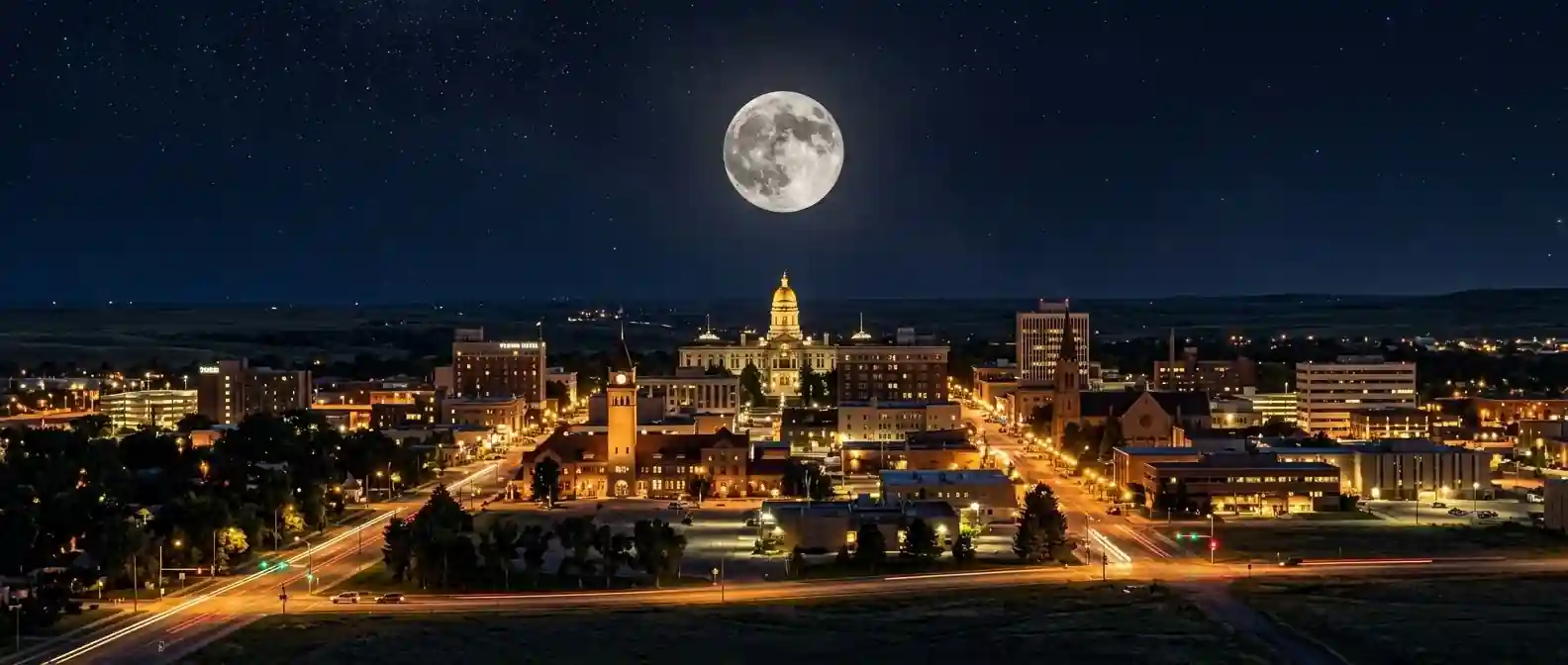
☽ Best Places to View the Moon in Cheyenne, WY
Cheyenne sits on the open High Plains at over 6,000 feet elevation, with wide, largely unobstructed horizons and generally dark, dry skies once you're away from downtown lighting. The date and your observing location together determine the moon's rise time and direction; your viewpoint determines how much of that horizon is actually unobstructed. Here are five Cheyenne-area locations that offer different ways to experience or photograph the moon.
Curt Gowdy State Park
A 24-mile drive west of Cheyenne into the foothills of the Laramie Mountains, with elevation ranging from 6,800 to 7,900 feet — genuinely dark skies far from city light. Unusually for this site, the park itself is officially open 24 hours a day, with most grounds open year-round weather permitting, and an entrance fee (roughly $7 resident/$12 non-resident per vehicle); only the visitor center keeps separate daytime hours. Address: 1264 Granite Springs Rd.
Lions Park & Sloan's Lake
Cheyenne's largest developed open space, built around Sloan's Lake, with paved greenway trails, playgrounds, and open lawn space — a favorite spot for the city's Fourth of July fireworks. The lake's surface can work well for a reflection shot. Address: near S. Lions Park Dr.
Cheyenne Botanic Gardens
A free public garden inside Lions Park, with the Shane Smith Grand Conservatory and Paul Smith Children's Village as its indoor attractions. The main grounds are open dawn to dusk; the Conservatory keeps separate hours (generally Tuesday–Saturday 10 a.m.–5 p.m., plus Sunday afternoons in summer) and is closed Mondays. Since the grounds themselves close at dusk, this suits an early-evening visit rather than a true moonrise.
Wyoming State Capitol & Capitol Square
Built 1886–1890 in Renaissance Revival style, topped by a gold-leafed dome, with statues of Esther Hobart Morris and Chief Washakie out front. Self-guided tours are available during posted visitor hours, which vary seasonally — the exterior square is a public downtown space, but confirm current building access before planning around it. Address: 200 W. 24th St.
Cheyenne Depot Plaza & Historic Downtown
The heart of downtown Cheyenne, centered on the restored 1886 Union Pacific Depot, with restaurants, bars, and museums nearby and a free summer concert series ("Fridays on the Plaza") that draws crowds into the evening. A convenient, well-lit urban option if you'd rather not drive out of town after dark. Address: 121 W. 15th St.
◉ Best Times for Moon Photography
📷 Quick Photography Tips
Cheyenne runs on Mountain Time — MST (UTC−7) in winter and MDT (UTC−6) in summer, following the standard U.S. daylight saving schedule. PhotoPills or Stellarium will handle the moon's exact rise azimuth for any of these spots automatically, as long as your device's clock is correct.
The moon phase today in Cheyenne is shown in detail above — complete with exact illumination percentage, moonrise/set times, and the best local spots to see it. For the moon phase today in any other city worldwide, visit our Dynamic Moon Phase Calculator on the home page.
◐ What the Experience Actually Feels Like
Out at Curt Gowdy, the difference from anywhere else on this list is simply darkness — no city glow competing with the sky, granite outcrops and pine forest instead of streetlights, and since the park never closes, there's no clock forcing an early exit.
Down at Lions Park, the mood is far more social — Sloan's Lake reflecting whatever light is available, joggers finishing a lap on the greenway, and the Botanic Gardens' greenhouse glowing softly nearby.
Around the Depot Plaza, restaurant patios and the restored 1886 depot building keep downtown lit and occupied into the evening, especially on a summer Friday when the free concert series is running.
"Out at Curt Gowdy, the difference from anywhere else on this list is simply darkness — no city glow competing with the sky, and since the park never closes, there's no clock forcing an early exit."
✓ Your Cheyenne Moon Chase Checklist
Before You Go
- Check the moonrise time and rise azimuth for your date — the date and your observing location together determine the moon's rise time and direction, while your viewpoint determines how much of that horizon is unobstructed
- Verify Site Access: Curt Gowdy State Park is open 24 hours, but the Wyoming State Capitol's tour hours vary seasonally and end well before dark, and the Botanic Gardens' main grounds close at dusk even though the park itself is free — check current schedules before planning around either
- Use PhotoPills or Stellarium to check whether the moon will align with a specific landmark on your date
- Check the forecast for wind and cold — both are routine on the High Plains, not occasional
- Confirm current rules on tripods and photography at your chosen venue, especially for anything beyond personal use
What to Bring
- A telephoto lens, often 200mm or longer, can help compress the scene and frame the moon with the Capitol dome or a Curt Gowdy rock formation
- Genuinely warm layers outside of summer — Wyoming winters run cold, and wind makes it feel colder still
- A remote shutter release or a 2-second timer to avoid shake on tripod shots, especially given how windy Cheyenne can get
- Spare batteries, particularly for long sessions or extended time outdoors
- A flashlight or headlamp for the less-lit trails around Sloan's Lake or Curt Gowdy after dark
On the Night
- As a general recommendation, arrive at your viewpoint at least 30–45 minutes early, especially at Curt Gowdy if you're driving the 24 miles from town
- Focus manually on the moon's surface detail or terminator (the light/dark boundary) — city or streetlight glow can confuse autofocus at dusk
- Bracket your exposures — one for the bright lunar disc, one for the darker plains, lake, or rock formations below
- If the moon looks soft or hazy right at moonrise, consider waiting until it climbs higher above the horizon, when atmospheric effects are often less pronounced
- Plan to be back at your vehicle before your chosen venue's posted closing time — don't count on staying past it, except at Curt Gowdy itself
? Cheyenne Moon Phase — Frequently Asked Questions
Q. What is the moon phase today in Cheyenne, Wyoming?
The moon phase today in Cheyenne is a New Moon with 0% illumination. The next full moon is in 17 days, on Oct 25. Moonrise is at 6:09 AM and moonset at 5:56 PM.
Q. Where is the best place to view the moon in Cheyenne?
For genuinely dark skies, Curt Gowdy State Park sits 24 miles west of Cheyenne in the foothills of the Laramie Mountains, at 6,800 to 7,900 feet, and is officially open 24 hours a day. In town, Lions Park and Sloan's Lake give open lawn space and a lake surface that can work well for a reflection shot, and the Cheyenne Botanic Gardens sit inside the same park. The gold-domed Wyoming State Capitol and Capitol Square are a classic downtown subject, while Cheyenne Depot Plaza and the historic downtown are a well-lit urban option if you'd rather not drive out of town after dark.
Q. Where does the moon rise and set in Cheyenne, and how high does it climb?
At about 41.1°N, Cheyenne's moonrise and moonset points swing across the horizon each month, from roughly northeast to southeast for rising and northwest to southwest for setting. A winter full moon climbs high in the south, to roughly 72° above the horizon, while a summer full moon stays lower, peaking near 25°. Cheyenne sits on the open High Plains at over 6,000 feet, so horizons are wide and largely unobstructed, while the granite outcrops and pine forest at Curt Gowdy can block parts of the horizon from lower spots. Check the azimuth for your date and exact viewpoint.
Q. Is light pollution a problem for moon observing in Cheyenne?
The moon is bright enough to observe and photograph from almost anywhere in Cheyenne, so light pollution rarely limits the lunar disc itself. It does wash out earthshine on a thin crescent and any faint sky detail. Skies are generally dark and dry once you are away from downtown lighting, and Curt Gowdy State Park has no city glow competing with the sky, which makes it the best choice around a new moon. Downtown and Depot Plaza carry more artificial lighting, and city or streetlight glow can confuse autofocus at dusk, so focus manually on the moon's surface detail or terminator.
Q. What camera settings and phases work best for moon photography in Cheyenne?
For a full moon, start with Looney 11 (f/11, ISO 100, 1/100 s) and refine using your histogram, since it is a baseline rather than a guarantee. The moon is much brighter than the surrounding city lights or open prairie landscape, so shoot RAW and bracket or blend exposures to keep both crater detail and the foreground. A full moon rises around sunset, and the days before full see it rise later each evening. A 200 mm or longer lens helps compress the scene and frame the moon with the Capitol dome or a Curt Gowdy rock formation, and a sturdy tripod with a remote release or 2-second timer matters especially given Cheyenne's wind. PhotoPills or Stellarium can check whether the moon will line up with a landmark on your date.
Q. How do High Plains wind, cold and elevation affect moon viewing in Cheyenne?
Cheyenne's high elevation and exposed High Plains setting can produce strong winds and rapid weather changes, and wind and cold are routine rather than occasional. Bring genuinely warm layers outside of summer, since Wyoming winters run cold and wind makes it feel colder still, and carry spare batteries because cold can drain them faster. Check the forecast before heading out, and if the moon looks soft or hazy right at moonrise, wait until it climbs higher above the horizon, when atmospheric effects are often less pronounced.
Q. Can I visit Cheyenne's moon viewpoints after dark?
Access varies by site. Curt Gowdy State Park is officially open 24 hours a day, with most grounds open year-round weather permitting and an entrance fee of roughly $7 for residents and $12 for non-residents per vehicle, though the visitor center keeps separate daytime hours. The Cheyenne Botanic Gardens' main grounds are open dawn to dusk, and the Conservatory keeps its own limited hours and is closed Mondays. The Wyoming State Capitol's visitor hours vary seasonally and end well before dark, so confirm current building access. Depot Plaza and downtown stay lively in the evening, especially during the free summer "Fridays on the Plaza" concert series.
✦ Explore Further
Moon Phase Today: Denver
Check tonight's moon phase in Denver, south of Cheyenne along the Front Range.
⛰️Moon Phase Today: Colorado Springs
See the moon over Colorado Springs, south of Cheyenne at the foot of Pikes Peak.
🇺🇸Moon Phase in the United States
Browse moon phase pages for cities across the United States, from Seattle to Miami.
🌍World Moon Phase Directory
Find the moon phase, rise and set times for cities in every region of the world.