
Moon Phase Today Denver
On Friday, October 9, 2026, the moon in Denver is a New Moon with 0% illumination. Moon age: 28.9 days.
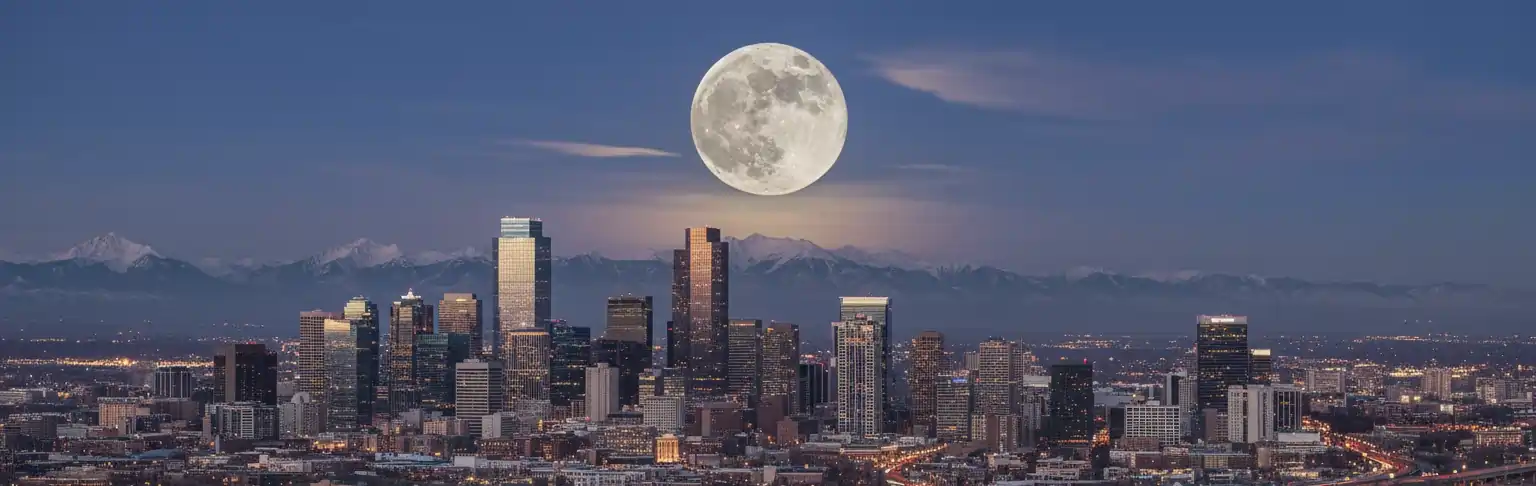
☽ Best Places to View the Moon in Denver
Denver sits at 5,280 feet on the edge of the Great Plains, directly below the Front Range of the Rocky Mountains — a geographic situation unlike any other major American city. The mile-high elevation thins the atmosphere enough that the moon appears noticeably larger and sharper than at sea level, and the air is cleaner: winter moonrises over downtown can appear 10–15% crisper than the same moon seen from Chicago or Houston. To the west, the jagged silhouette of the Front Range — from Longs Peak in the north to Pikes Peak in the south — frames the moon's arc across the sky. To the east, the plains stretch flat to the Kansas border and give unobstructed moonrises that mirror the wide, dramatic skies of the high prairie. Denver is the only major city in the country where the moon, the mountains, and a genuine urban skyline appear together in the same frame.
Sloan's Lake Park – East Shore
The classic Denver moonrise postcard. From the eastern shore of Sloan's Lake, the moon rises dead-centre behind the downtown skyline — Republic Plaza, the Wells Fargo "Cash Register" building, and 1801 California tower line up over the water. On calm nights the lake surface doubles the entire composition in reflection: city, moon, and sky repeated perfectly below. Sailboats moored near the west bank add foreground depth; the Rockies loom behind on clear evenings. Free, open 24/7; accessible by the W light-rail line to the Sheridan station.
City Park – Ferril Lake East Side
City Park is Denver's largest urban park and one of its finest moonrise positions. From the east side of Ferril Lake, the moon climbs over the skyline with the Denver Museum of Nature and Science's white towers providing distinctive foreground architecture. The wide-open grassy lawns allow low tripod angles that pull in the lake reflection at the bottom of the frame while the full skyline fills the top. Less wind-exposed than Sloan's Lake; a more relaxed, park-bench atmosphere that suits longer, unhurried sessions. Free, open 24/7; Colorado Boulevard buses nearby.
Red Rocks Park – Trading Post & Upper Lots
Red Rocks Park and Amphitheatre, 25 minutes west of downtown, offers the most dramatic non-skyline moonrise in the Denver region. The ancient sandstone formations — lit amber by the moon — rise on either side of the stage, and on full-moon concert nights the scene is legendary. From the Trading Post trail or the upper parking lots, the moon clears the plains to the east with the faint Denver glow on the horizon. The park gates close at dusk; roadside pull-offs along the access road allow night photography without entering the main lot.
Confluence Park – Cherry Creek Trail
At the confluence of Cherry Creek and the South Platte River in the heart of lower downtown, Confluence Park offers an urban riverfront moonrise against the Millennium Bridge and the LoDo and RiNo skylines. The pedestrian bridges over the South Platte reflect the city lights, and the moon rises behind the mid-rise buildings east of Larimer Square. A more intimate, street-level composition than Sloan's Lake — better for photographers who want the moon integrated into the city's textures rather than framed by open water. Open 24/7; walkable from Union Station light rail.
Lookout Mountain – Jefferson County Open Space
At 7,377 feet above sea level, Lookout Mountain above Golden gives the highest quick-access vantage point in the metro area. The panoramic east-facing view takes in the entire Denver metro spread across the plains below, with downtown's Republic Plaza tower visible at centre. The moon rises over the full expanse of the city with the Front Range behind you — the only viewpoint in the region where you look down on the moonrise rather than across at it. Buffalo Bill's grave and the "M" on Mount Zion add foreground interest. Drive-up road open 24 hours; about 30 minutes from downtown Denver.
Ruby Hill Park – Levitt Pavilion Overlook
Ruby Hill in south Denver is an elevated neighbourhood park with a 180° eastern view that is surprisingly dark for its location — noticeably less light pollution than the lakefront parks closer to downtown. From the Levitt Pavilion overlook, the moon rises dead-centre over the Tech Center glow on the southern horizon and the downtown cluster to the northeast. A favourite among local photographers for supermoon nights, when the moon clears the horizon with the full city spread below it. Free, open 24/7; Evans Avenue buses nearby.
◉ Best Times for Moon Photography
📷 Quick Photography Tips
Denver operates on MST (UTC−7) in winter and MDT (UTC−6) during daylight saving time. Clocks go forward on the second Sunday in March and back on the first Sunday in November. Colorado observes DST statewide. Apps like PhotoPills or Stellarium set to Denver apply the correct offset automatically — useful for calculating exact moonrise times against the Front Range and skyline geometry throughout the year.
For the moon phase in any other city worldwide, visit our Dynamic Moon Phase Calculator for instant lunar data tailored to wherever you are.
The moon phase today in Denver, CO is shown in detail above — complete with exact illumination percentage, moonrise/set times, and the best local spots to see it. For the moon phase today in any other city or location worldwide, visit our Dynamic Moon Phase Calculator on the home page.
◐ What the Experience Actually Feels Like
There is a particular quality to moonrise in Denver that you do not fully understand until you are standing on the eastern shore of Sloan's Lake on a still November evening. You expect the urban lake to be pleasant — a nice city park, a fine view. And then the moon comes up behind Republic Plaza and the Cash Register building and the lake surface, completely flat in the cold air, catches the whole composition below your feet, and the mountains you almost forgot about loom dark and enormous in your peripheral vision to the west. It is more than you planned for. The mile-high city, it turns out, lives up to its reputation in ways that have nothing to do with altitude sickness.
Denver at 5,280 feet gives the moon a quality that photographers who visit from lower-elevation cities notice immediately. The atmosphere is thinner and drier and the moon appears sharper — especially in winter, when the High Plains air loses its last traces of summer humidity and the skyline comes into focus against the sky like an architectural model. There is no single iconic structure with the compositional magnetism of, say, New York's Empire State Building, but Denver has something more interesting: a tight cluster of distinctive towers — Republic Plaza's stepped crown, the Wells Fargo Cash Register's curved roofline, the cylindrical 1801 California — that the moon can rise among, not merely behind. The alignments reward the photographer who uses PhotoPills and plans months in advance.
What Denver has that almost no other city can offer is the vertical. From Lookout Mountain above Golden, you look east and the entire metro area is spread below you on the plains — downtown's towers visible as small bright shapes in the distance, the suburbs glowing amber in a vast arc, and the moon rising over all of it from the Kansas horizon. You are above the moonrise. You are in the mountains looking down at a city looking up at the same moon. It is a perspective that requires a 30-minute drive and a road that climbs to 7,377 feet, but there is nothing else like it within an hour of any major American city.
"The moon comes up behind Republic Plaza and the lake surface, completely flat in the cold air, catches the whole composition below your feet — and the mountains loom dark and enormous to the west."
✓ Your Denver Moon Chase Checklist
Before You Go
- Check the moonrise time and phase on this page — the moon's position relative to the downtown cluster changes significantly by date and requires PhotoPills to hit the Republic Plaza alignments precisely
- Target the 48–72 hour window before full moon if possible — the moon rises during golden and blue hour, and the purple Colorado twilight above the Front Range gives the skyline its most atmospheric colour
- Check wind conditions for Sloan's Lake and City Park — calm nights only produce mirror reflections; a breeze of even 8 mph will break the lake surface and eliminate the doubled composition
- If planning Lookout Mountain or Red Rocks, check the Jefferson County road conditions — snow and ice close the access roads quickly in winter and the approaches are steep
- Confirm Red Rocks gate closure times if shooting inside the park — the main lots close at dusk, though roadside pull-offs on the access road remain accessible for night photography year-round
What to Bring
- Sturdy tripod — high-altitude wind is persistent at the exposed lakefronts and dramatically stronger at Lookout Mountain and Red Rocks, where gusts routinely exceed 30 mph on clear nights
- A lens between 200–400mm for skyline compression shots from Sloan's Lake — the distance to Republic Plaza rewards longer glass significantly, and the moon appears proportionally larger against the towers
- Warm layers even in autumn — Denver's mile-high elevation drops temperatures quickly after sunset, and the exposed lake shores and ridge positions at Lookout Mountain accelerate wind chill sharply
- A wide-angle lens for Red Rocks — the sandstone formations rising on both sides of the stage create a natural frame that rewards focal lengths of 16–24mm for environmental context
- Extra batteries — cold temperatures at elevation drain batteries faster than at sea level, and longer sessions at the lake or ridge positions can exhaust a single battery before the best compositions present themselves
- Sunscreen if arriving early — Denver's UV index at 5,280 feet is significantly higher than at sea level and the afternoon approach to golden-hour positions can cause rapid sunburn
On the Night
- Arrive at your viewpoint 30–45 minutes before moonrise — the sky behind the Denver skyline transitions through a warm amber-to-deep-blue gradient, and the purple-indigo twilight that the Rockies cast is a composition in itself before the moon appears
- At Sloan's Lake, position yourself on the eastern shore near the Sheridan Boulevard access point for the best combined view of the lake reflection and the full downtown cluster in the same frame
- Shoot RAW — the dynamic range between the bright moon, Republic Plaza's lit crown, the surrounding dark sky, and the water reflection below requires separate exposures blended carefully in post
- Stay 20–30 minutes after moonrise — as the moon climbs above the horizon haze it sharpens and brightens rapidly at this elevation, and the skyline compositions become cleaner and more precise
- At Lookout Mountain, stay aware of the road edge — the overlooks are unfenced in places and the drop below is significant; use a headlamp and stay well back from the rim when working in the dark
? Denver Moon Phase — Frequently Asked Questions
Q. What is the moon phase in Denver, CO today?
The moon phase today in Denver is a New Moon with 0% illumination (moon age: 28.9 days). You can see the exact moonrise, moonset, and calendar in the widget at the top of this page. Denver's coordinates (39.7392° N, 104.9903° W) and its Mountain Time zone are already factored in, so the phase and times shown are accurate for the city without any adjustment needed.
Q. What time does the moon rise in Denver today?
Moonrise changes daily and is calculated live for Denver in the info panel above. Tap any date on the calendar to see the phase and moonrise time for that specific day.
Q. Where is the best place to view the moon in Denver?
Sloan's Lake is the classic Denver shot — the moon rises dead-centre behind the downtown skyline, and calm nights give a clean lake reflection of the whole scene. City Park offers a similar view with the Denver Museum of Nature and Science as foreground, and Lookout Mountain above Golden gives a rare elevated view where you look down over the entire metro area as the moon clears the eastern plains.
Q. Why does the moon look sharper in Denver than in other cities?
Denver sits at 5,280 feet, and the thinner, drier air at that elevation scatters less light than the atmosphere at sea level. That means less haze between you and the moon, especially in winter when humidity drops further — full moons in Denver often appear noticeably crisper than the same moon seen from a lower-elevation city.
Q. When is the next full moon in Denver?
The date of the next full moon is calculated live and shown in the "Next Full Moon" card above. For a full breakdown of upcoming full moons and their traditional names, see our next full moon guide.
Q. Does Denver observe daylight saving time?
Yes. Denver runs on Mountain Standard Time (MST, UTC−7) in winter and switches to Mountain Daylight Time (MDT, UTC−6) from the second Sunday in March to the first Sunday in November. All times shown on this page already account for the correct offset.
Q. What's the best time of year for moon photography in Denver?
October through March brings the driest, clearest air and the tightest alignments with the downtown skyline. September and April are mild with vivid twilight color over the Front Range. Whatever the season, check the wind — even a light breeze will break the reflections at Sloan's Lake and City Park.
Q. Does this page work for cities besides Denver?
This page is set up specifically for Denver, CO. For the moon phase in any other city or location worldwide, use the Dynamic Moon Phase Calculator on the moonphase.today home page.
✦ Explore Further
Moon Phase Today: Boise
Check tonight's moon phase in Boise, another high-desert Mountain West city with its own foothills backdrop.
📷Moon Photography Guide
Camera settings, lenses, and techniques for shooting sharp, well-exposed moon shots.
📐Looney 11 Exposure Calculator
Dial in the exact f-stop, ISO, and shutter speed for a full moon — the same rule used in our Sloan's Lake tips.
🌆Blue Hour Calculator
Find tonight's exact blue hour window to time your Front Range moonrise shots.
NASA Moon Phase & Libration Gallery
NASA's Scientific Visualization Studio's daily renders of the moon's exact phase, libration, and orientation, straight from official mission data.