
Moon Phase Today Charleston
On Friday, October 9, 2026, the moon in Charleston is a New Moon with 0% illumination. Moon age: 28.9 days.
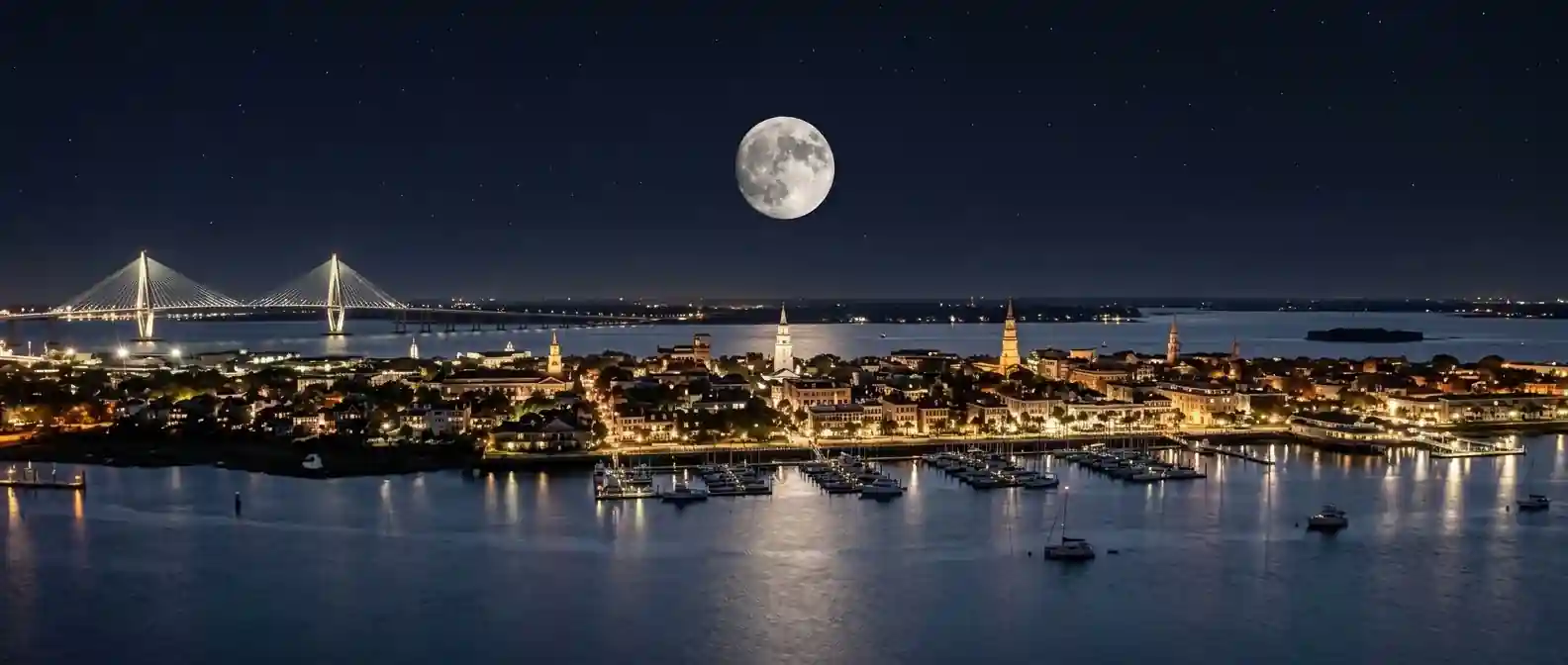
☽ Best Places to View the Moon in Charleston, SC
Charleston sits on Charleston Harbor, an inlet of the Atlantic formed where the Ashley and Cooper Rivers meet, and the old city occupies a peninsula between them. That peninsula is very low, some of it landfill, and it frequently floods during heavy rains, storm surges, and unusually high tides, so the best viewpoints here are waterfront piers, bridges, and beaches rather than anything elevated. The date and your observing location together determine the moon's rise time and direction; your viewpoint determines how much of that horizon is actually unobstructed. Here are six Charleston-area locations that offer different ways to experience or photograph the moon, with their posted hours, since several close at or before sunset.
Waterfront Park
A park of about half a mile along the Cooper River downtown, home to the Pineapple Fountain, a long pier with swings, and a tree-lined promenade with open views of ships moving in and out of the harbor and the Ravenel Bridge. Published hours conflict — one source says sunrise to sunset, another says the park is accessible any time, and a third lists 6 a.m. to midnight — so check posted signage before a late visit.
White Point Garden & the Battery
A 5.7-acre park on the Battery at the southern tip of the peninsula, where the Ashley and Cooper Rivers converge, with sweeping views of Charleston Harbor and Fort Sumter, shaded by live oaks and dotted with historic cannons. The Battery seawall promenade runs alongside it. Sources differ on closing times, with some listing 9 a.m. to sunset and others describing it as open daily, so confirm before a late visit. Address: 2 Murray Blvd.
Arthur Ravenel Jr. Bridge & Wonders' Way
The 2.7-mile shared bike and pedestrian path on the south side of the cable-stayed bridge, 12 feet wide, with views from Folly Beach to the Isle of Palms and a bird's-eye view of the harbor from the top. The climb is steady and can be windy, and the bridge's lighting is reportedly turned off after dark during sea turtle nesting season (May–October). Parking is easier at the Mount Pleasant Visitor Center, and no posted hours were found for the path, so check current rules before an evening visit.
Mount Pleasant Memorial Waterfront Park & Pier
A park at the base of the Ravenel Bridge on the Mount Pleasant side of the Cooper River, with a large lawn and a 1,250-foot pier with swings, benches, and views of the harbor, the bridge, and the downtown skyline. The park is open 6 a.m. to 11 p.m., and the pier runs 7 a.m. to 10 p.m. in winter and fall and 6 a.m. to 10 p.m. from April to September, which makes it one of the best late-evening options here. Address: 99 Harry M. Hallman Jr. Blvd.
Folly Beach Pier
The Edwin S. Taylor Folly Beach Fishing Pier stretches 1,049 feet into the open Atlantic, 22 feet above the sea, with unobstructed ocean views from the "Edge of America." Pier hours are 8 a.m. to sunset and vary through the year, and fishing isn't allowed after sunset, so it suits a dusk visit rather than a late one. The pier is just off Center Street, and parking can be hard to find in summer.
Sullivan's Island & Fort Moultrie
An island east of the harbor with about three miles of generally wide beaches, tidal sandbars, and old military bunkers, with beachfront Fort Moultrie dating to the Revolutionary War. The stretch closest to the harbor mouth is best for watching ships and dolphins. The dunes are sea turtle nesting habitat and off-limits, and high tide can shrink the beach, so check the tide and the town's current beach and parking rules.
◉ Best Times for Moon Photography
📷 Quick Photography Tips
Charleston runs on Eastern Time — EST (UTC−5) in winter and EDT (UTC−4) in summer, following the standard U.S. daylight saving schedule. PhotoPills or Stellarium will handle the moon's exact rise azimuth for any of these spots automatically, as long as your device's clock is correct.
The moon phase today in Charleston, South Carolina is shown in detail above — complete with exact illumination percentage, moonrise/set times, and the best local spots to see it. For the moon phase today in any other city worldwide, visit our Dynamic Moon Phase Calculator on the home page.
◐ What the Experience Actually Feels Like
At Waterfront Park, the Cooper River opens up beside the Pineapple Fountain and the pier swings, with ships sliding in and out of the harbor and the Ravenel Bridge lit in the distance. It's the easiest downtown spot to settle in and watch the sky over the water.
From the Mount Pleasant Pier, the Ravenel Bridge rises directly overhead and the Charleston skyline sits across the water, a dramatic frame for a moon above the harbor, with hours that run well into the evening.
At Folly Beach Pier, the pier runs more than 1,000 feet out over the open Atlantic with nothing in the way, but it closes at sunset, so it works best for the first light of an evening moonrise or a dusk visit.
"Where the Ashley and Cooper come together to form the Atlantic Ocean — piers, a long bridge walkway, and a harbor full of ships all under the same moon."
✓ Your Charleston Moon Chase Checklist
Before You Go
- Check the moonrise time and rise azimuth for your date — the Cooper River side, the Battery, and the Mount Pleasant shore all face different directions
- Verify Site Access: Mount Pleasant Memorial Waterfront Park is open 6 a.m.–11 p.m. and its pier closes at 10 p.m., Folly Beach Pier closes at sunset, hours for Waterfront Park and White Point Garden are reported inconsistently, and no posted hours were found for Wonders' Way
- Use PhotoPills or Stellarium to check whether the moon will align with a specific landmark on your date
- Check the tide, and the forecast for cloud, haze, and tropical weather during hurricane season (June–November)
- Confirm current rules on tripods and photography at your chosen venue, especially for anything beyond personal use
What to Bring
- A telephoto lens, often 200mm or longer, plus a wide lens for the bridge, piers, and skyline
- A lens cloth for humidity and salt spray
- Bug spray for warm evenings near the water and marsh
- A remote shutter release or a 2-second timer to avoid shake on tripod shots
- Spare batteries, particularly for long sessions or extended time outdoors
On the Night
- As a general recommendation, arrive at your viewpoint at least 30–45 minutes early, especially at the piers
- Focus manually on the moon's surface detail using magnified live view — harbor, bridge, and downtown lighting can confuse autofocus at dusk
- Bracket your exposures — one for the bright lunar disc, one for the darker water, pier, and skyline below
- If the moon looks soft or hazy right at moonrise, consider waiting until it climbs higher above the horizon, when atmospheric effects are often less pronounced
- Stay out of the dunes, keep white lights off the beach during sea turtle nesting season, and respect posted closing times
? Charleston Moon Phase — Frequently Asked Questions
Q. What is the moon phase today in Charleston, South Carolina?
The moon phase today in Charleston is a New Moon with 0% illumination. The next full moon is in 17 days, on Oct 26. Moonrise is at 6:22 AM and moonset at 6:20 PM.
Q. Where is the best place to view the moon in Charleston?
For a late evening, Mount Pleasant Memorial Waterfront Park is open 6 a.m. to 11 p.m. and its 1,250-foot pier runs until 10 p.m., with views of the harbor, the Arthur Ravenel Jr. Bridge and the downtown skyline. Downtown, Waterfront Park on the Cooper River and White Point Garden at the Battery give open harbor views, though published closing times differ. The 2.7-mile Wonders' Way path on the Ravenel Bridge gives a bird's-eye view of the harbor from Folly Beach to the Isle of Palms. For an open-ocean horizon, Folly Beach Pier extends 1,049 feet into the Atlantic and closes at sunset, and Sullivan's Island near Fort Moultrie looks toward the harbor mouth.
Q. Where does the moon rise and set in Charleston, and how high does it climb?
At about 32.8°N, Charleston's moonrise and moonset points swing across the horizon each month, from roughly northeast to southeast for rising and northwest to southwest for setting. A winter full moon climbs very high in the south, to roughly 81° above the horizon, while a summer full moon stays lower, peaking near 34°. The peninsula is very low, so the horizon is broad over open water, and a rising moon can appear over the harbor or the Atlantic from waterfront and beach spots, while from the Mount Pleasant side of the Cooper River you look back toward the downtown skyline. Check the azimuth for your date and exact viewpoint, since the Cooper River side, the Battery and the Mount Pleasant shore all face different directions.
Q. Is light pollution a problem for moon observing in Charleston?
The moon is bright enough to observe and photograph from almost anywhere in Charleston, so light pollution rarely limits the lunar disc itself. It does wash out earthshine on a thin crescent and any faint sky detail. The downtown waterfront is not a dark-sky location, so a new moon is favorable astronomically but not practical for dark skies there. Harbor, bridge and downtown lighting can confuse autofocus at dusk, so focus manually on the moon's surface detail using magnified live view, and keep white lights off the beach during sea turtle nesting season.
Q. What camera settings and phases work best for moon photography in Charleston?
For a full moon, start with Looney 11 (f/11, ISO 100, 1/100 s) and refine using your histogram, since it is a baseline rather than a guarantee. The moon is much brighter than the harbor lights and the bridge, so shoot RAW and bracket to keep both crater detail and the water and skyline below. A full moon rises near sunset, and a waxing gibbous moon is useful for evening and twilight over the harbor and the bridge. A 200–400 mm lens can isolate the moon over the Ravenel Bridge towers, the Folly Beach Pier or ships in the harbor, and a sturdy tripod helps for bracketing, though piers and bridges can vibrate.
Q. How do tides, humidity and tropical weather affect moon viewing in Charleston?
The peninsula is very low and frequently floods during heavy rains, storm surges and unusually high tides, and high tide can limit the beach area, especially on Sullivan's Island, so check the tide before heading out. Check the forecast for cloud, haze and sea breeze, and for tropical weather during hurricane season, from June through November. Bring a lens cloth for humidity and salt spray, and bug spray for warm evenings near the water and marsh. If the moon looks soft or hazy right at moonrise, wait until it climbs higher above the horizon.
Q. Can I visit Charleston's moon viewpoints after dark?
Access varies by site. Mount Pleasant Memorial Waterfront Park is open 6 a.m. to 11 p.m., and its pier runs 7 a.m. to 10 p.m. in winter and fall and 6 a.m. to 10 p.m. from April to September. Folly Beach Pier is open 8 a.m. to sunset, with hours that vary through the year, and fishing isn't allowed after sunset. Published hours for Waterfront Park and White Point Garden conflict, so check posted signage, and confirm current rules for Wonders' Way before an evening visit. On Sullivan's Island, stay out of the dunes, which are sea turtle nesting habitat, and check the town's beach and parking rules.
✦ Explore Further
Moon Phase Today: Jacksonville
Check tonight's moon phase in Jacksonville, south of Charleston on Florida's northeast coast.
🏙️Moon Phase Today: Charlotte
See the moon over Charlotte, northwest of Charleston in North Carolina.
🇺🇸Moon Phase in the United States
Browse moon phase pages for cities across the United States, from Seattle to Miami.
🌍World Moon Phase Directory
Find the moon phase, rise and set times for cities in every region of the world.