
Moon Phase Today Charlotte
On Friday, October 9, 2026, the moon in Charlotte is a New Moon with 0% illumination. Moon age: 28.9 days.
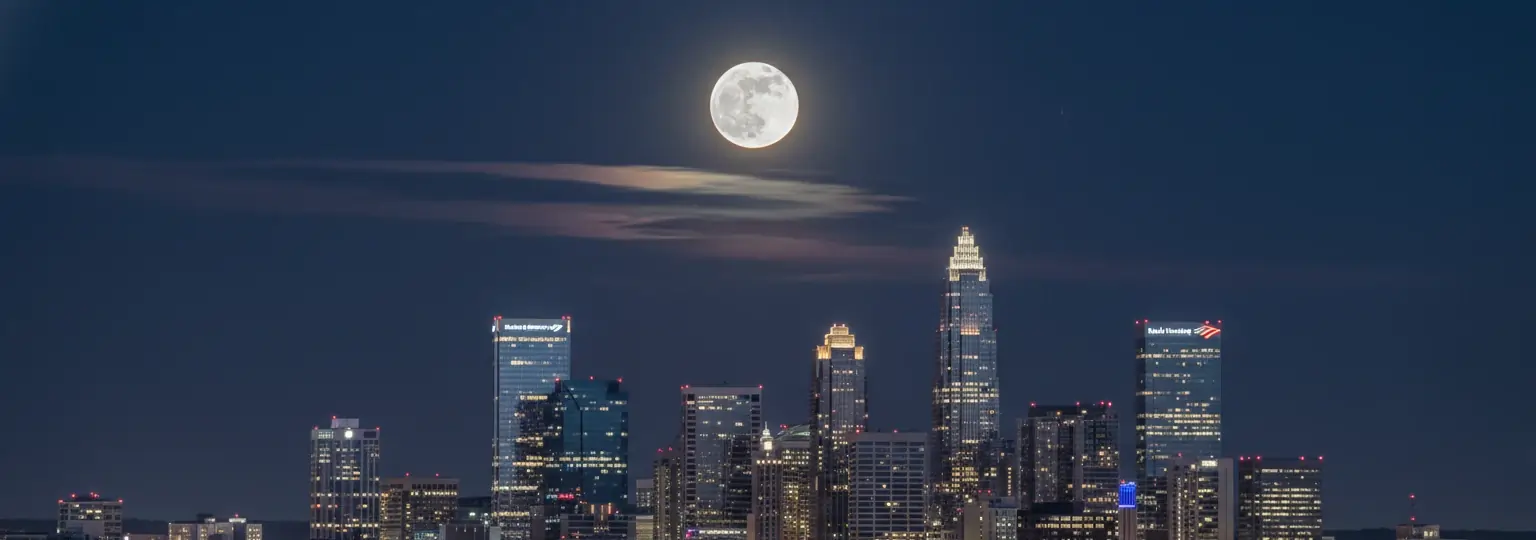
☽ Best Places to View the Moon in Charlotte
Charlotte sits at 35° North in the Carolina Piedmont, a fast-growing city on a gently rolling plateau between the Appalachian foothills to the west and the Atlantic coastal plain to the east. Its Uptown skyline — the Bank of America Corporate Center, the Duke Energy Center, and a cluster of glass towers rising from a relatively flat landscape — is compact and dramatically lit at night, and the city's network of greenways, urban parks, and fountain plazas gives photographers multiple foreground options within walking distance of each other. Charlotte has no river running through its center and no natural elevated viewpoints close in, so the parks and their water features do the work that rivers and hills do elsewhere — Romare Bearden Park's fountains and Marshall Park's pond are the city's primary reflection surfaces, and on calm evenings they produce compositions that would be unremarkable in a more geographically dramatic city but feel genuinely surprising here. For those willing to drive thirty minutes west, Crowders Mountain adds elevation, darker skies, and a telephoto view across the entire piedmont to the distant skyline.
Romare Bearden Park
Romare Bearden Park is the premier Charlotte moonrise viewpoint — a 5.4-acre urban park at the western edge of Uptown with open lawns, fountains, and a direct sight line toward the Bank of America Corporate Center and Duke Energy Center. The moon rises behind the skyline to the east and the park's water features reflect both the city lights and the rising moon on calm evenings. The most photographed Charlotte park at night; the combination of fountain foreground and compact skyline is distinctive and consistent. Free, open daily; well lit and accessible year-round.
Marshall Park
Marshall Park sits adjacent to Romare Bearden just south of Uptown and offers a quieter alternative with a central pond that gives some of the best still-water reflections in the city. The moon rises over the Uptown skyline to the north with the pond surface doubling the scene below — a composition that works particularly well in the 48–72 hours before full moon when the sky still holds colour at moonrise. Less foot traffic than Romare Bearden; the tree canopy around the pond adds framing. Free, open daily.
Cordelia Park – North End
Cordelia Park in the North End sits north of Uptown and gives a slightly elevated, more open view toward the skyline than the downtown parks. The moon rises behind the Bank of America tower and the Uptown cluster from this angle, with the NoDa arts district adding ambient glow to the foreground. More open green space than either Romare Bearden or Marshall; better for wide-angle compositions with the full skyline spread across the frame. Free, open daily.
The Green – First Ward Park
The Green at First Ward Park is a small, well-landscaped urban park directly east of Uptown with curved paths, lawn space, and proximity to the Spectrum Center and BB&T Ballpark. From here the moon rises over the skyline from the east at close range — an intimate, immersive composition rather than a panoramic one. The park is lit at night and remains active after dark, making it one of the few Charlotte spots where late-evening shooting feels comfortable. Free, open 24/7.
Little Sugar Creek Greenway – Metropolitan Overlooks
The Little Sugar Creek Greenway runs through Midtown Charlotte and has several elevated sections near the Metropolitan mixed-use development that give open views toward the Uptown skyline. The moon rises over the towers with the creek and urban landscaping as foreground — a different angle from the Uptown park spots, and less crowded. Water reflections in the creek on calm evenings. Free, open daily; the paved trail is well maintained and accessible year-round.
Crowders Mountain – Summit Trails
Crowders Mountain State Park, approximately 32 miles west of Charlotte, offers the most dramatic moonrise option in the region. The summit of Crowders Mountain rises to approximately 1,625 feet — nearly 800 feet above the surrounding piedmont — and gives a panoramic east-facing view across the entire Charlotte metro area. At this distance a 300–400mm lens compresses the Charlotte skyline into the frame with the moon rising behind it. Noticeably darker skies than any in-city option. Day use is free; trail hours vary by season (typically 7 or 8 am to 6–9 pm depending on the month — check the NC State Parks website before visiting).
◉ Best Times for Moon Photography
📷 Quick Photography Tips
Charlotte operates on EST (UTC−5) in winter and EDT (UTC−4) during daylight saving time. Clocks go forward on the second Sunday in March and back on the first Sunday in November. North Carolina observes DST statewide. Apps like PhotoPills or Stellarium set to Charlotte handle the offset automatically — useful for calculating exact moonrise times relative to sunset throughout the year.
For the moon phase in any other city worldwide, visit our Dynamic Moon Phase Calculator on our home page for instant lunar data tailored to wherever you are.
The moon phase today in Charlotte, NC is shown in detail above — complete with exact illumination percentage, moonrise/set times, and the best local spots to see it. For the moon phase today in any other city or location worldwide, visit our Dynamic Moon Phase Calendar on the home page.
◐ What the Experience Actually Feels Like
There is a particular quality to moonrise in Charlotte that has to do with the flatness of the landscape and the youth of the skyline. You stand at Romare Bearden Park on a clear October evening and the Uptown towers rise in front of you — the Bank of America Corporate Center's distinctive crown, the Duke Energy Center's clean glass lines — and the moon comes up behind them in a sky that, this far south and this far from any coast, tends to be clear and dark by nine o'clock. The fountains in the plaza below you catch the city light and the moon simultaneously, and for a few minutes the whole composition feels more polished than you expected from a city that, fifty years ago, barely had a skyline at all.
Charlotte at 35 degrees north gives the moon a generous arc across the sky — higher than the southern cities, more southerly than the northern ones, in that sweet mid-latitude zone where the full moon rides at a useful angle for photography for most of the year. In winter the air over the Piedmont is at its clearest — the humidity that makes summer nights hazy drops away, and the skyline sharpens against the sky in a way that rewards longer lenses. The October-through-March window is when most experienced Charlotte photographers do their best work; the alignments are tighter and the dynamic range between the moon and the city lights is more manageable in the cold.
What Charlotte lacks in natural drama it compensates for with accessibility and the unexpected reward of Crowders Mountain. The mountain sits thirty minutes west of the city on the edge of the Kings Mountain belt — a long, narrow ridge of resistant rock that the surrounding piedmont has worn down around, leaving it standing some 900 feet above the valley floor. From the summit, the Charlotte skyline is visible to the east across thirty miles of rolling Carolina landscape, and with a long lens the towers compress into the frame as the moon rises behind them. It is one of those compositions that requires planning — the right moon phase, the right lens, the right evening — but when it comes together it produces a photograph that looks like it was taken somewhere genuinely remote rather than thirty minutes from a city of one million people.
"The fountains catch the city light and the moon simultaneously, and the whole composition feels more polished than you expected from a city that barely had a skyline fifty years ago."
✓ Your Charlotte Moon Chase Checklist
Before You Go
- Check the moonrise time and phase on this page — the moon's exact alignment with the Bank of America Corporate Center or Duke Energy Center changes by date and rewards planning
- Target the 48–72 hour window before full moon if possible — the moon rises during blue hour when the Uptown skyline is still partially lit and the contrast with the sky is richest
- Check wind conditions before heading to Romare Bearden or Marshall Park — calm evenings give the fountain and pond reflections that define the best Charlotte moonrise shots
- For Crowders Mountain, check the NC State Parks website for current trail hours and conditions before visiting — hours vary by season and the summit trails are popular on weekends
- Use PhotoPills or Stellarium set to Charlotte to identify exact dates when the moon rises aligned with the Bank of America crown or centred above the Uptown cluster
What to Bring
- Sturdy tripod — even modest wind on the open lawns at Romare Bearden or the exposed Crowders Mountain summit will blur longer exposures without a solid base
- A lens between 100–200mm for skyline compression shots from Romare Bearden or Marshall Park — the distance to the Uptown towers rewards longer glass over wide-angle
- A 300–400mm lens for Crowders Mountain — at 32 miles from the skyline, significant compression is needed to bring the towers and the moon into the same frame
- Warm layers from November through February — Charlotte winters are mild but evenings drop quickly and the exposed Crowders Mountain summit is noticeably colder than the city
- Proper trail footwear for Crowders Mountain — the summit trail is rocky and steep in sections; flat-soled shoes are not adequate for the descent after dark
- A headlamp for Crowders Mountain — park hours close before full dark in many seasons, so plan to be descending well before closing time and carry a headlamp as backup
On the Night
- Arrive at Romare Bearden or Marshall Park 30–45 minutes before moonrise — the sky above the eastern skyline transitions through amber and blue in the final minutes before the moon clears the rooftops
- At Romare Bearden, position yourself near the fountain plaza on the western side of the park for the most direct sight line to the Bank of America crown and the full skyline
- Shoot RAW — the dynamic range between a bright full moon, the lit Bank of America crown, and the darker sky around it requires separate exposures blended in post
- Stay 20–30 minutes after moonrise — the moon climbs above the haze quickly on clear nights and the compositions evolve from warm and atmospheric to sharp and graphic
- At Crowders Mountain, arrive well before sunset — the summit trail takes 45–60 minutes each way and you need to be in position before the moon rises, which may happen before full dark in some seasons
? Charlotte Moon Phase — Frequently Asked Questions
Q. What is the moon phase today in Charlotte?
The moon phase today in Charlotte is a New Moon with 0% illumination. The next full moon is in 17 days, on Oct 26. Moonrise is at 6:26 AM and moonset at 6:22 PM.
Q. Where is the best place to view the moon in Charlotte?
Romare Bearden Park is the standout in-city spot — its open lawns and fountains sit right at the western edge of Uptown with a direct sight line to the Bank of America Corporate Center and Duke Energy Center, and the water features reflect the skyline and rising moon on calm evenings. Marshall Park's pond is a quieter alternative nearby. For a wider, darker view, Crowders Mountain State Park, about 32 miles west, gives a panoramic look back across the whole Piedmont toward the Uptown skyline.
Q. Why does Charlotte rely on parks and fountains for moon viewing instead of a river or hills?
Charlotte sits on a relatively flat piedmont plateau with no major river running through the city center and no natural elevated viewpoints nearby. Its parks and their water features — the fountains at Romare Bearden and the pond at Marshall Park — do the reflective work that a river or harbor would in other cities. For genuine elevation and darker skies, photographers head out to Crowders Mountain, about a thirty-minute drive west.
Q. When is the next full moon in Charlotte?
The date of the next full moon is calculated live and shown in the "Next Full Moon" card above. For a full breakdown of upcoming full moons and their traditional names, see our next full moon guide.
Q. Does Charlotte observe daylight saving time?
Yes. Charlotte runs on Eastern Standard Time (EST, UTC−5) in winter and switches to Eastern Daylight Time (EDT, UTC−4) from the second Sunday in March to the first Sunday in November. All times shown on this page already account for the correct offset.
Q. What's the best time of year for moon photography in Charlotte?
October through March brings the clearest Piedmont skies, the most southerly moon path, and the tightest alignments with the Bank of America Corporate Center and Duke Energy Center. September and April are milder and still reliably calm in the parks. Summer humidity tends to soften the skyline and haze the moon as it rises.
Q. Does this page work for cities besides Charlotte?
This page is set up specifically for Charlotte, NC. For the moon phase in any other city or location worldwide, use the Dynamic Moon Phase Calculator on the moonphase.today home page.
✦ Explore Further
Moon Phase Today: Atlanta
Check tonight's moon phase and best viewpoints in Atlanta, about a 3.5-hour drive south on I-85.
📷Moon Photography Guide
Camera settings, lenses, and techniques for shooting sharp, well-exposed moon shots.
🌗Why Does the Moon Rise and Set?
The simple science behind moonrise and moonset, and why the timing shifts every day.
🌌Best Dark Sky Parks in the USA
Worth a look before a Crowders Mountain trip — a guide to the country's darkest, most protected night skies.
NASA Moon Phase & Libration Gallery
NASA's Scientific Visualization Studio's daily renders of the moon's exact phase, libration, and orientation, straight from official mission data.
✦ Explore Further
Moon Photography Guide
Camera settings, lenses, and techniques for shooting sharp, well-exposed moon shots.
🌕When Is the Next Full Moon?
A running guide to upcoming full moons and what each one is traditionally called.
🌗Why Does the Moon Rise and Set?
The simple science behind moonrise and moonset, and why the timing shifts every day.
🌌Best Dark Sky Parks in the USA
Worth a look before a Crowders Mountain trip — a guide to the country's darkest, most protected night skies.
NASA Moon Phase & Libration Gallery
NASA's Scientific Visualization Studio's daily renders of the moon's exact phase, libration, and orientation, straight from official mission data.