
Moon Phase Today Birmingham
On Friday, October 9, 2026, the moon in Birmingham is a New Moon with 0% illumination. Moon age: 28.9 days.
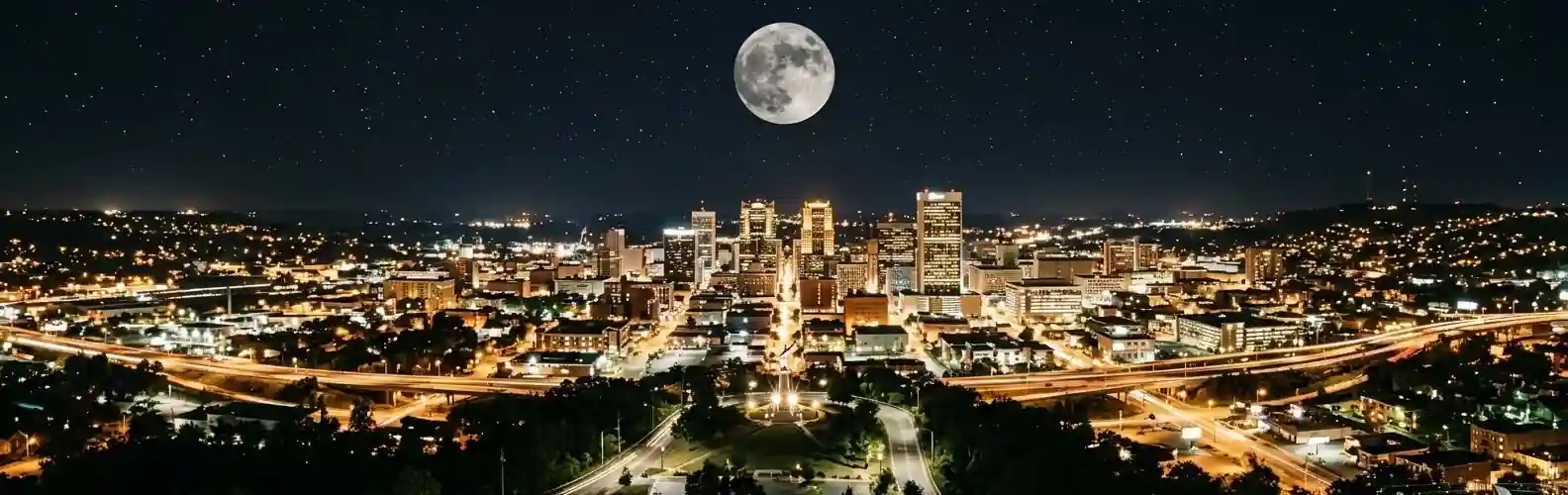
☽ Best Places to View the Moon in Birmingham, AL
Birmingham sits in Jones Valley in north-central Alabama, surrounded by rolling hills in the foothills of the Appalachians. Red Mountain is a long ridge running southwest to northeast that divides Jones Valley from Shades Valley to the south, so the city's best viewpoints split between a ridge-top overlook, a downtown park with late hours, and wooded ridge parks and preserves where much of the horizon is blocked by trees. The date and your observing location together determine the moon's rise time and direction; your viewpoint determines how much of that horizon is actually unobstructed. Here are six Birmingham-area locations that offer different ways to experience or photograph the moon, with their posted hours, since several close well before moonrise.
Vulcan Park and Museum
A park high atop Red Mountain with panoramic views of Birmingham. A moonrise over the city skyline is possible when the azimuth aligns, but the moon doesn't always rise over the skyline from here. The park grounds and observation tower are currently open Sunday–Thursday 10 a.m.–8 p.m. and Friday–Saturday 10 a.m.–9 p.m., with the Vulcan Trail parking lot open 10 a.m.–6 p.m. Good for evening and twilight, not a late-night observing location.
Railroad Park
A downtown urban oasis the park calls Birmingham's Front Lawn, with open grass, lakes, wetlands, walking trails, and an amphitheater, hosting recreation, events, and cultural activities. The official site lists it open 7 a.m.–11 p.m., 365 days a year, free to the public, which makes it unusually useful for early-evening lunar photography compared with most other locations here.
Red Mountain Park
A large park associated with Red Mountain, with hiking and biking trails, zip lines, and historic mining remnants. Much of the attraction is wooded terrain, so don't assume unobstructed astronomical horizons. It is more of a daytime and twilight nature location than an established nighttime observing site, so check current operating status before treating it as an evening photography destination.
Ruffner Mountain Nature Preserve
An urban nature preserve with extensive mountainous hiking trails, wildlife, geology, and mining remnants, with more secluded forested settings away from downtown lighting. The preserve and trails are open 7 a.m.–7 p.m. March–October and 7 a.m.–5 p.m. November–February, closed Mondays, with no entry before or after those hours. That early closing can eliminate much of the useful moonrise window, so it is not a late-night lunar observing site.
Oak Mountain State Park
Alabama's largest state park, south of the city, offering hiking, mountain biking, fishing, paddleboarding, and golf. Current state park information lists 7 a.m. until sunset. The campground has different access rules for registered guests, but that doesn't mean the general park is available after sunset. Check current hours, as many areas close at dusk.
City Walk BHAM
A public space under and around the I-20/59 corridor near the BJCC with a skatepark, roller rink, pickleball, a playground, an amphitheater, a dog park, and a lake lawn. The current visitor page shows conflicting hours (8 a.m.–8 p.m. in one place and 11 a.m.–7 p.m. weekdays and 9 a.m.–6 p.m. weekends in another), so check the posted hours. It has substantial artificial light and structural obstruction beneath the interstate, so it isn't a strong moon-viewing destination despite being a real location.
◉ Best Times for Moon Photography
📷 Quick Photography Tips
Birmingham runs on Central Time — CST (UTC−6) in winter and CDT (UTC−5) in summer, following the standard U.S. daylight saving schedule. PhotoPills or Stellarium will handle the moon's exact rise azimuth for any of these spots automatically, as long as your device's clock is correct.
The moon phase today in Birmingham, Alabama is shown in detail above — complete with exact illumination percentage, moonrise/set times, and the best local spots to see it. For the moon phase today in any other city worldwide, visit our Dynamic Moon Phase Calculator on the home page.
◐ What the Experience Actually Feels Like
At Vulcan Park, the overlook atop Red Mountain opens to the city bowl below, best within its 8 p.m. to 9 p.m. closing window, so plan to arrive well before moonrise.
At Railroad Park, open grass, lakes, and wetlands create a downtown oasis the park calls the city's Front Lawn, with evening hours to 11 p.m. that make it the standout choice for twilight lunar work.
At Red Mountain Park and Ruffner Mountain, wooded ridge trails offer natural clearings, but the trees can limit unobstructed horizons and early closings restrict late-night use.
"In Jones Valley with the Red Mountain ridge dividing the valleys, Railroad Park's 7 a.m.–11 p.m. hours are the standout for evening, while the ridge preserves close early."
✓ Your Birmingham Moon Chase Checklist
Before You Go
- Check the moonrise time and rise azimuth for your date — the direction varies through the month, so the moon won't always rise over the skyline
- Verify Site Access: Vulcan Park is open 10 a.m.–8 p.m. Sunday–Thursday and 10 a.m.–9 p.m. Friday–Saturday, Railroad Park 7 a.m.–11 p.m., Ruffner Mountain 7 a.m.–7 p.m. March–October and 7 a.m.–5 p.m. November–February (closed Mondays), and Oak Mountain 7 a.m. to sunset, while City Walk has conflicting posted hours
- Use PhotoPills or Stellarium to check whether the moon will align with a specific landmark on your date
- Check current event schedules, trail closures, and whether fishing or campground rules affect access
- Confirm current rules on tripods and photography at your chosen venue, especially for anything beyond personal use
What to Bring
- A telephoto lens, often 200mm or longer, plus a wide lens for skyline and ridge compositions
- A lens cloth for humidity
- Bug spray for evenings near wetlands and woods
- A remote shutter release or a 2-second timer to avoid shake on tripod shots
- Spare batteries, particularly for long sessions or extended time outdoors
On the Night
- As a general recommendation, arrive at your viewpoint at least 30–45 minutes early, so you're set up well before the posted closing time
- Focus manually on the moon's surface detail using magnified live view — city lighting can confuse autofocus at dusk
- Bracket your exposures — one for the bright lunar disc, one for the darker city and ridges during the twilight window
- If the moon looks soft or hazy right at moonrise, consider waiting until it climbs higher above the horizon, when atmospheric effects are often less pronounced
- Stay on marked trails and respect posted closing times — several of the most attractive natural locations are not nighttime-accessible
? Birmingham Moon Phase — Frequently Asked Questions
Q. What is the moon phase today in Birmingham, Alabama?
The moon phase today in Birmingham is a New Moon with 0% illumination. The next full moon is in 17 days, on Oct 25. Moonrise is at 5:51 AM and moonset at 5:48 PM.
Q. Where is the best place to view the moon in Birmingham?
Vulcan Park and Museum sits high atop Red Mountain with panoramic views of Birmingham, and a moonrise over the skyline is possible when the azimuth aligns, though it is an evening and twilight spot rather than a late-night one. Railroad Park, a downtown urban oasis the park calls Birmingham's Front Lawn, has open grass, lakes, wetlands and an amphitheater and is open 7 a.m. to 11 p.m., making it the standout for extended evening viewing. Red Mountain Park, Ruffner Mountain Nature Preserve and Oak Mountain State Park offer wooded ridge and forest settings, but they close early and much of the horizon is blocked by trees.
Q. Where does the moon rise and set in Birmingham, and how high does it climb?
At about 33.5°N, Birmingham's moonrise and moonset points swing across the horizon each month, from roughly northeast to southeast for rising and northwest to southwest for setting. A winter full moon climbs very high in the south, to roughly 80° above the horizon, while a summer full moon stays lower, peaking near 33°. Birmingham sits in Jones Valley, surrounded by rolling hills, with Red Mountain's long ridge running southwest to northeast, and wooded ridge terrain can limit unobstructed horizons. The Vulcan Park overlook gives the broadest view over the city, though the moon won't always rise over the skyline, so check the azimuth for your date and exact viewpoint.
Q. Is light pollution a problem for moon observing in Birmingham?
The moon is bright enough to observe and photograph from almost anywhere in Birmingham, so light pollution rarely limits the lunar disc itself. It does wash out earthshine on a thin crescent and any faint sky detail. Skies are darker away from downtown lighting, and Ruffner Mountain Nature Preserve offers secluded forested settings away from downtown lighting, though it closes early. City Walk BHAM, beneath the interstate, has substantial artificial light and structural obstruction, so it isn't a strong moon-viewing destination, and city lighting can confuse autofocus at dusk, so focus manually using magnified live view.
Q. What camera settings and phases work best for moon photography in Birmingham?
For a full moon, start with Looney 11 (f/11, ISO 100, 1/100 s) and refine using your histogram, since it is a starting point rather than a guaranteed exposure. The moon is much brighter than the foreground, so shoot RAW and bracket to keep both crater detail and the city and ridges below. A full moon rises near sunset, and a waxing gibbous moon is useful for evening and twilight over the city and ridges. A 200–400 mm lens can isolate the moon over ridge lines and the downtown skyline, and a sturdy tripod helps for bracketing and reflections over water.
Q. How do haze, humidity and bugs affect moon viewing in Birmingham?
Check the forecast for cloud, haze and wind before heading out. Bring a lens cloth for humidity, and bug spray for evenings near the wetlands at Railroad Park and in the woods. If the moon looks soft or hazy right at moonrise, wait until it climbs higher above the horizon, when atmospheric effects are often less pronounced.
Q. Can I visit Birmingham's moon viewpoints after dark?
Access varies by site, and several attractive natural locations are not nighttime-accessible. Vulcan Park's grounds and observation tower are open Sunday through Thursday 10 a.m. to 8 p.m. and Friday and Saturday 10 a.m. to 9 p.m. Railroad Park is open 7 a.m. to 11 p.m., 365 days a year, free to the public. Ruffner Mountain is open 7 a.m. to 7 p.m. March through October and 7 a.m. to 5 p.m. November through February, closed Mondays, and Oak Mountain State Park is open 7 a.m. until sunset. City Walk BHAM shows conflicting posted hours, and Red Mountain Park's operating status should be checked before an evening visit.
✦ Explore Further
Moon Phase Today: Huntsville
Check tonight's moon phase in Huntsville, northeast of Birmingham in north Alabama.
🏙️Moon Phase Today: Montgomery
See the moon over Montgomery, south of Birmingham on the Alabama River.
🇺🇸Moon Phase in the United States
Browse moon phase pages for cities across the United States, from Seattle to Miami.
🌍World Moon Phase Directory
Find the moon phase, rise and set times for cities in every region of the world.