
☽ Best Places to View the Moon in Huntsville
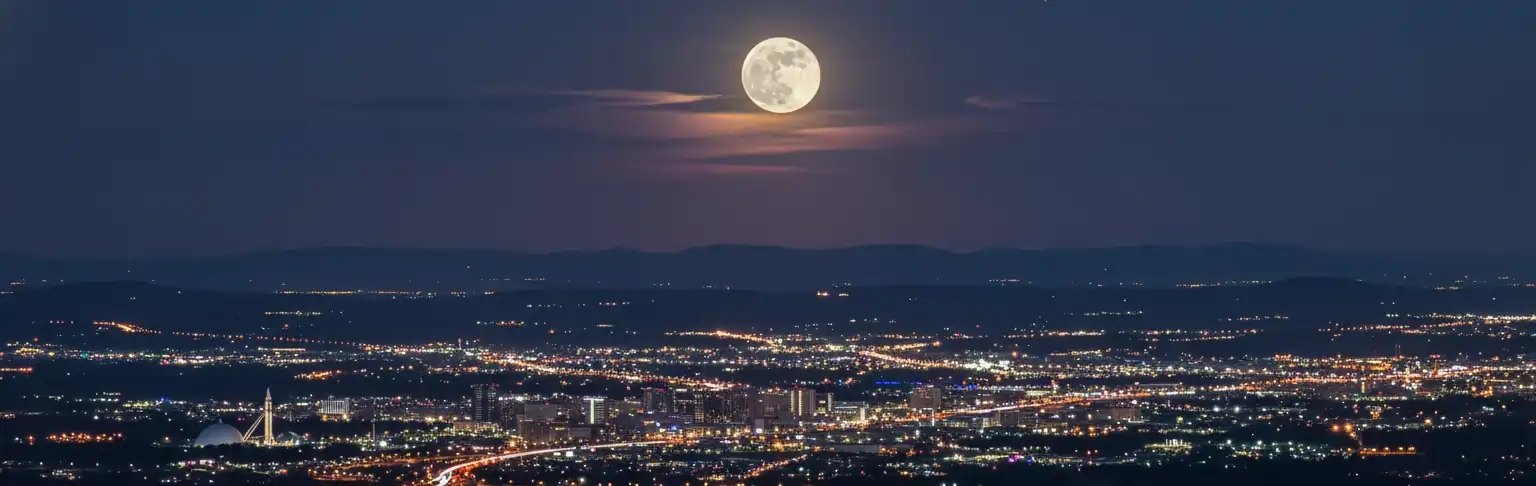
Huntsville — Rocket City — sits in a bowl in the Tennessee Valley at the foot of the Cumberland Plateau, with Monte Sano Mountain rising to about 1,620 feet on its eastern edge and a scattering of smaller ridges surrounding the city. That topography defines everything about moon photography here. The mountain rises roughly 300 metres above the valley floor, and from its western face the entire Huntsville skyline, the Tennessee Valley, and — on clear days — the NASA rocket test stands are visible in a single sweep. The moon rises to the east from behind Monte Sano's ridge and tracks south across the Alabama sky, and the viewpoints along the mountain's western bluff catch it as it clears the ridgeline above the city lights below. What makes Huntsville unique is the space heritage layer — the Saturn V rocket at the U.S. Space and Rocket Center, the NASA facilities on Redstone Arsenal, and the rocket test stands visible from the mountain heights all add a foreground that no other moonrise city in America can offer.
Burritt on the Mountain
The premier Huntsville moonrise viewpoint. Burritt on the Mountain sits on Round Top Mountain — a plateau connected to Monte Sano — and its grounds offer a breathtaking panoramic view of Huntsville and the full Tennessee Valley. On clear days the NASA rocket test stands are visible on the horizon alongside the city lights below. The eccentric 1930s X-shaped mansion provides distinctive historic foreground architecture. Note: grounds are open Tuesday–Saturday 10am–4pm, Sunday 12pm–4pm; closed Monday — daytime-only access makes this best suited for a moonset or afternoon golden-hour visit. Check the website for seasonal evening event schedules when night access may be available.
Monte Sano State Park – North Plateau & Overlooks
Monte Sano State Park covers over 2,100 acres at roughly 1,600 feet elevation on the mountain's eastern portion, with multiple trail-accessible overlooks looking west across the city. The North Plateau Loop trail leads to open views over the Tennessee Valley — darker skies than anywhere in the city proper, with the full Huntsville bowl lit below. The moon rises over the ridge behind you and tracks west above the city; the foreground forest and rock outcrops frame compositions that the roadside viewpoints cannot match. Open 7am to sunset; small vehicle fee applies.
U.S. Space & Rocket Center – Perimeter & Davidson Center
The U.S. Space and Rocket Center is the foreground element that makes Huntsville's moonrise unlike anywhere else on Earth. The Saturn V rocket — 363 feet of the most powerful machine ever built — stands upright in the Davidson Center, and the rocket garden's collection of Mercury, Gemini, and Apollo hardware provides extraordinary foreground for moonrise compositions from the perimeter. The museum grounds face east and the moon rises directly above the rockets on many dates. Perimeter views are accessible from the adjacent parking areas and Tranquillity Base path without an entry ticket; check PhotoPills for moon-over-Saturn-V alignment dates.
Big Spring International Park
Big Spring International Park in the heart of downtown Huntsville centres on a natural spring-fed lagoon that provides reliable water reflections in the middle of the city. The moon rises to the east and tracks above the surrounding downtown buildings — von Braun Center, the Huntsville skyline — with the lagoon below catching the moonrise glow and city lights in calm reflections. The park is lit at night and fully accessible, making it one of the most convenient and photogenic late-evening positions in the city. Free, open 24/7.
Huntsville Botanical Garden – Upper Paths
The Huntsville Botanical Garden covers over 100 acres at the foot of Monte Sano and its upper paths give elevated views over the garden's ponds and naturalistic landscapes toward the city. The moon rises over the ridge to the east and tracks above the tree line — garden compositions with water, specimen trees, and the distant skyline glow are available nowhere else in Huntsville. The garden hosts seasonal evening events and special moon-viewing nights. Entry fee applies; open evenings seasonally — check the calendar for Galaxy of Lights and other after-dark events when the grounds are accessible at night.
Lowe Mill ARTS & Entertainment – Surrounding Trails
Lowe Mill ARTS and Entertainment occupies a repurposed 1930s cotton mill in the Five Points South neighbourhood and its surrounding streets and the nearby Pinhook Creek greenway give an urban-industrial foreground for moonrise compositions looking east toward Monte Sano's ridge. The mill's brick facades, chimneys, and creative-district character offer a distinctly different aesthetic from the mountain and park viewpoints. The moon rises over the ridge behind the mill and tracks above the rooftops. The surrounding neighbourhood is lively in the evenings. Free outdoor access 24/7.
◉ Best Times for Moon Photography
📷 Quick Photography Tips
Huntsville operates on CST (UTC−6) in winter and CDT (UTC−5) during daylight saving time. Clocks go forward on the second Sunday in March and back on the first Sunday in November. Alabama observes DST statewide. Apps like PhotoPills or Stellarium set to Huntsville apply the correct local offset automatically — useful for planning the exact moonrise time above Monte Sano's ridge and the Saturn V alignment at the Space and Rocket Center.
For the moon phase in any other city worldwide, visit our Dynamic Moon Phase Calculator for instant lunar data tailored to wherever you are.
The moon phase today in Huntsville, AL is shown in detail below — complete with exact illumination percentage, moonrise/set times, and the best local spots to see it. For the moon phase today in any other city or location worldwide, visit our Dynamic Moon Phase Calculator on the home page.
◐ What the Experience Actually Feels Like
There is a particular quality to a moonrise in Huntsville that you do not fully understand until you are standing at the Space and Rocket Center perimeter on a clear October evening with the Saturn V visible through the Davidson Center's glass walls behind you and the Monte Sano ridge on the eastern horizon. The ridge is dark — the mountain's western face has no lights — and the moon rises above it slowly, enormous and amber in the way it always is close to the horizon, and for a moment it is directly above the rocket park with the Saturn V in the foreground. This is a composition that exists nowhere else on Earth: the moon that humans actually reached, rising above the machine that took them there.
Monte Sano changes the perspective entirely. From the North Plateau overlook at 1,600 feet, you are above the city rather than inside it, and the Tennessee Valley spreads in every direction below — Huntsville's lights in the centre, the dark ridgelines of the Cumberland Plateau on the horizon to the north and west, and to the east the forest of Monte Sano State Park stretching behind you toward the Alabama interior. The moon rises over the ridge to the east and begins its arc south across the sky, and the city below is small enough at this distance that its individual buildings disappear into a continuous amber glow. On very clear days and evenings, the NASA rocket test stands are visible on Redstone Arsenal to the west — white towers rising from the valley floor, lit at night.
Huntsville is a city of unexpected layers. The cotton-mill arts district, the hilltop Victorian-era museum, the mid-century space campus, the spring-fed lagoon in the middle of downtown — each is a different foreground for the same moon rising above the same ridge. What they share is the mountain: Monte Sano rises every evening above whatever composition you have chosen, and the moon clears its edge on its way south, and Huntsville earns its nickname in a way that has nothing to do with the ground.
"The moon rises above the Monte Sano ridge with the Saturn V in the foreground — the moon that humans actually reached, rising above the machine that took them there. This composition exists nowhere else on Earth."
✓ Your Huntsville Moon Chase Checklist
Before You Go
- Check the moonrise time and phase on this page — the moon rises over Monte Sano's ridge to the east; use PhotoPills to find the specific dates when it aligns with the Saturn V from the Space and Rocket Center perimeter
- Target the 48–72 hour window before full moon if possible — the moon rises during civil twilight and the warm Alabama sky gives the city and mountain the most atmospheric colour before full dark
- For Burritt on the Mountain, check the website for evening event schedules — the grounds are normally Tuesday–Saturday 10am–4pm, Sunday 12pm–4pm; night access for moonrise requires a special event or after-hours arrangement
- For Monte Sano State Park, check operating hours (7am to sunset) and note that the park closes at sunset — plan accordingly if you want to catch the overlook during civil twilight rather than full dark
- Check Big Spring lagoon conditions — calm, windless evenings produce the cleanest water reflections in the downtown park; the fountain at the spring can also disrupt the water surface
What to Bring
- Sturdy tripod — the Monte Sano and Round Top ridgelines are exposed to consistent hill winds; even moderate gusts at elevation will blur long exposures significantly
- A lens between 200–400mm for Space and Rocket Center compositions — compressing the moon against the Saturn V or the Davidson Center's glass facade requires substantial focal length from the perimeter positions
- A wide-angle lens (16–24mm) for Monte Sano overlooks and Burritt — the full Tennessee Valley panorama and the mountain foreground both reward environmental compositions that include sky, city, and terrain
- Insect repellent from April through October — Monte Sano's trails and Big Spring Park can be heavily buggy on warm, still evenings; the same calm air that produces good reflections produces mosquitoes
- Layers for the mountain positions — even in summer, temperatures at the Monte Sano overlooks can be 5–8°C cooler than the valley floor, and night sessions on the exposed ridge get cold quickly after sunset in autumn and winter
- A headlamp for Monte Sano trail sections — the path to the North Plateau overlook is rocky and unlit, and the descent in full dark without a light is genuinely hazardous on the rockier sections
On the Night
- Arrive at your viewpoint 30–45 minutes before moonrise — the Monte Sano ridge catches a warm pre-moonrise glow before the moon clears the top, and that brief amber light on the ridge above the dark city is often the evening's best compositional moment
- At the Space and Rocket Center perimeter, position yourself to place the Saturn V between the camera and the eastern horizon — the exact position depends on the moon's azimuth on your chosen date; PhotoPills gives the precise bearing
- Shoot RAW throughout — the dynamic range between a bright moon, the lit Saturn V interior, the dark mountain ridge, and the city glow below requires multiple exposures blended carefully in post
- Stay 20–30 minutes after moonrise — as the moon climbs above the ridge it sharpens and brightens, and the compositions from Monte Sano looking west over the city become more defined as the city lights fully activate
- At Big Spring Park, wait for the fountain to cycle off if it is running — the natural spring flow is smooth and reflective; the fountain disrupts the water surface and eliminates the lagoon reflection
Moon Phase Today Huntsville

