
Moon Phase Today Şanlıurfa
On Sunday, October 4, 2026, the moon in Sanliurfa is a Last Quarter with 45% illumination. Moon age: 22.6 days.
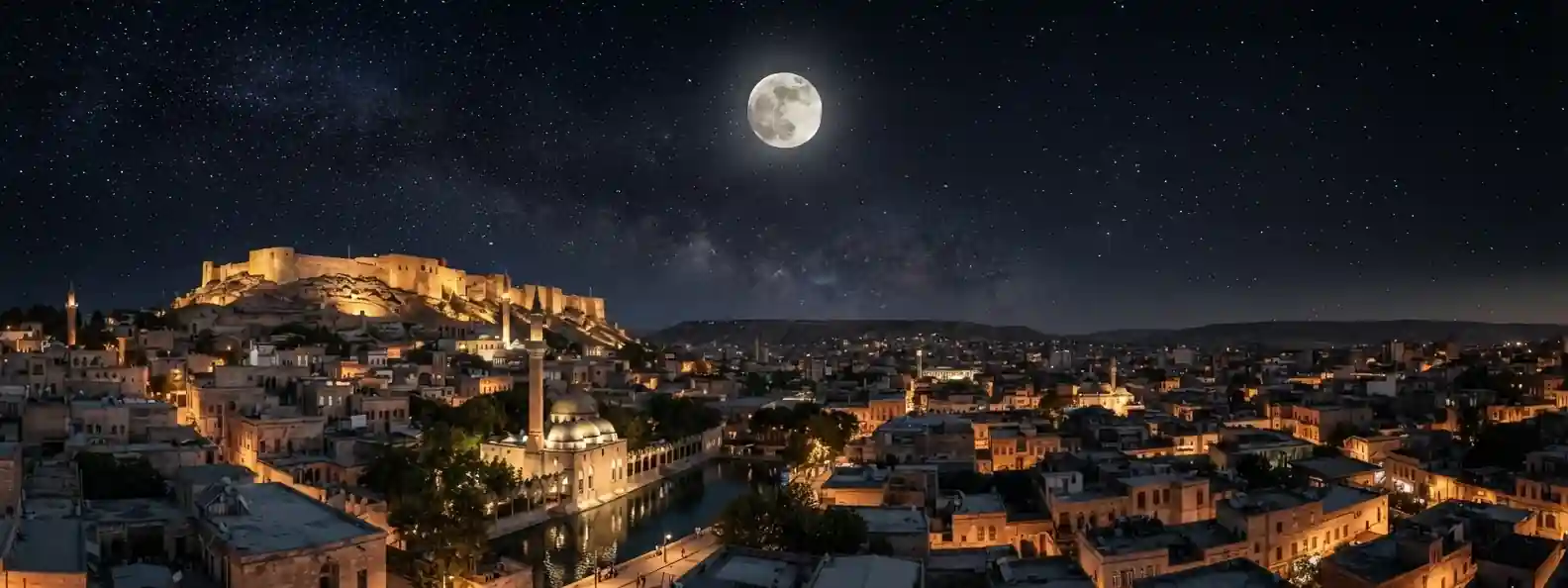
☽ Best Places to View the Moon in Şanlıurfa, Turkey
Şanlıurfa sits on a semi-arid plain in southeastern Turkey, with flat, gently sloping terrain and wide open horizons, limestone plateaus to the north and the Harran Plain to the south. It also has an unusual lunar heritage: Harran was a centre of worship of the moon god Sin and is said to be the birthplace of the astronomer al-Battani, and Soğmatar in the Tektek hills was another centre of the Sin cult. The Moon rises in the east, crosses the southern sky and sets in the west, and on this plain a rising Moon comes up over a long, open horizon. From Göbeklitepe, which looks south over the Harran Plain, the Moon crosses the sky in front of you. Exact Moonrise and Moonset directions change with the date and your observing position, so check both before planning a specific composition.
Göbeklitepe – Plateau Above the Harran Plain
Göbeklitepe stands at about 780 m on a plateau north-east of the city, with commanding views over the Harran Plain and wide horizons around it. Its monumental structures date broadly to roughly 9600–8200 BC. Because it looks south over the plain, the Moon crosses the southern sky in front of you. It is a protected archaeological site with managed visitor areas, so check current visitor information for opening times and access.
Karahan Tepe – Tektek Plateau
Karahan Tepe, at about 690 m, is part of the Taş Tepeler cluster, in the Tektek Mountains on a limestone plateau with open steppe. It is a good place for low-horizon lunar work away from the city's lights, though no dark-sky designation is listed for it. It is a protected archaeological site, so check current visitor information before visiting.
Soğmatar – A Centre of the Moon-God Sin
Soğmatar lies about 60 km south-east of Şanlıurfa and about 40 km north-east of Harran, in the Tektek hills. It was a centre of worship of the moon god Sin, with Roman-period inscriptions naming him, and it has an open-air altar, a cave with carved statues and the remains of temples on surrounding hills, including Pognon Cave, dedicated to Sin. Reached by the Şuayb City route, it is remote, with uneven ground, so check access and conditions before an evening visit.
Harran – Moon-God Heritage, Beehive Houses and Battani
Harran, about 44 km from Şanlıurfa, had a famous temple to the moon god Sin that was active for centuries, and the ruins of an ancient school. It is said to be the birthplace of al-Battani, whose name is on a crater on the Moon. The flat plain gives a long, open horizon, with beehive houses as low, distinctive foregrounds, though buildings and distant terrain can still interrupt the view. The Battani Space and Aviation Science Center in Harran welcomes visitors, and an observatory was reported under construction there in 2018, so check its current status.
Karacadağ – Extinct Volcanic Highland
Karacadağ is an extinct volcanic mountain and basaltic plateau on the border of the Şanlıurfa, Diyarbakır and Mardin provinces, with a highest point of about 1,957 m. Its height brings colder conditions, and it can have snow in winter. It is a remote, exposed highland, so check road and weather conditions before going.
Tektek Mountains National Park & Atatürk Reservoir
Tektek Mountains National Park lies on the northern border of the plain. The Atatürk Reservoir, with a surface area listed at 817 km², gives water-level reflections, while the surrounding plateaus have dry steppe air. Individual access points should be checked before a nighttime visit.
◉ Best Times for Moon Photography in Şanlıurfa
📷 Quick Tips for Şanlıurfa
🕐 Timezone: Şanlıurfa uses Turkey Time (TRT), UTC+3, year-round. Turkey has used a single permanent time zone since September 2016 and does not observe daylight saving. Europe/Istanbul zone.
🔭 Astronomy Heritage and Facilities: Harran was a centre of the moon-god Sin cult and is said to be al-Battani's birthplace. The Battani Space and Aviation Science Center in Harran welcomes visitors, and an observatory was reported under construction there in 2018. No regular public telescope night is widely advertised, so check current announcements.
Access: Göbeklitepe, Karahan Tepe and Harran have managed visitor areas, so check current information. Soğmatar is remote, reached by the Şuayb City route. Karacadağ can have snow in winter.
The moon phase today in Şanlıurfa is shown above. For moon phase today anywhere else, visit the calculator on our home page.
◐ What It Feels Like
At Göbeklitepe, the plateau feels vast, with a wide open sky and commanding views over the Harran Plain, and the Moon crossing the southern sky in front of you.
On the Harran Plain, the flat terrain gives an expansive horizon, with the Tektek Mountains to the north. The beehive houses provide low, distinctive foregrounds, and the ruins stand where people once watched the Moon and named it a god.
At Soğmatar, the carved altar, the cave and the ruined temples on the surrounding hills reflect the area's old cult of the moon god Sin, in a quiet, open landscape.
"From the plain to plateaus at 690 and 780 m and a 1,957 m volcanic highland — wide horizons and one of the oldest moon-watching landscapes in the world."
✓ Checklist for Lunar Observers
Before You Go
- Check moonrise and moonset azimuth for your date and spot — it varies with the Moon's declination
- Check the MGM forecast — dust, and winter rain or snow at higher elevations
- Confirm current access for Göbeklitepe, Karahan Tepe, Harran and Soğmatar through official visitor information
What to Bring
- Telephoto 200 mm or longer, and a wide lens for the plain and the temple foregrounds
- Tripod, remote shutter release and a red torch
- Lens cloth for steppe dust
- A warm layer — Karacadağ and the plateaus are colder, especially at night
On the Night
- Manual focus on the lunar limb
- Bracket for the disc and the limestone or basalt foreground
- Stay on paths — the archaeological sites are protected
- Treat the plateaus as better skies, not dark-sky sites
? Şanlıurfa Moon Phase — Frequently Asked Questions
Q. What is the moon phase today in Şanlıurfa?
The moon phase today in Şanlıurfa is a Last Quarter with 45% illumination. The next full moon is in 23 days, on 26 Oct. Moonrise is at — and moonset at 2:38 PM.
Q. Where is the best place to view the moon in Şanlıurfa?
Şanlıurfa sits on a semi-arid plain in southeastern Turkey, so horizons are wide and open, and the region has an unusual lunar heritage. Harran, on the plain south-east of the city, was a centre of worship of the moon god Sin and is said to be the birthplace of the astronomer al-Battani, and its beehive houses and the ruins of an ancient school give distinctive foregrounds. Göbeklitepe, on a plateau north-east of the city, has wide views over the Harran Plain, and Karahan Tepe sits on the Tektek plateau. Soğmatar, in the Tektek hills, was another centre of the Sin cult. Karacadağ is a high volcanic plateau on the Diyarbakır and Mardin border.
Q. Can I look at the moon through a telescope in Şanlıurfa?
A regular public telescope night is not widely advertised in Şanlıurfa. In Harran, the Battani Space and Aviation Science Center, named after al-Battani, welcomes visitors, and an observatory was reported under construction there in 2018, with funding from the GAP Regional Development Administration, so check its current status. Check the Science Center's and the municipality's announcements for any sky-watching events, since observing depends on the weather.
Q. Where does the moon rise and set in Şanlıurfa, and how high does it climb?
At about 37.2°N, Şanlıurfa's moonrise and moonset points swing widely across the horizon each month, from roughly east-north-east to east-south-east for rising and west-north-west to west-south-west for setting, with an even wider swing in years near a major lunar standstill. A full moon near the winter solstice climbs to roughly 76° in the south, while a full moon near the summer solstice stays lower, peaking near 29°. The plain to the south and south-east is flat and open, so a rising moon comes up over a long horizon, and from Göbeklitepe, which looks south over the Harran Plain, the moon crosses the sky in front of you. Check the azimuth for your date and exact spot.
Q. Is light pollution a problem for moon observing in Şanlıurfa?
The moon is bright enough to observe and photograph from almost anywhere in Şanlıurfa, so light pollution rarely limits the lunar disc itself. It does wash out earthshine on a thin crescent and any faint sky detail. Şanlıurfa is a large city, so stars are faint in and around it, but the plains and plateaus outside, around Harran, Karahan Tepe and Soğmatar, have far fewer lights. Even so, no measured dark-sky designation is listed for them, so treat them as better, not dark.
Q. What camera settings and phases work best for moon photography in Şanlıurfa?
For a full moon, start with Looney 11 (f/11, ISO 100, 1/100 s) and refine using your histogram, since it is a baseline rather than a guarantee. The moon is much brighter than the limestone and the plain, so shoot RAW and bracket or blend exposures to keep both crater detail and the foreground. A waxing gibbous suits blue hour at Göbeklitepe and Harran while the foreground is still lit. For a moon-and-monument shot, move farther back and use a longer focal length of 200 mm or more, with a sturdy tripod and manual focus on the moon's edge using magnified live view. The moon illusion makes a low moon look huge, but it is perceptual, not a change in size.
Q. How do heat, dust and wind affect moon viewing in Şanlıurfa?
Şanlıurfa has a semi-arid climate with very hot summers and cooler, wetter winters, and dust and haze can lower contrast and soften a low moon. The plain can be windy, and higher ground such as Karacadağ is colder and can have snow in winter. Check the weather forecast for cloud, dust and visibility before you go, and bring a lens cloth for steppe dust and a warm layer for the night.
Q. What time zone are Şanlıurfa's moonrise and moonset times shown in?
Şanlıurfa runs on Turkey Time, UTC+3, all year. Turkey has used a single permanent time zone since September 2016 and does not change its clocks. Moonrise and moonset times on this page follow the local clock. Şanlıurfa lies at about 38.8°E, west of the 45°E meridian on which UTC+3 is based, so the sun and moon cross the sky about 25 minutes later on the clock than they would on that meridian.
Q. Can I shoot the moon at Şanlıurfa's heritage sites after dark?
Not at all of them. Göbeklitepe, Karahan Tepe and Harran have managed visitor areas with set opening times, and the archaeological sites are protected, so stay on paths and check current visitor information rather than assuming night access. Soğmatar is remote, reached by the Şuayb City route, and has uneven ground. Karacadağ can have snow in winter. The open plain gives wide horizons, but check local conditions before an evening visit.
✦ Explore Further
Moon Phase Today: Gaziantep
Check tonight's moon phase in Gaziantep, roughly 125 km west of Şanlıurfa in south-eastern Turkey.
🏰Moon Phase Today: Diyarbakır
See the moon over Diyarbakır, roughly 150 km north-east of Şanlıurfa, with its basalt walls above the Tigris.
🌍World Moon Phase Directory
Find the moon phase, rise and set times for cities in every region of the world.
Blue Hour Calculator
Work out when blue hour falls, ideal for waxing gibbous shots over the Harran Plain.