
Moon Phase Today Gaziantep
On Sunday, October 4, 2026, the moon in Gaziantep is a Last Quarter with 45% illumination. Moon age: 22.6 days.
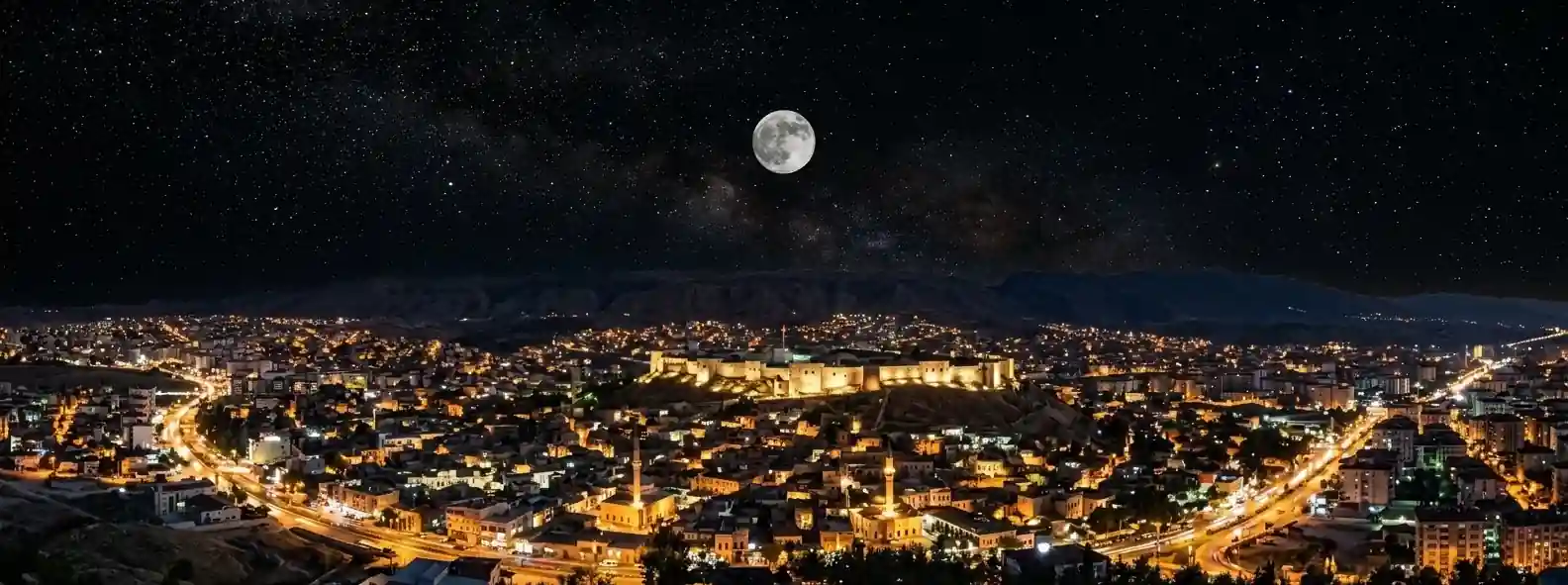
☽ Best Places to View the Moon in Gaziantep, Turkey
Gaziantep offers a useful combination of large urban parks, forested recreation areas, elevated viewpoints and historic landscapes. For convenient Moon viewing, the city's parks are the easiest choices. For more dramatic landscape photography, the Euphrates and Rumkale region provides a very different setting outside the city. The Moon rises in the east and sets in the west, so to put it behind a landmark, work out its azimuth and altitude for your date and viewpoint first. Gaziantep also hosts a real sky-watching festival with telescopes at Yamaçtepe.
100. Yıl Atatürk Kültür Parkı – Uzay Parkı and Planetarium
This large central park complex includes the Uzay Parkı, which contains a planetarium, along with botanical, recreational and family-oriented facilities. The planetarium makes the complex particularly relevant to astronomy enthusiasts, while the park itself provides an accessible urban setting for viewing and photographing the Moon. The planetarium is primarily an educational facility, so check its current programme rather than assuming that public night-time observing is available.
Yamaçtepe Science Camp – Sky-Watching Festival
Şahinbey Municipality's Yamaçtepe Science Camp hosted the first Bilim Türkiye Yamaçtepe Gökyüzü Gözlem Şenliği, run with the Türkiye Technology Team Foundation, from 10 to 12 August 2024. The Sun was observed by day and the Moon, Mars, Jupiter, Saturn and the Andromeda Galaxy at night, with workshops on traditional tools such as the sundial and astrolabe. Places were limited, with applications open to all provinces and bungalow or tent accommodation, so check for later editions.
Dülükbaba & Erikçe – Forest Recreation Areas
Dülükbaba Tabiat Parkı is a large forested recreation area north of Gaziantep, whose trees and open spaces provide a more natural environment than the central city and can make an attractive foreground for Moon photography. Erikçe is a forest and recreation area that includes the Erikçe Macera Parkı Çocuk ve Gençlik Kamp Eğitim Merkezi, a municipal facility that hosts day activities, camps and organised programmes by appointment, so it should not be treated as a guaranteed public night-time location. Both are managed areas, so check current access conditions before an evening visit.
Kavaklık Parkı – Urban Park on the Alleben Stream
Kavaklık is one of Gaziantep's established urban recreation areas, with walking, running and sports facilities. Its trees, paths and Alleben Stream setting can provide useful foreground elements for photographing the Moon. Because it is surrounded by the city, expect substantial artificial light, and treat it primarily as a Moon-and-landscape photography location rather than a dark-sky observing site.
Rumkale & the Euphrates – Historic Landscape
Rumkale, in Yavuzeli district, is one of the region's most dramatic historic landscapes. The fortress stands on steep rocky ground where the Merzimen Stream meets the Euphrates and is surrounded on three sides by reservoir water, an especially interesting setting for landscape photography. Access is associated with routes from Kasaba and boat transportation from Kasaba or Halfeti, so confirm current access and boat arrangements before planning a visit.
Şahinbey Parkı & Teleferik Area – Elevated Views
Şahinbey Parkı is a large recreation area in southern Gaziantep with walking, picnic and family-oriented facilities. The park's cable car provides elevated views during its operating periods, while the surrounding park offers open areas and landscape viewpoints. Attraction operating hours can differ from general park access, so check current schedules if you want to include the cable car in a photography outing.
◉ Best Times for Moon Photography in Gaziantep
📷 Quick Tips for Gaziantep
🕐 Timezone: Gaziantep uses Türkiye Time (TRT), UTC+3, year-round. Türkiye has used this offset all year since September 2016 rather than switching between standard time and daylight saving time. Set astronomy applications for Gaziantep and the correct local date and time. Europe/Istanbul zone.
🔭 Telescope Options: Şahinbey Municipality's Yamaçtepe Science Camp hosted the first Yamaçtepe sky-observation festival in August 2024 with telescopes. The planetarium at the 100. Yıl Atatürk Kültür Parkı is an educational facility. Check each organiser's announcements for dates.
Access: Dülükbaba and Erikçe are managed recreation areas, the Şahinbey cable car keeps its own hours, and Rumkale needs boat arrangements from Kasaba or Halfeti.
The moon phase today in Gaziantep is shown above. For moon phase today anywhere else, visit the calculator on our home page.
◐ What It Feels Like
Moon watching in central Gaziantep is primarily an urban landscape experience. Parks such as Kavaklık and the 100. Yıl Atatürk Kültür Parkı provide accessible green settings where the Moon can be incorporated into an evening walk or photograph, while the surrounding city provides architectural foregrounds.
The experience changes considerably around Rumkale. The historic fortress rises above the Euphrates at the meeting point of the Merzimen Stream and the river, with steep rocky terrain and reservoir water surrounding much of the site, an unusually strong setting for landscape photography, although access arrangements are different from those of a normal city park.
On a festival night at Yamaçtepe, telescopes are set up on the camp's grounds and visitors line up for a look at the Moon and planets.
"Gaziantep's most distinctive Moon photographs can combine the lunar disk with the city's architecture, surrounding hills, or the dramatic Euphrates landscape rather than treating the Moon as an isolated subject."
✓ Checklist for Lunar Observers
Before You Go
- Check the exact Moon phase for your date
- Check Moonrise and Moonset times for Gaziantep
- Check the Moon's azimuth and altitude
- Use a weather forecast that includes cloud cover and visibility
- Allow extra time to reach your chosen viewpoint
- Check current park and attraction access before travelling, and confirm boat arrangements for a Rumkale visit
What to Bring
- A tripod for Moon-and-landscape photography
- A telephoto lens when the Moon needs to dominate the frame
- A shorter lens when you want a broad landscape with the Moon relatively small
- A remote release or self-timer to reduce camera movement
On the Night
- Arrive 30 to 45 minutes early for a planned landscape composition
- Use manual focus for detailed lunar images
- Keep the Moon relatively small when photographing a broad landscape
- Respect barriers, protected archaeological areas and local restrictions
? Gaziantep Moon Phase — Frequently Asked Questions
Q. What is the moon phase today in Gaziantep?
The moon phase today in Gaziantep is a Last Quarter with 45% illumination. The next full moon is in 23 days, on 26 Oct. Moonrise is at — and moonset at 2:43 PM.
Q. Where is the best place to view the moon in Gaziantep?
For convenient moon viewing, the city's parks are the easiest choices. The 100. Yıl Atatürk Kültür Parkı is a large central park whose Uzay Parkı includes a planetarium, Kavaklık is an established urban recreation area along the Alleben Stream, and Şahinbey Parkı in the south has a cable car with elevated views. Dülükbaba Nature Park and Erikçe Forest Park give forested settings outside the centre. For a dramatic landscape, Rumkale in Yavuzeli district stands where the Merzimen Stream meets the Euphrates, surrounded by reservoir water.
Q. Can I look at the moon through a telescope in Gaziantep?
At events. The Bilim Türkiye Yamaçtepe Gökyüzü Gözlem Şenliği, a sky-observation festival run by the Türkiye Technology Team Foundation and Şahinbey Municipality at the municipality's Yamaçtepe Science Camp, was first held from 10 to 12 August 2024, with the Sun observed by day and the Moon, Mars, Jupiter, Saturn and the Andromeda Galaxy at night, plus workshops and astronomy talks. Places were limited, with applications open to all provinces. The planetarium in the 100. Yıl Atatürk Kültür Parkı is primarily an educational facility, so check its programme rather than assuming public night-time observing. Observing depends on the weather.
Q. Where does the moon rise and set in Gaziantep, and how high does it climb?
At about 37.1°N, Gaziantep's moonrise and moonset points swing widely across the horizon each month, from roughly east-north-east to east-south-east for rising and west-north-west to west-south-west for setting, with an even wider swing in years near a major lunar standstill. A full moon near the winter solstice climbs to roughly 76° in the south, while a full moon near the summer solstice stays lower, peaking near 30°. To put the moon behind a landmark such as Rumkale, a building or a hill, work out its azimuth and altitude for your date and viewpoint first, using an app such as PhotoPills or Stellarium.
Q. Is light pollution a problem for moon observing in Gaziantep?
The moon is bright enough to observe and photograph from almost anywhere in Gaziantep, so light pollution rarely limits the lunar disc itself. It does wash out earthshine on a thin crescent and any faint sky detail. Gaziantep is a large city, so its parks, such as Kavaklık, have substantial artificial light and are better treated as moon-and-landscape photography locations than as dark-sky sites. The forested areas and the Euphrates region outside the city are less lit, though darkness still depends on nearby lighting.
Q. What camera settings and phases work best for moon photography in Gaziantep?
For a full moon, start with Looney 11 (f/11, ISO 100, 1/100 s) and refine using your histogram, since it is a baseline rather than a guarantee. The moon is much brighter than the surrounding night sky, so start with a fast shutter speed and low ISO, and adjust for the phase and the atmosphere. A full moon at moonrise suits landscape shots, a thin waxing crescent after sunset suits illuminated architecture, and a moon at first quarter shows craters and mountains in strong relief. A telephoto lens makes the moon larger against a landmark, a shorter lens keeps it small in a broad landscape, and a tripod, a remote release and manual focus using magnified live view help.
Q. How do haze, dust and humidity affect moon viewing in Gaziantep?
Clouds are only part of the picture. Haze, dust, humidity and atmospheric turbulence can reduce lunar detail, especially when the moon is close to the horizon, and clear, transparent air gives better results. Check the forecast for cloud cover and visibility, not just the general weather, before you go.
Q. What time zone are Gaziantep's moonrise and moonset times shown in?
Gaziantep runs on Turkey Time, UTC+3, all year. Turkey has used a single permanent time zone since September 2016 and does not change its clocks. Moonrise and moonset times on this page follow the local clock. Gaziantep lies at about 37.4°E, west of the 45°E meridian on which UTC+3 is based, so the sun and moon cross the sky about 30 minutes later on the clock than they would on that meridian.
Q. Can I shoot the moon at Gaziantep's viewpoints after dark?
Mostly, with care, but check each place. Dülükbaba Nature Park and the other forest recreation areas are managed, so check their current access conditions before an evening visit, and Erikçe's camp facility runs by appointment. The cable car at Şahinbey Parkı keeps its own operating hours, which can differ from general park access. Rumkale is reached by routes from Kasaba and by boat from Kasaba or Halfeti, so confirm access and boat arrangements, and respect barriers and protected archaeological areas.
✦ Explore Further
Moon Phase Today: Şanlıurfa
Check tonight's moon phase in Şanlıurfa, roughly 125 km east of Gaziantep near Harran and Göbeklitepe.
🌅Moon Phase Today: Hatay
See the moon over Hatay, roughly 145 km south-west of Gaziantep near the Mediterranean coast.
🌍World Moon Phase Directory
Find the moon phase, rise and set times for cities in every region of the world.
Blue Hour Calculator
Work out when blue hour falls, ideal for waxing gibbous shots over the Euphrates.