
Moon Phase Today Diyarbakır
On Sunday, October 4, 2026, the moon in Diyarbakir is a Last Quarter with 45% illumination. Moon age: 22.6 days.
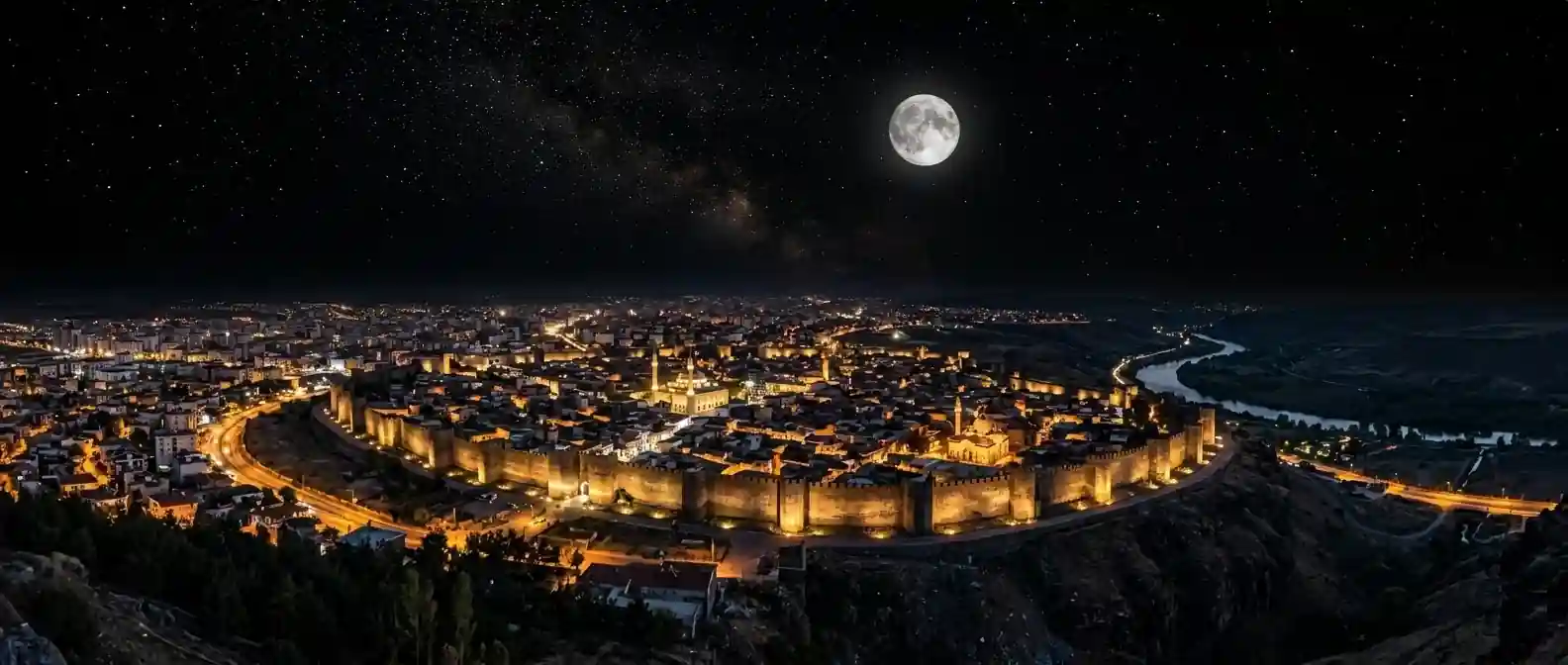
☽ Best Places to View the Moon in Diyarbakır, Turkey
Diyarbakır combines historic basalt architecture with the Dicle (Tigris) River valley, Hevsel Gardens and elevated viewpoints. The Diyarbakır Fortress and Hevsel Gardens Cultural Landscape is a UNESCO World Heritage property, and the relationship between the fortress, gardens and river creates some of the city's most distinctive landscape views. Fiskaya Social Facilities provide an elevated viewpoint toward the Dicle Valley and Hevsel Gardens, while Gazi Köşkü occupies an elevated position near the Dicle Bridge area. The historic Diyarbakır Walls, İçkale and On Gözlü Köprü provide additional architectural and riverside foregrounds, and Zerzevan Castle, outside the city, is a known sky-watching site. The Moon rises in the east and sets in the west, and the Dicle Valley and the Hevsel Gardens lie east and south-east of the walled city, so from viewpoints facing the river a rising Moon can come up over the valley. The Moon's exact rise time, altitude and direction depend on the date and observing position, so check those details before planning a specific composition.
Fiskaya Seyir Alanı
Fiskaya Social Facilities are one of Diyarbakır's established scenic viewpoints. The municipality renovated the facility and reopened it in June 2025, describing the site as a place to view the Dicle Valley, Fiskaya Waterfall and Hevsel Gardens. The renewed complex includes a viewing terrace and glass terrace. The municipality currently lists the social facilities as open from 09:00 to 23:00, making this the clearest officially documented late-evening viewing option in this group. The viewing terrace itself is described as free.
Gazi Köşkü
Gazi Köşkü, also known as Samanoğlu Köşkü, is a historic 15th-century building on the western slope of the Dicle Bridge area outside Mardin Gate. The official Culture Portal places it in Köşkler Mahallesi on the Eski Mardin Yolu. Its elevated setting provides views toward the Dicle River and the surrounding river landscape. Treat the historic building and its facilities separately from the surrounding viewpoint: published visitor information for the site does not establish unrestricted all-night access.
Diyarbakır Surları & İçkale
Diyarbakır's historic city walls are among the city's defining landmarks and form a major component of the UNESCO-listed cultural landscape. The massive basalt fortifications, towers and gates provide dramatic architectural foregrounds for Moon photography, and İçkale, the inner-citadel area with the archaeological and museum complex, connects visually with the walls and the wider landscape. Walls that face the Dicle Valley look east and south-east, toward where the Moon rises. Some mapped portions are accessible to visitors, and the museum complex has defined visitor hours, so access to individual wall sections, towers and restored areas should not be assumed to be unrestricted after dark.
Hevsel Bahçeleri
Hevsel Gardens form the cultivated riverine landscape between Diyarbakır's historic fortress and the Dicle River. They are an integral part of the UNESCO-listed cultural landscape. From suitable surrounding viewpoints, the gardens provide a broad natural foreground beneath the Moon. Because Hevsel is a protected cultural landscape rather than a conventional nighttime attraction, use appropriate public access routes and respect current conservation arrangements.
On Gözlü Köprü & Dicle
On Gözlü Köprü, also known as Dicle Köprüsü, is the historic multi-arched bridge over the Dicle River south of the historic city. Its stone arches and river setting make a distinctive foreground for lunar photography. Current municipal reporting has highlighted both conservation concerns and flood risks around the Dicle River and the area surrounding On Gözlü Köprü. It should therefore be treated as a scenic location with changing riverside conditions rather than an unrestricted nighttime recreation area.
Zerzevan Castle — Sky-Watching Site Outside the City
Zerzevan Castle, in the Çınar area outside the city, is a 3,000-year-old site with a Mithras temple, placed on UNESCO's Tentative List in 2020 and described by TÜBİTAK as one of the best places in Turkey for sky-watching. It has hosted the Diyarbakır Zerzevan Gökyüzü Gözlem Etkinliği, a multi-day sky-observation event backed by TÜBİTAK, the Diyarbakır Governorship and the Metropolitan Municipality, with telescope observations, workshops and talks, and more than a thousand people attended the June 2022 edition. This is the best chance near Diyarbakır to see the Moon through a telescope. It is an archaeological site and a scheduled event, not a nightly service, so check for current editions and access.
◉ Best Times for Moon Photography
📷 Quick Photography Tips
🕐 Timezone: Diyarbakır uses Turkey Time (TRT), UTC+3 year-round. Türkiye has used a single permanent time zone since September 2016 and does not use seasonal daylight-saving clock changes. For Moonrise photography, use the local date and time for Diyarbakır and check the Moon's exact azimuth and altitude for the specific viewpoint you plan to use.
🔭 Telescope Option: There is no regular public telescope night widely advertised in the city. The Diyarbakır Zerzevan Gökyüzü Gözlem Etkinliği, held at Zerzevan Castle outside Diyarbakır, offers telescope observations, workshops and talks on set dates. Check for current editions.
The moon phase today in Diyarbakır is shown in detail above — complete with exact illumination percentage, moonrise/set times, and the best local spots to see it. For the moon phase today in any other city worldwide, visit our Dynamic Moon Phase Calculator on the home page.
◐ What the Experience Actually Feels Like
Fiskaya provides one of Diyarbakır's clearest elevated views toward the Dicle Valley and Hevsel Gardens. The Metropolitan Municipality renovated the social facilities and reopened them in June 2025, describing the site as a scenic viewing area for the Dicle Valley, Fiskaya Waterfall and Hevsel Gardens. The renewed complex includes a viewing terrace and glass terrace, and the municipality lists the facility as open from 09:00 to 23:00.
Gazi Köşkü provides a different perspective over the river landscape. The official Culture Portal identifies it as the historic Samanoğlu Köşkü on the western slope of the Dicle Bridge area outside Mardin Gate. Its elevated location makes the surrounding Dicle landscape useful for Moon-and-landmark compositions, but the historic site's visitor arrangements should be checked separately from the broader surrounding area.
The city walls and İçkale bring the Moon into a much more architectural setting. Diyarbakır's basalt fortifications are a major part of the UNESCO-listed cultural landscape, while İçkale contains the archaeological and museum complex. These are heritage areas rather than dedicated astronomical facilities, so photographers should use permitted visitor areas and follow current opening and access arrangements.
Around Hevsel and On Gözlü Köprü, the scenery becomes more natural. The Dicle River, cultivated gardens and historic bridge form a landscape closely associated with Diyarbakır's identity. Recent municipal reporting has also documented flooding and concerns about development around the river corridor and On Gözlü Köprü, so conditions near the water can change and visitors should remain in appropriate public areas.
Away from the city lights, Zerzevan Castle offers the deepest sky. On the nights of its sky-watching events, telescopes are set up around the ruins, and visitors look at the Moon, planets and stars beside a Roman-era fortress.
"Diyarbakır's Moon-viewing experience combines monumental basalt walls, an ancient cultivated river landscape and elevated viewpoints overlooking the Dicle Valley."
✓ Your Diyarbakır Moon Chase Checklist
Before You Go
- Check the Moon's rise time, altitude and azimuth for your date and exact Diyarbakır viewpoint — the Moon's direction changes substantially from date to date
- If you're planning a landmark photograph, use PhotoPills or Stellarium to determine whether the Moon will align with the walls, Dicle Valley, Hevsel Gardens or bridge
- Verify Site Access: do not assume that historic monuments, museum areas, Hevsel access points or riverside locations remain open throughout the night
- Fiskaya Social Facilities currently list hours of 09:00–23:00. Check the municipality for any temporary changes before a late visit.
- Check cloud cover and horizon visibility, particularly when planning a low Moonrise
- Allow extra time if combining several locations, since the best viewpoints are spread across different parts of the city and river landscape, and check for Zerzevan Castle sky-watching dates if you want a telescope
What to Bring
- A telephoto lens — 200mm or longer can be useful when you want the Moon to appear relatively large beside a distant Diyarbakır landmark
- A sturdy tripod for landscape compositions, particularly when combining a darker foreground with the bright lunar disc
- A remote shutter release or 2-second timer to reduce camera shake during tripod shots
- A small flashlight for safely navigating permitted paths after sunset, while avoiding unnecessary bright light around other visitors
- A backup viewing location in case clouds, access arrangements or changing conditions interfere with the original composition
On the Night
- Arrive early for a planned Moonrise composition so you can establish your foreground, camera position and framing before the Moon appears
- If autofocus struggles in low light, switch to manual focus and focus carefully on the Moon's edge or another distant subject
- Bracket exposures when you want both the bright lunar disc and the much darker walls, river or landscape to remain visible
- If the Moon appears soft or hazy at the horizon, consider waiting until it rises higher, when the longer atmospheric path is reduced
- Respect current conservation, visitor and access rules around the UNESCO cultural landscape, Hevsel Gardens and Dicle River corridor
Use the tools on this page, check the current site access information, pick your vantage point, and catch a Diyarbakır moonrise for yourself.
? Diyarbakır Moon Phase — Frequently Asked Questions
Q. What is the moon phase today in Diyarbakır?
The moon phase today in Diyarbakır is a Last Quarter with 45% illumination. The next full moon is in 23 days, on 26 Oct. Moonrise is at — and moonset at 2:34 PM.
Q. Where is the best place to view the moon in Diyarbakır?
Diyarbakır's best moon settings are around its basalt walls and the Dicle (Tigris) valley, which are part of the UNESCO-listed Diyarbakır Fortress and Hevsel Gardens Cultural Landscape. The Fiskaya viewing terrace looks over the Dicle Valley and the Hevsel Gardens and, after its renovation, is listed as open until 11pm. Gazi Köşkü, a historic kiosk on the slope near the Dicle Bridge, looks over the river, and the city walls and İçkale give dramatic basalt foregrounds. The ten-arched On Gözlü Köprü crosses the Dicle south of the old city. Outside the city, Zerzevan Castle is known as a sky-watching site.
Q. Can I look at the moon through a telescope in Diyarbakır?
At scheduled events. Zerzevan Castle, a 3,000-year-old site with a Mithras temple in the Çınar area outside the city, is listed among the best places in Turkey for sky-watching, and it has hosted the Diyarbakır Zerzevan Gökyüzü Gözlem Etkinliği, a multi-day sky-observation event backed by TÜBİTAK, the Diyarbakır Governorship and the Metropolitan Municipality, with telescope observations, workshops and talks. The June 2022 edition drew more than a thousand people. A regular public telescope night in the city is not widely advertised, so check for current editions and dates, since observing depends on the weather.
Q. Where does the moon rise and set in Diyarbakır, and how high does it climb?
At about 37.9°N, Diyarbakır's moonrise and moonset points swing widely across the horizon each month, from roughly east-north-east to east-south-east for rising and west-north-west to west-south-west for setting, with an even wider swing in years near a major lunar standstill. A full moon near the winter solstice climbs to roughly 75° in the south, while a full moon near the summer solstice stays lower, peaking near 29°. The Dicle Valley and the Hevsel Gardens lie east and south-east of the walled city, so from the walls and viewpoints facing the river a rising moon can come up over the valley. Check the azimuth for your date and exact spot.
Q. Is light pollution a problem for moon observing in Diyarbakır?
The moon is bright enough to observe and photograph from almost anywhere in Diyarbakır, so light pollution rarely limits the lunar disc itself. It does wash out earthshine on a thin crescent and any faint sky detail. Diyarbakır is a large city, and the lit walls add to the glow, so stars are faint in and around the old city. For dark skies, the usual choice is to go outside the city, as the Zerzevan Castle sky-watching events do.
Q. What camera settings and phases work best for moon photography in Diyarbakır?
For a full moon, start with Looney 11 (f/11, ISO 100, 1/100 s) and refine using your histogram, since it is a baseline rather than a guarantee. The moon is much brighter than the walls, the river and the gardens, so shoot RAW and bracket or blend exposures to keep both crater detail and the foreground. The best composition may come a day or two before or after the exact full moon. For a moon-and-landmark shot, move farther back and use a longer focal length of 200 mm or more, with a sturdy tripod where allowed and manual focus on the moon's edge using magnified live view. The moon illusion makes a low moon look huge, but it is perceptual, not a change in size.
Q. How do heat, dust and haze affect moon viewing in Diyarbakır?
Diyarbakır has hot, dry summers and cold winters, so evenings can be warm in summer and cold in winter. Haze, dust and other atmospheric effects near the horizon can reduce contrast and make a low moon look soft, so check cloud cover and visibility before you leave. Conditions beside the Dicle can change quickly after heavy rain, so stay in public areas near the river.
Q. What time zone are Diyarbakır's moonrise and moonset times shown in?
Diyarbakır runs on Turkey Time, UTC+3, all year. Turkey has used a single permanent time zone since September 2016 and does not change its clocks. Moonrise and moonset times on this page follow the local clock. Diyarbakır lies at about 40.2°E, west of the 45°E meridian on which UTC+3 is based, so the sun and moon cross the sky about 19 minutes later on the clock than they would on that meridian.
Q. Can I shoot the moon at Diyarbakır's viewpoints after dark?
Only at some of them. The municipality lists the Fiskaya Social Facilities as open from 09:00 to 23:00, and the viewing terrace is described as free, so it is the clearest late-evening option. Gazi Köşkü, the city walls, İçkale and the Hevsel Gardens are heritage areas, and published visitor information does not establish all-night access, so use permitted areas and check current hours. The area around On Gözlü Köprü has had flooding and conservation concerns, so treat the riverside as changeable. Zerzevan Castle is an archaeological site, so check access before visiting.
✦ Explore Further
Moon Phase Today: Şanlıurfa
Check tonight's moon phase in Şanlıurfa, roughly 150 km south-west of Diyarbakır in Upper Mesopotamia.
🏙Moon Phase Today: Gaziantep
See the moon over Gaziantep, roughly 265 km west-south-west of Diyarbakır in south-eastern Turkey.
🌍World Moon Phase Directory
Find the moon phase, rise and set times for cities in every region of the world.
Blue Hour Calculator
Work out when blue hour falls, ideal for waxing gibbous shots over the Dicle Valley.