
Moon Phase Today Balıkesir
On Sunday, October 4, 2026, the moon in Balikesir is a Last Quarter with 45% illumination. Moon age: 22.6 days.
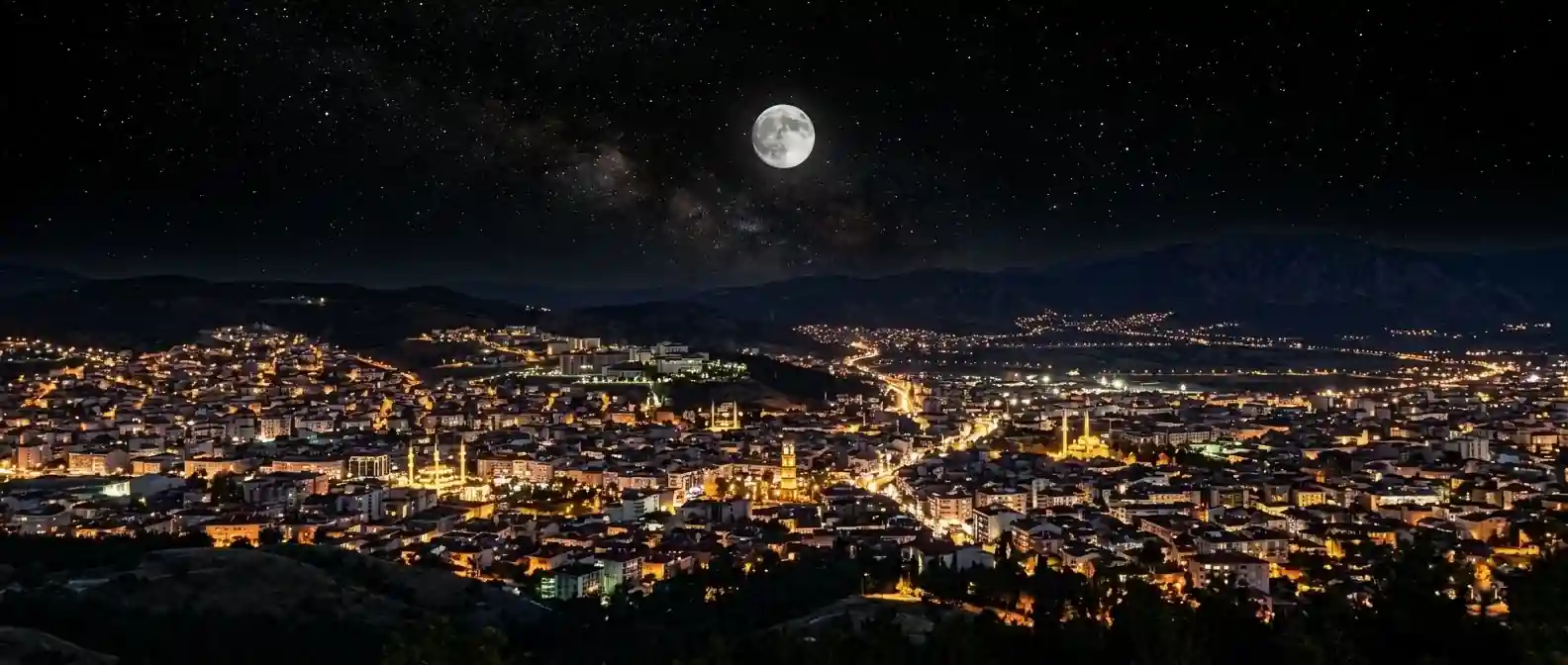
☽ Best Places to View the Moon in Balıkesir, Turkey
Balıkesir sits where the Marmara and the Aegean meet, with coastlines on both seas backed by forested mountains inland. Low plains and long beaches give you broad sea horizons, while high ridges around the Edremit area offer elevation above haze, and a rural plateau in Sındırgı has hosted a sky-watching festival with telescopes. The Moon rises in the east and sets in the west. The Aegean lies to the west of Ayvalık and Cunda, so a setting Moon can drop over the water there, while at Edremit and Altınoluk the mountain rises to the north, where the Moon never rises or sets. Exact Moonrise and Moonset directions change with the date and your observing position, so check both before planning a specific composition.
Kaz Dağı (Mount Ida) – 1,774 m at Karataş Tepe
Kazdağı reaches 1,774 m at Karataş Tepe, the highest point of the Kazdağı massif and of the Biga Peninsula. The mountain lies in the southern Biga Peninsula, in the transition between the Marmara and Aegean parts of western Turkey, with rich forests and longstanding mythology. Use accessible high-elevation viewpoints, and check current national park access rules before travelling.
Edremit & Altınoluk – Coastal Plain Below Kazdağı
A coastal plain backed by the steep Kazdağı. The coast faces south over the Gulf of Edremit, so the Moon crosses the sky above the water in front of you, while the mountain rises behind you to the north. Check the azimuth for your date, and check current park rules for the higher viewpoints.
Ayvalık & Cunda – Aegean Islands
Ayvalık lies on the northern Aegean coast, with Cunda (Alibey) Island the best known, and the province describes Ayvalık as having 22 islands. The coast faces west, the direction the Moon sets, so a setting Moon can drop over the sea and the islands, depending on the date. Coastal viewpoints give broad horizons depending on location and lunar azimuth.
Erdek & Kapıdağ Peninsula – Marmara Coast
Holiday towns along the southern shore of the Marmara Sea. The Kapıdağ Peninsula extends into the Marmara and offers broad horizons that can work when the Moon's azimuth falls over water, so check the azimuth for your date and spot.
Lake Kuş (Manyas) & Kuşcenneti National Park – Bird Lake
Lake Kuş, also known as Manyas Lake, lies within Bandırma and Manyas districts and extends about 20 km east to west and 14 km north to south. Kuşcenneti National Park was established in 1959, and the wetland is a listed Ramsar site and an important stopover, feeding and breeding area for birds on the migration paths between Europe and Asia. It is a protected wetland, so stay on paths and check access.
Sarıcaova Plateau, Sındırgı – Sky-Watching Festival Site
Sarıcaova plateau, in the rural Gözören neighbourhood of Sındırgı district, hosted the province's first Gökyüzü Gözlem Şenliği, a sky-observation festival that drew thousands of people, with leading astronomers taking part. Press reports describe the area as one of the darkest regions in Turkey, though no measured dark-sky designation is listed. It is a rural plateau with no lighting, so check for later festival dates and take care on the ground in the dark.
◉ Best Times for Moon Photography in Balıkesir
📷 Quick Tips for Balıkesir
🕐 Timezone: Balıkesir uses Turkey Time (TRT), UTC+3, year-round. Turkey has used a single permanent time zone since September 2016 and does not observe daylight saving. Europe/Istanbul zone.
🔭 Telescope Option: A regular public telescope night is not widely advertised in Balıkesir. The Sarıcaova plateau in Sındırgı hosted the province's first sky-observation festival, so check the district municipalities' announcements for later editions.
Access: Accessible viewpoints around Kazdağı and Edremit are subject to park rules. Lake Kuş lies within Bandırma and Manyas districts and Kuşcenneti National Park is a protected wetland. Ayvalık has 22 islands, and Erdek is reached by the Bandırma road.
The moon phase today in Balıkesir is shown above. For moon phase today anywhere else, visit the calculator on our home page.
◐ What It Feels Like
On the Aegean edge at Ayvalık and Cunda, olive groves and stone houses meet open water where evening light lingers, and a setting Moon can follow the sun down over the islands.
At Lake Kuş, reedbeds and quiet watchtowers overlook the migration paths between Europe and Asia.
Around Kazdağı, forested slopes rise behind the coastal plain, cooler and darker above the haze.
On the Sarıcaova plateau, far from the coast and its lights, thousands of people have gathered with telescopes on festival nights.
"Two seas at the edges, a quiet lake in between, and forested slopes and a dark plateau rising behind — wide horizons and cooler air above the plain."
✓ Checklist for Lunar Observers
Before You Go
- Check moonrise and moonset azimuth — it determines whether the Moon is over water
- Check MGM — coastal haze and mountain cloud
- Confirm access — park rules and wetland protections, and the dates of any sky-watching festival
What to Bring
- Telephoto and wide for sea and lake foregrounds
- Tripod for landscape and bracketing
- Lens cloth for sea spray
- Warm layers — substantially colder at high elevation
On the Night
- Manual focus on the lunar limb
- Bracket for the disc and the foreground
- Stay on paths — the national parks and wetlands are protected
- Treat the higher ground as better skies, not dark-sky sites
? Balıkesir Moon Phase — Frequently Asked Questions
Q. What is the moon phase today in Balıkesir?
The moon phase today in Balıkesir is a Last Quarter with 45% illumination. The next full moon is in 23 days, on 26 Oct. Moonrise is at — and moonset at 3:31 PM.
Q. Where is the best place to view the moon in Balıkesir?
Balıkesir has coastlines on both the Sea of Marmara and the Aegean, backed by forested mountains inland. Ayvalık and Cunda Island on the northern Aegean coast face west over the sea and its islands, so a setting moon can drop over the water, and Erdek and the Kapıdağ Peninsula lie on the Marmara coast. Edremit and Altınoluk sit on a coastal plain below Kazdağı (Mount Ida), which reaches 1,774 m at Karataş Tepe. Lake Kuş (Manyas) is a large wetland with open horizons, and Sarıcaova plateau in Sındırgı is a rural site that press reports call one of the darkest areas in Turkey.
Q. Can I look at the moon through a telescope in Balıkesir?
At events. Sarıcaova plateau, in the Gözören neighbourhood of Sındırgı, hosted the province's first Gökyüzü Gözlem Şenliği, a sky-observation festival that drew thousands of people, with leading astronomers taking part. A regular public telescope night is not widely advertised elsewhere in the province, so check the district municipalities' announcements for later editions, since observing depends on the weather.
Q. Where does the moon rise and set in Balıkesir, and how high does it climb?
At about 39.6°N, Balıkesir's moonrise and moonset points swing widely across the horizon each month, from roughly east-north-east to east-south-east for rising and west-north-west to west-south-west for setting, with an even wider swing in years near a major lunar standstill. A full moon near the winter solstice climbs to roughly 74° in the south, while a full moon near the summer solstice stays lower, peaking near 27°. The Aegean lies to the west of Ayvalık and Cunda, the direction the moon sets, so a setting moon, mostly a waning moon in the morning or a crescent in the evening, can drop over the water there. At Edremit and Altınoluk, Kazdağı rises to the north, where the moon never rises or sets. Check the azimuth for your date and exact spot.
Q. Is light pollution a problem for moon observing in Balıkesir?
The moon is bright enough to observe and photograph from almost anywhere in Balıkesir, so light pollution rarely limits the lunar disc itself. It does wash out earthshine on a thin crescent and any faint sky detail. The coastal towns and the cities of Balıkesir and Bandırma are lit, so stars are fainter there. The rural uplands, such as Sarıcaova in Sındırgı and the Kazdağı slopes, are darker, though no measured dark-sky designation is listed for them, so treat them as better, not dark.
Q. What camera settings and phases work best for moon photography in Balıkesir?
For a full moon, start with Looney 11 (f/11, ISO 100, 1/100 s) and refine using your histogram, since it is a baseline rather than a guarantee. The moon is much brighter than the sea, the lake and the forest, so shoot RAW and bracket by two to three stops to keep both crater detail and the foreground. A waxing gibbous suits blue hour at Ayvalık and Erdek while the foreground is still lit. A telephoto of about 200 to 400 mm can isolate the moon against Cunda's rooftops, fishing boats or Kapıdağ's silhouette, with a tripod and manual focus on the moon's edge using magnified live view. Coastal haze and lake mist can change the exposure.
Q. How do coastal haze, wind and mountain cloud affect moon viewing in Balıkesir?
Balıkesir sits between two seas and a high mountain, so conditions can change quickly between the coast and the interior. Coastal haze and wind can affect the Marmara and Aegean shores, mist can form over Lake Kuş, and cloud can build on Kazdağı. Check the Turkish State Meteorological Service forecast for haze, wind and cloud before you go, and bring warm layers for the high ground, which is much colder than the coast.
Q. What time zone are Balıkesir's moonrise and moonset times shown in?
Balıkesir runs on Turkey Time, UTC+3, all year. Turkey has used a single permanent time zone since September 2016 and does not change its clocks. Moonrise and moonset times on this page follow the local clock. Balıkesir lies at about 27.9°E, well west of the 45°E meridian on which UTC+3 is based, so the sun and moon cross the sky about 68 minutes later on the clock than they would on that meridian.
Q. Can I shoot the moon at Balıkesir's viewpoints after dark?
Mostly, with care, but check each place. The beaches and harbours of Ayvalık, Erdek and Altınoluk are public, though local rules apply. Kuşcenneti National Park, on Lake Kuş, is a protected wetland, and Kazdağı National Park has its own rules, so stay on paths and check park access before travelling. Sarıcaova is a rural plateau with no lighting, so take care on the ground in the dark.
✦ Explore Further
Moon Phase Today: Bursa
Check tonight's moon phase in Bursa, roughly 115 km east-north-east of Balıkesir at the foot of Uludağ.
🏛Moon Phase Today: Manisa
See the moon over Manisa, roughly 120 km south-south-west of Balıkesir at the foot of Mount Spil.
🌍World Moon Phase Directory
Find the moon phase, rise and set times for cities in every region of the world.
Blue Hour Calculator
Work out when blue hour falls, ideal for waxing gibbous shots over the Aegean.