
Moon Phase Today Bursa
On Sunday, October 4, 2026, the moon in Bursa is a Last Quarter with 45% illumination. Moon age: 22.6 days.
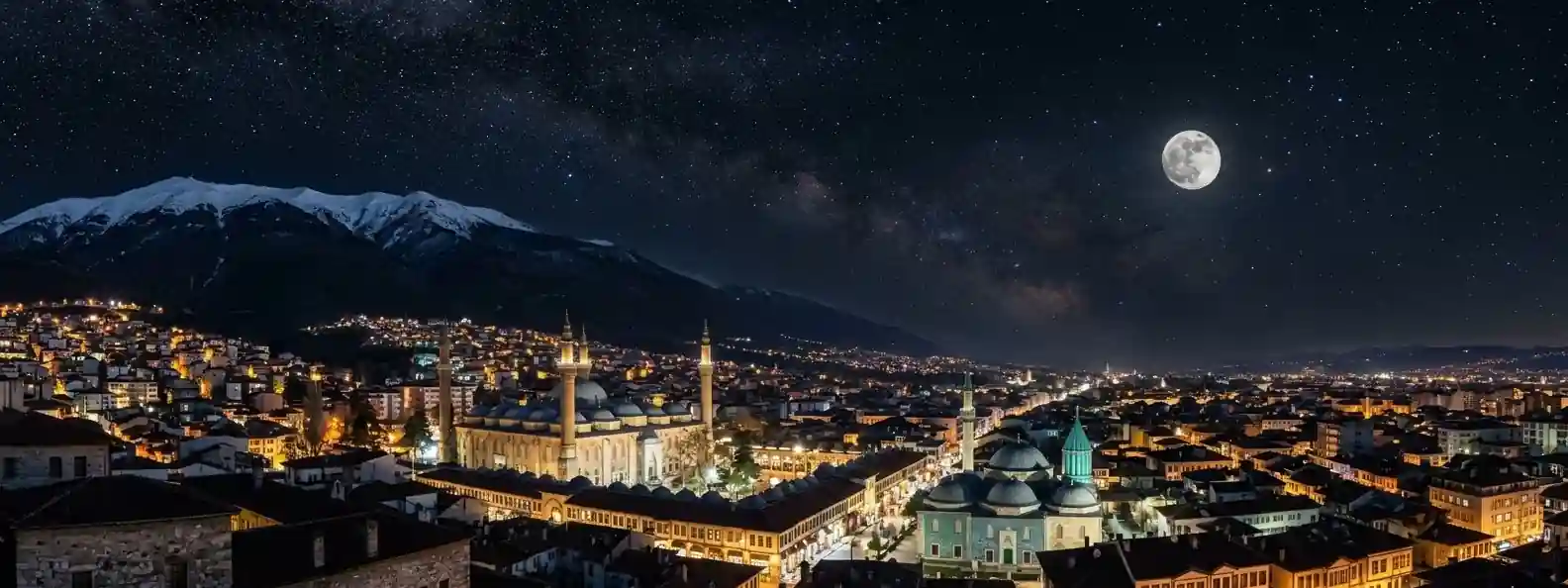
☽ Best Places to View the Moon in Bursa, Turkey
Bursa sits at the foot of Uludağ, the Marmara Region's highest mountain, with two large lakes and the Sea of Marmara within reach. Low neighbourhoods and lakeshores lie near the sea, and forested slopes and open alpine meadows rise just to the south and south-east of the city, so you get broad lake horizons and high, open sky in one province. The Moon rises in the east and sets in the west. Uludağ rises to the south and south-east of the city, so a Moon rising toward east-south-east can be hidden behind the mountain, while Lake Uluabat lies to the west, so from Gölyazı a setting Moon can drop over the lake. The Bursa area also hosts real sky-watching events with telescopes. Exact Moonrise and Moonset directions change with the date and your observing position, so check both before planning a specific composition.
Uludağ & Kirazlı Yaylası – 2,543 m and a Sky-Watching Site
Uludağ is the Marmara Region's highest mountain at 2,543 m, and was declared a national park on 20 September 1961. Habitats range from maquis on the lower slopes through deciduous woodland and beech and fir forest to alpine meadows. The 26th TÜBİTAK Sky Observation Event was held at Kirazlı Yaylası on the slopes of Uludağ from 9 to 11 August 2024, at a site chosen after air and light pollution studies, and Saturn, Jupiter, Mars, Uranus and the Moon were observed through telescopes. The high ground is cold and often cloudy, so check conditions and park rules.
Bursa Science and Technology Center – Planetarium and Telescopes
Bursa Metropolitan Municipality's Science and Technology Center has a planetarium, and it has hosted a sky-watching festival at Hüdavendigar City Park, where visitors looked at the Moon, Saturn, Venus, Jupiter and Mars through professional telescopes. It is the easiest place in the city to see the Moon through a telescope, though these are scheduled events, not nightly, so check current dates.
Gölyazı & Lake Uluabat – Peninsula Village on a Shallow Lake
Gölyazı is a neighbourhood in Nilüfer district on a peninsula extending into Lake Uluabat on its eastern shore, according to official Bursa tourism material, about 41 km from central Bursa. The ancient settlement dates back to the 6th century BCE, and it is a popular photography and sunset location and a small fishing village. The lake, a large, shallow freshwater lake of roughly 135 to 160 km² depending on the water level, lies to the west, so a setting Moon can drop over the water.
Lake İznik – Long East-West Lake
Lake İznik is a large freshwater lake in Bursa province, about 32 km long and 10 km wide, with the town of İznik at its eastern end. The long east-west axis suits lunar photography: from İznik, looking west along the lake, a setting Moon can follow the water, and from the western end a rising Moon can come up over the lake toward the town. It is an important wetland, so check park and wetland rules.
Cumalıkızık & Saitabat – Foothill Heritage
Cumalıkızık is an Ottoman village, the rural component of Bursa and Cumalıkızık: The Birth of the Ottoman Empire, inscribed as a UNESCO World Heritage Site in 2014. Saitabat lies on Uludağ's northern slopes. Both are generally less urbanised than central Bursa, although lighting varies by location, and Cumalıkızık is a living village, so be considerate of residents.
Mudanya & Tirilye – Marmara Coast
Coastal towns north of Bursa on the Sea of Marmara, with open horizons over the sea. The coast faces roughly north, so the Moon rises over the water only when it rises north of due east, and sets over the water only when it sets north of due west, so check the azimuth for your date to confirm the Moon is actually over water.
◉ Best Times for Moon Photography in Bursa
📷 Quick Tips for Bursa
🕐 Timezone: Bursa uses Turkey Time (TRT), UTC+3, year-round. Turkey has used a single permanent time zone since September 2016 and does not observe daylight saving. Europe/Istanbul zone.
🔭 Telescope Options: Bursa Metropolitan Municipality's Science and Technology Center has a planetarium and has held sky-watching festivals with professional telescopes, and Uludağ's Kirazlı Yaylası hosted the 26th TÜBİTAK Sky Observation Event in August 2024. Check each organiser's announcements for dates.
Access: Uludağ National Park is south of Bursa, reached by road, with a cable car listed from the city to the Sarıalan plateau. Gölyazı is in Nilüfer district, İznik is east of the city, and Mudanya is on the coast to the north. Check park and wetland rules.
The moon phase today in Bursa is shown above. For moon phase today anywhere else, visit the calculator on our home page.
◐ What It Feels Like
At Gölyazı, on a peninsula extending into Lake Uluabat, the lake opens around the village, with islands and traditional fishing boats, and the Moon can set over the water.
At Lake İznik, the town lies at the eastern end of a long lake, with a long east-west sightline along the water for a Moonrise or Moonset.
On Uludağ, the habitats change from maquis to alpine meadows, with open high ground above the forest and the city below when cloud allows, and on an event night, telescopes and tents fill the meadow at Kirazlı Yaylası.
"From a peninsula village on Lake Uluabat to Uludağ at 2,543 m just south of town — lake reflections, alpine meadows and telescopes on event nights."
✓ Checklist for Lunar Observers
Before You Go
- Check moonrise and moonset azimuth for your date — it varies with the Moon's declination, and decides whether the Moon is over water or behind Uludağ
- Check the MGM forecast — mountain cloud and lake haze
- Confirm access: Uludağ National Park and its cable car, the Gölyazı peninsula, Lake İznik and the wetlands
- Check the Science and Technology Center's dates if you want a telescope
What to Bring
- Telephoto 200 mm or longer, and a wide lens for lake and village foregrounds
- Tripod for landscapes and bracketing — a close-up Moon can be shot handheld with a fast shutter
- Lens cloth for lake mist
- Warm layers — it is much colder on Uludağ than in Bursa
On the Night
- Manual focus on the lunar limb or a distant light
- Bracket for the disc and the lake and forest foreground
- Stay on paths — the national park and wetlands are protected
- Treat the higher ground as better skies, not dark-sky sites
? Bursa Moon Phase — Frequently Asked Questions
Q. What is the moon phase today in Bursa?
The moon phase today in Bursa is a Last Quarter with 45% illumination. The next full moon is in 23 days, on 26 Oct. Moonrise is at — and moonset at 3:28 PM.
Q. Where is the best place to view the moon in Bursa?
Bursa sits at the foot of Uludağ, the Marmara Region's highest mountain at 2,543 m, with two large lakes nearby. Uludağ National Park, declared in 1961, rises to the south and south-east of the city and is reached by road or cable car. Gölyazı, an old fishing village on a peninsula in Lake Uluabat to the west of the city, is a popular photography and sunset spot, and Lake İznik to the east is about 32 km long, with the town of İznik at its eastern end. The village of Cumalıkızık, part of the UNESCO-listed Bursa and Cumalıkızık site, sits on the foothills, and Mudanya and Tirilye are on the Marmara coast.
Q. Can I look at the moon through a telescope in Bursa?
Yes, at events. Bursa Metropolitan Municipality's Science and Technology Center, which has a planetarium, has held a sky-watching festival at Hüdavendigar City Park, where visitors looked at the Moon, Saturn, Venus, Jupiter and Mars through professional telescopes. On Uludağ, the 26th TÜBİTAK Sky Observation Event was held at Kirazlı Yaylası from 9 to 11 August 2024, at a site chosen after studies of air and light pollution, with the Moon, Saturn, Jupiter, Mars and Uranus observed through telescopes. Check the municipality's and TÜBİTAK's announcements for current dates, since observing depends on the weather.
Q. Where does the moon rise and set in Bursa, and how high does it climb?
At about 40.2°N, Bursa's moonrise and moonset points swing widely across the horizon each month, from roughly east-north-east to east-south-east for rising and west-north-west to west-south-west for setting, with an even wider swing in years near a major lunar standstill. A full moon near the winter solstice climbs to roughly 73° in the south, while a full moon near the summer solstice stays lower, peaking near 26°. Uludağ rises to the south and south-east of the city, so a moon rising toward east-south-east can be hidden behind the mountain, while Lake Uluabat lies to the west, so from Gölyazı a setting moon can drop over the lake. Check the azimuth for your date and exact spot.
Q. Is light pollution a problem for moon observing in Bursa?
The moon is bright enough to observe and photograph from almost anywhere in Bursa, so light pollution rarely limits the lunar disc itself. It does wash out earthshine on a thin crescent and any faint sky detail. Bursa is a large city, so stars are faint in and around it. The high ground of Uludağ is darker, and TÜBİTAK chose Kirazlı Yaylası for its sky-watching event after studies of air and light pollution, though no dark-sky designation is listed for the area.
Q. What camera settings and phases work best for moon photography in Bursa?
For a full moon, start with Looney 11 (f/11, ISO 100, 1/100 s) and refine using your histogram, since it is a baseline rather than a guarantee. The moon is much brighter than the lakes and the forest, so shoot RAW and bracket or blend exposures to keep both crater detail and the foreground, and adjust for lake reflection and haze. A waxing gibbous suits blue hour at Gölyazı and the Uludağ foothills while the foreground is still lit. For close-ups the moon is bright enough to shoot handheld with a fast shutter, while a tripod suits landscapes, and a longer lens can isolate the moon against islands, boats or village roofs. Focus manually on the moon's edge or a distant light.
Q. How do mountain cloud, lake mist and cold affect moon viewing in Bursa?
Uludağ makes its own weather, with mountain cloud and fog, and its high elevations are much colder than Bursa, with snow in winter. Mist can form over the lakes and the Marmara coast, and haze can soften a low moon. Check the Turkish State Meteorological Service forecast for coastal haze, wind, cloud and mountain weather shortly before you go, and bring warm layers for Uludağ.
Q. What time zone are Bursa's moonrise and moonset times shown in?
Bursa runs on Turkey Time, UTC+3, all year. Turkey has used a single permanent time zone since September 2016 and does not change its clocks. Moonrise and moonset times on this page follow the local clock. Bursa lies at about 29.1°E, well west of the 45°E meridian on which UTC+3 is based, so the sun and moon cross the sky about 64 minutes later on the clock than they would on that meridian.
Q. Can I shoot the moon at Bursa's viewpoints after dark?
Mostly, with care, but check each place. Uludağ is a national park, so follow its rules, check the cable car's operating hours and the road conditions, and take care on the mountain after dark. Gölyazı and the lake shores are public, though the wetlands are protected, so stay on paths. Cumalıkızık is a living village and UNESCO site, so be considerate of residents, and check local conditions along the Marmara coast.
✦ Explore Further
Moon Phase Today: Istanbul
Check tonight's moon phase in Istanbul, roughly 90 km north of Bursa across the Sea of Marmara.
🌊Moon Phase Today: Kocaeli
See the moon over Kocaeli, roughly 100 km north-east of Bursa around the İzmit Gulf.
🌍World Moon Phase Directory
Find the moon phase, rise and set times for cities in every region of the world.
Blue Hour Calculator
Work out when blue hour falls, ideal for waxing gibbous shots over Lake Uluabat.