
Moon Phase Today Tijuana
On Sunday, October 4, 2026, the moon in Tijuana is a Waning Crescent with 34% illumination. Moon age: 23.7 days.
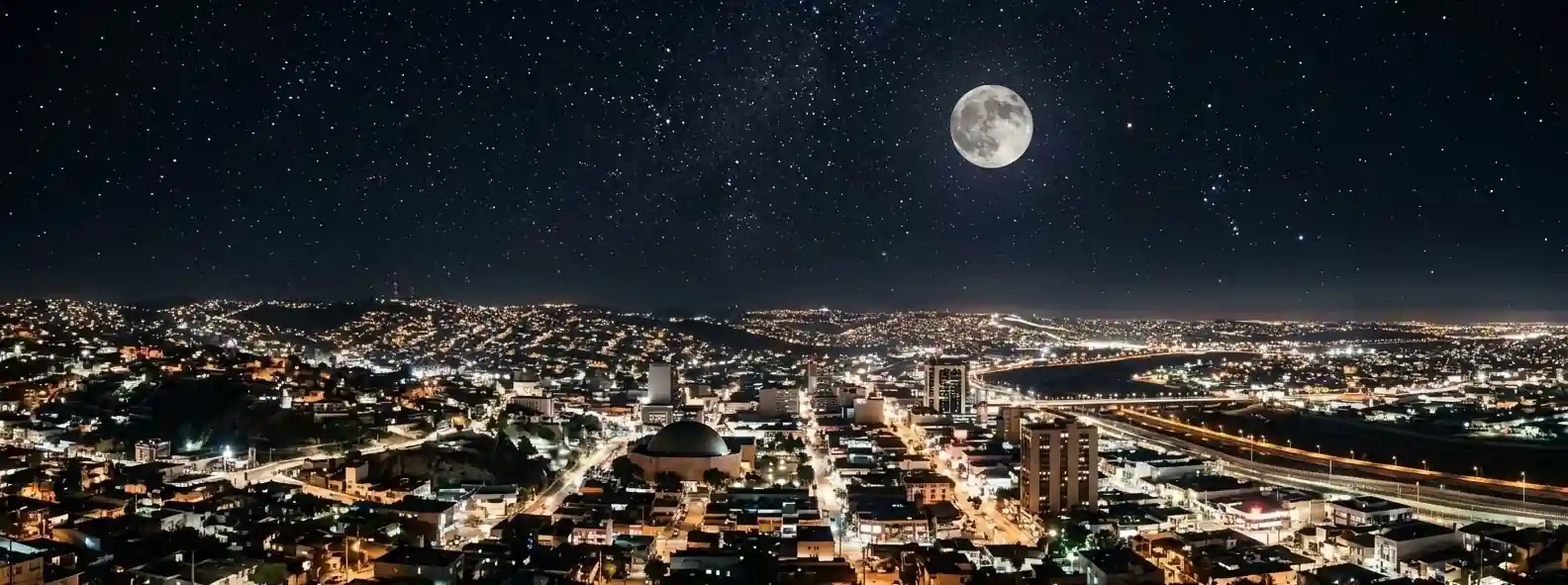
☽ Best Places to View the Moon in Tijuana, Mexico
Tijuana sits at roughly 32.53°N on Mexico's northwestern Pacific coast, right against the U.S. border, with around 1.9 million residents in the municipality — one of Mexico's westernmost major cities and, together with San Diego, part of one of the busiest binational metropolitan areas in the world. Founded in 1889, Tijuana's development has been deeply shaped by its position beside the U.S. border, growing from a small settlement into a major manufacturing and cultural hub, all while keeping a beach at its western edge where the coastline and the international border reach the Pacific. Between an iconic downtown arch, a spherical cultural centre, and that same stretch of coastline, Tijuana gives a genuinely distinctive set of places to watch the moon.
Arco Monumental (Tijuana Arch)
A tall, bright yellow steel arch marking the entrance to Avenida Revolución, illuminated at night and one of the most recognizable symbols of the city. It's an easy, central landmark to use as a foreground for a moonrise shot downtown.
Avenida Revolución
Tijuana's historic main tourist street, lined with bars, shops, and murals, running from the arch through the heart of downtown. It's the simplest option for an ordinary evening, with plenty of street life to go along with the view.
Playas de Tijuana
The city's Pacific coastline, where the international border reaches the ocean. Its open beach and boardwalk give an unobstructed sea view for a moonrise, quite different from the busier downtown streets.
Tijuana Cultural Center (CECUT)
A cultural complex in the Zona Río district, its distinctive spherical Omnimax theatre, known locally as "la bola," standing out against the skyline. It's worth checking current exhibition and showtime schedules if you want to combine a visit with your evening.
Tijuana Cathedral (Nuestra Señora de Guadalupe)
The city's main Catholic cathedral, near the historic downtown core, giving a quieter, more traditional stop than the busier tourist strip nearby.
Zona Río & Paseo de los Héroes
A modern district built up since the mid-20th century, its wide central boulevard lined with monumental statues and traffic circles (glorietas). It's an easy option for an ordinary evening walk with a more contemporary feel than the historic downtown.
◉ Best Times for Moon Photography
📷 Quick Photography Tips
Tijuana runs on Pacific Time (UTC-8, or UTC-7 during Daylight Saving Time). Unlike most of Mexico, Baja California follows the same U.S. Pacific Time daylight saving schedule as neighboring California, given the region's close economic and daily ties across the border.
For the moon phase in any other city worldwide, visit our Dynamic Moon Phase Calculator for instant lunar data tailored to wherever you are.
The moon phase today in Tijuana, Mexico is shown in detail above — complete with exact illumination percentage, moonrise/set times, and the best viewpoints to see it. For the moon phase today in any other city or location worldwide, visit our Dynamic Moon Phase Calculator on the home page.
◐ While Actually There
Tijuana's identity is bound up with its position more than almost any other city on this site. Its development has been deeply shaped by its place beside the U.S. border, and Playas de Tijuana makes that geography literal — walk far enough along the beach and you reach the point where the international boundary itself continues out into the ocean.
Even Tijuana's clocks reflect that relationship. While most of Mexico abolished seasonal clock changes in 2022, Baja California still shifts to daylight saving time each year on the same U.S. Pacific Time schedule as California just across the border, because so much of daily life here runs on both sides at once.
None of it requires much beyond checking CECUT's current schedule if you want to combine an exhibition with your visit. The Arco Monumental, Avenida Revolución, and the Zona Río are all straightforward for an ordinary evening without much advance planning.
"Tijuana's border doesn't stop at the edge of the city — it runs right out into the Pacific, past the beach where the coastline meets the ocean."
✓ Your Tijuana Moon Chase Checklist
Before You Go
- Check the moonrise time and phase on this page for each night of your stay
- Check current CECUT exhibition and showtime schedules if you want to combine the cultural centre with your visit
- Check current opening hours for Tijuana Cathedral if you want to go inside, not just view the exterior
- Check the forecast for coastal fog if visiting Playas de Tijuana in summer
- Check current border-crossing wait times if you're planning to cross from San Diego
What to Bring
- A light layer for winter evenings — generally mild, though ocean breezes can add a chill
- A tripod, useful at open spots like Playas de Tijuana
- Comfortable shoes for walking Avenida Revolución and the Zona Río
- A light layer for summer evenings, which stay warm well after sunset
- A cloth to wipe down camera gear after time near the coast
On the Night
- Arrive 20–30 minutes before moonrise at open spots like Playas de Tijuana
- Shoot RAW and bracket exposures, especially where the illuminated Arco Monumental mixes with moonlight
- Mind ocean wind and shifting sand at exposed beach spots
- Confirm current transport options if visiting Zona Río or the cultural centre in the evening
- Watch for coastal fog rolling in during summer evenings, which can obscure the sky with little warning
? Tijuana Moon Phase — Frequently Asked Questions
Q. What is the moon phase today in Tijuana?
The moon phase today in Tijuana is a Waning Crescent with 34% illumination. The next full moon is in 22 days, on Oct 25. Moonrise is at 12:18 AM and moonset at 3:08 PM.
Q. Where is the best place to view the moon in Tijuana?
Playas de Tijuana, where the coastline and the international border reach the Pacific, gives the most open sightline in the city, with a beach and boardwalk facing the ocean. Downtown, the illuminated Arco Monumental at the entrance to Avenida Revolución is an easy landmark to use as a foreground, and the spherical Omnimax theatre of the Tijuana Cultural Center (CECUT) in the Zona Río stands out against the skyline. Paseo de los Héroes in the Zona Río offers wide boulevards and glorietas for an evening walk, while Tijuana Cathedral is a quieter stop near the historic downtown core.
Q. Where does the moon rise and set in Tijuana, and how high does it climb?
At about 32.5°N, Tijuana's moonrise and moonset points swing across the horizon each month, from roughly northeast to southeast for rising and northwest to southwest for setting. A winter full moon culminates very high in the south, at roughly 80° above the horizon, while a summer full moon stays higher than in Europe, peaking near 34°. Tijuana's coastline faces west, so the Pacific lies in the direction of moonset, not moonrise: a waxing moon can set over the ocean in the evening, and a full moon sets over the water around sunrise. A rising moon appears in the east over the city, so it is best framed from downtown rather than from the beach. Check the azimuth for your date and exact spot.
Q. Is light pollution a problem for moon observing in Tijuana?
The moon is bright enough to observe and photograph from almost anywhere in Tijuana, so light pollution rarely limits the lunar disc itself. It does wash out earthshine on a thin crescent and any faint sky detail. Avenida Revolución, the illuminated arch, the Zona Río and the wider Tijuana–San Diego metropolitan area all carry substantial artificial lighting, so Tijuana is a light-polluted site rather than a dark-sky one. From the beach the ocean gives an unobstructed horizon, but the metropolitan glow still washes out faint sky detail.
Q. What camera settings and phases work best for moon photography in Tijuana?
For a full moon, start with Looney 11 (f/11, ISO 100, 1/100 s) and refine using your histogram, since it is a baseline rather than a guarantee. The moon is much brighter than the illuminated downtown foreground, so shoot RAW and bracket or blend exposures to keep both crater detail and the arch or skyline. A waxing crescent or first-quarter moon suits a low evening moonset over the Pacific from Playas de Tijuana, and a full moon rises around sunset over the city. A 200–400 mm lens helps isolate the moon against the ocean horizon or the skyline, with a tripod for bracketing and manual focus on the moon using magnified live view.
Q. How does coastal fog affect moon viewing in Tijuana?
Tijuana has warm, dry summers, but coastal fog can roll in near Playas de Tijuana and obscure the sky with little warning, particularly on summer evenings. Salt air and fog can also leave a film on lenses, so carry a cloth to wipe down equipment. Winters are generally mild, with freezing temperatures rare near the coast, though ocean breezes can add a chill. Check local forecasts for fog, cloud and wind before heading to the beach, and be ready to move inland if the coast clouds over.
Q. What time zone are Tijuana's moonrise and moonset times shown in?
Tijuana runs on Pacific Time, UTC-8, or UTC-7 during daylight saving time. Unlike most of Mexico, which abolished seasonal clock changes in 2022, Baja California still follows the same daylight saving schedule as California, so moonrise and moonset times shift with the seasons in the same way as in San Diego. Double-check your device's time zone if you are traveling from elsewhere in Mexico around a clock-change date.
Q. Can I shoot the moon at Tijuana's viewpoints after dark?
Access varies by site. CECUT keeps its own exhibition and showtime schedules, so check current times if you want to combine the cultural center with your evening. Check current opening hours for Tijuana Cathedral if you want to go inside rather than photograph the exterior. Playas de Tijuana, the Arco Monumental, Avenida Revolución and the Zona Río are open urban spaces with artificial lighting, so confirm transport options for evening visits, and check current border-crossing wait times if you are crossing from San Diego.
Q. Does this page work for cities besides Tijuana?
This page is set up specifically for Tijuana, Mexico. For the moon phase in any other city or location worldwide, use the Dynamic Moon Phase Calculator on the moonphase.today home page.
✦ Explore Further
Moon Phase Today: San Diego
Check tonight's moon phase in San Diego, just north of Tijuana across the border.
🌵Moon Phase Today: Mexicali
See the moon over Mexicali, east of Tijuana along the border.
🇲🇽Moon Phase in Mexico
Browse moon phase pages for cities across Mexico, from Mexico City to Cancún.
🌍World Moon Phase Directory
Find the moon phase, rise and set times for cities in every region of the world.
Eclipses
Check upcoming lunar and solar eclipses and whether they are visible from Baja California.