
Moon Phase Today Mexicali
On Sunday, October 4, 2026, the moon in Mexicali is a Waning Crescent with 34% illumination. Moon age: 23.7 days.
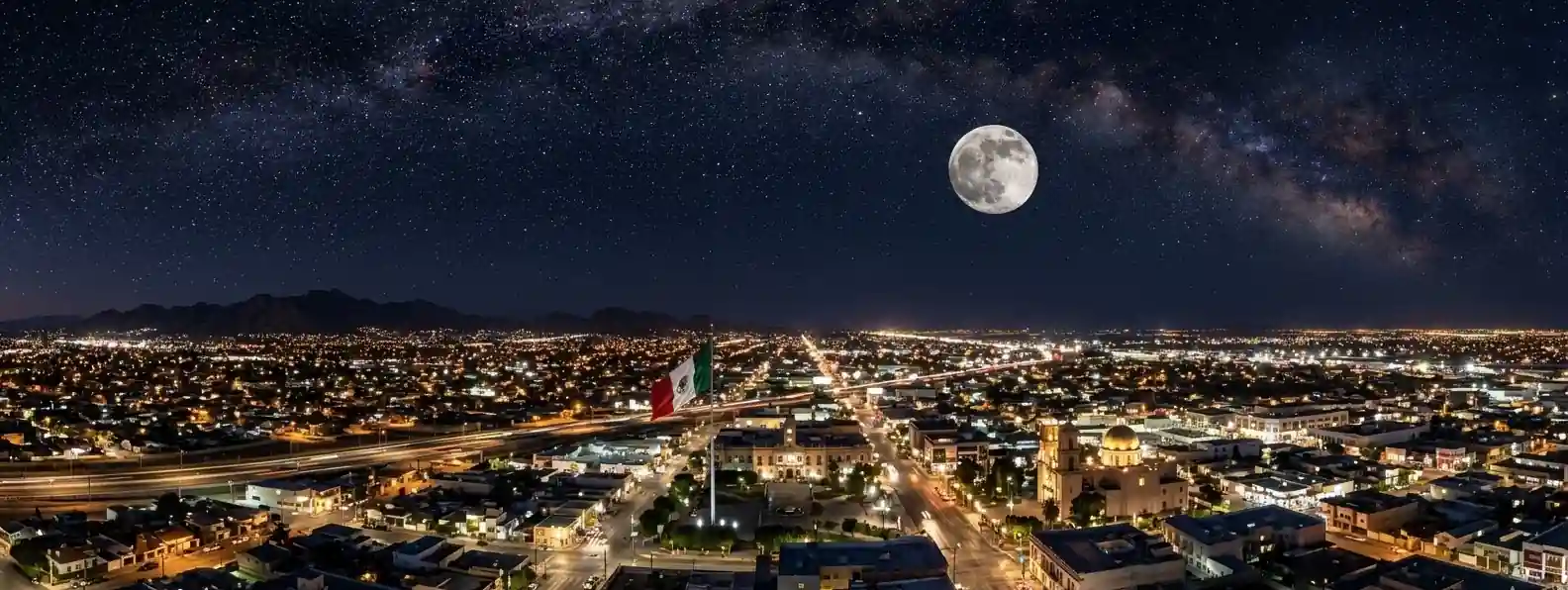
☽ Best Places to View the Moon in Mexicali, Mexico
Mexicali sits at roughly 32.63°N right against the US border in the Sonoran Desert, the capital of Baja California with just over a million residents. Founded in 1903, Mexicali is the only Mexican state capital that sits directly on the international border, and its extreme desert climate has earned it the nickname "the City that Captured the Sun." Between a neighbourhood often described as Mexico's largest Chinatown, a volcanic and geothermal complex nearby, and a cathedral with a genuinely unusual origin story, Mexicali gives a distinctive set of places to watch the moon.
La Chinesca
Often described as Mexico's largest Chinatown, its history tracing back to Chinese labourers who built the valley's irrigation system in the early 20th century and stayed on afterward. A network of underground basements and passages developed beneath the neighbourhood, partly providing relief from Mexicali's extreme summer heat, and later took on other uses — one of La Chinesca's most unusual historical features, even where individual passages are no longer accessible. It's a lively, central option for an evening walk.
Catedral de Nuestra Señora de Guadalupe
A church that began in 1918 and wasn't formally erected as a cathedral until 1966, giving Mexicali's central Catholic landmark nearly five decades between its beginnings and its elevation to cathedral status. Its plaza gives an easy, central stop for an evening near the heart of the city.
Cerro Prieto
A volcanic and geothermal complex about 30 kilometres southeast of central Mexicali, associated with the Cerro Prieto and Imperial fault systems and formed roughly 80,000 years ago during the Pleistocene. The area is now one of Mexico's major geothermal fields, with power-generation infrastructure spread across the surrounding desert — an unusual industrial-geological landmark to know about, though it's primarily an active facility rather than an open public viewpoint, so check current access before planning a visit.
Bosque de la Ciudad Park
One of Mexicali's main city parks, with open green space and shaded walking paths offering a break from the surrounding desert streets. It's a straightforward, easy option for an ordinary evening walk.
Museo Sol del Niño
An interactive science museum inaugurated in September 1998 inside the restored La Jabonera del Pacífico, a historic industrial building associated with cotton-seed storage and processing, with exhibits on physics, ecology, and technology plus an IMAX theatre. Check current opening hours if you want to combine an exhibition with your evening, since it keeps daytime hours.
Cañón de Guadalupe (a short trip further out)
A desert canyon southwest of the city known for natural hot springs, granite boulders, palm groves, and ancient rock art, actively promoted for its dark, low-light-pollution night skies. It's a further drive than anything else on this list, but a genuine option for a night-sky-focused visit away from the city's lights.
◉ Best Times for Moon Photography
📷 Quick Photography Tips
Mexicali runs on Pacific Time (UTC-8, or UTC-7 during Daylight Saving Time). Unlike most of Mexico, all of Baja California follows the same U.S. Pacific Time daylight saving schedule as neighboring California.
For the moon phase in any other city worldwide, visit our Dynamic Moon Phase Calculator for instant lunar data tailored to wherever you are.
The moon phase today in Mexicali, Mexico is shown in detail above — complete with exact illumination percentage, moonrise/set times, and the best viewpoints to see it. For the moon phase today in any other city or location worldwide, visit our Dynamic Moon Phase Calculator on the home page.
◐ While Actually There
Mexicali's identity was shaped by an unlikely combination of forces: an American irrigation company, thousands of Chinese labourers, and a stretch of desert most people would have considered unlivable. The Chinese workers who built the Mexicali Valley's canal system stayed on after the job was done, and the underground spaces beneath La Chinesca, developed partly to escape the brutal summer heat, remain one of the more surprising things to learn about a city most visitors know only as a border crossing.
Cerro Prieto tells a different but related story about turning a hostile environment into an asset. The same volcanic geology that makes this stretch of desert so extreme also underlies one of Mexico's major geothermal fields, a working industrial site rather than a casual visitor attraction, but a striking reminder of just how much geological energy sits beneath this part of the desert.
None of it requires much beyond checking the Museo Sol del Niño's hours if you want to combine it with your evening. La Chinesca, the cathedral, and Bosque de la Ciudad Park are all straightforward for an ordinary evening without much advance planning.
"Mexicali turned a hostile desert into a city by building canals and tunnels — and the same fault line that makes the ground shift here now generates power for the whole region."
✓ Your Mexicali Moon Chase Checklist
Before You Go
- Check the moonrise time and phase on this page for each night of your stay
- Check current opening hours for the Museo Sol del Niño if you want to combine it with your visit
- Check current opening hours for the cathedral if you want to go inside, not just view the exterior
- Check current access conditions before any visit near Cerro Prieto, since it's primarily an active geothermal facility
- Check the forecast for extreme heat if visiting between June and September
What to Bring
- Serious sun and heat protection for summer visits — Mexicali's desert heat is genuinely extreme
- A warm layer for winter nights, which can turn cold in the desert despite the generally mild season
- A tripod, useful at open spots like Bosque de la Ciudad Park and Cañón de Guadalupe
- Comfortable shoes for walking La Chinesca's streets
- Plenty of water regardless of season, given the desert climate
On the Night
- Arrive 20–30 minutes before moonrise at open spots like Bosque de la Ciudad Park or Cañón de Guadalupe
- Shoot RAW and bracket exposures, especially where La Chinesca's lit signage mixes with moonlight
- Confirm current transport and road conditions if visiting Cañón de Guadalupe in the evening, since it sits well outside the city
- Let camera gear cool down gradually after a hot summer day before shooting
- Watch for sudden temperature drops after sunset in the desert, even in summer
? Mexicali Moon Phase — Frequently Asked Questions
Q. What is the moon phase today in Mexicali?
The moon phase today in Mexicali is a Waning Crescent with 34% illumination. The next full moon is in 22 days, on Oct 25. Moonrise is at 12:11 AM and moonset at 3:02 PM.
Q. Where is the best place to view the moon in Mexicali?
Bosque de la Ciudad Park, one of the city's main parks, offers open green space and wide sightlines for an ordinary evening. La Chinesca, often described as Mexico's largest Chinatown, is a lively central option whose lit storefronts give a colourful foreground, and the plaza of the Catedral de Nuestra Señora de Guadalupe is an easy central stop. The Museo Sol del Niño, an interactive science museum with an IMAX theatre, keeps daytime hours, while Cañón de Guadalupe, a desert canyon southwest of the city promoted for its dark night skies, is the genuine dark-sky option for a longer trip.
Q. Where does the moon rise and set in Mexicali, and how high does it climb?
At about 33°N, Mexicali sees the moon rise and set within roughly 30° of due east and due west. A winter-solstice full moon climbs very high, reaching roughly 80–85° above the southern horizon, while a summer full moon culminates much lower, at about 30–35°. Exactly where the moon rises relative to La Chinesca, the cathedral or the city parks depends on the date and your position, so check the rise azimuth for your date and location before planning a shot.
Q. Where can I find dark skies near Mexicali?
Mexicali is a city of just over a million people, so the lunar disc is easy to see from town but city lights wash out earthshine and faint sky detail. Cañón de Guadalupe, a desert canyon southwest of the city with hot springs, granite boulders, palm groves and rock art, is actively promoted for its dark, low-light-pollution skies and gives wide, unobstructed sightlines. It is a further drive than anything else in town with limited services, so plan transport and check road conditions before an evening visit.
Q. What camera settings work best for moon photography in Mexicali, and how does the heat affect gear?
For a bright full moon, start with the Looney 11 rule (f/11, ISO 100, 1/100 s) and adjust from your histogram. The moon is much brighter than a night-time foreground, so shoot RAW and bracket exposures, especially where La Chinesca's lit signage mixes with moonlight. A tripod helps at open spots such as Bosque de la Ciudad Park and Cañón de Guadalupe. Summer days are extremely hot and evenings stay warm well after sunset, so let equipment cool and acclimate before shooting, and pack a warm layer for winter nights, which can turn genuinely cold in the desert.
Q. Can I photograph the moon in Mexicali's parks and plazas after dark?
Access varies by site. The Museo Sol del Niño keeps daytime hours, so check current opening times if you want to combine it with your evening, and check the cathedral's hours if you want to go inside. Cerro Prieto, a volcanic and geothermal complex about 30 km southeast of the city, is primarily an active facility rather than a public viewpoint, so confirm access before any visit. Cañón de Guadalupe sits well outside the city, so plan transport and road conditions carefully rather than treating it as a spontaneous evening stop.
Q. Does Mexicali observe daylight saving time?
Yes. Mexicali runs on Pacific Time, UTC−8 in winter and UTC−7 during daylight saving time. Unlike most of Mexico, all of Baja California follows the same daylight saving schedule as neighbouring California, so moonrise and moonset times shift by an hour at each change.
Q. Does this page work for cities besides Mexicali?
This page is set up specifically for Mexicali, Mexico. For the moon phase in any other city or location worldwide, use the Dynamic Moon Phase Calculator on the moonphase.today home page.
✦ Explore Further
Moon Phase Today: Tijuana
Check tonight's moon phase in Tijuana, west of Mexicali along the Baja California border.
🌊Moon Phase Today: San Diego
See the moon over San Diego, on the Pacific coast just across the border.
🇲🇽Moon Phase in Mexico
Browse moon phase pages for cities across Mexico, from Tijuana to Cancun.
🌍World Moon Phase Directory
Find the moon phase, rise and set times for cities in every region of the world.
NASA Moon Phase & Libration Gallery
NASA's Scientific Visualization Studio's daily renders of the moon's exact phase, libration, and orientation, straight from official mission data.