
Moon Phase Today San Luis Potosí
On Sunday, October 4, 2026, the moon in San Luis Potosi is a Waning Crescent with 34% illumination. Moon age: 23.7 days.
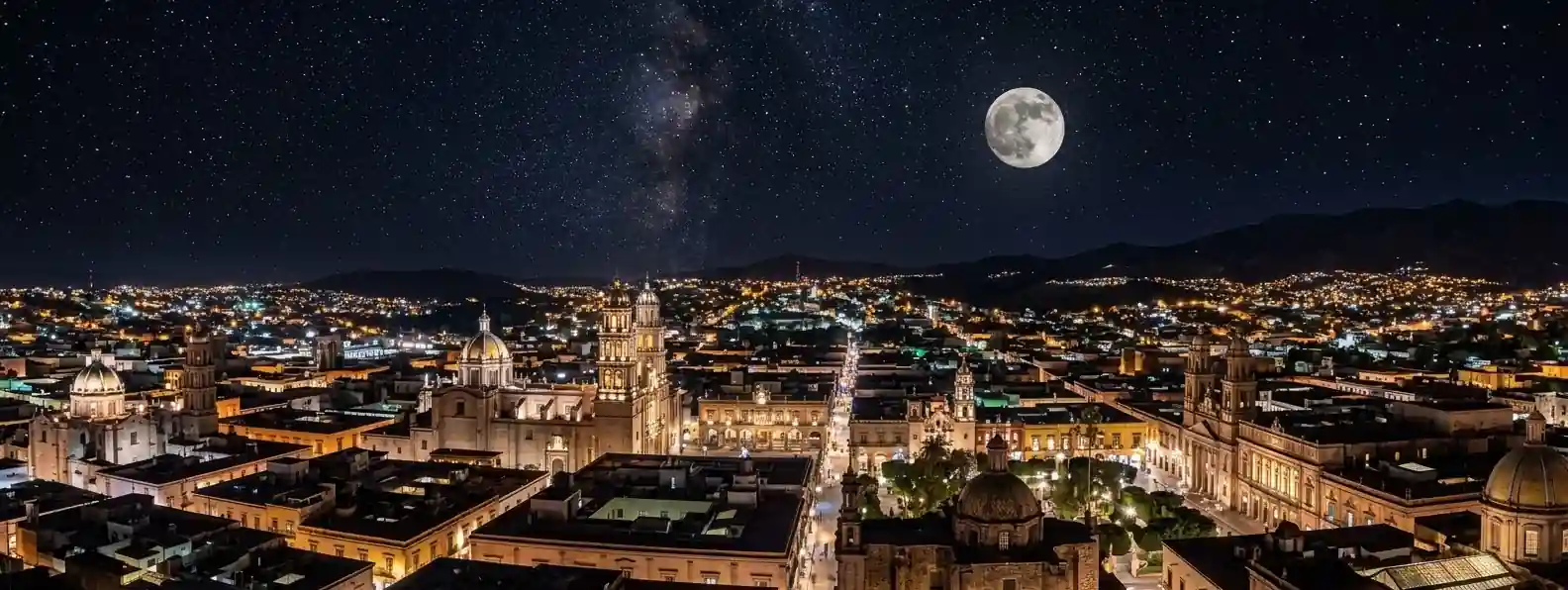
☽ Best Places to View the Moon in San Luis Potosí, Mexico
San Luis Potosí sits at roughly 22.15°N at an elevation of around 1,880 metres on Mexico's central plateau, the capital and largest city of its namesake state, with roughly 770,000 residents in the latest estimate. Founded in 1592 and named for the silver mines of Potosí, Bolivia, the city's historic centre — full of pink quarry-stone buildings — is one of the component sites of UNESCO's Camino Real de Tierra Adentro, the old silver route inscribed in 2010. Between a baroque plaza, a garden the size of a small town, and a nearby mining settlement tied to the city's earliest wealth, San Luis Potosí gives a genuinely layered set of places to watch the moon.
Plaza de Armas & Metropolitan Cathedral
The principal square of the historic centre, anchored by a cathedral built between 1670 and 1730, with twelve Carrara-marble apostle sculptures adorning its façade. The surrounding Palacio Municipal, Palacio de Gobierno, and octagonal bandstand make it the natural starting point for an evening in the old town.
Templo del Carmen
One of the city's outstanding examples of Mexican Baroque, built between 1749 and 1764, a short walk from the Plaza de Armas. Its ornate façade, recently restored and illuminated in the evening, gives a striking foreground for a moonrise shot in the historic centre.
Teatro de la Paz
A historic theatre standing near the Templo del Carmen, one of the anchors of the city's cultural district. Its plaza and surroundings give an easy, central option for an ordinary evening walk.
Jardín de San Francisco
A historic garden and plaza in the heart of the old town, part of the cluster of colonial-era landmarks that make up the UNESCO-recognized historic centre. It's a quieter, shaded stop between the busier Plaza de Armas and Templo del Carmen.
Tangamanga Park
The city's principal park, extending over roughly 410 hectares and described by the state tourism authority as the second-largest urban park in Mexico after Chapultepec. Its open lawns and paths give a wide, green option away from the historic centre for an evening walk.
Cerro de San Pedro
A former silver-mining settlement a short drive outside the city, closely tied to the mining wealth that helped establish San Luis Potosí. Its quiet, historic streets give an entirely different, more remote setting than anywhere in the city itself, with an elevated position that can offer darker conditions than the city centre.
◉ Best Times for Moon Photography
📷 Quick Photography Tips
San Luis Potosí runs on Central Standard Time (UTC-6) year-round. The state does not change clocks for daylight saving time.
For the moon phase in any other city worldwide, visit our Dynamic Moon Phase Calculator for instant lunar data tailored to wherever you are.
The moon phase today in San Luis Potosí, Mexico is shown in detail above — complete with exact illumination percentage, moonrise/set times, and the best viewpoints to see it. For the moon phase today in any other city or location worldwide, visit our Dynamic Moon Phase Calculator on the home page.
◐ While Actually There
San Luis Potosí's whole existence traces back to the same thing that gave it its name: silver. The city was founded in 1592, explicitly named after the fabulously rich mines of Potosí in Bolivia in hopes of similar fortune, and for centuries afterward it functioned as a key stop on the Camino Real de Tierra Adentro, the royal road that moved silver from mines across northern Mexico down toward the coast.
Cerro de San Pedro is the other half of the city's early silver story. Its mines helped generate the wealth that shaped San Luis Potosí, while the city's historic centre later became one of the component sites of UNESCO's Camino Real de Tierra Adentro. Cerro de San Pedro's own streets remain quiet and historically distinctive, a small settlement whose fortunes rose and fell with the mines around it.
None of it requires much beyond checking current road conditions if you want to make the trip out to Cerro de San Pedro. The Plaza de Armas, Templo del Carmen, and Tangamanga Park are all straightforward for an ordinary evening in the city itself.
"San Luis Potosí was named after a silver mine on another continent — and the local mine that helped make it rich is now a quiet historic settlement a short drive from its baroque plazas."
✓ Your San Luis Potosí Moon Chase Checklist
Before You Go
- Check the moonrise time and phase on this page for each night of your stay
- Check current opening hours for the Metropolitan Cathedral and Templo del Carmen if you want to go inside, not just view the exterior
- Check current road conditions and transport options before an evening trip out to Cerro de San Pedro
- Check current opening hours for Tangamanga Park before an evening visit
- Check the forecast for the rainy season if visiting between June and October
What to Bring
- A warm layer for evenings year-round — the city's elevation keeps nights notably cooler than the daytime temperature suggests
- A tripod, useful at open spots like Tangamanga Park and Cerro de San Pedro
- Comfortable shoes for walking the historic centre's cobblestones
- A light rain layer during the June-to-October rainy season
- Spare camera batteries kept warm in an inner pocket during cool evenings
On the Night
- Arrive 20–30 minutes before moonrise at open spots like Tangamanga Park
- Shoot RAW and bracket exposures, especially where the illuminated Templo del Carmen mixes with moonlight
- Confirm your return transport in advance if visiting Cerro de San Pedro in the evening, since it sits well outside the city
- Keep to lit paths in Tangamanga Park after dark
- Watch for sudden thunderstorms during the rainy season
? San Luis Potosí Moon Phase — Frequently Asked Questions
Q. What is the moon phase today in San Luis Potosí?
The moon phase today in San Luis Potosí is a Waning Crescent with 34% illumination. The next full moon is in 22 days, on Oct 25. Moonrise is at 12:38 AM and moonset at 2:37 PM.
Q. Where is the best place to view the moon in San Luis Potosí?
Tangamanga Park, about 410 hectares of open lawns and paths, offers a wide, low-horizon sightline away from the busiest streets and is the best choice inside the city for watching a moonrise. In the historic centre, the illuminated Templo del Carmen and the Plaza de Armas give strong architectural foregrounds, though buildings block the low horizon at street level. Cerro de San Pedro, a former mining settlement at about 2,040 m roughly 20 km east of the city, offers an elevated setting that may give darker conditions than the centre. Check road access and conditions before an evening trip, and confirm your return transport.
Q. Where does the moon rise and set in San Luis Potosí, and how high does it climb?
At about 22.2°N, the Moon's rising point swings between roughly east-northeast (azimuth near 59°) and east-southeast (near 121°) over a month at the widest point of its 18.6-year declination cycle, with the setting point mirrored in the west. That cycle peaked with the major lunar standstill of 2024–2025, so the monthly swing is still near its widest. At culmination the Moon ranges from about 39° above the southern horizon at its southern extreme to about 84° above the northern horizon at its northern extreme. San Luis Potosí lies south of the Tropic of Cancer, so both the Sun and, on some nights, the Moon can pass directly overhead. A December full moon typically culminates within about 6° of the zenith, while a June full moon peaks near 44° in the south.
Q. When is the best time to see a young crescent moon and earthshine from San Luis Potosí?
Thin crescents are easiest to catch when the ecliptic stands steep against the horizon at sunset or sunrise. At this latitude the ecliptic meets the western horizon at nearly 90° around the March equinox but only about 44° around the September equinox, so a young evening crescent stays higher and lasts longer after sunset in spring, while a waning crescent before dawn is best in autumn. Look 20–40 minutes after sunset with a clear western horizon, and use a tripod and a longer exposure to bring out earthshine on the dark limb. The illuminated Templo del Carmen can supply a foreground while the sky is still in twilight.
Q. Is light pollution a problem for moon observing in San Luis Potosí?
The Moon is bright enough to observe and photograph from almost anywhere in the city, so light pollution rarely limits the lunar disc itself. With roughly 770,000 residents, San Luis Potosí does wash out earthshine on a thin crescent and faint stars or planets near the Moon, and the illuminated historic centre adds to the glow. Large open spaces such as Tangamanga Park keep buildings out of your foreground, while the elevated setting of Cerro de San Pedro may offer darker conditions than the centre. The city itself remains a light-polluted urban location rather than a dark-sky site.
Q. How do altitude and the rainy season affect moon viewing in San Luis Potosí?
At about 1,880 m, surface pressure is roughly 80% of the sea-level value, so there is less air between you and the Moon, which slightly reduces dimming and reddening near the horizon. The semi-arid highland climate brings cool, generally dry winters, and evenings can turn notably cool at this elevation year-round. The main rainy season runs roughly June to October, when sudden thunderstorms and cloud are the main obstacle to lunar observing. Check the cloud forecast before heading out, and carry a warm layer.
Q. What camera settings and phases work best for moon photography in San Luis Potosí?
For a full moon, start with Looney 11 (f/11, ISO 100, 1/100 s) and refine using your histogram, since it is a baseline rather than a guarantee. Shoot RAW and bracket exposures, especially where an illuminated facade such as the Templo del Carmen shares the frame with the Moon, and blend them afterward. A waxing gibbous is useful for blue hour while the foreground is still lit, and a full moon rises around sunset. A 200–400 mm lens isolates the Moon against distant towers and ridgelines, with a tripod for bracketing and manual focus on the Moon using magnified live view.
Q. Does this page work for cities besides San Luis Potosí?
This page is set up specifically for San Luis Potosí, Mexico. For the moon phase in any other city or location worldwide, use the Dynamic Moon Phase Calculator on the moonphase.today home page.
✦ Explore Further
Moon Phase Today: Aguascalientes
Check tonight's moon phase in Aguascalientes, roughly 140 km west-southwest of San Luis Potosí.
🏙️Moon Phase Today: Querétaro
See the moon over Querétaro, a colonial highland city roughly 185 km south-southeast.
🇲🇽Moon Phase in Mexico
Browse moon phase pages for cities across Mexico, from Tijuana to Cancún.
🌍World Moon Phase Directory
Find the moon phase, rise and set times for cities in every region of the world.
Moon Age Calculator
Find the Moon's age in days, handy for judging when a young crescent becomes visible.