
Moon Phase Today Querétaro
On Sunday, October 4, 2026, the moon in Queretaro is a Waning Crescent with 34% illumination. Moon age: 23.7 days.
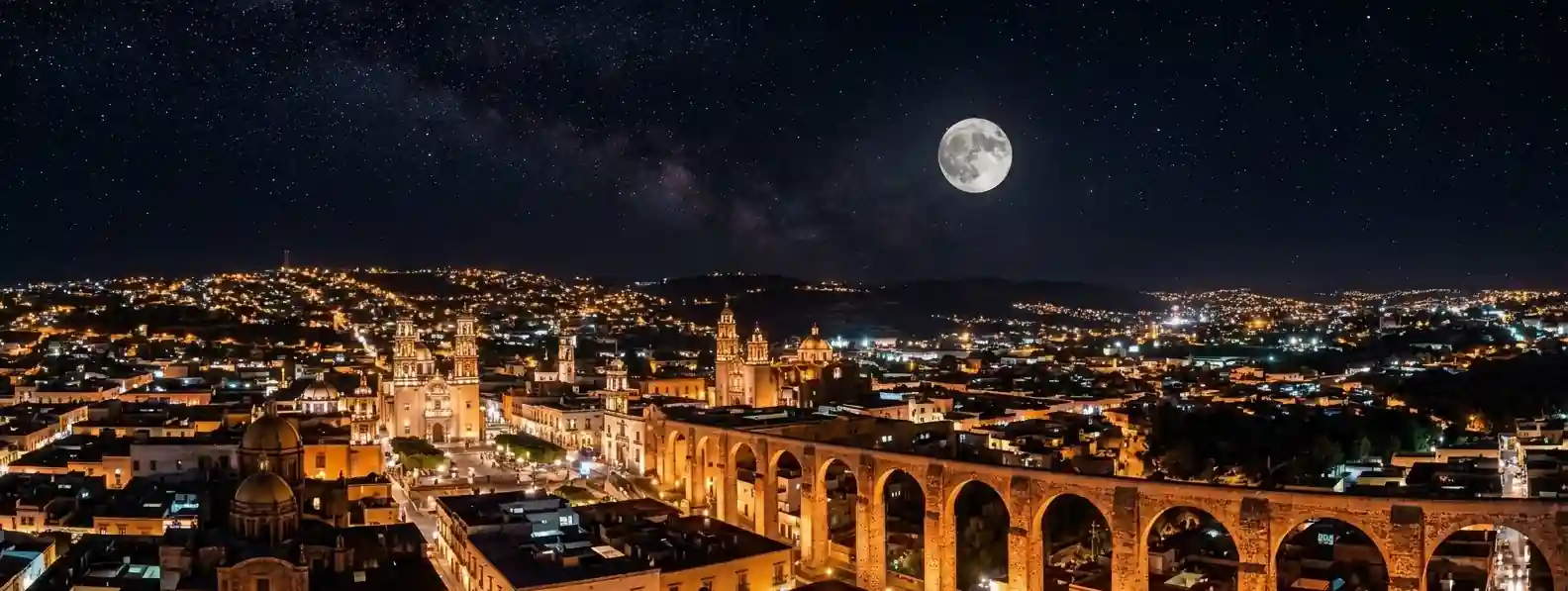
☽ Best Places to View the Moon in Querétaro, Mexico
Querétaro sits at roughly 20.59°N at an elevation of about 1,820 metres in central Mexico's Bajío region, the capital and largest city of its namesake state, with more than one million residents in the wider municipality. Founded in 1531 and nicknamed "the Pearl of the Bajío," its historic centre was recognized by UNESCO as a World Heritage Site in 1996 for its blend of baroque and neoclassical architecture, and the city played a pivotal role in both Mexico's independence movement and the dramatic end of its short-lived Second Empire. Between a colonial aqueduct, a hilltop where an emperor was executed, and a plaza tied to the country's founding conspiracy, Querétaro gives an unusually storied set of places to watch the moon.
Acueducto de Querétaro (Los Arcos)
A colonial-era aqueduct built between 1726 and 1735, with 74 towering quarry-stone arches stretching over 1,270 metres, built to bring water into the city and now its most recognizable structure. Illuminated in pink tones at night, it gives a distinctive moonrise foreground along its length.
Cerro de las Campanas
The hill where Emperor Maximilian of Habsburg was executed alongside two of his generals on June 19, 1867, bringing an end to the Second Mexican Empire. A small chapel built by Emperor Franz Joseph marks the exact spot, a colossal statue of Benito Juárez looks down from further up the slope, and the rest of the hill is a public park with paths and one of the widest views over the city anywhere in Querétaro.
Plaza de Armas (Plaza de la Independencia)
A shaded square centred on a fountain topped by a statue of the marquis who financed the aqueduct, ringed by arcaded cafés that stay lively well into the evening. On its north side stands the Casa de la Corregidora, home to Josefa Ortiz de Domínguez, who in 1810 sent word to the conspirators that their independence plans had been discovered.
Templo de Santa Rosa de Viterbo
A remarkable baroque church dating from the late 17th and early 18th centuries, with an ornate façade and a distinctive tower whose design incorporates Arab architectural influences. Its illuminated exterior gives a striking, historic option for an evening in the old town.
Historic Centre (Centro Histórico)
A UNESCO World Heritage Site since 1996, covering about four square kilometres across some 203 blocks and containing roughly 1,400 designated monuments, most of it walkable on foot. It's an easy, central base for an ordinary evening, with plenty of colonial architecture to frame along the way.
Convento de la Santa Cruz
A former convent supplied by the aqueduct, later serving as one of the places Emperor Maximilian was held in 1867 before his execution at Cerro de las Campanas. Guided visits generally run in groups, so check current tour times if you want to go inside.
◉ Best Times for Moon Photography
📷 Quick Photography Tips
Querétaro runs on Central Standard Time (UTC-6) year-round. Like most of Mexico, the state does not observe seasonal clock changes.
For the moon phase in any other city worldwide, visit our Dynamic Moon Phase Calculator for instant lunar data tailored to wherever you are.
The moon phase today in Querétaro, Mexico is shown in detail above — complete with exact illumination percentage, moonrise/set times, and the best viewpoints to see it. For the moon phase today in any other city or location worldwide, visit our Dynamic Moon Phase Calculator on the home page.
◐ While Actually There
Querétaro carries an outsized share of Mexican history for a city its size. Josefa Ortiz de Domínguez's warning from the Casa de la Corregidora in 1810 helped set off the independence movement, and more than half a century later, Cerro de las Campanas closed a very different chapter — the execution of Emperor Maximilian, a Habsburg archduke installed on a Mexican throne with French backing, whose death effectively ended the country's brief experiment with imperial rule.
The aqueduct and convent tie the city's colonial and imperial histories together in their own way. Built in the 18th century to bring water into Querétaro, the aqueduct supplied the city while the nearby Convento de la Santa Cruz later became one of the places where Maximilian was held in 1867.
None of it requires much beyond checking current tour times for the Convento de la Santa Cruz if you want to go inside. The historic centre, Plaza de Armas, and the aqueduct's illuminated arches are all straightforward for an ordinary evening without much advance planning.
"Querétaro's aqueduct once supplied water to the whole city — including the convent where an emperor spent his final days before his execution nearby."
✓ Your Querétaro Moon Chase Checklist
Before You Go
- Check the moonrise time and phase on this page for each night of your stay
- Check current tour times for the Convento de la Santa Cruz if you want to go inside
- Check current opening hours for the Museo del Cerro de las Campanas if you want to combine it with your visit
- Check current opening hours for Templo de Santa Rosa de Viterbo if you want to go inside, not just view the exterior
- Check the forecast for the summer rainy season if visiting between June and August
What to Bring
- A warm layer for evenings year-round — Querétaro's elevation can make evenings cool even in summer
- A tripod, useful at open, elevated spots like Cerro de las Campanas
- Comfortable shoes for walking the historic centre's cobblestones
- A light rain layer during the summer rainy season
- Spare camera batteries kept warm in an inner pocket during cool evenings
On the Night
- Arrive 20–30 minutes before moonrise at open spots like Cerro de las Campanas
- Shoot RAW and bracket exposures, especially where the pink-illuminated aqueduct mixes with moonlight
- Follow current park access rules and stay on designated paths at Cerro de las Campanas
- Confirm current transport options if visiting the aqueduct's far end or Cerro de las Campanas in the evening
- Watch for sudden summer thunderstorms during the rainy season
? Querétaro Moon Phase — Frequently Asked Questions
Q. What is the moon phase today in Querétaro?
The moon phase today in Querétaro is a Waning Crescent with 34% illumination. The next full moon is in 22 days, on Oct 25. Moonrise is at 12:39 AM and moonset at 2:32 PM.
Q. Where is the best place to view the moon in Querétaro?
Cerro de las Campanas, a hillside park outside the old town, gives one of the widest open sightlines over the city, so it is the strongest choice for watching a moonrise. The Acueducto de Querétaro, a colonial aqueduct more than 1.2 km long and lit pink at night, offers a distinctive foreground along its arches. The walkable Centro Histórico is a convenient base with colonial architecture to frame, though buildings block the low horizon at street level. Follow current park access rules and stay on designated paths at Cerro de las Campanas, and check opening hours before an evening visit.
Q. Where does the moon rise and set in Querétaro, and how high does it climb?
At about 20.6°N, the Moon's rising point swings between roughly east-northeast (azimuth near 59°) and east-southeast (near 121°) over a month at the widest point of its 18.6-year declination cycle, with the setting point mirrored in the west. That cycle peaked with the major lunar standstill of 2024–2025, so the monthly swing is still near its widest. At culmination the Moon ranges from about 41° above the southern horizon at its southern extreme to about 82° above the northern horizon at its northern extreme. Because the Moon's declination can match the city's latitude, it can pass directly overhead on some nights, and a December full moon typically culminates within about 8° of the zenith, while a June full moon peaks near 46° in the south.
Q. How do I photograph the moon with Querétaro's illuminated aqueduct and historic centre?
The aqueduct's pink night lighting and the old town's pink quarry stone create a strongly coloured foreground, so shoot RAW and set white balance deliberately, keeping the Moon's neutral disc and the pink arches from shifting each other. Lit monuments are far brighter than an unlit landscape but far dimmer than the Moon, so bracket three to five frames and blend them, or shoot in twilight when sky, arches and Moon sit within a few stops of each other. The Moon spans only about 0.5°, so a wide-angle lens renders it as a small dot; a 200–400 mm lens from a distance makes it large against the arches.
Q. Is light pollution a problem for moon observing in Querétaro?
The Moon is bright enough to observe and photograph from almost anywhere in the city, so light pollution rarely limits the lunar disc itself. It does wash out earthshine on a thin crescent and faint stars or planets near the Moon, and the historic centre's illuminated streets and monuments add to the glow. Elevated, open ground such as Cerro de las Campanas lets you keep the brightest street lighting out of your foreground, though Querétaro remains a light-polluted urban location rather than a dark-sky site.
Q. How do altitude and the rainy season affect moon viewing in Querétaro?
At about 1,820 m, surface pressure is roughly 80% of the sea-level value, so there is less air between you and the Moon, which slightly reduces dimming and reddening near the horizon. The city's semi-arid highland climate has a summer rainy season from roughly June to August, and sudden thunderstorms and cloud are the main obstacle to lunar observing then. Outside those months evenings tend to be more settled, but nights are cool year-round at this elevation, so a warm layer helps on long sessions. Check the cloud forecast before heading out.
Q. What camera settings and phases work best for moon photography in Querétaro?
For a full moon, start with Looney 11 (f/11, ISO 100, 1/100 s) and refine using your histogram, since it is a baseline rather than a guarantee. At this latitude a winter full moon climbs close to the zenith, where atmospheric dimming is minimal and Looney 11 holds well, while a moon near the horizon needs a stop or two more exposure. Open up further as the illuminated fraction shrinks toward quarter and crescent, and watch highlights on the lit limb. A tripod with a tilting head helps for high moons, and manual focus on the Moon using magnified live view keeps craters sharp.
Q. Does this page work for cities besides Querétaro?
This page is set up specifically for Querétaro, Mexico. For the moon phase in any other city or location worldwide, use the Dynamic Moon Phase Calculator on the moonphase.today home page.
✦ Explore Further
Moon Phase Today: León
Check tonight's moon phase in León, another of the Bajío's large highland cities.
🏙️Moon Phase Today: Mexico City
See the moon over Mexico City, roughly 200 km southeast of Querétaro.
🇲🇽Moon Phase in Mexico
Browse moon phase pages for cities across Mexico, from Tijuana to Cancún.
🌍World Moon Phase Directory
Find the moon phase, rise and set times for cities in every region of the world.
Lunar Looney 11 Calculator
Work out Looney 11 exposure settings for the moon phase you are shooting.