
Moon Phase Today Puebla
On Sunday, October 4, 2026, the moon in Puebla is a Waning Crescent with 34% illumination. Moon age: 23.7 days.
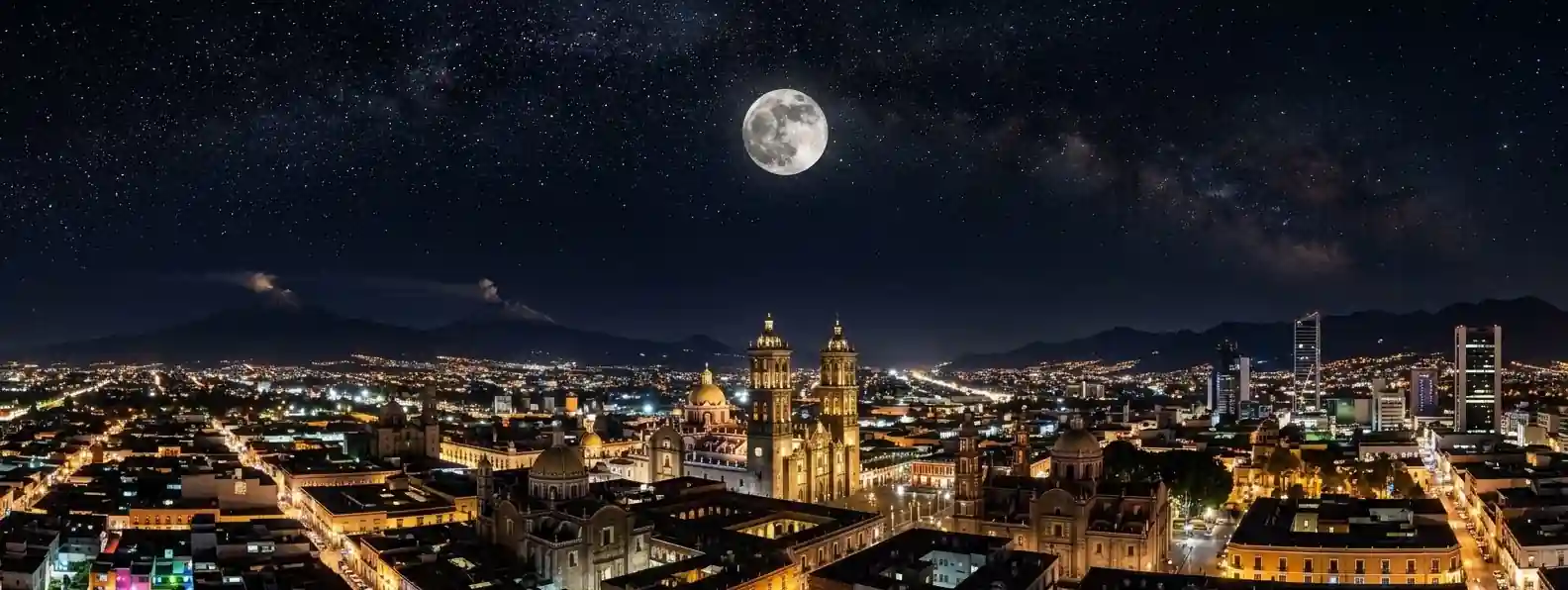
☽ Best Places to View the Moon in Puebla, Mexico
Puebla sits at roughly 19.04°N at an elevation of about 2,150 metres in central Mexico, the capital of Puebla state and the fourth-largest city in the country. Founded on April 16, 1531 as a planned Spanish colonial city in the Valley of Cuetlaxcoapan, Puebla earned the nickname "Angelópolis" from a founding legend involving angels, and its historic centre has been a UNESCO World Heritage Site since 1987. Between a baroque chapel once called the eighth wonder of the world, twin forts tied to one of Mexico's most celebrated battles, and one of the largest pyramids on Earth just outside town, Puebla gives an unusually dramatic set of places to watch the moon.
Zócalo de Puebla & Cathedral
The city's central plaza, ringed by cafés and colonial arcades, with Puebla Cathedral's twin towers rising prominently above it. It's the natural starting point for an evening in the historic centre.
Capilla del Rosario
A chapel inside the Templo de Santo Domingo, so densely covered in gold-leaf baroque ornamentation that it's long been nicknamed the "eighth wonder of the world." Check current opening hours if you want to see the interior, since it keeps its own posted schedule separate from the surrounding streets.
Fuertes de Loreto y Guadalupe
The twin forts where a heavily outnumbered Mexican army defeated invading French forces on May 5, 1862, an event now commemorated as Cinco de Mayo. The area's viewpoints give striking views toward the volcanoes Popocatépetl and Iztaccíhuatl on a clear day, and a wide sightline over the city after dark — follow current park access rules, since the site is not freely open around the clock.
Great Pyramid of Cholula
Just outside the city, the largest pyramid by volume known to exist anywhere in the world, its ancient stepped structure long since overgrown and topped by the Church of Nuestra Señora de los Remedios. Its excavation tunnels reopened to the public in 2026 after several years closed, now with timed, limited-group access — the archaeological zone itself keeps daytime hours, so plan a daytime or sunset visit rather than an after-dark one.
Barrio del Artista & Los Sapos
A cluster of artisan studios and antique shops in the historic centre, known for open-air art displays and a lively evening atmosphere. It's an easy, central option for an ordinary evening walk with some local colour.
Africam Safari
A large drive-through and walk-through wildlife park on the city's outskirts, open 365 days a year but with daytime visiting hours. It's best treated as an afternoon stop rather than part of an evening moon-watching plan.
◉ Best Times for Moon Photography
📷 Quick Photography Tips
Puebla runs on Central Standard Time (UTC-6) year-round. Like most of Mexico, the state does not observe seasonal clock changes.
For the moon phase in any other city worldwide, visit our Dynamic Moon Phase Calculator for instant lunar data tailored to wherever you are.
The moon phase today in Puebla, Mexico is shown in detail above — complete with exact illumination percentage, moonrise/set times, and the best viewpoints to see it. For the moon phase today in any other city or location worldwide, visit our Dynamic Moon Phase Calculator on the home page.
◐ While Actually There
Puebla's founding legend sets the tone for the whole city: the site was supposedly chosen by angels, appearing in a bishop's dream to mark out the streets before a single building went up. Whatever the truth of that story, the result was one of colonial Mexico's most deliberately planned cities, and its historic centre has held onto that layout closely enough to earn UNESCO recognition in 1987.
Just outside town, Cholula tells a much older and stranger version of the same impulse to build something enormous. What looks from a distance like an ordinary hill is actually the largest pyramid by volume anywhere in the world, its ancient form gradually buried and overgrown until a church went up on the summit centuries ago. Its internal tunnels, closed to visitors for years, only reopened in 2026 under a new, more carefully managed access system. The forts at Loreto and Guadalupe carry a more recent story — the site of an outnumbered Mexican army's victory over French invaders in 1862, an event that gave the country Cinco de Mayo.
None of it requires much beyond checking the Capilla del Rosario's hours if you want to see its interior, and planning a daytime trip to Cholula's archaeological zone rather than an evening one. The Zócalo, the forts, and the Barrio del Artista are all straightforward for an ordinary evening without much advance planning.
"Puebla was supposedly laid out by angels in a bishop's dream — and just outside town sits a hill that turns out to be the largest pyramid by volume in the world."
✓ Your Puebla Moon Chase Checklist
Before You Go
- Check the moonrise time and phase on this page for each night of your stay
- Check current opening hours for the Capilla del Rosario if you want to see its interior
- Check current tunnel access and timed-entry availability at Cholula if you want to visit them, since it reopened under a new controlled system in 2026
- Check current opening hours for Africam Safari if you want to visit earlier in the day
- Check the forecast for the rainy season if visiting between June and October
What to Bring
- A warm layer for evenings year-round — Puebla's elevation keeps nights cool even in summer
- A tripod, useful at open, elevated spots like the Fuertes de Loreto y Guadalupe
- Comfortable shoes for walking the historic centre's cobblestones
- A light rain layer during the rainy season
- Spare camera batteries kept warm in an inner pocket during cool evenings
On the Night
- Arrive 20–30 minutes before moonrise at open spots like the forts
- Shoot RAW and bracket exposures, especially where the illuminated cathedral mixes with moonlight
- Plan any Cholula visit for daytime or sunset, since the archaeological zone keeps daytime hours
- Follow current park access rules and stay on designated paths at the forts
- Watch for sudden thunderstorms during the rainy season
? Puebla Moon Phase — Frequently Asked Questions
Q. What is the moon phase today in Puebla?
The moon phase today in Puebla is a Waning Crescent with 34% illumination. The next full moon is in 22 days, on Oct 25. Moonrise is at 12:33 AM and moonset at 2:19 PM.
Q. Where is the best place to view the moon in Puebla?
The Fuertes de Loreto y Guadalupe, the twin forts tied to the 1862 victory commemorated as Cinco de Mayo, give an open, elevated sightline over the city and, on a clear day, toward the volcanoes Popocatépetl and Iztaccíhuatl, within current park access rules. The Zócalo, the central plaza with Puebla Cathedral's twin towers rising above it, is the natural starting point in the historic centre, and the illuminated cathedral makes a distinctive foreground. Barrio del Artista and Los Sapos add an easy evening walk, while the Great Pyramid of Cholula just outside the city is a daytime or sunset visit.
Q. Where does the moon rise and set in Puebla, and how high does it climb?
At about 19°N, Puebla sees the moon rise and set within roughly 30° of due east and due west. When the moon's declination is north of the city's latitude, as it can be around a winter-solstice full moon, it passes almost overhead or slightly north of the zenith, while a summer full moon culminates much lower, at roughly 45° in the south. Popocatépetl and Iztaccíhuatl lie to the west of the city, so framing the moon with their silhouettes from the forts is a moonset shot that depends on the date, the moon's phase and your exact position.
Q. How do Puebla's altitude and seasons affect moon viewing?
Puebla sits at about 2,150 metres, so nights stay cool year-round even in summer, and cool highland evenings can reduce battery performance faster than expected. Winters are cool and generally dry, the warm days from June to August bring a rainy season that extends into autumn, and sudden thunderstorms are possible during it. The volcanoes are only visible on the clearest evenings, so check the forecast for cloud and rain before planning a session.
Q. What camera settings work best for moon photography in Puebla?
For a bright full moon, start with the Looney 11 rule (f/11, ISO 100, 1/100 s) and adjust from your histogram. The moon is much brighter than a night-time foreground, so shoot RAW and bracket exposures, especially where the illuminated cathedral mixes with moonlight. A tripod helps at open, elevated spots such as the forts, which are more exposed than the streets of the historic centre. On the clearest evenings, the forts' viewpoint can frame the moon alongside the volcano silhouettes, and spare batteries should be kept warm in an inner pocket.
Q. Can I photograph the moon in Puebla and at Cholula after dark?
Access varies by site. The Fuertes de Loreto y Guadalupe are not freely open around the clock, so follow current park access rules and stay on designated paths. The Capilla del Rosario keeps its own posted hours, Africam Safari has daytime visiting hours, and the Great Pyramid of Cholula's archaeological zone keeps daytime hours, so plan a daytime or sunset visit rather than an after-dark one. Its excavation tunnels reopened in 2026 with timed, limited-group access, so check current availability if you want to go inside.
Q. Does this page work for cities besides Puebla?
This page is set up specifically for Puebla, Mexico. For the moon phase in any other city or location worldwide, use the Dynamic Moon Phase Calculator on the moonphase.today home page.
✦ Explore Further
Moon Phase Today: Mexico City
Check tonight's moon phase in Mexico City, northwest of Puebla across the volcanic highlands.
📍Moon Phase Today: Nezahualcóyotl
See the moon over Nezahualcóyotl, in Greater Mexico City on the road toward Puebla.
🇲🇽Moon Phase in Mexico
Browse moon phase pages for cities across Mexico, from Tijuana to Cancun.
🌍World Moon Phase Directory
Find the moon phase, rise and set times for cities in every region of the world.
NASA Moon Phase & Libration Gallery
NASA's Scientific Visualization Studio's daily renders of the moon's exact phase, libration, and orientation, straight from official mission data.