
Moon Phase Today Nezahualcóyotl
On Sunday, October 4, 2026, the moon in Nezahualcoyotl is a Waning Crescent with 34% illumination. Moon age: 23.7 days.
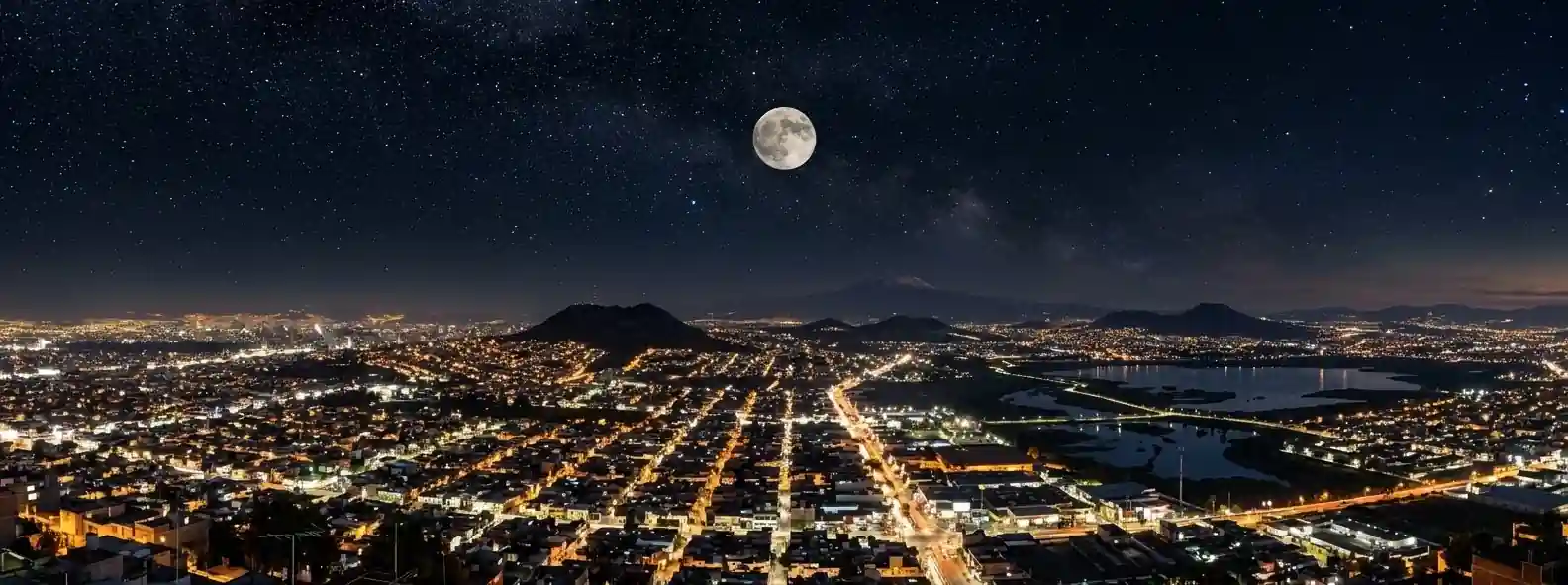
☽ Best Places to View the Moon in Nezahualcóyotl, Mexico
Nezahualcóyotl sits at roughly 19.41°N at an elevation of about 2,220 metres, directly against the northeastern edge of Mexico City and part of Greater Mexico City. With more than a million residents packed into about 64 square kilometres, it is one of Mexico's most densely populated municipalities. Formally established as a municipality in 1963 and named for the Acolhua poet-king of nearby Texcoco, much of the city grew across the former Lake Texcoco basin, with settlements expanding rapidly from the 1940s onward. It is a densely populated, largely residential city rather than a conventional tourist destination, but it still offers a handful of genuine options for an evening under the moon.
Parque del Pueblo (Neza Zoo)
The city's best-known green space, inaugurated in 1975 as a recreational park with an artificial lake, a train, green areas, and a small animal collection. It underwent major rehabilitation and reopened in 2003, today combining the zoo with recreational and environmental-education facilities. Another rehabilitation project began in August 2026, so check current access and opening hours before visiting.
Estadio Neza 86
A stadium that opened in 1981 as Estadio José López Portillo and was renamed Estadio Neza 86 in connection with the 1986 FIFA World Cup. It holds an unusual piece of World Cup trivia: during a Scotland–Uruguay match here, a player was sent off just 56 seconds into the game, widely recorded as one of the fastest red cards in the tournament's history.
Palacio Municipal & Central Civic Area
The seat of city government and the surrounding civic plaza, a straightforward, central point of reference in a city that otherwise spreads out across a dense residential grid. It's an easy, unremarkable but genuinely open spot for an ordinary evening.
Bordo de Xochiaca
A long stretch of land on the city's edge, historically known as an informal landfill. Parts of the area have undergone public-space and infrastructure rehabilitation in recent years, but conditions and access vary considerably by section, so check current conditions before visiting.
Residential Neighbourhood Streets
Much of Nezahualcóyotl is a flat, low-rise residential grid, a legacy of the settlements that filled in the former lakebed from the 1940s onward. Its wide, open streets away from taller Mexico City buildings can give an unobstructed view of the sky for an ordinary evening close to home — stick to well-lit, populated streets after dark, as in any large city.
Texcoco (a short trip further out)
The historic city that the real Nezahualcóyotl actually ruled as Acolhua king in the 15th century, a short distance from Ciudad Neza. It's a separate city with its own centre and landmarks rather than part of Nezahualcóyotl itself, but worth knowing about if you want to trace the story behind the city's name a little further.
◉ Best Times for Moon Photography
📷 Quick Photography Tips
Nezahualcóyotl runs on Central Standard Time (UTC-6) year-round. Like most of Mexico, the State of Mexico does not observe seasonal clock changes.
For the moon phase in any other city worldwide, visit our Dynamic Moon Phase Calculator for instant lunar data tailored to wherever you are.
The moon phase today in Nezahualcóyotl, Mexico is shown in detail above — complete with exact illumination percentage, moonrise/set times, and the best viewpoints to see it. For the moon phase today in any other city or location worldwide, visit our Dynamic Moon Phase Calculator on the home page.
◐ While Actually There
Nezahualcóyotl's whole existence is a fairly recent engineering afterthought. Lake Texcoco once covered much of this ground, and only after decades of drainage work did settlement become possible here at scale. Families migrating from rural Mexico from the 1940s onward filled the area in gradually, long before it had reliable water, electricity, or sewerage, and the municipality wasn't formally established until 1963.
That improvised, built-from-nothing history is part of what makes the city interesting rather than a liability. Parque del Pueblo has been a fixture since 1975, rebuilt into something closer to a proper zoo after a 2003 rehabilitation, and it's currently mid-way through another round of improvements. Estadio Neza 86 carries a strange footnote in World Cup history from a tournament the city helped host. None of it is dressed up for tourists, which is exactly what makes it feel like an honest slice of how Greater Mexico City actually works.
None of it requires much beyond checking Parque del Pueblo's current access conditions given its ongoing rehabilitation work. The central civic area and the residential streets around it are straightforward for an ordinary evening without much advance planning.
"Nezahualcóyotl exists because a lake was drained and more than a million people decided to build a life on the ground that was left behind."
✓ Your Nezahualcóyotl Moon Chase Checklist
Before You Go
- Check the moonrise time and phase on this page for each night of your stay
- Check current opening hours and access conditions for Parque del Pueblo, since it is undergoing rehabilitation work as of 2026
- Check current conditions and access at Bordo de Xochiaca before visiting, since improvements vary by section
- Check current event schedules at Estadio Neza 86 if you want to time a visit around a match
- Check the forecast for the wetter season if visiting between June and September
What to Bring
- A warm layer for evenings, particularly during the dry season — the city's elevation keeps nights cool
- A tripod, useful at open spots like Parque del Pueblo
- Comfortable shoes for walking the residential grid around the central civic area
- A light rain layer during the wetter months
- Spare camera batteries kept warm in an inner pocket during cool evenings
On the Night
- Arrive 20–30 minutes before moonrise at open spots like Parque del Pueblo
- Shoot RAW and bracket exposures to make the most of streetlight and ambient city glow
- Stick to well-lit, populated streets and areas after dark, as in any large city
- Confirm current transport options if visiting Bordo de Xochiaca or the stadium in the evening
- Watch for sudden thunderstorms during the wetter months
? Nezahualcóyotl Moon Phase — Frequently Asked Questions
Q. What is the moon phase today in Nezahualcóyotl?
The moon phase today in Nezahualcóyotl is a Waning Crescent with 34% illumination. The next full moon is in 22 days, on Oct 25. Moonrise is at 12:36 AM and moonset at 2:23 PM.
Q. Where is the best place to view the moon in Nezahualcóyotl?
Nezahualcóyotl sits on the flat bed of the former Lake Texcoco at about 2,220 m, so the best sightlines come from open ground and wide streets rather than any hilltop. Parque del Pueblo, with its open lake area, offers one of the clearest views in the city, though another rehabilitation project began there in August 2026, so confirm current access before going. Wide avenues in the low-rise residential grid can also give an unobstructed sky, particularly toward the east where the Moon rises. The Bordo de Xochiaca on the city's edge is open land, but conditions and access vary by section, so check before visiting.
Q. Where does the moon rise and set in Nezahualcóyotl, and how high does it climb?
At about 19.4°N, the Moon's rising point swings between roughly east-northeast (azimuth near 60°) and east-southeast (near 120°) over a month at the widest point of its 18.6-year declination cycle, with the setting point mirrored in the west. That cycle peaked with the major lunar standstill of 2024–2025, so the monthly swing is still near its widest. At culmination the Moon ranges from about 42° above the southern horizon at its southern extreme to about 81° above the northern horizon at its northern extreme, passing north of the zenith. A December full moon typically culminates within about 10° of the zenith, while a June full moon peaks near 47° in the south.
Q. Can the moon be seen rising behind the Sierra Nevada volcanoes from Nezahualcóyotl?
Partly. From central Nezahualcóyotl, Cerro Tláloc (about 4,150 m) lies roughly 32 km due east and Iztaccíhuatl (over 5,200 m) roughly 47 km away at a bearing near 123°, and both stand about 3° above a flat horizon. The Moon rises due east twice a month, when its declination crosses zero, which puts it behind Tláloc. A 3° ridge takes about 15 minutes to clear, so the visible moonrise comes later than a flat-horizon time. Near its southernmost declination the Moon rises close to the line toward Iztaccíhuatl, but Popocatépetl (bearing near 137°) lies south of the Moon's rising range at this latitude, so the Moon never rises behind it. All of these views need clear air.
Q. Is light pollution a problem for moon observing in Nezahualcóyotl?
The Moon is bright enough to observe and photograph from anywhere in the city, so light pollution rarely limits the lunar disc itself. As part of Greater Mexico City, Nezahualcóyotl is a heavily lit urban area that washes out earthshine on a thin crescent and faint stars or planets near the Moon. Shooting crescents in twilight and shielding your lens or eyes from nearby streetlights helps. For fine lunar detail such as craters, rilles and the terminator, atmospheric steadiness matters more than sky darkness, and heat rising from paved surfaces can degrade it early in the evening.
Q. How do altitude and Valley of Mexico air quality affect moon viewing in Nezahualcóyotl?
At about 2,220 m, surface pressure is roughly three-quarters of the sea-level value, so there is less air between you and the Moon, which slightly reduces dimming and reddening near the horizon. The city also lies in the Valley of Mexico basin, where ozone season runs from mid-February to early June with the highest concentrations in April and May, and authorities report elevated particulates in the same dry period. Haze softens lunar contrast and dims low moonrises. Wetter months from June to September bring storms and cloud, so check cloud and air-quality forecasts before heading out.
Q. What camera settings and phases work best for moon photography in Nezahualcóyotl?
For a full moon, start with Looney 11 (f/11, ISO 100, 1/100 s) and refine using your histogram, since it is a baseline rather than a guarantee. Shoot RAW and bracket, and open up a stop or two for a hazy or low moon. A full moon rises around sunset, so a moonrise behind the eastern ridge falls in twilight, when the sky and foreground sit within a few stops of the Moon. A waxing gibbous rises in the afternoon and offers similar balance in golden-hour light. A 200–400 mm lens frames the Moon against distant ridgelines, with a tripod for bracketing and manual focus on the Moon using magnified live view.
Q. Does this page work for cities besides Nezahualcóyotl?
This page is set up specifically for Nezahualcóyotl, Mexico. For the moon phase in any other city or location worldwide, use the Dynamic Moon Phase Calculator on the moonphase.today home page.
✦ Explore Further
Moon Phase Today: Mexico City
Check tonight's moon phase in Mexico City, right next door to the west and north of Nezahualcóyotl.
🌆Moon Phase Today: Ecatepec de Morelos
See the moon over Ecatepec de Morelos, north of Nezahualcóyotl within Greater Mexico City.
🇲🇽Moon Phase in Mexico
Browse moon phase pages for cities across Mexico, from Tijuana to Cancún.
🌍World Moon Phase Directory
Find the moon phase, rise and set times for cities in every region of the world.
Blue Hour Calculator
Plan the twilight window when the Moon and a lit foreground expose well together.