
Moon Phase Today Mexico City
On Friday, October 9, 2026, the moon in Mexico City is a New Moon with 0% illumination. Moon age: 28.9 days.
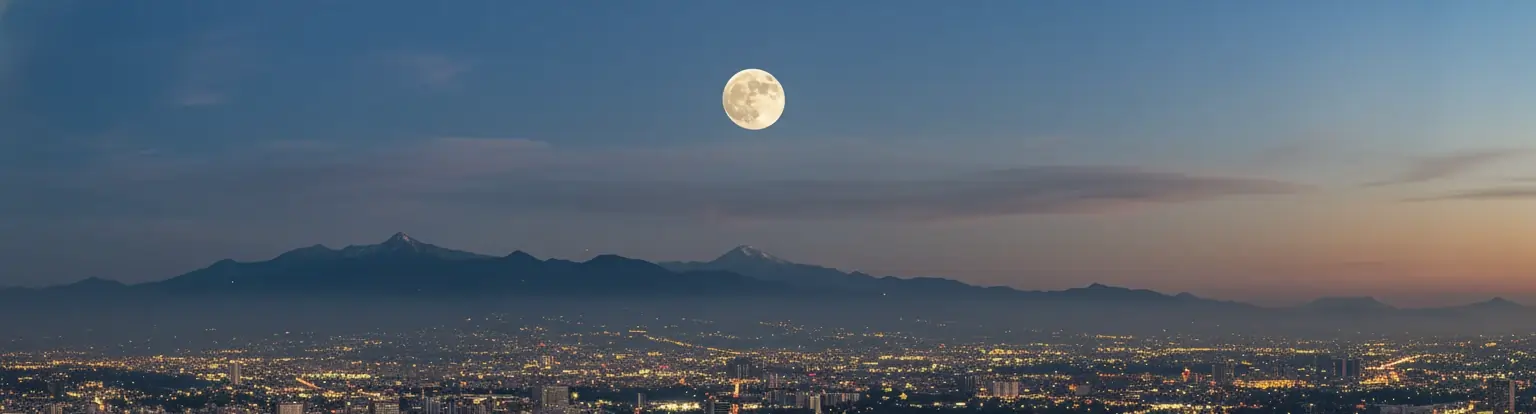
☽ Best Places to View the Moon in Mexico City
Mexico City occupies one of the most dramatic urban settings on earth — a vast highland basin 2,240 metres above sea level, ringed by volcanoes and mountain ranges, with a metropolitan area of over 20 million people spreading across the Valle de México in every direction. The high altitude thins the atmosphere and can sharpen the moon on clear nights, though the city's famous haze is a real planning factor: the dry season from November through April gives the clearest conditions. The city's moonrise character is defined by layering — the moon rises not over a simple skyline but over Paseo de la Reforma's unbroken diagonal, the Angel of Independence column, the Art Deco dome of the Monumento a la Revolución, and the distant volcanic silhouettes of Popocatépetl and Iztaccíhuatl on very clear nights. From Chapultepec Hill the entire composition — palace, boulevard, basin, volcanoes — resolves into a single extraordinary frame.
Chapultepec Castle – Panoramic Terraces
The finest elevated moonrise viewpoint in Mexico City. Chapultepec Castle sits atop Chapultepec Hill — the only royal castle in the Americas — with checkered terraces looking east over Paseo de la Reforma stretching in a straight line toward the Zócalo, and south over the city bowl toward the distant volcanoes. The moon rises over this composition from the hilltop terraces in a historic frame of imperial Mexico. Entry fee approximately MXN 90 for Mexican nationals (higher for foreign visitors); open Tuesday–Sunday 9am–5pm, closed Mondays. Evening access to the terraces requires arriving before 5pm closing; the park grounds are open after hours but not the castle itself.
Torre Latinoamericana – Observation Deck
The historic centro's signature elevated viewpoint. The Torre Latinoamericana was the tallest building in Latin America when completed in 1956 and remains an icon of the Historic Center. The observation deck on the 44th floor sits at 166 metres above street level — already at 2,240 m city elevation — giving a true 360° panorama: Palacio de Bellas Artes directly below, the Zócalo and cathedral to the east, Chapultepec Forest to the west, and the volcanic silhouettes on clear days. The moon rises over the city's eastern sprawl. Open evenings; entry approximately MXN 170 for adults. One of the few viewpoints that can be accessed at night.
Monumento a la Revolución – Mirador
The world's tallest triumphal arch and one of Mexico City's most distinctive elevated viewpoints. The Monumento a la Revolución stands 67 metres above Plaza de la República on its own, with a glass elevator rising to the observation deck at 65 metres inside the Art Deco copper dome. From the deck, Paseo de la Reforma and Avenida de los Insurgentes intersect below — the two great diagonal arteries of the city — while the skyline spreads in every direction. The moon rises over the eastern city with the Reforma towers in the middle distance. Entry approximately MXN 150; open Tuesday–Sunday (noon most days, 10am Sundays), open until 10pm Fridays and Saturdays.
Ángel de la Independencia – Paseo de la Reforma
The Ángel de la Independencia column stands at the centre of Paseo de la Reforma's grandest roundabout — a 36-metre gilded winged victory figure on a tall column, flanked by the avenue's skyscrapers. From the ground-level base and the surrounding roundabout, the moon rises directly along the Reforma axis to the east while the golden angel catches the city lights and glows in the foreground. A ground-level composition rather than an elevated one, but the axial alignment of Reforma — one of the great urban boulevards of the Americas — gives it an architectural power that compensates. Free, accessible 24/7; the surrounding lanes require care at night.
Palacio de Bellas Artes – Historic Center
The Palacio de Bellas Artes is Mexico City's supreme Art Nouveau and Art Deco landmark — its white marble and multicolored tiled dome visible from across the city center. The palace has no public rooftop or exterior terrace; it is best used as a foreground element from the street level and from the Alameda Central gardens directly in front. The moon rises over the Torre Latinoamericana (visible to the east) with the palace dome as a lit foreground — a composition available from ground level on Avenida Juárez. The surrounding plaza and Alameda gardens are free and open 24/7.
Desierto de los Leones – National Park Viewpoints
A national park in the Sierra de las Cruces range about 30 minutes west of the city, rising to approximately 3,000 metres above sea level — nearly 800 metres above the city basin. Desierto de los Leones offers the darkest skies within reasonable distance of Mexico City: the city's light dome glows to the east and the moon rises above it, with the full extent of the Valle de México visible below. A 16th-century Carmelite convent deep in the pine forest adds historic foreground. Free entry; roads close at dusk so access the viewpoints before dark — plan a moonrise session for early evening in winter when moonrise occurs before gate closure.
◉ Best Times for Moon Photography
📷 Quick Photography Tips
Mexico City operates on CST (UTC−6) year-round — Mexico abolished daylight saving time in October 2022, and Mexico City's clocks no longer change. The timezone is fixed at UTC−6 throughout the year, making moonrise calculations straightforward. Apps like PhotoPills or Stellarium set to Mexico City apply the correct offset automatically.
For the moon phase in any other city worldwide, visit our Dynamic Moon Phase Calculator for instant lunar data tailored to wherever you are.
The moon phase today in Mexico City is shown in detail above — complete with exact illumination percentage, moonrise/set times, and the best local spots to see it. For the moon phase today in any other city or location worldwide, visit our Dynamic Moon Phase Calculator on the home page.
◐ What the Experience Actually Feels Like
Mexico City moonrises have a quality that is difficult to find elsewhere in the Americas. The altitude accounts for part of it — at 2,240 metres the air is thinner, and on the nights when the city's famous haze lifts, the moon comes up over the eastern rim of the Valle de México with an edge and a colour that sea-level cities rarely produce. But the greater part of the experience is the scale. From the Chapultepec Castle terraces you look east along Paseo de la Reforma — one of the longest and most ambitious boulevards on the continent — and the moon rises directly over that axis, above 20 million people's lights spread across a basin ringed by volcanoes, and the composition is so complete and so over-determined that it feels arranged rather than found.
The Torre Latinoamericana gives a different version of the same city. From the 44th-floor observation deck at 166 metres above the already-elevated street level, you look down at the dome of the Palacio de Bellas Artes directly below — one of the great Art Nouveau buildings of the hemisphere — and the moon rises over the historic center's church towers and colonial rooftops to the east. The Torre was the tallest building in Latin America when completed in 1956, and it has withstood the 1985 and 2017 earthquakes without significant damage, which is part of what makes it an icon rather than just a viewpoint. Standing on the deck at night, with the city spread in every direction at high altitude, is one of the more vertiginous urban experiences available anywhere.
The Monumento a la Revolución is the one that surprises people. The building was never finished as originally intended — it was meant to be a legislative palace for Porfirio Díaz, construction interrupted by the revolution it was eventually repurposed to commemorate — and its Art Deco copper dome has a slightly incomplete, improvised grandeur that is more honest than most monuments. From the observation deck at 65 metres, Paseo de la Reforma and Avenida de los Insurgentes cross below you in the greatest intersection in Mexico City, and the moon rises over the eastern towers of the financial district with the dome's sculptural groups in the foreground. It is the monument the city deserved from the history it actually had.
"From the Chapultepec Castle terraces you look east along Paseo de la Reforma and the moon rises directly over that axis, above 20 million people's lights spread across a basin ringed by volcanoes — the composition feels arranged rather than found."
✓ Your Mexico City Moon Chase Checklist
Before You Go
- Check the moonrise time and phase on this page — use PhotoPills to find dates when the moon rises along the Paseo de la Reforma axis from the Ángel roundabout or the Chapultepec terraces; the alignment reward is exceptional
- Check the IMECA air quality index before planning a session — high haze days will soften the moon and erase the volcanic silhouettes; post-rain evenings give the sharpest views of the full composition
- Chapultepec Castle is closed Mondays — plan your visit for Tuesday through Sunday; arrive before 5pm if you want terrace access as the castle closes at that time
- For the Torre Latinoamericana or Monumento a la Revolución, verify current opening hours before visiting — both offer evening access but hours vary; booking in advance skips queues at peak times
- For Desierto de los Leones, plan a moonrise that falls in the early evening — park roads close at dusk and you need to be out before the gates shut; winter full moons rising before 7pm are the most practical option
What to Bring
- Sturdy tripod — the Chapultepec Hill terraces and the Monumento a la Revolución observation deck are exposed to valley crosswinds; a sandbag or ballast hook is strongly recommended at both elevated positions
- A telephoto lens (200–400mm) for the Chapultepec terraces and the Torre Latinoamericana deck — compressing the moon against the Ángel column, the Bellas Artes dome, or the distant towers rewards longer glass dramatically
- A wide-angle lens (16–24mm) for the Reforma axis at street level — the boulevard's vanishing point with the moon rising above it suits shorter focal lengths that capture the full diagonal sweep of the avenue
- Warm layers for the elevated positions — at 2,240 m city elevation the evenings are genuinely cool year-round; the Chapultepec terraces and Desierto de los Leones at ~3,000 m can be surprisingly cold even in summer
- Pesos in cash for entry fees — Chapultepec Castle, Torre Latinoamericana, and the Monumento a la Revolución all charge entry; cash remains the most reliable payment method at on-site kiosks
- A photocopy or digital copy of your passport for Chapultepec Castle — foreign visitors pay a higher fee and may be asked to show identification at the ticket desk
On the Night
- Arrive at your viewpoint 30–45 minutes before moonrise — the sky over Mexico City's eastern valley rim transitions through a warm amber-to-deep-blue gradient, and the Reforma tower lights and the Ángel column come up against it before the moon appears
- At Chapultepec Castle, position yourself on the lower checkered terrace facing northeast along Reforma for the best axial view — the moon rises along the boulevard and the golden Ángel column is visible in the middle distance
- At the Torre Latinoamericana, face east from the observation deck for the city's historic core spread below — Bellas Artes dome in the near foreground, the Zócalo cathedral towers further east, and the moon clearing the valley rim beyond
- Shoot RAW throughout — the dynamic range between the bright moon, the illuminated monuments, the dense city light grid, and the dark volcanic horizon requires multiple exposures blended carefully in post
- Stay 20–30 minutes after moonrise — the moon clears the eastern valley haze quickly at this altitude on clear nights, and the Reforma and historic center compositions tighten and sharpen as it climbs above the ambient glow of 20 million lights
? Mexico City Moon Phase — Frequently Asked Questions
Q. What is the moon phase today in Mexico City?
The moon phase today in Mexico City is a New Moon with 0% illumination. The next full moon is in 17 days, on Oct 25. Moonrise is at 5:38 AM and moonset at 5:47 PM.
Q. Where is the best place to view the moon in Mexico City?
Chapultepec Castle's terraces give the finest elevated view — the moon rises along the axis of Paseo de la Reforma, with the whole city basin and, on very clear days, the volcanoes Popocatépetl and Iztaccíhuatl visible beyond. The Torre Latinoamericana's observation deck offers a 360° view over the historic center at night, and the Ángel de la Independencia gives a striking street-level composition along the Reforma boulevard itself.
Q. Why does haze matter so much for moon viewing in Mexico City?
Mexico City sits in a high-altitude basin ringed by mountains, which can trap haze over the valley, especially outside the dry season. On hazy days the moon looks soft and the distant volcanic silhouettes disappear entirely, so checking air quality before heading to a viewpoint makes a real difference to what you'll actually see.
Q. Does Mexico City observe daylight saving time?
No. Mexico abolished daylight saving time in October 2022, so Mexico City now stays on Central Standard Time (CST, UTC−6) year-round with no seasonal clock changes. All times shown on this page already account for this fixed offset.
Q. What's the best time of year for moon photography in Mexico City?
November through April, the dry season, brings the lowest haze and the clearest air, giving the best chance of seeing the volcanic silhouettes alongside the moon. The rainy season from May through October is hit or miss during the day, but evenings after rain can clear dramatically and produce some of the sharpest views of the year.
Q. Does this page work for cities besides Mexico City?
This page is set up specifically for Mexico City. For the moon phase in any other city or location worldwide, use the Dynamic Moon Phase Calculator on the moonphase.today home page.
✦ Explore Further
Moon Phase Today: Guadalajara
Check tonight's moon phase in Guadalajara, about 340 miles west.
📷Moon Photography Guide
Camera settings, lenses, and techniques for shooting sharp, well-exposed moon shots.
🌅Why the Moon Turns Orange at Rise
The atmospheric science behind the haze that can soften a Mexico City moonrise.
📖Moon Dictionary
Plain-language definitions for lunar terms like syzygy, libration, terminator, and more.
NASA Moon Phase & Libration Gallery
NASA's Scientific Visualization Studio's daily renders of the moon's exact phase, libration, and orientation, straight from official mission data.
✦ Explore Further
Moon Photography Guide
Camera settings, lenses, and techniques for shooting sharp, well-exposed moon shots.
🌗Why Does the Moon Rise and Set?
The simple science behind moonrise and moonset, and why the timing shifts every day.
🌅Why the Moon Turns Orange or Red at Rise
The atmospheric science behind the haze that can soften a Mexico City moonrise.
📖Moon Dictionary
Plain-language definitions for lunar terms like syzygy, libration, terminator, and more.
NASA Moon Phase & Libration Gallery
NASA's Scientific Visualization Studio's daily renders of the moon's exact phase, libration, and orientation, straight from official mission data.