
Moon Phase Today Hermosillo
On Sunday, October 4, 2026, the moon in Hermosillo is a Waning Crescent with 34% illumination. Moon age: 23.7 days.
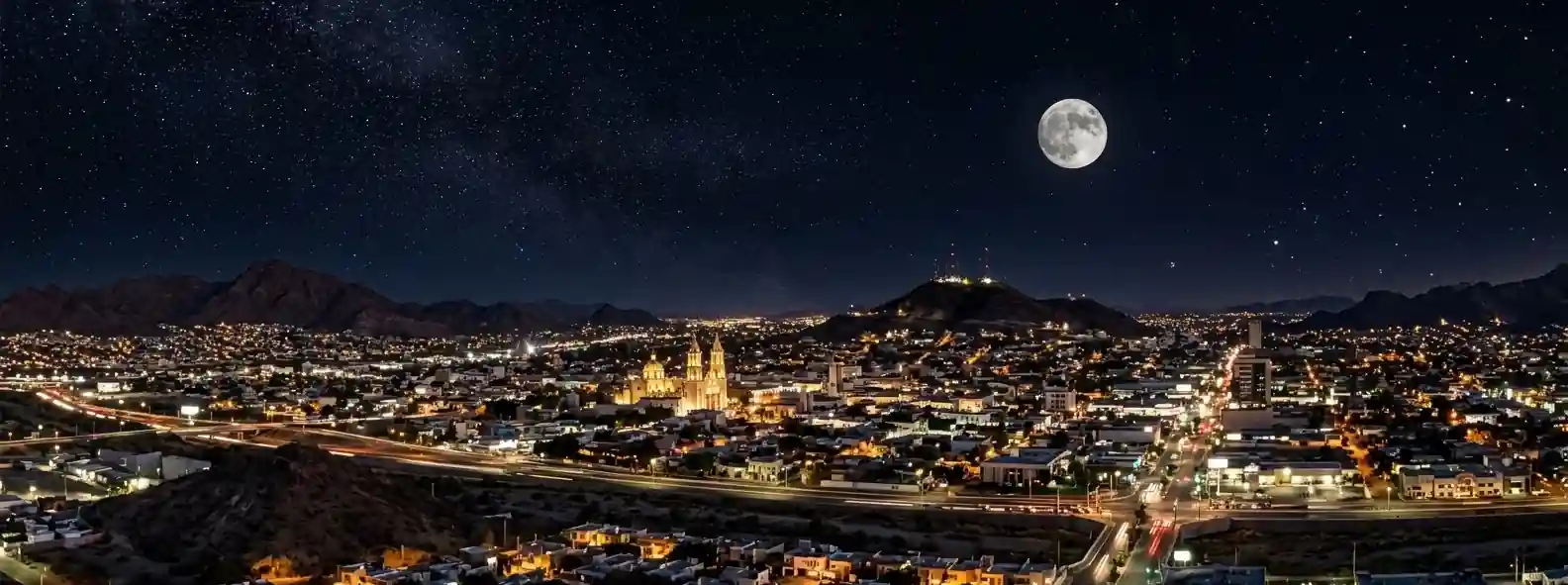
☽ Best Places to View the Moon in Hermosillo, Mexico
Hermosillo calls itself Ciudad del Sol, the City of the Sun, and the Sonoran Desert's dry, generally clear air makes it a genuinely good place to watch the sky once that sun goes down. The city's best-known landmark, Cerro de la Campana, has served as a lookout point since long before it had a name in Spanish, and a handful of central plazas, a reopened park, and a real astronomical observatory round out the in-town options — with the Gulf of California a couple of hours away for anyone chasing a darker horizon. As always, the moon's exact rise time and direction shift with the date and your observing location, so it's worth checking both against whichever spot you're planning around. Here are six useful moon-viewing options in the area, each suited to a different kind of visit.
Cerro de la Campana
A 319-metre rocky hill in the center of the city, a ceremonial site for the Comca'ac (Seri) people long before it became Hermosillo's official lookout point in 1909, with a paved road spiraling up to a nearly complete panoramic view of the city. Free to visit. Open daily, 8 a.m.–8 p.m. Address: Bella Vista, near Angel Flores.
Plaza Zaragoza
Hermosillo's main plaza since 1865, facing the Catedral de la Asunción, the Palacio de Gobierno, and the Palacio Municipal, with a cast-iron Moorish-style kiosk brought from Florence, Italy. Free, generally accessible as a public square; frequent evening cultural events. Address: historic center, facing the cathedral.
Centro Ecológico de Sonora
A Sonoran Desert zoo and botanical park with its own Astronomical Observatory for public night-sky viewing. General park hours are seasonal and daytime-only (recently 8 a.m.–3 p.m. in cooler months); the observatory runs separate evening sessions — check the current schedule for both. Address: Blvd. Abelardo L. Rodríguez 16.
Bosque Urbano La Sauceda
A large riverside park that reopened in 2025 after roughly a decade closed, with a wetland, an open-air forum, walking and jogging paths, and family attractions. Free to enter. Hours have been limited while later construction phases continue (recently Fri 4–9 p.m., Sat–Sun 9 a.m.–9 p.m.) — check the current schedule, since access has been expanding as work progresses. Address: Comonfort y Dr. Paliza S/N, Colonia Centenario.
Cerrito de la Virgen
A smaller, quieter hill on the city's south side, climbed by a staircase of roughly 180 steps to a painted image of the Virgin of Guadalupe (in place since 1957) and a panoramic desert sunset view. Free, generally accessible. Address: Los Mirasoles neighborhood.
Bahía de Kino
A Gulf of California beach town roughly 108 km (about 1.5 hours by road) west of Hermosillo, with wide public beaches, the Isla Tiburón nature reserve visible offshore, and a genuinely darker sky than anywhere in the city. Free public beach access. Address: via Highway 100 (Carretera a Bahía de Kino).
◉ Best Times for Moon Photography
📷 Quick Photography Tips
Hermosillo runs on Pacific Time year-round (UTC−7). Unlike most of Mexico, the state of Sonora does not observe daylight saving time, so Hermosillo stays on the same clock time all year. PhotoPills or Stellarium will handle the moon's exact rise azimuth for any of these spots automatically.
The moon phase today in Hermosillo is shown in detail above — complete with exact illumination percentage, moonrise/set times, and the best local spots to see it. For the moon phase today in any other city worldwide, visit our Dynamic Moon Phase Calculator on the home page.
◐ What the Experience Actually Feels Like
Cerro de la Campana draws a steady stream of visitors as sunset approaches, since the spiral road up is popular for exactly that reason, and the view stretches across nearly the whole city from the summit. It's also a place with real history behind the postcard shot — the Comca'ac (Seri) people used the hill as a gathering and ceremonial site long before it became the city's official viewpoint.
Plaza Zaragoza stays busy well into the evening, with families, food stalls, and frequent cultural events around the historic kiosk. The cathedral and government buildings framing the square are lit at night, giving the plaza a backdrop even on evenings without a scheduled event.
The Centro Ecológico's observatory is a different kind of stop from anywhere else on this list — a working public facility built specifically for viewing the night sky, run separately from the zoo's own daytime hours. It's worth checking the observatory's current session schedule directly rather than assuming it lines up with a daytime park visit.
"The Centro Ecológico's observatory is a working public facility built specifically for viewing the night sky, run on its own schedule separate from the zoo's daytime hours."
✓ Your Hermosillo Moon Chase Checklist
Before You Go
- Check the moon's rise time and azimuth for your date and observing location — alignment with Cerro de la Campana, the plaza, or a specific landmark depends on both
- Check both the moon's rise time and each site's current hours — the Centro Ecológico's observatory and Bosque Urbano La Sauceda both run on schedules separate from (and more limited than) a typical park's daytime hours
- Verify Site Access: La Sauceda's hours have been expanding in phases as construction continues — confirm current days and hours before heading over
- Use PhotoPills or Stellarium to check whether the moon will align with a specific landmark on your date
- Check the forecast for monsoon dust and storms in summer, and plan around extreme heat at any time of year
- If you're heading to Bahía de Kino, plan for a couple of hours' drive each way and check current road conditions
What to Bring
- A telephoto lens — 200mm or longer can be useful when you want a relatively large moon beside a distant landmark, depending on your shooting distance
- Water and sun protection for Cerro de la Campana or Cerrito de la Virgen, where the climbs are exposed with little shade
- A remote shutter release or a 2-second timer to avoid shake on tripod shots, where tripods are permitted
- Sturdy footwear for the roughly 180 steps up Cerrito de la Virgen
- A backup viewing location in case your first choice is crowded, closed, or hosting an event
On the Night
- Arrive at least 30–45 minutes early when photographing during a scheduled event or observatory session
- If autofocus struggles in the low light, switch to manual focus and focus carefully on the moon's edge
- Bracket your exposures — one for the bright lunar disc, one for the darker hillside or plaza below
- If the moon looks soft or hazy right at moonrise, consider waiting until it climbs higher above the horizon; the longer path through the atmosphere at low altitude increases scattering and distortion
- At the Centro Ecológico or Bosque Urbano La Sauceda, plan around each site's current posted hours rather than assuming unrestricted evening access
? Hermosillo Moon Phase — Frequently Asked Questions
Q. What is the moon phase today in Hermosillo?
The moon phase today in Hermosillo is a Waning Crescent with 34% illumination. The next full moon is in 22 days, on Oct 25. Moonrise is at 12:01 AM and moonset at 2:34 PM.
Q. Where is the best place to view the moon in Hermosillo?
Cerro de la Campana, a 319-metre hill in the centre of the city, is the best-known lookout, with a paved road spiralling up to a nearly complete panorama and free entry. Plaza Zaragoza, the main plaza facing the cathedral and government palaces, is a lively public square with frequent evening events, and Cerrito de la Virgen on the south side is a quieter hill reached by about 180 steps. The Centro Ecológico de Sonora has its own astronomical observatory for public night-sky viewing, Bosque Urbano La Sauceda is a large riverside park reopened in 2025, and Bahía de Kino on the Gulf of California, about 108 km west, offers a much darker sky than anywhere in the city.
Q. Where does the moon rise and set in Hermosillo, and how high does it climb?
At about 29°N, Hermosillo sees the moon rise and set within roughly 30° of due east and due west. A winter-solstice full moon climbs very high, reaching the mid-to-high 80s of degrees and passing close to the zenith, while a summer full moon culminates much lower, at roughly 35°. Because Cerro de la Campana gives a nearly complete view over the city, you can watch the moon over a broad horizon, but whether it lines up with a particular landmark depends on the date and your exact position, so check the rise azimuth with a planning app such as PhotoPills or Stellarium.
Q. How do desert conditions affect moon viewing in Hermosillo?
Hermosillo's Sonoran Desert setting often gives dry, clear air and good visibility outside the summer monsoon, which runs roughly from July to September and can bring sudden storms and blowing dust. Check the forecast for dust and haze along with cloud, and plan around extreme heat at any time of year, particularly for the exposed climbs at Cerro de la Campana and Cerrito de la Virgen where there is little shade. City lighting rarely limits the lunar disc itself, but a genuinely darker sky is found at Bahía de Kino, a couple of hours from the city.
Q. Can I look at the moon through a telescope in Hermosillo?
Yes, the Centro Ecológico de Sonora has its own Astronomical Observatory for public night-sky viewing. The observatory runs separate evening sessions from the park's seasonal, daytime-only hours, which were recently 8 a.m. to 3 p.m. in the cooler months, so check the current schedule for both before you go rather than assuming it lines up with a daytime visit to the zoo and botanical park.
Q. What camera settings work best for moon photography in Hermosillo, and why does the moon look so big near the horizon?
For a bright full moon, the Looney 11 rule (f/11, ISO 100, 1/100 s) is a useful starting point, then adjust from your histogram, and shoot RAW and bracket so both the lunar disc and the darker hillside or plaza below keep their detail. Low on the horizon the moon can look strikingly large, but that is the moon illusion, a perceptual effect rather than a real change in size, and a photograph does not preserve it automatically. Framing a large moon beside a landmark comes down mostly to your shooting distance and focal length, so a telephoto of 200 mm or longer is useful. If the moon looks soft right at moonrise, wait for it to climb, since the longer path through the atmosphere increases scattering and distortion.
Q. Can I photograph the moon in Hermosillo after dark?
Access varies by site. Cerro de la Campana is free and open daily from 8 a.m. to 8 p.m., so plan for an early-evening moon or confirm current hours. Plaza Zaragoza is generally accessible as a public square but can host cultural events, so check rules before setting up a tripod. Bosque Urbano La Sauceda has had limited hours while construction phases continue, recently Friday 4–9 p.m. and Saturday–Sunday 9 a.m.–9 p.m., so confirm the current schedule. Cerrito de la Virgen is generally accessible, and Bahía de Kino has free public beach access via Highway 100.
Q. Does this page work for cities besides Hermosillo?
This page is set up specifically for Hermosillo, Mexico. For the moon phase in any other city or location worldwide, use the Dynamic Moon Phase Calculator on the moonphase.today home page.
✦ Explore Further
Moon Phase Today: Chihuahua
Check tonight's moon phase in Chihuahua, east of Hermosillo across the Sierra Madre.
📍Moon Phase Today: Culiacán
See the moon over Culiacán, south of Hermosillo on Mexico's Pacific plain.
🇲🇽Moon Phase in Mexico
Browse moon phase pages for cities across Mexico, from Tijuana to Cancun.
🌍World Moon Phase Directory
Find the moon phase, rise and set times for cities in every region of the world.
NASA Moon Phase & Libration Gallery
NASA's Scientific Visualization Studio's daily renders of the moon's exact phase, libration, and orientation, straight from official mission data.