
Moon Phase Today Chihuahua
On Sunday, October 4, 2026, the moon in Chihuahua is a Waning Crescent with 34% illumination. Moon age: 23.7 days.
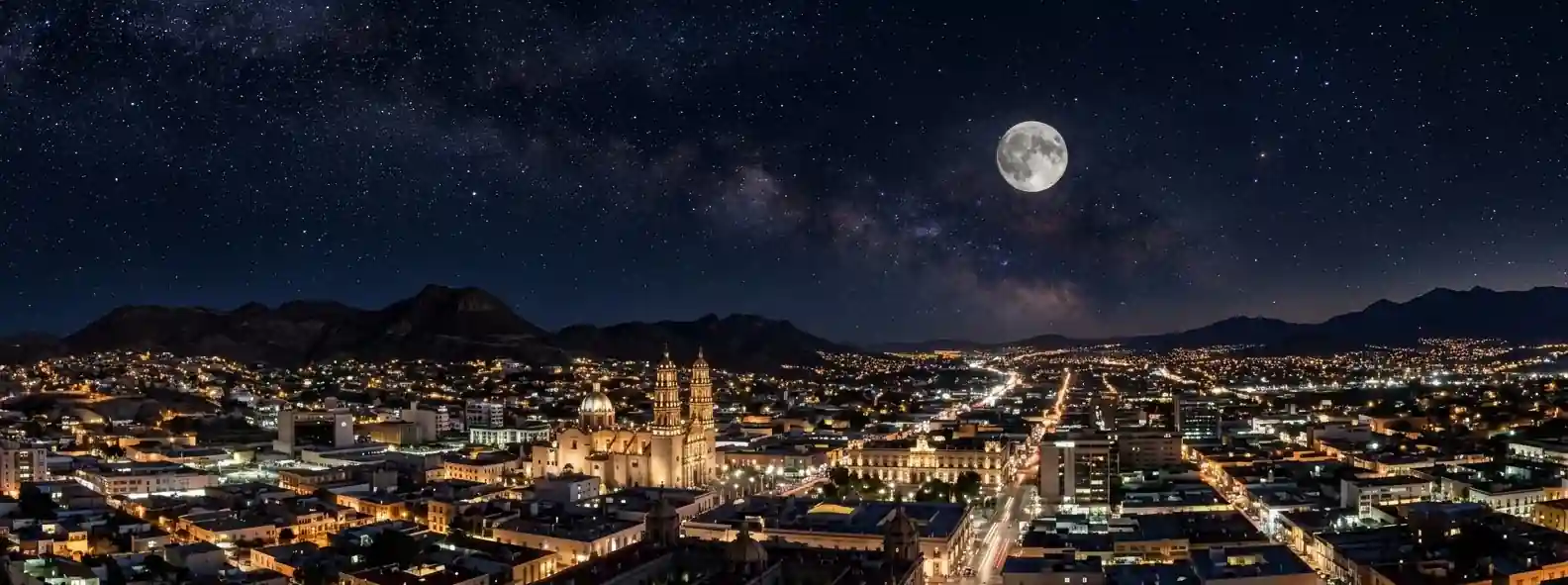
☽ Best Places to View the Moon in Chihuahua, Mexico
Chihuahua lies in the central part of the state within a broad urban basin, with the Río Chuvíscar and Río Sacramento among the principal rivers crossing the city. The Tres Presas area southwest of the urban center provides reservoir landscapes and open sightlines, while surrounding higher terrain provides elevated perspectives.
Parque Metropolitano Tres Presas – Reservoir Corridor
Current state planning documents identify Presa El Rejón, Presa Chihuahua and Presa Chuvíscar as the Parque Metropolitano Tres Presas area southwest of the city. Presa El Rejón is a reservoir on the El Rejón arroyo with a total storage capacity of about 6 million m³. Now converted into a metropolitan park with facilities for cycling, kayaking and family activities, with viewpoint offering view of lake and Family Monument.
Presa El Rejón Viewpoint – Open Lake Horizons
On the southwestern outskirts of Chihuahua, a park encompasses the Presa El Rejón reservoir. The park is a good place to get a sense of Chihuahua's topography and see surrounding terrain. Situated near Centro Cultural Universitario, the park encompasses the picturesque dam and surrounding lake offering open water and shoreline foreground with unobstructed sky suitable for Moon-over-water compositions rather than dark-sky observing.
Cerro Grande Area – Elevated City Perspectives
Elevated terrain offers panoramic views over Chihuahua. Cerro Grande is featured on the city's coat of arms and provides a recognizable photographic foreground. Avoid assuming the hilltop itself is publicly accessible at night; use surrounding public viewpoints and check current access rules before planning a nighttime session.
Parque El Reliz – Urban Trail System
Large urban park with trails, sports areas and open spaces near Presa El Rejón. Popular destination for outdoor enthusiasts with paved and unpaved paths for cycling and walking. Check current park hours before planning a Moon session as conditions and facility hours can vary.
Presa Chihuahua & Presa Chuvíscar – Southwestern Reservoirs
Part of the southwestern reservoir area forming the Parque Metropolitano Tres Presas. Presa Chihuahua and Presa Chuvíscar provide open water and shoreline foregrounds for low-angle Moon photography. These are urban recreation areas, so they are useful for Moon-over-city and Moon-over-water compositions rather than dark-sky observing. Confirm access for evening use.
Centro Histórico & Plaza de Armas – Cityscape Foregrounds
Historic center with cathedral, Government Palace and open plazas. Urban plazas provide heritage architecture foregrounds and open sky views within city center, better for cityscape Moon compositions than dark-sky observing.
◉ Best Times for Moon Photography in Chihuahua
📷 Quick Tips for Chihuahua
🕐 Timezone
Central Standard Time (CST) — UTC−6 year-round; no daylight-saving clock changes. The special Chihuahua municipalities that use a different schedule are Coyame del Sotol, Ojinaga and Manuel Benavides, not Chihuahua municipality.
📍 Geography Note
Horizons: Municipality forms part of the Río Conchos drainage system, with city's principal waterways including Río Chuvíscar and Río Sacramento. Tres Presas area southwest of urban center provides reservoir landscapes and open sightlines. Parque Metropolitano Tres Presas consists of Presa El Rejón, Presa Chihuahua and Presa Chuvíscar per current state planning documents. Southwestern reservoir area, not southern chain, with open water and shoreline foreground and unobstructed sky useful for photography.
Elevation: Chihuahua is a high-elevation inland city; surrounding terrain varies substantially across municipality. City is at roughly 1,400 m above sea level per INEGI Aspectos geográficos, with terrain rising and falling across surrounding municipality. Presa El Rejón reservoir on El Rejón arroyo with total storage capacity about 6 million m³ per official state material.
Access: Parque Metropolitano Tres Presas area popular destination for outdoor enthusiasts near Centro Cultural Universitario offering sport fishing and water activities. Check current hours and facility schedules before Moon session. Cerro Grande Area elevated city perspectives, avoid assuming hilltops publicly accessible at night. Parque El Reliz urban trail system with varying hours.
The moon phase today in Chihuahua is shown above. For moon phase today anywhere else, visit the calculator on our home page.
◐ What It Feels Like
At Parque Metropolitano Tres Presas southwest of the urban center, three reservoirs including Presa El Rejón on the El Rejón arroyo provide open water and shoreline foreground with unobstructed sky and views of the surrounding basin.
From the El Rejón viewpoint you have a view of the lake and Family Monument, with a sense of the city's topography within a broad urban basin crossed by Río Chuvíscar and Río Sacramento.
In the historic center, open plazas provide urban foregrounds under high desert sky, with elevated perspectives available from surrounding higher terrain.
"Reservoir corridor southwest of downtown, broad urban basin with two principal rivers, and elevated terrain for broader sightlines."
✓ Checklist for Lunar Observers
Before You Go
- Check moonrise / moonset azimuth — determines alignment along reservoir corridors and elevated perspectives
- Check SMN — weather, wind and visibility can vary with terrain and elevation
- Confirm access — Tres Presas reservoir corridor with Presa El Rejón reservoir capacity about 6 million m³, southwestern reservoir area, Cerro Grande Area elevated perspectives check access, Parque El Reliz varying hours
What to Bring
- Telephoto and wide lenses for reservoir and cityscape foregrounds
- Tripod for landscape and bracketing — useful for multi-exposure, close Moon can be handheld
- Lens cloth for dust, dew or condensation
- Water and an extra layer — temperatures can change noticeably with elevation and after sunset in high-elevation inland city
On the Night
- Manual focus on lunar limb
- Bracket for disc vs. foreground — difficult to retain both in single exposure
- Stay on designated paths and observe posted access rules
- Higher ground can provide broader sightlines, but darkness still depends on nearby artificial light and current access
? Chihuahua Moon Phase — Frequently Asked Questions
Q. What is the moon phase today in Chihuahua?
The moon phase today in Chihuahua is a Waning Crescent with 34% illumination. The next full moon is in 22 days, on Oct 25. Moonrise is at 12:43 AM and moonset at 3:13 PM.
Q. Where is the best place to view the moon in Chihuahua?
The Parque Metropolitano Tres Presas area southwest of the city, made up of Presa El Rejón, Presa Chihuahua and Presa Chuvíscar, offers reservoir shorelines with open water and unobstructed sky. The Presa El Rejón viewpoint looks over the lake and the Family Monument, and Parque El Reliz nearby has trails and open spaces. For a cityscape foreground, the plazas of the Centro Histórico give heritage architecture, while the elevated terrain around Cerro Grande, which appears on the city's coat of arms, offers panoramic views. All are urban or urban-edge sites, so they suit Moon-over-water and Moon-over-city compositions rather than dark-sky observing.
Q. Where does the moon rise and set in Chihuahua, and how high does it climb?
At about 29°N, Chihuahua sees the moon rise and set within roughly 30° of due east and due west. A winter-solstice full moon climbs very high, reaching the mid-to-high 80s of degrees above the southern horizon and passing close to the zenith, while a summer full moon culminates much lower, at roughly 35°. Because the reservoirs lie southwest of the urban centre, the moon can be framed rising over the city from the shorelines or setting over the reservoir area from the city side, depending on the date and your exact position, and higher terrain around Cerro Grande can change the visible horizon.
Q. How do the dry high-desert conditions affect moon viewing in Chihuahua?
Chihuahua is a high-elevation inland city at roughly 1,400 m above sea level, so there is less atmosphere overhead than at the coast, but weather, wind and visibility can vary substantially with terrain and elevation across the municipality. Dust, haze and cloud can still soften the moon, and city lighting washes out earthshine even though the lunar disc itself is easy to see. Check the Servicio Meteorológico Nacional for haze, wind and cloud before heading out, and bring an extra layer because temperatures can change noticeably after sunset.
Q. What camera settings and phases work best for moon photography in Chihuahua?
For a full moon, start with Looney 11 (f/11, ISO 100, 1/100 s) and refine using your histogram, particularly when the moon is low over surrounding terrain. The moon is much brighter than a dark foreground, so shoot RAW and bracket or blend exposures to keep both crater detail and the reservoir, shoreline and city lights. A waxing gibbous works well at blue hour at Presa El Rejón and Parque El Reliz while the foreground is still lit, and a full moon rises around sunset. A 200–400 mm lens compresses the moon against dam walls, the Family Monument or Cerro Grande, and still air is needed if you want reflections on the reservoirs.
Q. Can I photograph the moon at Chihuahua's reservoirs and hills after dark?
Access varies by site and should be confirmed. The Tres Presas area is a popular outdoor destination near the Centro Cultural Universitario with sport fishing and water activities, so check current hours and facility schedules before an evening session. Parque El Reliz has varying hours, Presa Chihuahua and Presa Chuvíscar should be confirmed for evening use, and the hilltop at Cerro Grande should not be assumed publicly accessible at night, so use surrounding public viewpoints and check current access rules.
Q. Does this page work for cities besides Chihuahua?
This page is set up specifically for Chihuahua, Mexico. For the moon phase in any other city or location worldwide, use the Dynamic Moon Phase Calculator on the moonphase.today home page.
✦ Explore Further
Moon Phase Today: Juárez
Check tonight's moon phase in Juárez, north of Chihuahua on the US border.
🌵Moon Phase Today: Hermosillo
See the moon over Hermosillo, across the Sierra Madre in Sonora's desert.
🇲🇽Moon Phase in Mexico
Browse moon phase pages for cities across Mexico, from Tijuana to Cancun.
🌍World Moon Phase Directory
Find the moon phase, rise and set times for cities in every region of the world.
NASA Moon Phase & Libration Gallery
NASA's Scientific Visualization Studio's daily renders of the moon's exact phase, libration, and orientation, straight from official mission data.