
Moon Phase Today Dallas
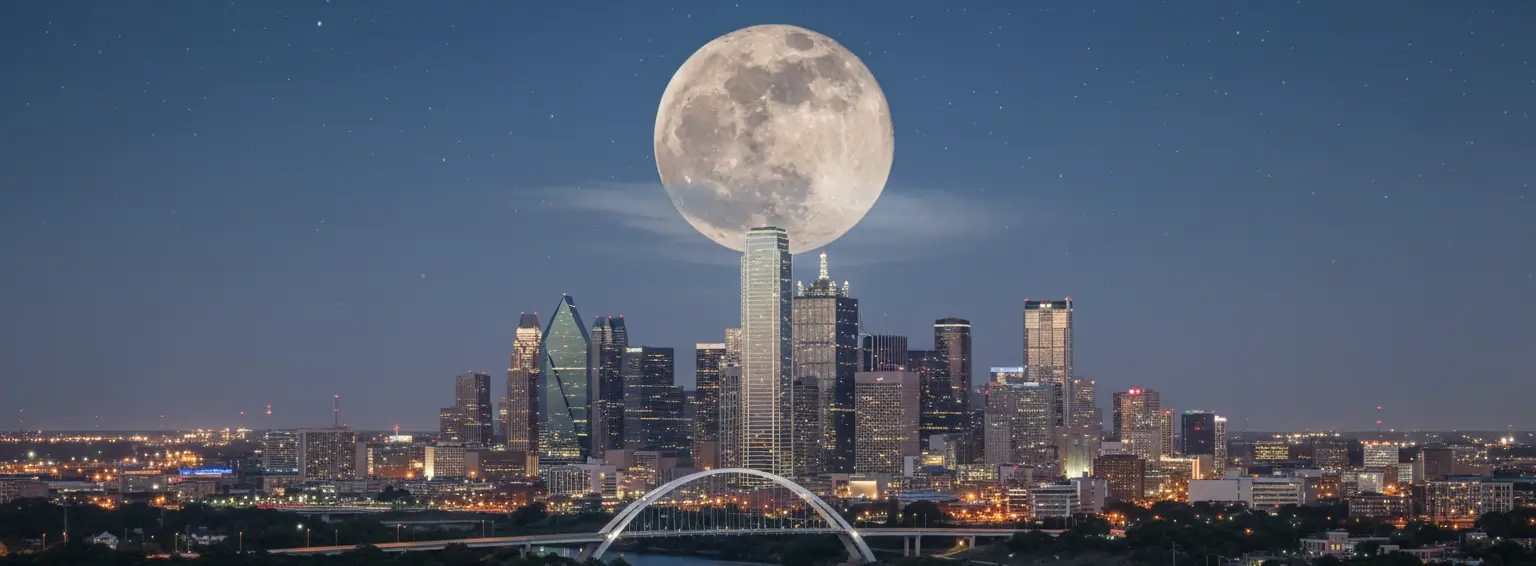
On Sunday, November 22, 2026, the moon in Dallas is a Waxing Gibbous with 96% illumination. Moon age: 12.8 days.
A Field Guide to the Moon's Phases
The Moon has eight phases across a cycle of about 29.5 days. Its shape never changes; what shifts is how much of its sunlit half faces Earth. Moonrise slips roughly 50 minutes later each night, which is why each phase has its own best viewing window.
Viewing conditions across the US
The lower 48 sit between roughly 25°N and 49°N, a band narrow enough that most Americans see fairly similar Moon behavior: a high, steep arc in winter and a lower, lazier path in summer. Hawaii, near 20°N, sees the Moon on a much more vertical track, closer to how it looks near the equator. Alaska reaches past 70°N, where the seasonal swing is severe enough that a winter full moon can stay up for days and a summer one barely clears the horizon. Use the calculator above for exact moonrise, moonset, and phase times for your location.
Jump to a phase
The eight moon phases at a glance
| Phase | Cycle day | Illuminated | Rises and sets | Best for |
|---|---|---|---|---|
| The New Moon | ~1 | 0% | Rises at sunrise, sets at sunset | Faint galaxies and nebulae |
| Waxing Crescent | ~4 | 1-49% | Visible after sunset in the west | Earthshine |
| First Quarter | ~8 | 50% | Visible from noon to midnight | Telescope views along the terminator |
| Waxing Gibbous | ~11 | 51-99% | Rises afternoon, sets after midnight | Copernicus crater |
| The Full Moon | ~15 | 100% | Rises at sunset, up all night | Ray craters like Tycho |
| Waning Gibbous | ~19 | 99-51% | Rises late evening, up into morning | Oceanus Procellarum, Grimaldi |
| Last Quarter | ~22 | 50% | Rises around midnight, up in the morning | Clavius crater field |
| Waning Crescent | ~26 | 49-1% | Visible just before sunrise in the east | Earthshine at dawn |
The New Moon
Day ~1 of cycle · Rises at sunrise, sets at sunset
The Moon tracks the Sun across the sky almost exactly, so its night side faces us and the sky goes fully dark. Poor conditions for lunar viewing, but the single best window each month for spotting distant galaxies and nebulae.
The science
A solar eclipse can only happen at new moon, when the Moon passes directly between Earth and the Sun. It doesn't happen every month because the Moon's orbit is tilted about 5 degrees relative to Earth's.
What to look for
With moonlight out of the picture, dark-sky sites open up views of the Milky Way's core and galaxies that would otherwise be lost in the glow.
Fun fact
Some anglers still plan trips around the new moon, on the folklore that fish feed differently without moonlight.
Waxing Crescent
Day ~4 of cycle · Visible after sunset in the west
A narrow arc of light appears low over the western horizon shortly after sundown. Look closely and you may catch Earthshine, a soft secondhand glow lighting up the rest of the disc, courtesy of sunlight reflected off Earth.
The science
Only a thin edge of the sunlit hemisphere is visible from Earth at this point, seen from a sharp angle, which is why the crescent looks so slim.
What to look for
Earthshine: a dim blue-grey tint across the dark part of the disc. It's sunlight bouncing off Earth's clouds and oceans onto the Moon, then back to your eyes.
Fun fact
"Crescent" comes from the Latin crescere, meaning "to grow," the same root as the word "increase."
First Quarter
Day ~8 of cycle · Visible from noon to midnight
Despite the name, half the visible disc is lit; "quarter" refers to how far the Moon is through its orbit. The terminator runs straight down the middle, and shadows along it are as long and sharp as they get. This is a telescope night.
The science
The Sun, Earth, and Moon sit at a 90-degree angle here. That right angle is why the terminator, the light-dark boundary, reads as a nearly straight line.
What to look for
Low-angle sunlight along the terminator stretches every shadow, pulling crater rims and mountain ridges into sharp 3D relief. One of the best telescope nights of the month.
Fun fact
The Sea of Tranquility, where Apollo 11 landed, sits just inside the lit half at first quarter, within reach of a modest backyard telescope.
Waxing Gibbous
Day ~11 of cycle · Rises afternoon, sets after midnight
Illumination climbs past 50% toward full, and the Moon is already up well before dark. Copernicus crater, freshly lit, becomes the night's headline feature.
The science
The terminator has crossed past the disc's midpoint and curves along the left edge, a sign that more than half the visible face is catching sunlight.
What to look for
Copernicus: a crater about 93 km wide and nearly 4 km deep, with a cluster of central peaks on its floor.
Fun fact
Because it rises in the afternoon, the waxing gibbous is one of the easier phases to catch in daylight. Scan the eastern sky not long after lunch.
The Full Moon
Day ~15 of cycle · Rises at sunset, visible all night
The whole face is lit, and it's the brightest the Moon ever gets, though flat, head-on lighting makes it the weakest night for surface texture. Ray craters like Tycho more than make up for it.
The science
Sunlight strikes the Moon head-on at full moon, so shadows disappear and craters flatten out visually. That same lighting makes the pale ejecta rays around young craters pop.
What to look for
Tycho's ray system fans out across a huge stretch of the southern highlands from a crater about 85 km wide, and Copernicus adds its own rays.
Fun fact
The Moon reflects only around 12% of the sunlight that hits it, yet that's still plenty to cast a visible shadow on a clear night.
Waning Gibbous
Day ~19 of cycle · Rises late evening, visible into morning
Moonrise now comes late in the evening, and the shadow edge begins to eat into the disc from the left. Oceanus Procellarum and the crater Grimaldi get their turn in the spotlight, a phase serious observers shouldn't skip.
The science
This is essentially the waxing gibbous run in reverse: the lit portion shrinks from the left while the terminator sweeps across the disc.
What to look for
Oceanus Procellarum, the Moon's largest dark plain at roughly 2,500 km across, is well lit, along with the heavily cratered basin Grimaldi near the western edge.
Fun fact
This window is easy to overlook because it comes late at night, but the terminator lighting is just as good as during the waxing phases.
Last Quarter
Day ~22 of cycle · Rises around midnight, visible in the morning
Half-lit again, but on the opposite side from first quarter, rising close to midnight. The terminator sweeps across the southern highlands, and the crater field around Clavius is the standout feature.
The science
The same 90-degree Sun-Earth-Moon geometry as first quarter is back, with the illuminated half flipped to the other side of the disc.
What to look for
Clavius: a sprawling walled plain about 225 km across, packed with an arc of smaller craters inside it. One of the most photogenic formations on the Moon.
Fun fact
Rising around midnight and setting near noon, the last quarter moon is often still visible in a bright morning sky, which catches casual sky-watchers off guard.
Waning Crescent
Day ~26 of cycle · Visible just before sunrise in the east
A thin arc hangs in the pre-sunrise sky, the last visible sliver before the Moon disappears into the glare of the Sun for a day or two. Earthshine often makes one more appearance before the reset.
The science
As with the waxing crescent, Earthshine returns here: faint light bounced off Earth, illuminating the Moon's dark portion just enough to notice.
What to look for
Best caught by early risers. Shallow morning light picks out craters such as Schickard and the Schiller-Zucchius basin in the Moon's southwestern region.
Fun fact
Many historical calendars treated this final sliver as the close of a lunar month, with the reappearance of a waxing crescent marking the start of the next.
? Dallas Moon Phase — Frequently Asked Questions
Q. What is the moon phase today in Dallas?
The moon phase today in Dallas is a Waxing Gibbous with 96% illumination. The next full moon is in 2 days, on Nov 24. Moonrise is at 3:42 PM and moonset at 4:56 AM.
Q. Where is the best place to view the moon in Dallas?
White Rock Lake is the classic Dallas shot — the moon rises over the water with the downtown skyline in the middle distance, and calm nights give a clean lake reflection of the whole scene. Trinity Overlook Park and the Ronald Kirk Pedestrian Bridge offer a more architectural composition with the Margaret Hunt Hill Bridge cables in frame, and Klyde Warren Park puts you right in the middle of downtown for a close, urban view of Reunion Tower.
Q. Why does Dallas's flat landscape make it good for moon photography?
Dallas sits on flat blackland prairie with no mountains or coastline to break the horizon, so the moon rises fast and clears the skyline quickly. That means positioning matters more here than in hillier cities — the compact downtown cluster, anchored by Reunion Tower's lit ball, is what gives an otherwise plain horizon a strong focal point to shoot against.
Q. When is the next full moon in Dallas?
The date of the next full moon is calculated live and shown in the "Next Full Moon" card above. For a full breakdown of upcoming full moons and their traditional names, see our next full moon guide.
Q. Does Dallas observe daylight saving time?
Yes. Dallas runs on Central Standard Time (CST, UTC−6) in winter and switches to Central Daylight Time (CDT, UTC−5) from the second Sunday in March to the first Sunday in November. All times shown on this page already account for the correct offset.
Q. What's the best time of year for moon photography in Dallas?
October through April brings the clearest air and a more southerly moon path, giving the tightest alignments with Reunion Tower. September and March are mild with low humidity too. Summer heat and humidity create noticeable haze at the horizon, so the moon looks orange and soft rather than sharp during the hottest months.
Q. Does this page work for cities besides Dallas?
This page is set up specifically for Dallas, TX. For the moon phase in any other city or location worldwide, use the Dynamic Moon Phase Calculator on the moonphase.today home page.
✦ Explore Further
Moon Phase Today: Austin
Check tonight's moon phase in Austin, about 200 miles south down I-35.
📷Moon Photography Guide
Camera settings, lenses, and techniques for shooting sharp, well-exposed moon shots.
🌗Why Does the Moon Rise and Set?
The simple science behind moonrise and moonset, and why the timing shifts every day.
🌌Best Dark Sky Parks in the USA
Worth a look before a Cedar Ridge Preserve trip — a guide to the country's darkest, most protected night skies.
NASA Moon Phase & Libration Gallery
NASA's Scientific Visualization Studio's daily renders of the moon's exact phase, libration, and orientation, straight from official mission data.