
Moon Phase Today Austin
On Friday, October 9, 2026, the moon in Austin is a New Moon with 0% illumination. Moon age: 28.9 days.
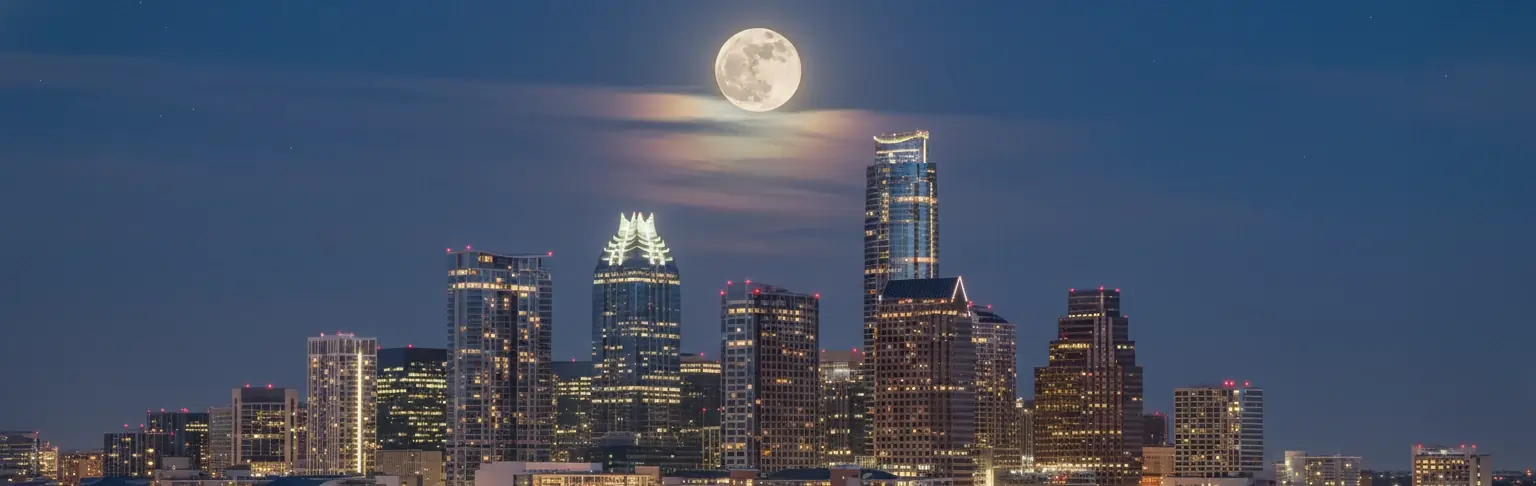
☽ Best Places to View the Moon in Austin
Austin occupies a uniquely Texan geography — the Colorado River winds through the heart of the city, dammed into a chain of urban lakes that give downtown Austin something most inland Texas cities lack: still, reflective water right beneath the skyline. Lady Bird Lake sits at the city's core, flanked by hike-and-bike trails and open shores that face the Frost Bank Tower, The Independent "Jenga" building, and the rest of the rapidly evolving downtown cluster. To the west, the limestone bluffs of the Texas Hill Country rise abruptly above Lake Austin, giving vantage points that look back over the city with the Pennybacker Bridge's weathering-steel arch in the foreground. Austin moonrises are defined by two things: the Colorado River's mirror-flat surface on calm evenings, and the dramatic compression of the Hill Country bluffs — limestone, cedar, and open sky meeting a skyline that has grown faster than almost any other in the American South.
Congress Avenue Bridge – South Bank Boardwalk
The iconic Austin moon shot. From the Ann W. Richards Congress Avenue Bridge south bank boardwalk, the moon rises dead-centre behind the bridge arches and climbs above the downtown skyline — Frost Bank Tower and The Independent "Jenga" building frame it closely. Lady Bird Lake sits perfectly flat below on calm evenings, doubling the whole composition in reflection. The bridge is also home to the world's largest urban bat colony — up to 1.5 million Mexican free-tailed bats that emerge at dusk from mid-March through October. Note that bright full moons can suppress bat flights; the best bat viewing happens on darker, warmer evenings around new moon, making this a site with two distinct seasonal personalities. Free, open 24/7; parking along Riverside Drive or the South Congress corridor.
Lou Neff Point – Zilker Park / Auditorium Shores
The widest, most open view of Lady Bird Lake and the downtown skyline from ground level. Lou Neff Point at the western end of Auditorium Shores juts into the lake, giving a near-360° water view: the moon rises over the skyline to the east while Barton Creek flows in from the south behind you. The grassy open shores allow low tripod setups that pull the lake reflection into the full bottom half of the frame. Longhorn Dam's lights add a secondary foreground element to the east. Free, open 24/7; large parking areas off Barton Springs Road.
Mount Bonnell – Covert Park Summit
Austin's most dramatic elevated viewpoint. Mount Bonnell rises 775 feet (236 m) above sea level on the limestone bluffs above Lake Austin — one of the highest accessible points within the city limits. The 106-step limestone staircase leads to a pavilion with sweeping views west over Lake Austin and east toward downtown, with the Pennybacker Bridge visible from certain angles. Long telephoto lenses compress the skyline dramatically from this height. Note: Covert Park is open 5 AM–10 PM daily — confirm your moonrise time falls within these hours. Free parking at the base; no lights on the staircase, so bring a torch for the descent.
Pennybacker Bridge Overlook – Loop 360
Austin's most architectural moon composition. From the 360 Bridge overlook trail on the limestone bluffs above Lake Austin, the moon rises over the Hill Country while the Pennybacker Bridge's weathering-steel arch sweeps across the foreground below — 1,150 feet of span with no columns touching the water. The downtown skyline is faintly visible to the southeast. The overlook trail is a short, rocky 0.25-mile climb from the roadside pull-offs on the west side of Loop 360 just north of the bridge. Note that no official parking lot exists — spaces are informal shoulder pull-offs on Loop 360, a high-speed highway; arrive early, especially on weekends. Free, open 24/7.
Auditorium Shores – East End & Boardwalk
The eastern end of Auditorium Shores and the adjacent boardwalk along the north bank of Lady Bird Lake give a complementary angle to Lou Neff Point — the moon rises over the water with the Congress Avenue Bridge framing the right side of the composition and the downtown towers filling the left. The boardwalk's wooden railings provide ready foreground geometry for wide-angle shots. More sheltered from wind than the open lake at Lou Neff; better for the still-water reflections that are Austin's signature moonrise element. Free, open 24/7; accessible from South First Street.
Butler Metro Park – Lake Shore Trail
A quieter alternative to the busier Auditorium Shores positions. Butler Metro Park's lake shore trail runs along the south bank of Lady Bird Lake east of the Congress Avenue Bridge, offering an uninterrupted east-facing view across the water with the skyline framed above the far bank. Fewer crowds than the main boardwalk; the boardwalk sections give direct water-level access that produces the clearest lake-surface reflections of any position on the south shore. Free, open 24/7; accessible from Riverside Drive.
◉ Best Times for Moon Photography
📷 Quick Photography Tips
Austin operates on CST (UTC−6) in winter and CDT (UTC−5) during daylight saving time. Clocks go forward on the second Sunday in March and back on the first Sunday in November. Texas observes DST statewide. Apps like PhotoPills or Stellarium set to Austin apply the correct offset automatically — useful for calculating exact moonrise times against the Lady Bird Lake skyline geometry throughout the year.
For the moon phase in any other city worldwide, visit our Dynamic Moon Phase Calculator for instant lunar data tailored to wherever you are.
The moon phase today in Austin, TX is shown in detail below — complete with exact illumination percentage, moonrise/set times, and the best local spots to see it. For the moon phase today in any other city or location worldwide, visit our Dynamic Moon Phase Calculator on the home page.
◐ What the Experience Actually Feels Like
There is a quality to a full-moon night on Lady Bird Lake that takes most visitors by surprise. You expect a pleasant urban park — hike-and-bike trail, kayakers, the downtown towers lit in the distance. And then you find a still evening in October, the lake absolutely flat, and the moon comes up over the East Austin horizon behind the Congress Avenue Bridge arches and the Jenga building and Frost Bank Tower and every single element of that composition repeats itself perfectly in the water below. Austin, it turns out, has been quietly building one of the most photogenic urban moonrise scenes in the American South, one skyscraper at a time.
The Congress Avenue Bridge has a double life that photographers need to understand. In the months from mid-March through October, up to 1.5 million Mexican free-tailed bats roost beneath the bridge — the world's largest urban bat colony. They emerge at dusk each evening in a continuous stream that can last 45 minutes, spiralling east over Lady Bird Lake. But here is the nuance: a bright full moon actually suppresses bat flights, as the light-sensitive bats are reluctant to emerge into an illuminated sky. The bridge delivers two great spectacles, but rarely at the same time. Plan a near-full-moon visit for the moonrise photography, and a darker night near new moon if the bats are the priority.
Austin's Hill Country topography gives the city a second completely different mode of moon photography. From the limestone bluffs at Mount Bonnell or the Pennybacker Bridge overlook, you look back at the city from the west — the Colorado River winding below you, the weathering-steel arch of the 360 Bridge sweeping across Lake Austin, and the downtown cluster glowing on the horizon seven miles to the east. The moon rises into that eastern sky, and from 775 feet above the river you watch it climb above a city that is still building its skyline, still deciding what it wants to be, and still surrounded by more open limestone hill country than any other state capital in America.
"The lake absolutely flat, the moon coming up behind the Congress Avenue Bridge arches — and every element of that composition repeats itself perfectly in the water below."
✓ Your Austin Moon Chase Checklist
Before You Go
- Check the moonrise time and phase on this page — the moon's position relative to the Congress Avenue Bridge arches changes significantly by date and requires PhotoPills planning to hit the tightest alignments
- Target the 48–72 hour window before full moon if possible — the moon rises during golden hour and the warm Texas light gives Lady Bird Lake its richest amber reflection
- Check wind conditions along Lady Bird Lake — calm nights only produce the mirror reflections that make the Congress Avenue and Auditorium Shores compositions exceptional; even a light breeze breaks them
- If planning Mount Bonnell, confirm your moonrise time falls within park hours — Covert Park is open 5 AM to 10 PM daily; some late-season moonrises fall close to the 10 PM closing time
- If combining a bat watch with moon photography at Congress Avenue Bridge, note that full and near-full moons suppress bat flights — the two spectacles work best on different nights
What to Bring
- Sturdy tripod — the lake breeze along Lady Bird Lake is persistent and the exposed limestone bluffs at Mount Bonnell and the Pennybacker overlook can surprise with sudden gusts from the Hill Country
- A telephoto lens of 200–400mm for skyline compression shots from Mount Bonnell and the Pennybacker overlook — the distance back to downtown rewards longer glass significantly
- Insect repellent from April through October — the Lady Bird Lake shore and boardwalk trail have significant mosquito activity after dark in warm months; the exposed limestone bluffs are less affected
- A wide-angle lens for the Congress Avenue Bridge positions — the bridge arches overhead and the lake below create a strong architectural frame that rewards focal lengths of 16–24mm
- A torch for Mount Bonnell — the 106-step limestone staircase has no lighting, and the descent after a moonrise session requires care on irregular stone steps in the dark
- Water and sunscreen if arriving before dusk in summer — Austin's heat index can exceed 105°F in July and August, and the exposed lake shore positions have minimal shade
On the Night
- Arrive at your viewpoint 30–45 minutes before moonrise — the sky over downtown Austin transitions through a warm amber-to-indigo gradient as the moon approaches, and the skyline lights come up against it before the moon appears
- At the Congress Avenue Bridge south bank, position yourself on the boardwalk east of the bridge for the best combined view of the arches, the lake reflection, and the full downtown skyline behind
- Shoot RAW throughout — the dynamic range between the moon, the lit bridge deck, the downtown towers, and the dark lake water requires separate exposures blended in post for the full scene
- Stay 20–30 minutes after moonrise — as the moon climbs above the horizon haze it sharpens and brightens rapidly, and the skyline compositions from both the lakeside and bluff positions get cleaner as the twilight fades
- In summer, accept that atmospheric haze will soften the moon at the horizon — shoot slightly later when it has climbed clear of the worst of the heat shimmer, and use the deep amber colour as mood rather than fighting it
? Austin Moon Phase — Frequently Asked Questions
Q. What is the moon phase today in Austin?
The moon phase today in Austin is a New Moon with 0% illumination. The next full moon is in 17 days, on Oct 25. Moonrise is at 6:35 AM and moonset at 6:35 PM.
Q. Where is the best place to view the moon in Austin?
The Congress Avenue Bridge is Austin's signature moonrise spot, framing the moon behind the bridge arches with the downtown skyline reflected in Lady Bird Lake below. Lou Neff Point and Auditorium Shores give wide, open lakeside angles, while Mount Bonnell and the Pennybacker Bridge overlook on the Hill Country bluffs above Lake Austin offer elevated views back over the whole city.
Q. Why does moon visibility change so much in Austin through the year?
Austin sits at roughly 30.3° N, so it doesn't see the extreme seasonal daylight swings of far-northern cities. What changes here is heat and humidity: Texas summers bring thick horizon haze that makes the moon look soft and orange as it rises, while the drier, cooler air from October through April gives much sharper, clearer views of the moon against the skyline and the Hill Country bluffs.
Q. When is the next full moon in Austin?
The date of the next full moon is calculated live and shown in the "Next Full Moon" card above, already adjusted for Austin's time zone.
Q. Does Austin observe daylight saving time?
Yes. Austin runs on Central Standard Time (CST, UTC−6) in winter and switches to Central Daylight Time (CDT, UTC−5) from the second Sunday in March to the first Sunday in November. All times shown on this page already account for the correct offset.
Q. What's the best time of year for moon photography in Austin?
October through April offers the clearest, driest air and the sharpest moonrises over the downtown skyline and Hill Country bluffs. Summer heat and humidity create significant horizon haze that softens and reddens the moon low in the sky, so photographers chasing crisp detail get the best results once the Texas heat breaks in fall.
Q. Does this page work for cities besides Austin?
This page is set up specifically for Austin, TX. For the moon phase in any other city or location worldwide, use the Dynamic Moon Phase Calculator on the moonphase.today home page.
✦ Explore Further
Moon Phase Today: San Antonio
Check tonight's moon phase in San Antonio, about 80 miles south-west.
📷Moon Photography Guide
Camera settings, lenses, and techniques for shooting sharp, well-exposed moon shots.
📐Looney 11 Exposure Calculator
Dial in the exact f-stop, ISO, and shutter speed for a full moon — the same rule used in our Austin skyline tips.
🌆Blue Hour Calculator
Find tonight's exact blue hour window to time golden-hour moonrise shots over Lady Bird Lake.
NASA Moon Phase & Libration Gallery
NASA's Scientific Visualization Studio's daily renders of the moon's exact phase, libration, and orientation, straight from official mission data.