

Ever notice how the Moon, just like the Sun, seems to play a cosmic game of hide-and-seek? One moment it’s high in the night sky, and the next it’s gone, only to reappear hours later. The answer comes down to two things happening at once: Earth’s spin, and the Moon’s own slow orbit around our planet.
Earth’s Spin Is the Main Event
The biggest reason the Moon (and the Sun, and every star) rises and sets each day is simply that Earth is constantly spinning. Picture standing on a giant, smoothly turning merry-go-round: things in the distance seem to appear on one side, drift across your view, and disappear on the other — but they’re not moving around you, you’re the one turning.
Earth works the same way, completing one full spin roughly every 24 hours. That spin is what produces day and night, and moonrise and moonset along with them.
- As your part of Earth spins toward the Moon, it appears to rise above the horizon, the same way the Sun rises each morning.
- As your part of Earth spins away from the Moon, it appears to set below the horizon.
If Earth stopped spinning, the Moon would simply hang in place — visible from half the planet, invisible to the other half, all day long. It’s Earth’s rotation that turns the sky into a moving picture.
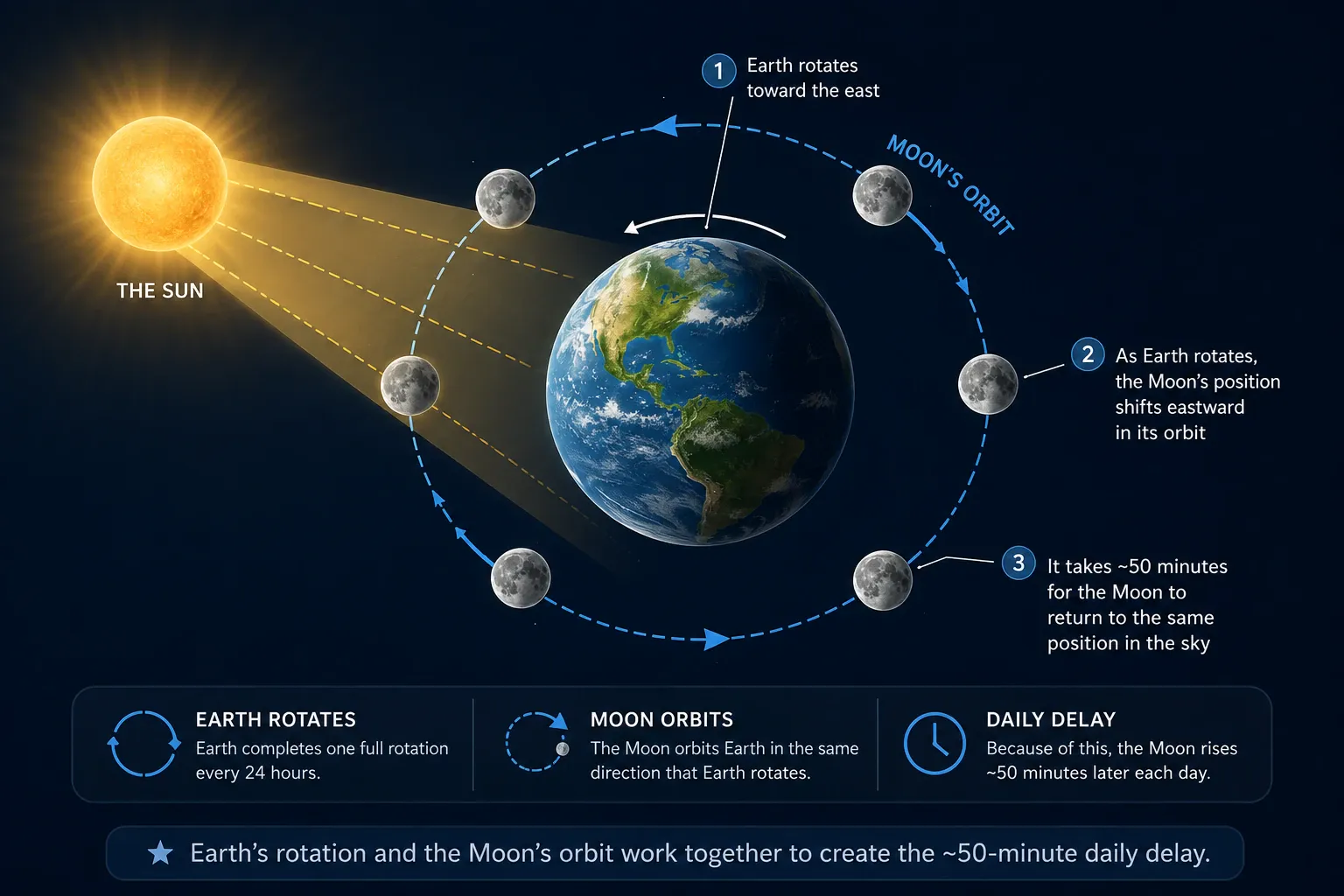
The Moon’s Slow Dance: Why It’s Not Exactly Like the Sun
If it’s just Earth spinning, why don’t the Moon and Sun rise and set at the same time every day? Because the Moon is doing its own moving too — orbiting Earth once roughly every 27.3 days.
Earth spins fast (once every 24 hours), while the Moon creeps slowly eastward against the background stars — about 13° a day. Because the Moon keeps inching forward in its orbit, Earth has to spin a little further each day to “catch up” and bring the Moon back into view at the same spot in the sky.
That extra catch-up time adds up to roughly 50 minutes: the Moon rises about 50 minutes later each day than it did the day before. It’s this steady daily shift that moves moonrise through the morning, afternoon, evening, and back around again over the course of a month.
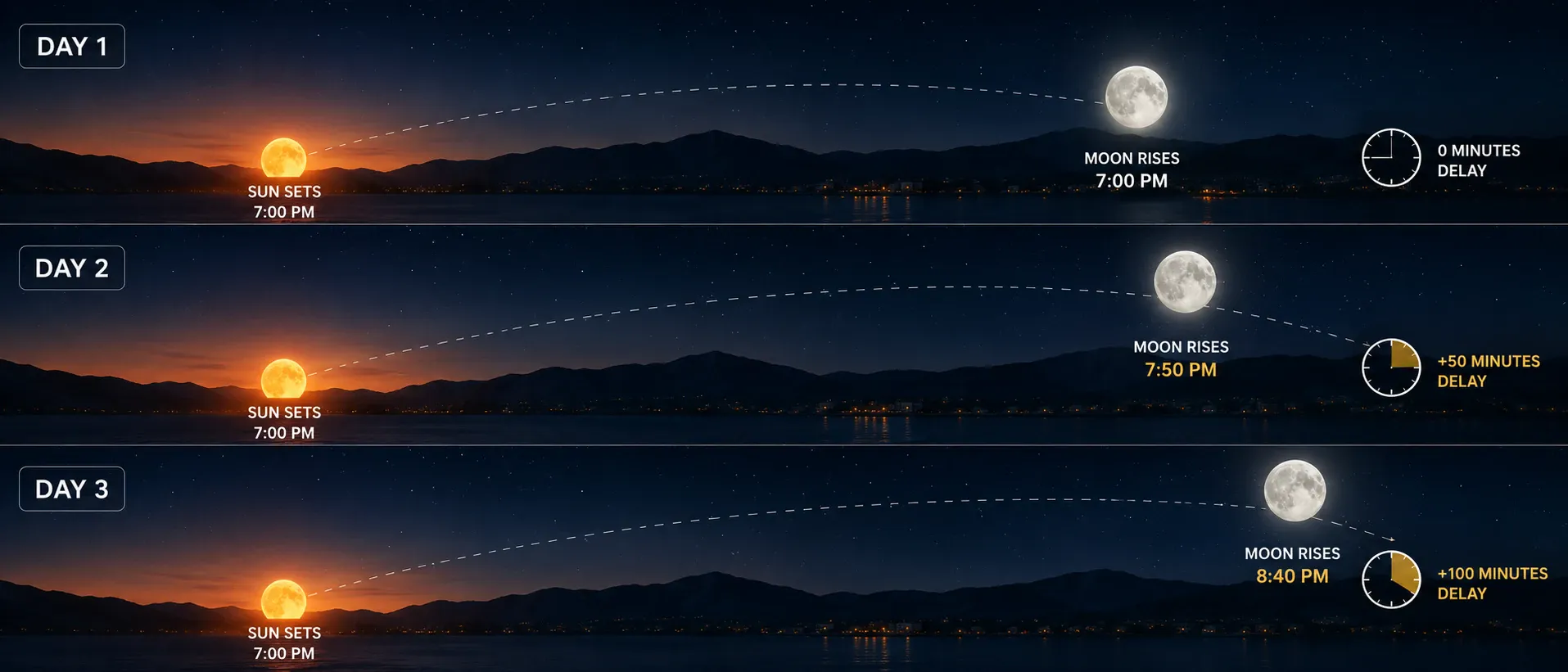
A Day-by-Day Example
- Day 1: A Full Moon rises right as the Sun sets.
- Day 2: The Sun has already set, but the Moon hasn’t cleared the horizon yet — you’ll wait about 50 extra minutes for it to appear.
- Day 3: The wait stretches out a little more.
This continues across the month: moonrise creeps into the middle of the night, then the early morning, and so on, until it circles back around to sunset again by the time the Moon is full once more.
The Phases Play a Role Too
The Moon’s phases — New, Quarter, Full, and everything between — also give a rough clue to its daily schedule:
| Phase | Typical Rise | Typical Set |
|---|---|---|
| New Moon | With the Sun | With the Sun |
| First Quarter | Around noon | Around midnight |
| Full Moon | Around sunset | Around sunrise |
| Last Quarter | Around midnight | Around noon |
A New Moon rises and sets with the Sun — since its lit side faces away from Earth, it’s essentially invisible anyway. A Full Moon, on the other hand, rises right as the Sun sets and stays up the entire night.
Tides and the Moon’s Influence
The Moon’s daily journey across the sky isn’t just a pretty sight — it’s a driving force behind Earth’s tides. The Moon’s gravity pulls on Earth’s oceans, creating a high tide on the side of Earth facing the Moon, and a second high tide on the opposite side of the planet caused by inertia. As the Moon moves through the sky each day, that pull moves with it, which is why most coastlines see two high tides and two low tides roughly every 24 hours.
A Daily Spectacle
The next time you see the Moon peeking over the horizon — whether it’s a sliver of crescent or a glorious full orb — you’ll know what’s behind the show: Earth’s constant spin giving us a changing view, and the Moon’s own slow orbit nudging its schedule a little later each day. It’s a predictable, logical dance that turns the night sky — and sometimes the daytime sky — into one of the best free shows around.
FAQ: The Moon’s Daily Show — Why It Rises and Sets
Why does the Moon rise and set just like the Sun?
Because Earth is constantly spinning on its axis. As our planet turns, the Moon appears to rise in the east and set in the west — just like the Sun and stars.
Why doesn’t the Moon rise and set at the same time every day?
The Moon is slowly orbiting Earth, moving eastward about 13° per day. Because of this motion, Earth has to spin a little more each day for the Moon to appear in the same spot again — making the Moon rise about 50 minutes later daily.
How much later does the Moon rise each day?
On average, the Moon rises about 50 minutes later each day than it did the day before. This steady delay is what causes the Moon to appear at different times throughout the month.
Do the Moon’s phases affect when it rises and sets?
Yes. New Moon rises and sets with the Sun (usually invisible); First Quarter rises around noon and sets around midnight; Full Moon rises at sunset and sets at sunrise; Last Quarter rises around midnight and sets around noon.
Does my location on Earth influence when I see the Moon rise or set?
Absolutely. Your latitude and longitude affect the timing and angle of moonrise and moonset. Near the poles, the Moon’s path can appear very low or very high in the sky depending on the season.
If Earth stopped spinning, would the Moon still rise and set?
Not in the way we see it now. Without Earth’s rotation, the Moon wouldn’t appear to rise or set daily — instead, it would move very slowly across the sky due to its 27-day orbit around Earth.
Why is the Moon sometimes visible during the day?
Because its rising and setting times shift each day, there are many points in the lunar cycle when the Moon is above the horizon during daylight hours — perfectly normal and easy to spot.
Does the Moon’s daily movement affect anything on Earth?
Yes. As the Moon moves across the sky, its gravity pulls on Earth’s oceans, creating a high tide on the side of Earth facing the Moon and a second high tide on the opposite side caused by inertia — the two daily tidal cycles most coastlines experience.