
Moon Phase Sapporo
On Saturday, October 10, 2026, the moon in Sapporo is a New Moon with 0% illumination. Moon age: 29.0 days.
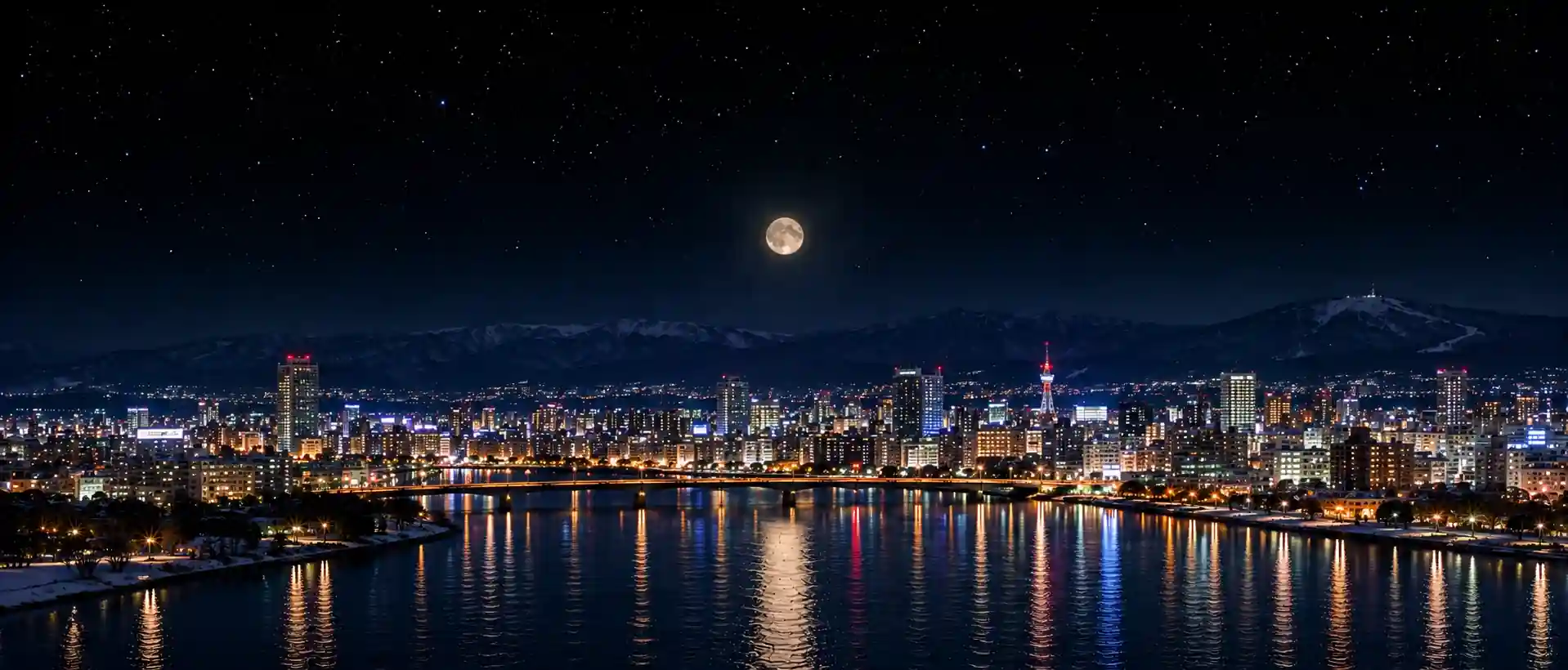
☽ Best Places to View the Moon in Sapporo, Japan
Sapporo sits at roughly 43.06°N on Hokkaido, Japan's northernmost main island, with around 1.97 million residents. Laid out on a grid inspired by Kyoto and American frontier towns, the city built its identity around Odori Park and a ring of hills and towers meant to be looked out from. That habit paid off: Sapporo has twice been selected as one of Japan's "Three New Major Night Views," in 2015 and 2018, based on votes from thousands of people certified through the country's night-view appreciation program. Between the hills, the towers, and the deep snow that defines its winters, Sapporo gives an unusually wide range of places to watch the moon.
Mount Moiwa Ropeway & Observation Deck
A 531-metre summit reached by ropeway and cable car south of the city centre, with a 360-degree observation deck at the top. It's one of the anchors of Sapporo's two selections as one of Japan's "Three New Major Night Views," and one of the highest and most expansive panoramic viewpoints over Sapporo.
Sapporo TV Tower
A 147.2-metre tower at the eastern end of Odori Park, with an observation deck around 90 metres up giving 360-degree views over the park and downtown. It's the most central of Sapporo's elevated viewpoints, an easy walk from the Snow Festival's main site in winter — note that tripods are not permitted on the observation deck itself.
JR Tower Observation Deck T38
An observation floor on the 38th floor of the tower directly connected to Sapporo Station, about 160 metres above ground, giving a grid-like view over the city in all four directions. Its central location makes it the easiest of Sapporo's towers to combine with an evening around the station.
Odori Park
A roughly 1.5-kilometre park running through the centre of the city, host to the Sapporo Snow Festival in winter and the White Illumination light display each year. It's the city's easiest option for an ordinary evening, with the TV Tower providing a distinctive foreground for moon photography.
Okurayama Ski Jump Observation Point
A viewing point at the start of the ski jump used in the 1972 Winter Olympics, around 307 metres above sea level, looking out over downtown Sapporo and the Ishikari Plain. It's a different, ski-jump-framed alternative to the central towers.
Maruyama Park & Hokkaido Shrine
A park built around the Maruyama Wild Forest, a stand of virgin forest designated a special natural treasure, next to Hokkaido Shrine and Maruyama Zoo. It's a genuinely tree-covered option on this list without needing to leave the city, best enjoyed on its maintained daytime and early-evening paths.
◉ Best Times for Moon Photography
📷 Quick Photography Tips
Sapporo runs on Japan Standard Time (UTC+9) year-round — Japan does not observe daylight saving time. Its latitude, well north of Tokyo, Yokohama, and Nagoya, means noticeably shorter winter days and longer summer ones than Japan's more southerly cities.
For the moon phase in any other city worldwide, visit our Dynamic Moon Phase Calculator for instant lunar data tailored to wherever you are.
The moon phase today in Sapporo, Japan is shown in detail above — complete with exact illumination percentage, moonrise/set times, and the best viewpoints to see it. For the moon phase today in any other city or location worldwide, visit our Dynamic Moon Phase Calculator on the home page.
◐ While Actually There
Sapporo takes its own night view seriously enough that there's an actual, ongoing selection process behind the claim. Since 2015, Japan's Night View Tourism Convention Bureau has periodically asked thousands of people certified through the country's night-view appreciation program to vote on the nation's best views, and Sapporo has placed second in both rounds held so far, just behind Nagasaki. Mount Moiwa, the TV Tower, and Odori Park's winter illuminations are the specific reasons cited.
What makes the moon here different from Japan's cities further south is mostly a matter of latitude and weather. Sapporo sits far enough north that winter days shrink noticeably and summer evenings stretch out later, and its winters bring genuinely serious snow — enough that, when the timing lines up, a full moon over Odori Park's snow-covered ice sculptures during the Snow Festival makes for a specifically Hokkaido kind of scene.
Most of the spots on this list are straightforward to reach, but the elevated attractions all have their own operating hours, and Mount Moiwa and Okurayama also depend on transport or facility access rather than being open around the clock. Odori Park, the TV Tower, and JR Tower are all within easy reach of Sapporo Station if you'd rather keep things simple, and Maruyama Park is a short ride from the centre if you want the more forested option instead.
"Sapporo's night view isn't just a nice line in a brochure — it's been selected twice by a nationwide panel of certified night-view experts as one of Japan's three best."
✓ Your Sapporo Moon Chase Checklist
Before You Go
- Check the moonrise time and phase on this page for each night of your stay
- Check current Mount Moiwa ropeway and cable car hours before planning an evening around it — they vary by season
- Check current Okurayama observation point hours and access, since it's further from the centre than the towers
- Check the Snow Festival dates if visiting in winter, since Odori Park gets very crowded during the event
- Check current trail conditions at Maruyama Park in winter, when paths can ice over
What to Bring
- Serious winter clothing for December–February — nights are routinely below freezing, with temperatures around −10°C possible during cold spells
- A tripod, useful at open, elevated spots like Mount Moiwa and Okurayama — but check the rules first, since Sapporo TV Tower doesn't allow them
- Sturdy, grippy footwear for icy pavements and trails, which are routine through the winter
- A small flashlight for dark approaches and winter conditions, while staying on maintained paths
- Spare camera batteries kept warm in an inner pocket — cold drains them fast
On the Night
- Arrive 20–30 minutes before moonrise at open spots like Odori Park or the towers
- Confirm last ascent times at Mount Moiwa and JR Tower before planning a visit around moonrise
- Shoot RAW and bracket exposures, especially where snow, ice, and moonlight all reflect differently than on bare ground
- Mind icy paths and stairs at every outdoor spot in winter
- Watch the northern sky as well on rare clear, active nights — Sapporo's latitude gives it a somewhat better chance of aurora than Japan's cities further south, though sightings remain uncommon
? Moon Phase Sapporo — Frequently Asked Questions
Q. What is the moon phase today in Sapporo?
The moon phase today in Sapporo is a New Moon with 0% illumination. The next full moon is in 17 days, on Oct 26. Moonrise is at 5:07 AM and moonset at 4:36 PM.
Q. Where is the best place to view the moon in Sapporo?
Mount Moiwa, a 531-metre summit reached by ropeway and cable car with a 360-degree observation deck, is one of the anchors of Sapporo's two selections among Japan's "Three New Major Night Views" and one of the highest panoramic viewpoints over the city. Sapporo TV Tower, 147.2 metres tall with an observation deck around 90 metres up, is the most central elevated viewpoint, and JR Tower's T38 observation floor, about 160 metres above ground, connects directly to Sapporo Station. Odori Park is the easiest ground-level option, Okurayama Ski Jump's observation point at about 307 metres gives a view over downtown and the Ishikari Plain, and Maruyama Park offers a tree-covered option within the city.
Q. Where does the moon rise and set in Sapporo, and how high does it climb?
At about 43°N, Sapporo's moon rises well to the northeast to southeast and sets well to the northwest to southwest over each month, swinging roughly 35–40° either side of due east and west depending on its declination. A winter full moon climbs high, to roughly 70–75° above the southern horizon, while a summer full moon stays low, peaking at about 20°. Sapporo's northerly latitude also means noticeably shorter winter days and longer summer evenings than Japan's more southerly cities, so moonrise times shift more between seasons, and where the moon lines up with a tower or hill depends on the date and your viewpoint.
Q. How do Sapporo's snow and cold affect moon viewing and photography?
Sapporo typically receives several metres of snow over a winter, and nights are routinely below freezing, with temperatures around −10°C possible during cold spells, so dress for genuine cold. Snow and ice reflect moonlight differently than bare ground, so shoot RAW and bracket exposures to keep both the moon and the brighter foreground, and use sturdy, grippy footwear for icy pavements and trails. Cold drains batteries fast, so carry spares in an inner pocket, and note that snowfall totals and winter lows vary considerably from year to year.
Q. What camera settings work best for moon photography in Sapporo?
For a bright full moon, start with the Looney 11 rule (f/11, ISO 100, 1/100 s) and adjust from your histogram. A tripod helps at open, elevated spots such as Mount Moiwa and Okurayama, which are more exposed to wind than the streets below, but check individual facility rules first, since tripods are not permitted on Sapporo TV Tower's observation deck. Odori Park's TV Tower makes a distinctive foreground for moon photography, and Maruyama Park's virgin forest gives a tree-covered foreground close to downtown.
Q. Can I photograph the moon over the Sapporo Snow Festival?
When the lunar cycle happens to coincide with the Sapporo Snow Festival in Odori Park, a moon over the illuminated snow and ice sculptures makes a particularly distinctive Sapporo composition. Check the festival dates and this page's phase calendar, and expect the park to be very crowded during the event. Odori Park also hosts the White Illumination light display each year.
Q. Can I photograph the moon in Sapporo after dark?
Access varies by site. Mount Moiwa's ropeway and cable car hours vary by season, so check current times and the last ascent before planning an evening around it. Okurayama's observation point is further from the centre than the towers and depends on transport and facility access, so check its hours. JR Tower's observation floor and Sapporo TV Tower have their own operating hours, and Maruyama Park is best enjoyed on its maintained daytime and early-evening paths, which can ice over in winter.
Q. Does this page work for cities besides Sapporo?
This page is set up specifically for Sapporo, Japan. For the moon phase in any other city or location worldwide, use the Dynamic Moon Phase Calculator on the moonphase.today home page.
✦ Explore Further
Moon Phase Today: Sendai
Check tonight's moon phase in Sendai, the nearest big city south of Hokkaido on Honshu.
📍Moon Phase Today: Niigata
See the moon over Niigata, across the Sea of Japan on Honshu's northwest coast.
🇯🇵Moon Phase in Japan
Browse moon phase pages for cities across Japan, from Sapporo to Kagoshima.
🌍World Moon Phase Directory
Find the moon phase, rise and set times for cities in every region of the world.
NASA Moon Phase & Libration Gallery
NASA's Scientific Visualization Studio's daily renders of the moon's exact phase, libration, and orientation, straight from official mission data.