
Moon Phase Niigata
On Saturday, October 10, 2026, the moon in Niigata is a New Moon with 0% illumination. Moon age: 29.0 days.
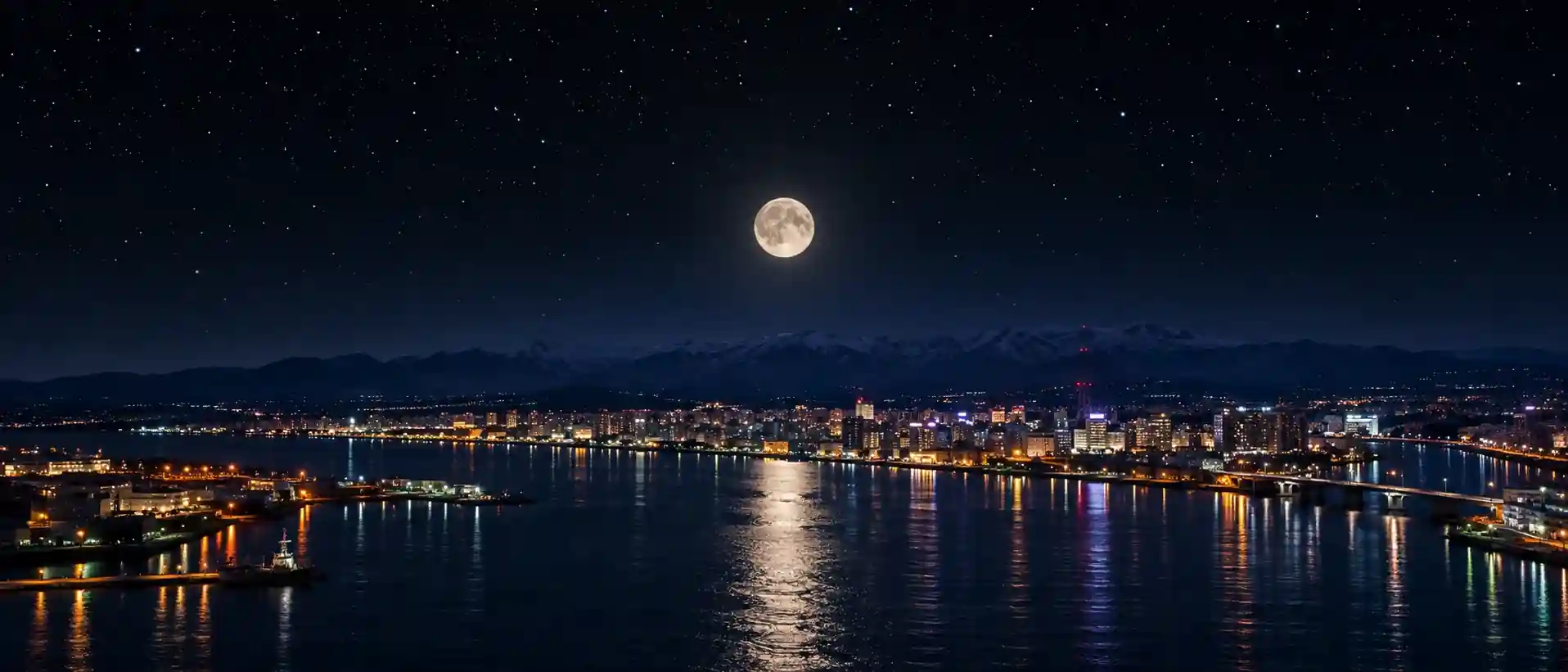
☽ Best Places to View the Moon in Niigata, Japan
Niigata sits at roughly 37.91°N on the Sea of Japan coast, the capital of Niigata Prefecture and the largest city on that coastline, with around 750,000 residents. It's the only government-designated city on the west coast of Honshu, and its port was designated as one of Japan's five treaty ports in 1858, officially opening to foreign trade in 1869. The Shinano River runs through the centre of the city, crossed by the historic Bandai Bridge, and ferries still leave from the waterfront for Sado Island, visible offshore on a clear day. Between the river, an observation deck built right into the port, and the ferry route out to Sado, Niigata gives a distinctly maritime set of places to watch the moon.
Toki Messe Observation Deck
A free observation deck 140 metres up on the 31st floor of this convention centre complex, completed in 2003. On a clear day it looks out over Sado Island, the Gozu mountain range, and the port where Sado-bound ferries depart just below — check current hours before planning a visit around moonrise.
Bandai Bridge & the Shinano River
A six-arched bridge dating to 1929 (rebuilding an 1886 original), designated an Important Cultural Property since 2004 and long considered the symbol of the city, illuminated after dark. Riverside paths and promenades around the bridge give an open, low-horizon view over the water running through the heart of Niigata.
Hakusan Park & Shrine
A historic park built around Hakusan Shrine, one of Japan's earliest urban parks and known for its distinct character across all four seasons. It offers a quieter, more contemplative option than the riverfront or the modern port district.
Furumachi Historic District
Niigata's old town, with narrower streets and older buildings than the rebuilt sections of the city. It's a good option for an easy evening walk with some historical texture.
Sado Kisen Ferry Terminal & Sado Island
Ferries leave from Niigata's waterfront for Sado Island in the Sea of Japan, a substantial trip best treated as its own excursion rather than an evening add-on — schedules vary seasonally, so check the current timetable. For those staying overnight, the island offers open sea views quite different from the mainland city.
Toyanogata Lake
A lake about 2 kilometres south of Niigata Station, ringed by parks and walking paths with bicycle rental available. Its open water gives a quieter, more residential alternative to the busier riverfront and port areas.
◉ Best Times for Moon Photography
📷 Quick Photography Tips
Niigata runs on Japan Standard Time (UTC+9) year-round — Japan does not observe daylight saving time, so the offset from UTC stays the same in every season.
For the moon phase in any other city worldwide, visit our Dynamic Moon Phase Calculator for instant lunar data tailored to wherever you are.
The moon phase today in Niigata, Japan is shown in detail above — complete with exact illumination percentage, moonrise/set times, and the best viewpoints to see it. For the moon phase today in any other city or location worldwide, visit our Dynamic Moon Phase Calculator on the home page.
◐ While Actually There
Niigata has been looking outward across the Sea of Japan for a long time. Its port was named one of the country's five treaty ports in 1858, even though the actual opening to foreign trade waited until 1869, and that same waterfront still sends ferries out to Sado Island today — a rare thing to have both a historic gateway and a working one in the same view. Toki Messe's observation deck puts that whole relationship on display at once: the port below, the ferries crossing, and Sado itself sitting on the horizon when the weather cooperates.
Inland, the Shinano River does the quieter work of organizing the rest of the city, crossed by the six stone arches of Bandai Bridge. Furumachi keeps a little more of that older texture than the rebuilt sections nearby, a good place for a walk with some genuine history underfoot.
None of it requires much planning beyond checking Toki Messe's current hours and the Sado ferry schedule if you're considering the crossing. The river, Furumachi, and Toyanogata Lake's public areas are all reasonable options for an ordinary evening.
"Niigata has been looking out toward Sado Island for well over a century — and its free observation deck puts you right at the point where the ferries still leave."
✓ Your Niigata Moon Chase Checklist
Before You Go
- Check the moonrise time and phase on this page for each night of your stay
- Check current Toki Messe observation deck hours before planning a visit around moonrise
- Check the Sado Kisen ferry timetable well in advance if you're considering a trip out to Sado Island
- Check the forecast for snow or icy conditions if visiting between December and February
- Check the forecast for typhoon activity if visiting in late summer or early autumn
What to Bring
- Serious winter clothing for December–February — Niigata's Sea of Japan coast sees regular, sometimes heavy snowfall
- A tripod, useful at open spots like the Shinano riverside and Toyanogata Lake
- Sturdy, grippy footwear for icy or snowy pavements in winter
- A light rain layer, especially during the June rainy season
- Spare camera batteries kept warm in an inner pocket during cold-weather sessions
On the Night
- Arrive 20–30 minutes before moonrise at open spots like the Shinano riverside or Toyanogata Lake
- Confirm Toki Messe's last admission time before planning a visit around moonrise
- Shoot RAW and bracket exposures, especially where the illuminated Bandai Bridge mixes with moonlight
- Mind icy paths and stairs at every outdoor spot in winter
- Watch for typhoon-related weather changes if visiting between summer and early autumn
? Niigata Moon Phase — Frequently Asked Questions
Q. What is the moon phase today in Niigata?
The moon phase today in Niigata is a New Moon with 0% illumination. The next full moon is in 17 days, on Oct 26. Moonrise is at 5:13 AM and moonset at 4:51 PM.
Q. Where is the best place to view the moon in Niigata?
The Toki Messe observation deck, a free deck 140 metres up on the 31st floor, looks out over the port, Sado Island and the Gozu mountain range on a clear day, though its hours should be checked before planning around moonrise. Bandai Bridge and the Shinano River's riverside paths give an open, low-horizon view over the water with the illuminated six-arched bridge as a foreground. Toyanogata Lake, ringed by parks and walking paths about 2 kilometres south of Niigata Station, is a quieter residential alternative. Hakusan Park and the Furumachi historic district suit an evening walk, while Sado Island is a separate ferry excursion.
Q. Where does the moon rise and set in Niigata, and how high does it climb?
At about 37.9°N, Niigata's moonrise and moonset points swing across the horizon each month, from roughly east-northeast to east-southeast for rising and west-northwest to west-southwest for setting. A winter full moon culminates high in the south, at roughly 75° above the horizon, while a summer full moon stays lower, peaking near 29°. Niigata sits on the Sea of Japan coast, so the sea lies to the north and west of the city and a setting moon can drop toward the water. Sado Island lies roughly west-southwest offshore, about where a full moon sets in spring and late summer, so on some evenings a setting moon can pass near it when visibility allows. A rising moon comes up over the plain and the mountains to the east. Check the azimuth for your date and exact spot.
Q. Is light pollution a problem for moon observing in Niigata?
The moon is bright enough to observe and photograph from almost anywhere in Niigata, so light pollution rarely limits the lunar disc itself. It does wash out earthshine on a thin crescent and any faint sky detail. The port, the illuminated Bandai Bridge and the city centre all carry substantial artificial lighting, so Niigata is a light-polluted site rather than a dark-sky one, best suited to moon-over-river and moon-over-port compositions. The sea to the north and west gives a clean low horizon, but the lit waterfront still washes out faint detail.
Q. What camera settings and phases work best for moon photography in Niigata?
For a full moon, start with Looney 11 (f/11, ISO 100, 1/100 s) and refine using your histogram, since it is a baseline rather than a guarantee. The moon is much brighter than the illuminated bridge and port, so shoot RAW and bracket or blend exposures to keep both crater detail and the foreground. A waxing gibbous is useful for blue hour over the Shinano while the foreground is still lit, and a full moon rises around sunset over the plain. A 200–400 mm lens helps isolate the moon against Bandai Bridge or the skyline, with a tripod for bracketing and manual focus on the moon using magnified live view.
Q. How do winter snow, the rainy season and typhoons affect moon viewing in Niigata?
Niigata has snowy winters typical of the Sea of Japan coast, with regular and sometimes heavy snowfall, so cloud and snow can close a lunar window and pavements, paths and stairs can be icy. Cold drains camera batteries quickly, so carry spares in an inner pocket and swap them rather than waiting for one to die. Summers are warm and humid, with a rainy season in June and typhoon risk from summer into early autumn, and humidity can leave condensation on lenses. Check local forecasts for cloud, snow and typhoon activity before heading out.
Q. What time zone are Niigata's moonrise and moonset times shown in?
Niigata runs on Japan Standard Time, UTC+9, year-round. Japan does not observe daylight saving time, so moonrise and moonset times stay on the same local clock in every season and the offset from UTC never changes.
Q. Can I shoot the moon at Niigata's viewpoints after dark?
Access varies by site. The Toki Messe observation deck is free, but its hours can vary by day of the week and season, so check current times and the last admission before planning an evening around it. Check the Sado Kisen ferry timetable well in advance if you are considering Sado Island, since it is a substantial trip in its own right and schedules vary seasonally. The Shinano riverside, Toyanogata Lake's parks and Furumachi are open urban spaces, though icy paths and stairs are a hazard in winter.
Q. Does this page work for cities besides Niigata?
This page is set up specifically for Niigata, Japan. For the moon phase in any other city or location worldwide, use the Dynamic Moon Phase Calculator on the moonphase.today home page.
✦ Explore Further
Moon Phase Today: Sendai
Check tonight's moon phase in Sendai, east of Niigata across the mountains on the Pacific side.
🌸Moon Phase Today: Saitama
See the moon over Saitama, south of Niigata across the mountains on the Kantō Plain.
🇯🇵Moon Phase in Japan
Browse moon phase pages for cities across Japan, from Sapporo to Kagoshima.
🌍World Moon Phase Directory
Find the moon phase, rise and set times for cities in every region of the world.
Sky Clarity
Check cloud cover and sky conditions before heading out, useful for Niigata's snowy winters and rainy season.