
Moon Phase Saitama
On Sunday, October 11, 2026, the moon in Saitama is a New Moon with 0% illumination. Moon age: 0.4 days.
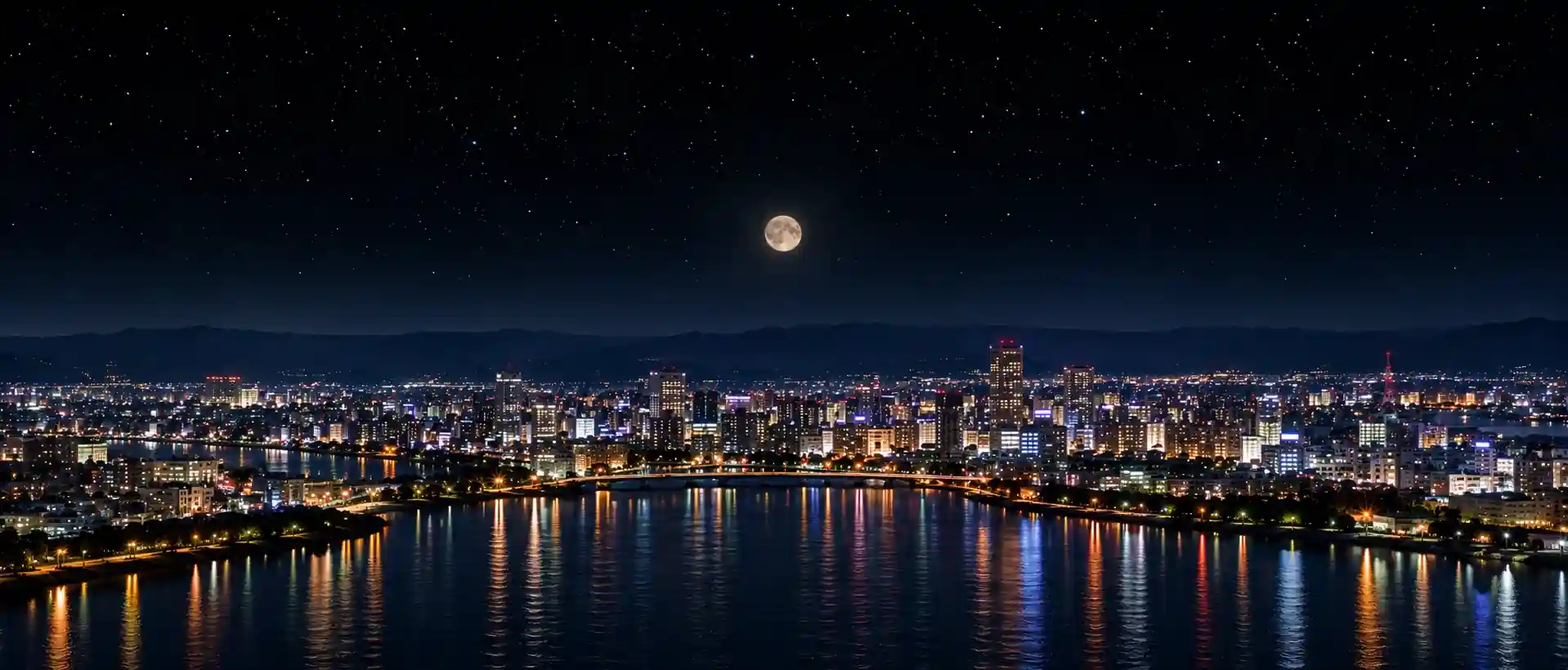
☽ Best Places to View the Moon in Saitama, Japan
Saitama sits at roughly 35.86°N on the Ōmiya Terrace of the Kantō Plain, about 25 kilometres north of central Tokyo, with a population of around 1.36 million. Formed in 2001 from the merger of Urawa, Ōmiya, and Yono (with Iwatsuki added in 2005), the city carries a much older history in its older districts — Ōmiya's Hikawa Shrine has a traditional history stretching back more than two thousand years. Between an ancient shrine approach, a park famous for its cherry blossoms, and a bonsai village unlike anywhere else in Japan, Saitama gives a quieter, more residential set of places to watch the moon than its giant neighbour to the south.
Hikawa Shrine & Its Approach
One of the principal Hikawa shrines serving the Tokyo and Saitama region, with a traditional history said to stretch back more than two thousand years. Its roughly 2-kilometre tree-lined approach from Ōmiya Station is often described as Japan's longest shrine approach, giving a long, quiet walk toward the shrine gates well suited to an evening under the moon.
Ōmiya Park
A roughly 68-hectare prefectural park next to Hikawa Shrine, known for its cherry blossoms and red pine forest and listed among Japan's "100 Best Cherry Blossom Viewing Spots." A free zoo sits within the park, and its open lawns and pine groves give more sky than the streets around Ōmiya Station.
Ōmiya Bonsai Village & Bonsai Art Museum
A residential district established in 1925 by bonsai growers who relocated here as a group after the 1923 Great Kanto earthquake, now recognized worldwide as a centre of bonsai cultivation. The adjoining Ōmiya Bonsai Art Museum displays historic and celebrated bonsai alongside related art and cultural materials, but keeps daytime hours only — the village's quiet residential streets, not the museum, are what make an evening walk possible here.
Railway Museum
A major museum tracing the history of Japan's railways through historic rolling stock and interactive exhibits, a short trip from Ōmiya Station. It keeps standard daytime museum hours rather than staying open into the evening, so it's best treated as an afternoon stop before heading elsewhere for the moon itself.
Saitama Super Arena & Shintoshin District
A large arena and the surrounding Saitama-Shintoshin district, built around Saitama-Shintoshin Station as one of the city's modern commercial and entertainment cores. It's Saitama's easiest option for an ordinary evening, with the moon rising somewhere over the district's newer towers.
Akigase Park
A riverside park along the Arakawa river, with sports fields and open green space that give a more open horizon than the built-up districts nearer the stations. It's a straightforward option for an evening away from the busier commercial areas without leaving the city.
◉ Best Times for Moon Photography
📷 Quick Photography Tips
Saitama runs on Japan Standard Time (UTC+9) year-round — Japan does not observe daylight saving time, so the offset from UTC stays the same in every season.
For the moon phase in any other city worldwide, visit our Dynamic Moon Phase Calculator for instant lunar data tailored to wherever you are.
The moon phase today in Saitama, Japan is shown in detail above — complete with exact illumination percentage, moonrise/set times, and the best viewpoints to see it. For the moon phase today in any other city or location worldwide, visit our Dynamic Moon Phase Calculator on the home page.
◐ While Actually There
Saitama is a young city built from older parts. The municipal boundary only dates to 2001, but Ōmiya's history is closely tied to Hikawa Shrine, whose traditional history stretches back more than two thousand years — long enough that the shrine's own approach, at roughly two kilometres, is often described as the longest in the country. Walking that approach in the evening, gate by gate, gives a very different rhythm to the city than the commuter crowds around the station a short walk away.
The Bonsai Village tells a smaller, stranger version of the same story: a whole neighbourhood established in 1925 by growers who moved here together after the 1923 earthquake, still organized around the trees and gardens that tradition began with. Between the shrine grounds, the pine forest of Ōmiya Park, and the quiet streets of the Bonsai Village, there's more genuine calm within a short walk of Ōmiya Station than the area's reputation as a Tokyo satellite might suggest.
The public approach to Hikawa Shrine, the parks, and the Bonsai Village's residential streets can all work for an evening walk, while the Railway Museum and Bonsai Art Museum require daytime planning. The Shintoshin district and Akigase Park both work as simple, low-effort options if you'd rather keep things easy.
"Saitama is a young city, but its oldest shrine has a traditional history stretching back more than two thousand years."
✓ Your Saitama Moon Chase Checklist
Before You Go
- Check the moonrise time and phase on this page for each night of your stay
- Check current Railway Museum hours if you want to combine a visit — it's a daytime destination only
- Check current opening hours for the Ōmiya Bonsai Art Museum if you want to go inside rather than just walk the village streets
- Check for any festivals or events around Hikawa Shrine, since its approach can get busy on festival dates
- Check the forecast for typhoon activity if visiting in late summer or early autumn
What to Bring
- A light jacket for winter evenings — generally moderate rather than severely cold, though a warm layer is still worth having
- A tripod, useful at open spots like Akigase Park and Ōmiya Park
- Comfortable shoes for the length of Hikawa Shrine's approach and a walk through the Bonsai Village
- A light rain layer, especially during the June rainy season
- Spare camera batteries and a lens cloth for humid summer evenings
On the Night
- Arrive 20–30 minutes before moonrise at open spots like Akigase Park or Ōmiya Park
- Shoot RAW and bracket exposures, especially where Hikawa Shrine's lanterns or gates mix with moonlight
- Respect shrine rules and other visitors when walking the Hikawa Shrine approach after dark
- Mind traffic and quiet residential streets when walking through the Bonsai Village at night
- Watch for typhoon-related weather changes if visiting between summer and early autumn
? Saitama Moon Phase — Frequently Asked Questions
Q. What is the moon phase today in Saitama?
The moon phase today in Saitama is a New Moon with 0% illumination. The next full moon is in 16 days, on Oct 26. Moonrise is at 6:13 AM and moonset at 5:17 PM.
Q. Where is the best place to view the moon in Saitama?
Akigase Park, a riverside park along the Arakawa with sports fields and open green space, gives a more open horizon than the built-up districts near the stations. Ōmiya Park, a roughly 68-hectare prefectural park beside Hikawa Shrine, has open lawns and pine groves that give more sky than the streets around Ōmiya Station. The roughly 2-kilometre tree-lined approach to Hikawa Shrine suits a quiet evening walk, and the Ōmiya Bonsai Village's residential streets give a low-key foreground. The Saitama Super Arena and Shintoshin district are an easy modern option, while the Railway Museum and Ōmiya Bonsai Art Museum keep daytime hours.
Q. Where does the moon rise and set in Saitama, and how high does it climb?
At about 35.9°N, Saitama's moonrise and moonset points swing across the horizon each month, from roughly east-northeast to east-southeast for rising and west-northwest to west-southwest for setting. A winter full moon culminates high in the south, at roughly 77° above the horizon, while a summer full moon stays lower, peaking near 31°. The city sits on the Ōmiya Terrace of the flat Kantō Plain, so buildings are the main horizon obstruction at street level, and the riverside at Akigase Park gives a cleaner low horizon. Hikawa Shrine's approach runs roughly north-northeast from Ōmiya Station, so a rising or setting moon will not line up along it, but the moon's southern path can when you look back toward the station. Check the azimuth for your date and exact spot.
Q. Is light pollution a problem for moon observing in Saitama?
The moon is bright enough to observe and photograph from almost anywhere in Saitama, so light pollution rarely limits the lunar disc itself. It does wash out earthshine on a thin crescent and any faint sky detail. Saitama is part of the Tokyo metropolitan area, and the station districts, the Shintoshin district and the wider city carry substantial artificial lighting, so it is a light-polluted site rather than a dark-sky one. Parks such as Akigase Park and Ōmiya Park offer more open sky, but not darker sky.
Q. What camera settings and phases work best for moon photography in Saitama?
For a full moon, start with Looney 11 (f/11, ISO 100, 1/100 s) and refine using your histogram, since it is a baseline rather than a guarantee. The moon is much brighter than the lit shrine lanterns and station districts, so shoot RAW and bracket or blend exposures to keep both crater detail and the foreground. A waxing gibbous is useful for blue hour while the foreground is still lit, and a full moon rises around sunset. A 200–400 mm lens helps isolate the moon against a distant skyline or the shrine's trees, with a tripod for bracketing and manual focus on the moon using magnified live view.
Q. How do the rainy season, typhoons and humidity affect moon viewing in Saitama?
Saitama has warm, humid summers with a rainy season in June and typhoon risk from summer into early autumn, so clear lunar windows can be short and weather can change quickly. Humidity can leave condensation on lenses, especially if your gear comes from an air-conditioned space, so let it acclimate before shooting. Winters are cool and generally drier on the inland Kantō Plain, and freezing temperatures are possible on colder nights, which drains batteries. Check local forecasts for cloud, rain and typhoon activity before heading out.
Q. What time zone are Saitama's moonrise and moonset times shown in?
Saitama runs on Japan Standard Time, UTC+9, year-round. Japan does not observe daylight saving time, so moonrise and moonset times stay on the same local clock in every season and the offset from UTC never changes.
Q. Can I shoot the moon at Saitama's viewpoints after dark?
Access varies by site. The Railway Museum and the Ōmiya Bonsai Art Museum keep daytime hours, so they are afternoon stops rather than evening viewpoints. The public approach to Hikawa Shrine can be walked in the evening, but respect shrine rules and other visitors, and expect crowds on festival dates. Check the posted hours for Ōmiya Park, and mind traffic and quiet residential streets when walking through the Bonsai Village at night. Akigase Park and the Shintoshin district are open urban spaces.
Q. Does this page work for cities besides Saitama?
This page is set up specifically for Saitama, Japan. For the moon phase in any other city or location worldwide, use the Dynamic Moon Phase Calculator on the moonphase.today home page.
✦ Explore Further
Moon Phase Today: Tokyo
Check tonight's moon phase in Tokyo, about 25 kilometres south of Saitama.
⚓Moon Phase Today: Yokohama
See the moon over Yokohama, south of Saitama on Tokyo Bay.
🇯🇵Moon Phase in Japan
Browse moon phase pages for cities across Japan, from Sapporo to Kagoshima.
🌍World Moon Phase Directory
Find the moon phase, rise and set times for cities in every region of the world.
Harvest Moon Calendar
Find when the harvest moon, the full moon nearest the autumn equinox, rises over the Kantō Plain.