
L81 Hesiodus A
One of the Moon’s most approachable oddities — a crater within a crater, its two-ring bullseye visible in scopes as small as 4.5 inches and readable in almost any phase.
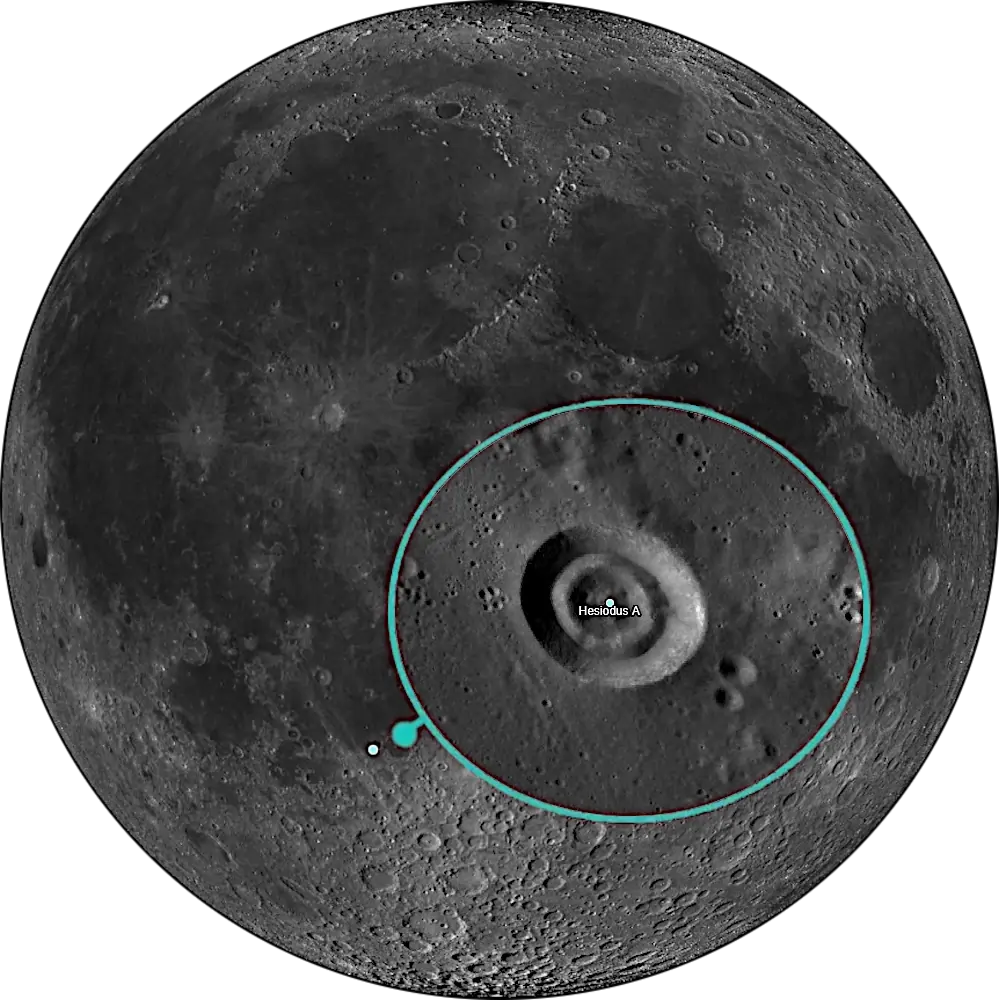
L81 Hesiodus A
Southern Mare Nubium · Concentric Crater📉 Vital Statistics
🔭 Field Notes
Hesiodus A is one of the more approachable oddities on this list. At first glance you might think two craters landed precisely on top of one another — a smooth, terrace-free outer bowl with a distinct, smaller ring nested inside it, like a bullseye. It’s visible in telescopes as small as 4.5 inches, and rewards pushing the magnification up to 200–250x once you’ve located it. Unlike many shadow-dependent lunar features, concentric craters like this one tend to remain visible even close to full Moon, when their subtle two-ring structure still stands out as a pattern of tone rather than relief.
- ▶ The Easiest Bullseye on the Moon: At least 59 lunar craters with concentric crater ridges have been catalogued. At roughly 15 km, Hesiodus A is both the largest of the group and, by wide consensus among lunar observers, the easiest one to see.
- ▶ A Puzzle of Formation: Concentric craters remain an unusual class of lunar feature, but their formation is not fully settled. Modern studies have proposed multiple mechanisms, including subsurface igneous intrusion and processes involving impact ejecta and shock interactions. Hesiodus A is one of the clearest examples of the morphology — a crater with a distinct concentric inner wall.
- ▶ Intruding on Its Neighbor: Hesiodus A physically overlaps and has intruded upon the southwest rim of the much larger crater Hesiodus — a visible reminder that, in this small corner of Mare Nubium, the smaller feature is actually the younger one.
📍 Nearby L100 Targets
- L15 Straight Wall (Rupes Recta): The Moon’s best-known escarpment, roughly 350 km northeast, casting a long, dramatic shadow under oblique lighting — a large-scale fault feature standing in contrast to Hesiodus A’s small, mysterious double-ring structure.
- L60 Kies Pi: A low, gently sloping volcanic dome roughly 190 km northwest, near the crater Kies — genuine volcanic construction rather than the impact-related origin debated at Hesiodus A.
- L84 Pitatus: The large floor-fractured crater roughly 90 km almost due east, directly adjoining Hesiodus itself — its own concentric rille system offering a larger-scale echo of the “rings within rings” theme found here.
🚀 Mission Log
Target Acquisition
Find Hesiodus, then look at its southwest rim
Locate Hesiodus on the southern shore of Mare Nubium, on Rükl chart 54, right next to its larger neighbor Pitatus. Hesiodus A, at 30.1°S, 17.0°W, sits directly on Hesiodus’s southwest rim, overlapping and intruding into it — a 15 km crater-within-a-crater that’s the easiest target of its kind on the Moon.
No need to chase the terminator this time
Unlike most of the shadow-dependent targets on this list, Hesiodus A doesn’t require a low sun angle to show itself. Its inner and outer rings remain visible even close to full Moon, when the double-ring structure reads as a pattern of subtle tonal contrast rather than shadow relief — which makes this a rare “any night” target you can slot into a session regardless of lunar phase.
Small aperture works — then push the magnification
A 4.5-inch scope is enough to pick out Hesiodus A’s bullseye shape, so don’t hold off on this one waiting for bigger glass. Once you’ve located it, push magnification up to 200–250x to fully separate the smooth, terrace-free outer bowl from the smaller, distinct ring nested inside it — the two-ring structure is the whole show here, and higher power is what turns a fuzzy double outline into a crisp bullseye.
From Hesiodus A to the Straight Wall, Kies Pi, and Pitatus
Northeast, roughly 350 km away, the Straight Wall (L15) is the Moon’s best-known escarpment, a large-scale fault feature that casts a long, dramatic shadow under oblique light — a study in contrast with Hesiodus A’s small, mysterious double-ring structure. Northwest, about 190 km off, Kies Pi (L60) is a low, gently sloping volcanic dome near the crater Kies — genuine volcanic construction rather than the debated impact origin proposed at Hesiodus A. And almost due east, roughly 90 km away, Pitatus (L84) is the large floor-fractured crater directly adjoining Hesiodus itself, its own concentric rille system offering a larger-scale echo of the “rings within rings” theme found here.
📝 Observation Log — L81 Hesiodus A
0/4 CompleteIs Hesiodus A visible tonight?
Hesiodus A sits at 30.1°S, 17.0°W, overlapping the southwest rim of the crater Hesiodus. Unlike most shadow-dependent targets on this list, it doesn’t need a low sun angle to show itself — its two-ring bullseye reads as a pattern of tone rather than relief, so it stays visible even close to full Moon. A 4.5-inch scope is enough to pick it out; push to 200–250x once located to fully separate the rings.
Check Moon Phase TodayReturn to the List
Ready to find the next target? Go back to the full map to see what else is visible tonight.
← Back to Lunar 100 Map
When to Observe Hesiodus A
Most Lunar 100 targets reward a low sun angle. Hesiodus A doesn’t depend on one the same way — its two-ring bullseye is a real concentric morphology that stays recognizable through tonal contrast even when shadow relief is weak, including close to full Moon.
- Don’t Depend on the Terminator: Unlike most shadow-dependent targets, Hesiodus A doesn’t need grazing light to show itself. Its inner and outer rings remain readable even close to full Moon, when the double-ring structure reads mainly through tonal contrast rather than strong shadow relief.
- Start Small, Then Push Power: A 4.5-inch scope is enough to pick out the bullseye shape, so don’t wait for bigger glass. Once you’ve located it, push magnification up to 200–250x to fully separate the smooth outer bowl from the smaller ring nested inside it.
- For Orientation: Locate Hesiodus on the southern shore of Mare Nubium, right next to its larger neighbor Pitatus. Hesiodus A sits on Hesiodus’s southwest rim, at 30.1°S, 17.0°W.
What to Look For
At first glance you might think two craters landed precisely on top of one another — a smooth outer bowl with a distinct, smaller ring nested inside it, like a target. There’s no terrace or shadow relief to hunt for; the whole show is the nested-ring pattern itself.
Hesiodus A’s rim slightly intrudes on Hesiodus’s southwest wall — a visible overlap that tells you, without any dating, which crater came second. In this small corner of Mare Nubium, the smaller feature is actually the younger one.
Roughly 58 lunar craters with concentric ridges are known in the commonly cited observing literature. At about 15 km across, Hesiodus A is the largest of the group and the easiest to see.
Concentric craters remain an unusual class of lunar feature, and their formation is not fully settled. Proposed mechanisms have included igneous intrusion, simultaneous or closely-timed impacts, and impacts into layered subsurface structures — Hesiodus A is one of the clearest examples of the morphology regardless of which explanation is correct.
The Science: A Crater Within a Crater
Hesiodus A is a rare case on this list where the “aha” moment doesn’t depend on catching the Moon at the right angle — it depends on power, patience, and knowing exactly what pattern you’re hunting for.
Vital Statistics
Located at 30.1°S, 17.0°W on Rükl chart 54, Hesiodus A is a 15 km concentric crater overlapping the southwest rim of the much larger Hesiodus. Its inner slopes are smooth and terrace-free, and its overlap with Hesiodus establishes that it’s younger than the affected part of the larger crater. Its L100 distinction: the largest and easiest-to-observe example of a lunar concentric crater.
Intruding on Its Neighbor
Hesiodus A physically overlaps and has intruded upon the southwest rim of Hesiodus — a visible reminder that, in this small corner of Mare Nubium, the smaller feature is actually the younger one. How concentric craters like this one form at all is still debated: proposed mechanisms have included igneous intrusion, simultaneous or closely-timed impacts, and impacts into layered subsurface structures, and no single explanation has won out.
Mission Record
Lunar Orbiter IV photographed the Moon’s surface during its 1967 global survey, and Hesiodus A appears in the orbital imagery of the Hesiodus–Pitatus region from that mission. Modern Lunar Reconnaissance Orbiter imagery has since provided much sharper views of the crater’s concentric structure, including dedicated LROC imaging of Hesiodus A.
Most Lunar 100 targets ask you to time a session around the Moon’s geometry. Hesiodus A asks something different — bring enough aperture and enough magnification, and it’s there waiting for you almost any night, still no closer to a settled explanation for why it looks the way it does.