
L84 Pitatus Crater
A 97 km crater on the shore of Mare Nubium, its floor fractured and flooded by magma from below — a concentric rille and a fleeting sunset ray reward a patient observer.
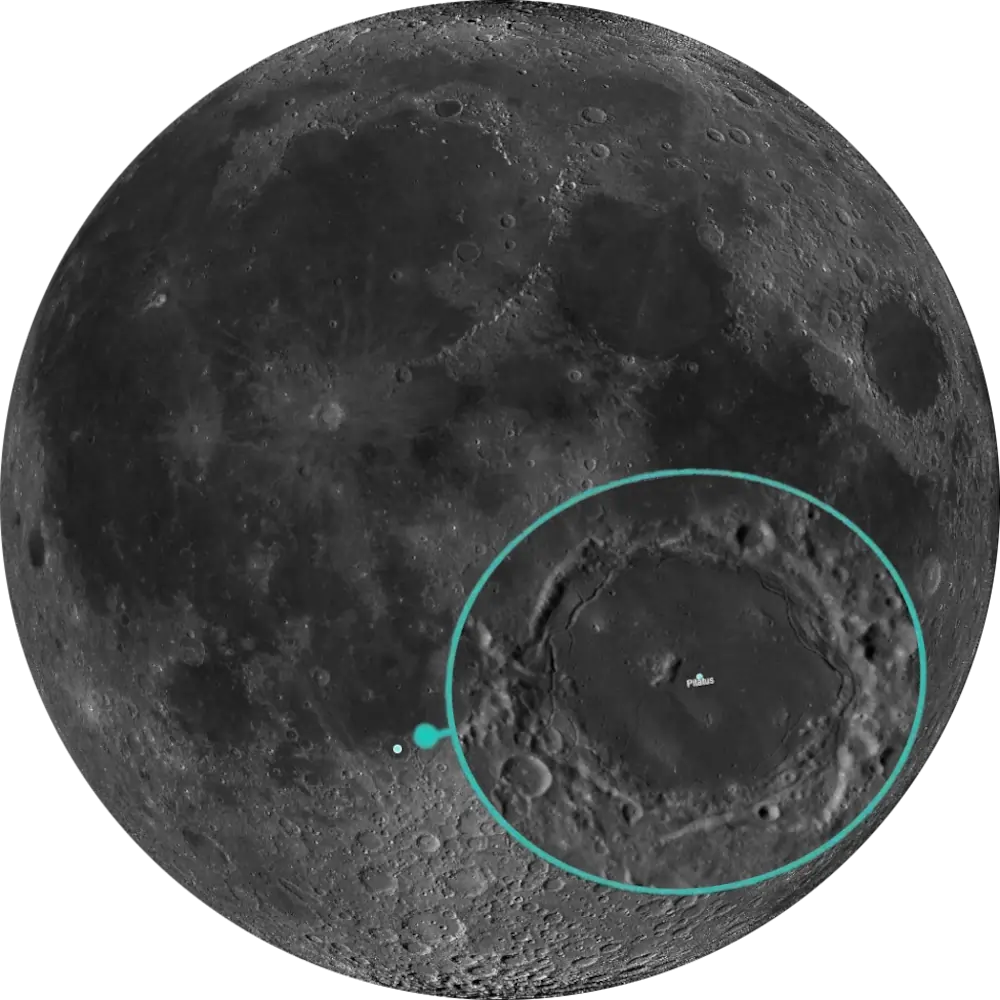
L84 Pitatus Crater
Southern Mare Nubium · Concentric Rilles📉 Vital Statistics
🔭 Field Notes
Pitatus rewards patience. Its floor looks deceptively smooth at first — a low, off-center central mountain, a patch of rough hills to its north, a scattering of tiny craterlets — but the real prize is the curious rille tracing the inside of the rim. Using a 10-inch scope under steady seeing, it’s easiest to catch near the northern edge, and in high-resolution views it can be followed nearly all the way around the crater’s eastern and southeastern inner wall. Look too for the western rim, which appears almost gouged out, as if something had dragged a groove along its edge.
- ▶ A Textbook Floor-Fractured Crater: Pitatus is a classic example of a floor-fractured crater (FFC). Its shallow, mare-flooded floor is cut by fractures concentrated near the crater wall. The leading explanation is that magma intruded beneath the floor, uplifting and fracturing it, though the exact mechanics of FFC formation remain debated and different craters may reflect different intrusive histories. Gassendi and Posidonius show related but morphologically distinct floor-fracture systems.
- ▶ The Pitatus Ray: A well-known clair-obscur effect briefly lights up Pitatus’s floor under local sunset lighting — the counterpart to the famous Hesiodus Ray, which appears under the opposite lighting condition, local sunrise, at its neighboring crater.
- ▶ A Connection to Tycho: A cleft in Pitatus’s northwest wall links it to the crater Hesiodus, and the floor also carries faint bright deposits associated with the Tycho impact far to the south, whose ejecta and secondary craters extend hundreds of kilometers across the southern highlands.
📍 Nearby L100 Targets
- L6 Tycho: The Moon’s most prominent ray crater, roughly 415 km south-southeast, its bright ejecta reaching Pitatus’s floor as a comparatively young (~108 million-year-old) impact.
- L15 Straight Wall (Rupes Recta): The Moon’s best-known escarpment, roughly 280 km northeast, casting a long, dramatic shadow under oblique lighting — a fault-driven feature standing in contrast to Pitatus’s magma-driven floor fractures.
- L81 Hesiodus A: Probably the most telescope-friendly and well-known concentric crater on the Moon, roughly 90 km almost due west, sitting on the southwest rim of Pitatus’s immediate neighbor Hesiodus — a small-scale echo of the “rings within rings” theme found at Pitatus itself.
🚀 Mission Log
Target Acquisition
Anchor on Mare Nubium’s southern shore
Find Mare Nubium and follow its southern edge to where two conjoined craters sit right on the shoreline: Pitatus at 29.8°S, 13.5°W and its immediate neighbor Hesiodus, linked by a cleft in Pitatus’s northwest wall. At 97 km across on Rükl chart 54, Pitatus is easy to pick out — the harder part is catching its floor detail, which only really opens up under the right light.
Chase the Pitatus Ray at local sunset
Pitatus has its own clair-obscur effect: a fleeting shaft of light briefly crosses the floor under local sunset lighting, a sunset counterpart to neighboring Hesiodus’s more famous sunrise “Hesiodus Ray.” Time a session for the terminator’s approach on this stretch of Mare Nubium and watch for the ray directly — but don’t stop there, since the low sun angle that produces it is also exactly what throws the crater’s low-relief floor fractures into shadow.
Trace the rille, then work the rest of the floor
In a 10-inch scope under steady seeing, hunt for the concentric rille running just inside the crater wall — easiest to pick up near the northern edge, and in the sharpest views traceable nearly all the way around the eastern and southeastern inner wall. Note the low, off-center central mountain, a patch of rough hills to its north, and a scatter of tiny craterlets across the otherwise deceptively smooth, mare-flooded floor. Finish at the western rim, which looks almost gouged out, as if something had dragged a groove along its edge.
From Pitatus to Tycho, Straight Wall, and Hesiodus A
South-southeast, roughly 415 km away, Tycho (L6) is the Moon’s most prominent ray crater, its comparatively young ejecta reaching all the way to Pitatus’s floor as pale bright deposits. Northeast, about 280 km off, the Straight Wall (L15) is the Moon’s best-known escarpment, a fault-driven feature that casts a long, dramatic shadow under oblique light — a study in contrast with Pitatus’s magma-driven floor fractures. And almost due west, some 90 km distant, Hesiodus A (L81) sits on the southwest rim of Hesiodus itself, arguably the most telescope-friendly concentric crater on the Moon — a small-scale echo of the “rings within rings” theme Pitatus shows on a larger stage.
📝 Observation Log — L84 Pitatus Crater
0/4 CompleteIs Pitatus visible tonight?
Pitatus sits on the southern shore of Mare Nubium near 29.8°S, 13.5°W, and rewards a session timed for local sunset on the crater, when the fleeting Pitatus Ray briefly crosses its floor. That same low light throws the concentric rille and floor fractures into shadow — easiest to catch near the northern inner wall in a 10-inch scope under steady seeing.
Check Moon Phase TodayReturn to the List
Ready to find the next target? Go back to the full map to see what else is visible tonight.
← Back to Lunar 100 Map
When to Observe Pitatus
Pitatus rewards patience more than rare timing. Its outline is easy to find under almost any light, but the floor detail that makes it a Lunar 100 target — the concentric rille, the fractured floor, the fleeting clair-obscur ray — only opens up if you catch it near the terminator and bring enough aperture.
- Chase the Pitatus Ray at Local Sunset: A fleeting shaft of light briefly crosses the floor under local sunset lighting — the sunset counterpart to neighboring Hesiodus’s more famous sunrise “Hesiodus Ray.” Time a session for the terminator’s approach on this stretch of Mare Nubium and watch for it directly.
- Bring a 10-Inch Class Scope: The concentric rille running just inside the crater wall is easiest to pick up near the northern edge in a 10-inch scope under steady seeing, and in the sharpest views can be traced nearly all the way around the eastern and southeastern inner wall.
- For Orientation: Find Mare Nubium and follow its southern edge to where two conjoined craters sit right on the shoreline: Pitatus at 29.8°S, 13.5°W and its immediate neighbor Hesiodus, linked by a cleft in Pitatus’s northwest wall.
What to Look For
Hunt for the rille tracing the inside of the rim — easiest to catch near the northern edge, and in high-resolution views followable nearly all the way around the crater’s eastern and southeastern inner wall.
Look for the low, off-center central mountain, a patch of rough hills to its north, and a scattering of tiny craterlets — floor detail that’s easy to miss on first glance at what looks like a featureless, mare-flooded plain.
Look too for the western rim, which appears almost gouged out, giving it one of the crater’s most distinctive visual features.
Watch for the Pitatus Ray itself, a well-known clair-obscur effect that briefly lights up the floor under local sunset lighting — the counterpart to the famous Hesiodus Ray, which appears under the opposite lighting condition, local sunrise, at its neighboring crater.
The Science: A Textbook Floor-Fractured Crater
Pitatus’s real interest for the Lunar 100 isn’t the impact that formed it, but what happened afterward — a shallow, mare-flooded floor cut by fractures that record one of the Moon’s clearest cases of post-impact volcanic modification.
Vital Statistics
Located at 29.8°S, 13.5°W, on Rükl chart 54, Pitatus is a 97 km floor-fractured crater (Class 6) with a system of concentric rilles following its inner wall. Named for Pietro Pitati, a 16th-century Italian astronomer, it’s an ancient crater on the southern shore of Mare Nubium, later modified when volcanic activity fractured and partly flooded its floor. Its L100 distinction: one of the Moon’s best examples of a floor-fractured crater with a well-developed concentric rille system.
A Magma Intrusion Beneath the Floor
Pitatus is a classic example of a floor-fractured crater. Its shallow, mare-flooded floor is cut by fractures concentrated near the crater wall. The leading explanation is that magma intruded beneath the floor, uplifting and fracturing it, though the exact mechanics of floor-fractured-crater formation remain debated and different craters may reflect different intrusive histories — Gassendi and Posidonius show related but morphologically distinct floor-fracture systems.
A Cleft to Hesiodus, and Traces of Tycho
A cleft in Pitatus’s northwest wall links it to the crater Hesiodus, and the floor also carries faint bright deposits associated with the Tycho impact far to the south, whose ejecta and secondary craters extend hundreds of kilometers across the southern highlands.
Mission Record
Lunar Orbiter IV provided systematic photographic coverage of Pitatus and the surrounding Mare Nubium region in 1967, capturing the crater’s flooded floor and concentric rille pattern. Orbital photography from multiple Apollo missions between 1969 and 1972 added further detail on the floor-fracture morphology and its connection to neighboring Hesiodus. Combined LOLA topography and LROC imagery were used in a major 2012 study classifying lunar floor-fractured craters, with Pitatus included as a classic Class 6 example of the concentric-fracture morphology.
Most Lunar 100 craters are studied for the impact that made them. Pitatus is studied for what came after — a case study in how magma can quietly reshape a crater long after the crater itself has formed.