

At many locations, there are stretches when a calendar day goes by with no moonrise at all — no glitch, no eclipse, just a mismatch between the Moon’s own rhythm and the 24-hour box we keep time in. It happens because the Moon’s average rise-to-rise rhythm runs about 50 minutes longer than a day, and how often that adds up to a skipped date depends on where you are. This guide works through the mechanism with real numbers, a worked example, and a diagram of the drift.
Contents ▾
The 24-hour-50-minute lunar day
Sunrise follows an approximately 24-hour rhythm because Earth’s rotation dominates the Sun’s apparent daily motion — though the exact clock time still creeps with the season and the observer’s latitude. Moonrise is different: the Moon is also orbiting Earth, moving eastward against the stars by about 13° per day on average, while the Sun’s apparent position shifts by only about 1° per day — leaving roughly 12° of relative motion between them each day. Because Earth has to rotate a little farther each day to bring the Moon back to the same position in the sky, successive moonrises occur later.
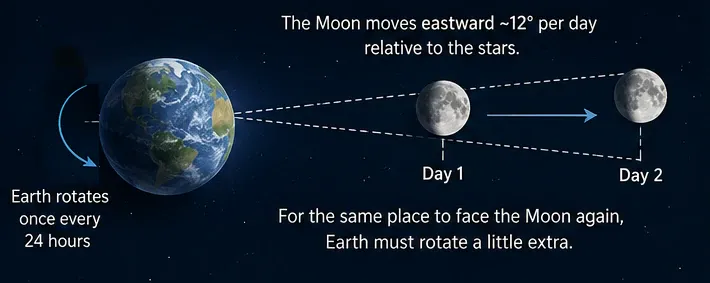
The math works out cleanly. The Moon completes one full cycle relative to the Sun — a synodic month — in about 29.53 days. Spread that catch-up motion evenly across a single rotation, and the delay per day comes to:
Derivation: one full 360° catch-up spread over (29.53 − 1) rotations, applied to a 24-hour day.
This 24-hour-50-minute figure is the mean lunar day — the average interval between successive meridian transits of the Moon at a fixed location (the moment the Moon crosses due south, or due north south of the equator). It’s closely related to the tidal day used in tidal astronomy, since tides broadly follow the Moon’s transit, though actual tide predictions use multiple harmonic constituents rather than simply repeating a 24h50m cycle. Moonrise and moonset track this same average, drifting about 50 minutes later day after day, rather than repeating on a fixed clock.
“On average” is doing real work in that sentence. The Moon’s orbit is elliptical, so by Kepler’s second law it moves faster near perigee (closest approach) and slower near apogee, which can shift the day-to-day retardation of lunar meridian transits substantially above or below the roughly 50-minute mean. Moonrise itself can vary even more than that, because the Moon’s changing declination and the observer’s latitude — the angle at which its path meets the horizon — affect how that motion projects into an actual rise time. At a particular location, the day-to-day moonrise delay can range from only a few minutes to well over an hour, and it’s usually declination and latitude, more than orbital speed on its own, that drive the largest swings.
How a 50-minute lag skips a whole day
Picture a moonrise that happens late at night, close to midnight. Add the roughly 24-hour-50-minute gap to get the next one, and it doesn’t land later that same night — it lands in the early hours after midnight, on the day after next.
| Day | Moonrise |
|---|---|
| Monday | 11:50 PM |
| Tuesday | No moonrise |
| Wednesday | 12:40 AM |
Monday’s moonrise happens before midnight, so it’s a Monday event. Adding the ~24h50m lag works out in two steps: the first 24 hours alone already carries the clock past one midnight, to Tuesday 11:50 PM, and the remaining ~50 minutes carries it past a second midnight, landing at 12:40 AM on Wednesday. Tuesday sits in between with no moonrise assigned to it: the Moon left over from Monday night is still up for part of Tuesday, and it rises again eventually, but only once the calendar has already turned to Wednesday. Nothing unusual is happening in the sky; it’s the 24-hour calendar trying to contain a ~24-hour-50-minute cycle that occasionally leaves a gap.
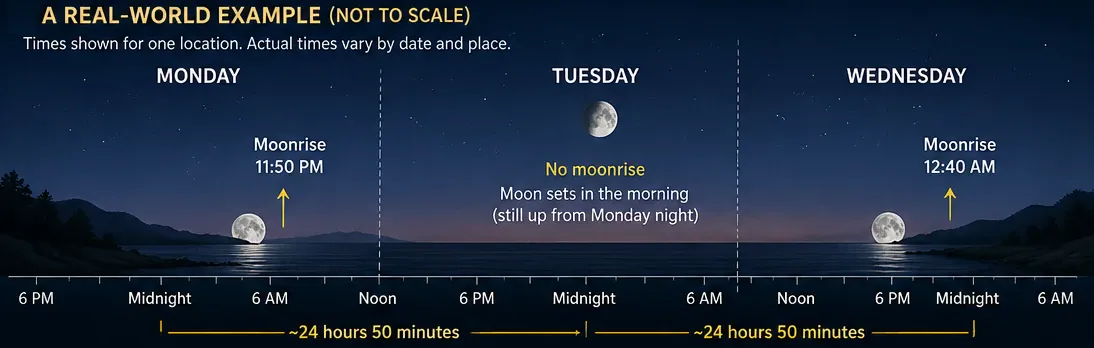
Diagram: the moonrise spiral
The clearest way to see the skip coming is to stop thinking in calendar days and plot moonrise the way an almanac-maker would: as a clock time that walks steadily around the dial, month after month. Below, each dot is one successive moonrise event across a synodic month. The angle is the clock time (midnight at the top), and the radius simply counts forward in time so the path spirals outward instead of overlapping itself.
One synodic month of moonrise times
Simulated with the mean lag of 50.8 min/event, starting from a moonrise at midnight. Watch the point pair on the upper-right: one event lands at 11:43 PM, and the very next lands at 12:34 AM roughly 24h51m later — jumping straight past an entire calendar date.
Because the plotted angle only depends on clock time, a full month of moonrises traces almost exactly one loop around the dial — the radius, not the angle, is what tracks total elapsed time between events. The single break in the line, where the connector jumps from just before midnight to just after it roughly 24 hours 51 minutes later, marks the skipped day — no point is plotted there, because no moonrise event happens on that date. Everywhere else on the spiral, the date simply advances by one; only across that gap does it advance by two.
Does the same thing happen with moonset?
Yes, for the same reason, and it can skip a calendar day the same way. Moonrise and moonset don’t usually skip on the same date, though, since they lag by different amounts depending on where the Moon sits in the sky that day. In a typical month, most locations see one calendar day with no moonrise and a separate day with no moonset.
How often does this happen?
At many mid-latitude locations, it works out to roughly once per synodic month — about every 29.53 days — for moonrise, and separately for moonset. But the frequency isn’t universal: it depends on latitude, the Moon’s declination at the time, and the observer’s local sequence of rise times, so some months a given location can see it happen more than once, and other months not at all. Because it depends on the exact clock time of moonrise, the missing date itself is local — it depends on the Moon’s actual rise time at that longitude and latitude, and on how that instant is expressed in the local civil time zone. Two people a few time zones apart can find the “missing” day falls on different dates, or that only one of them experiences it that month at all.
Why it varies by latitude
Near the equator, the Moon’s path across the sky is steep and fairly consistent, so the day-to-day lag stays close to the ~50-minute average most of the time. Farther from the equator, the Moon’s path slants more, and the lag becomes far less consistent: on some days it’s only a few minutes, on others well over an hour, depending on the Moon’s declination at the time.
The Moon’s orbit is tilted about 5.14° to the ecliptic, and combined with Earth’s own 23.4° axial tilt, its declination can swing between roughly ±18.3° and ±28.6° over an 18.6-year cycle (the lunar nodal cycle) — so how extreme this gets shifts slowly from year to year as well as day to day. At higher latitudes, this changing declination has a stronger effect on moonrise times, making the day-to-day intervals more variable and increasing the possibility of extended periods with no moonrise.
Near the poles: an extreme version
At sufficiently high latitudes, something more dramatic can happen: the Moon can remain continuously above the horizon for extended periods, or continuously below it, producing a lunar analogue of the Sun’s familiar polar day and night — rather than simply skipping a single calendar date. This isn’t guaranteed just by being inside the Arctic or Antarctic Circle; it depends on the interplay between latitude and the Moon’s declination at the time. The basic condition is that the Moon’s declination magnitude exceeds roughly 90° minus the observer’s latitude.
This is a related but distinct effect — driven by the Moon’s changing declination during its roughly 27.3-day orbit, superimposed on the 18.6-year nodal cycle, combined with high latitude, rather than by the lag between calendar days — so how often and how strongly it happens at a given polar location varies from year to year as well as month to month.
Key terms
- Synodic month
- The time it takes the Moon to return to the same position relative to the Sun as seen from Earth — about 29.53 days. This is the cycle that governs Moon phases.
- Mean lunar day (tidal day)
- The average interval between successive meridian transits of the Moon at a fixed location — about 24 hours 50.5 minutes. Moonrise intervals average close to this figure but can vary substantially depending on declination and latitude.
- Declination
- A celestial object’s angle north or south of the celestial equator — the sky’s equivalent of latitude. The Moon’s declination shifts over its ~27.3-day orbit and drifts further over the 18.6-year nodal cycle.
- Lunar nodal cycle
- An 18.6-year cycle in which the line of nodes — where the Moon’s orbit crosses the ecliptic — precesses, changing the Moon’s inclination relative to the celestial equator and, with it, the extremes its declination can reach.
- Perigee / apogee
- The points in the Moon’s elliptical orbit where it is closest to Earth (perigee) and farthest (apogee). The Moon moves faster near perigee, which lengthens the daily moonrise lag; it moves slower near apogee, which shortens it.
Frequently asked questions
Does a missing moonrise day mean the Moon isn’t visible that day?
No. The Moon that rose the night before is typically still up for part of that day, and often visible in the daytime sky as well. What’s “missing” is a moonrise event landing within that specific 24-hour calendar day, not the Moon’s visibility itself.
How often does this happen?
At many mid-latitude locations, roughly once per synodic month — about every 29.53 days — for moonrise, and separately for moonset. The exact frequency depends on latitude and the Moon’s declination, so it isn’t the same everywhere or every month.
Is the missing day the same everywhere in the world?
No. Since it depends on the exact clock time of moonrise, which varies by longitude and how that instant is expressed in the local civil time zone, the specific date of a missing moonrise day is local to each location rather than a single global date.
Why doesn’t the same thing happen with sunrise?
Sunrise repeats on an approximately 24-hour cycle because the Sun’s apparent daily motion changes only slightly from one day to the next. Moonrise is different because the Moon moves much more rapidly eastward across the sky, which adds roughly 50 minutes to the cycle on average and is what creates the periodic skip.
Does the daily lag stay close to 50 minutes all month?
No. Fifty minutes is only the average. The Moon’s elliptical orbit shifts the timing of lunar meridian transits above and below that mean, and the Moon’s changing declination and the observer’s latitude add further variation on top of that — so at a given location, the day-to-day moonrise delay can range from only a few minutes to well over an hour.
Is this connected to a Blue Moon or Black Moon?
No, they’re unrelated. A Blue Moon or Black Moon is about how many Full or New Moons fall within a single calendar month. A missing moonrise day is about individual daily rise events slipping past midnight — a separate quirk of matching a ~24-hour-50-minute cycle to a 24-hour calendar.