
Moon Phase Vantaa
On Sunday, October 4, 2026, the moon in Vantaa is a Last Quarter with 45% illumination. Moon age: 22.6 days.
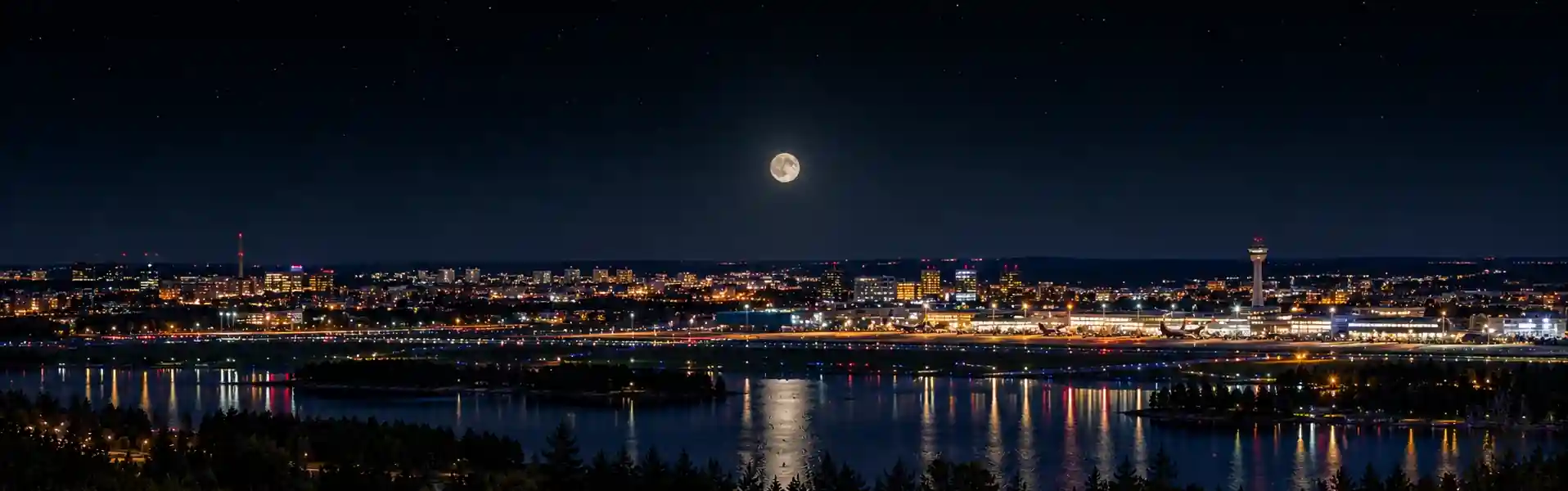
☽ Best Places to View the Moon in Vantaa, Finland
Vantaa sits at roughly 60.3°N, Finland's fourth-largest city and part of the Helsinki region. It has no sea coast, and its defining waterway is the Vantaanjoki river, which runs through much of the city. Vantaa is also home to Helsinki Airport, and to a share of Sipoonkorpi National Park's forest in the north-east. Between the river, the airport, and that slice of shared park land, Vantaa's Moon-viewing spots are small and specific rather than one grand stage. At this latitude the Moon rises between north-east and south-east, and a summer full Moon stays very low, near 6°, while a winter one climbs to about 53°. Vantaa also has the Finnish Science Centre Heureka, with a planetarium, in Tikkurila. Exact rise and set times and azimuth depend on the date and your observing position, so check both before planning a specific composition.
Kuusijärvi & Sipoonkorpi National Park
Kuusijärvi is a lake and forest recreation area in eastern Vantaa's Kuninkaanmäki district, with a swimming beach, traditional smoke saunas, and lit exercise trails that become ski tracks in winter. The Sudentassu bridge, completed in 2019, connects it directly to Sipoonkorpi National Park, about a kilometre's walk from the car park. Sipoonkorpi, established in 2011 and covering roughly 24 km² across Helsinki, Vantaa and Sipoo, is a large forest close to the capital with rocky terrain and open cliffs and only a few small lakes. Some areas have limited infrastructure, so follow current marked routes and park guidance, especially after dark.
Håkansböle Manor Park
An 18th-century manorial park in Hakunila, near Lake Kuusijärvi, laid out from the 1780s and later expanded into an English-style landscape garden. The grounds are open to the public year-round, with mature trees, open lawns, and a historic landscape setting, a reasonable option for an ordinary evening rather than a special outing. It hosts public gatherings through the year, so check whether an event is scheduled.
Vantaankoski & Pitkäkoski Rapids
The Vantaankoski rapids nature trail, on the western side of the city, is a short loop of paths, boardwalks, stairs and bridges along the Vantaanjoki, past a 240-metre stretch of rapids with a 5-metre drop. Further along the river near Kuninkaantammi, on the Helsinki–Vantaa border, the Pitkäkoski nature reserve is a small protected riverside grove centred on more rapids. Both give a quiet riverside walk with a clear line of sight up and down the water, useful for the Moon's reflection in the moving rapids rather than a view blocked by rooftops. The boardwalks can ice over in winter, so wear grippy footwear.
Church of St. Lawrence & Helsingin pitäjän kirkonkylä
The oldest building in Greater Helsinki, dating to the 1450s, stands in the small historic village of Helsingin pitäjän kirkonkylä on the Vantaanjoki, in central Vantaa. The church's old cemetery and the quiet streets around it sit right on the river, with the water and the historic village providing a distinctive foreground without leaving Tikkurila.
Heureka Planetarium – Tikkurila
Heureka, the Finnish Science Centre, at Tiedepuisto 1 in Tikkurila, has a digital planetarium with a 17.5-metre dome. It opened in 1989 as the Verne theatre and reopened on 26 December 2025 after more than a year of renovation, described as one of Europe's brightest, most colourful and most detailed presentation environments. It shows a projected sky, not the real Moon, so treat it as an astronomy stop rather than a viewing spot. Check current showtimes before visiting.
Ursa Observatory – Real Telescopes in Helsinki
Vantaa has no regular public telescope night of its own, but the Ursa Observatory in Kaivopuisto Park in Helsinki, about 16 km to the south-south-west, dates to 1926 and is still in active use. Non-members can attend its public shows, which look at solar phenomena in summer and at the starry sky in the darker months. They run to a timetable, only when the weather is clear and the temperature is not below −15 °C, so check its page or call.
◉ Best Times for Moon Photography in Vantaa
📷 Quick Photography Tips for Vantaa
🕐 Timezone: Vantaa runs on EET (UTC+2), shifting to EEST (UTC+3) for daylight saving time, from the last Sunday in March to the last Sunday in October. Double-check your moonrise app is set to Vantaa and not carrying over a stale offset across the DST switch.
🔭 Telescope Option: No regular public telescope night is advertised in Vantaa. Heureka's planetarium in Tikkurila shows a projected sky, and the Ursa Observatory in Kaivopuisto, Helsinki, runs public shows by timetable when the sky is clear and the temperature is above −15 °C. Check its page or call for dates. For the moon phase in any other city, use the calculator on our home page.
The moon phase today in Vantaa, Finland is shown in detail above — complete with exact illumination percentage, moonrise/set times, and the best viewpoints to see it. For the moon phase today in any other city or location worldwide, visit our Dynamic Moon Phase Calculator on the home page.
◐ What the Experience Actually Feels Like
Vantaa doesn't have a sea or a pair of big lakes to build a Moon-viewing identity around. What it has instead is a major river running through the city, an international airport occupying a large, central part of the municipality, and a shared corner of national park at its far edge. That's a less obviously scenic combination, but it means the city's best Moon-viewing spots tend to be small and specific — a bend in the Vantaanjoki, a bridge into a shared national park, a churchyard that predates the country it sits in.
The Church of St. Lawrence has stood by the river since the 1450s, long before Vantaa was Vantaa, and the same river still carries the rapids at Vantaankoski and Pitkäkoski further upstream. In winter, with the trees bare and the river running low and dark, those rapids give a genuinely open stretch of sky that's harder to find elsewhere in the city.
Sipoonkorpi is the exception — real forest, rocky and rough underfoot, reached from Vantaa's side by a purpose-built bridge from Kuusijärvi. It's shared with Helsinki and Sipoo, and some of its trails are less developed than in older national parks, but it's the city's strongest option for a more forested, less urban setting. For the real Moon through a telescope, the Ursa Observatory in Helsinki is the nearest regular option.
"Vantaa doesn't have a sea or a pair of lakes to define it — it has a river, an airport occupying a large part of the city, and a shared corner of forest at its edge."
✓ Your Vantaa Moon Chase Checklist
Before You Go
- Check the moonrise time and phase on this page for each night of your stay
- For Sipoonkorpi, check current trail conditions and parking on luontoon.fi before you go, since some areas have limited infrastructure
- Check whether Håkansböle's park grounds have an event scheduled, since it hosts public gatherings through the year
- Between late March and late October, remember Finland shifts to EEST — re-verify your moonrise app's offset
- In autumn or winter, check the aurora forecast alongside the moon phase
- Check the Ursa Observatory's page for its public show timetable if you want a telescope
What to Bring
- Proper winter layers — nights can occasionally fall well below −15°C
- A headlamp for unlit stretches of the Sipoonkorpi and Pitkäkoski trails
- A tripod, useful at the open cliffs in Sipoonkorpi and the lawns at Håkansböle
- Sturdy, grippy footwear for the boardwalks at Vantaankoski and Pitkäkoski, which can ice over in winter
- Spare camera batteries kept warm in an inner pocket
On the Night
- Arrive 20–30 minutes before moonrise at open spots like Håkansböle's lawns or the riverside at Vantaankoski
- In Sipoonkorpi, stay on marked trails after dark rather than cutting across the rockier, less-developed terrain
- At the rapids, mind slick boardwalks and stairs in freezing conditions
- Shoot RAW and bracket exposures, especially where moving water is involved
- Watch the northern sky as well as the Moon on clear winter nights — you may get both in the same frame
? Vantaa Moon Phase — Frequently Asked Questions
Q. What is the moon phase today in Vantaa?
The moon phase today in Vantaa is a Last Quarter with 45% illumination. The next full moon is in 23 days, on 26 Oct. Moonrise is at 11:13 PM and moonset at 5:48 PM.
Q. Where is the best place to view the moon in Vantaa?
Vantaa, Finland's fourth-largest city, has no sea coast, so its best moon spots are along the Vantaanjoki river and in its forest. The rapids at Vantaankoski and Pitkäkoski give an open stretch of sky and moving water that reflects the moon. The Kuusijärvi recreation area connects by the Sudentassu bridge, completed in 2019, to Sipoonkorpi National Park, a forest park established in 2011. Håkansböle Manor Park in Hakunila has open lawns and mature trees, and the Church of St. Lawrence, dating to the 1450s, stands by the river in the old village in central Vantaa.
Q. Can I look at the moon through a telescope in Vantaa?
Not at a regular public night in Vantaa itself. Heureka, the Finnish Science Centre in Tikkurila, has a digital planetarium with a 17.5 m dome that reopened on 26 December 2025 after more than a year of renovation, but it shows a projected sky rather than the real moon. For a real telescope, the nearest regular public shows are at the Ursa Observatory in Kaivopuisto Park in Helsinki, about 16 km to the south-south-west, which dates to 1926. Non-members can attend its public shows, which look at solar phenomena in summer and at the starry sky in the darker months, to a timetable and only when the weather is clear and the temperature is not below −15 °C.
Q. Where does the moon rise and set in Vantaa, and how high does it climb?
At about 60.3°N, Vantaa's moonrise and moonset points swing widely across the horizon each month, from roughly north-east to south-east for rising and north-west to south-west for setting, a wider swing than further south, and wider still in years near a major lunar standstill. A full moon near the winter solstice climbs to roughly 53° in the south, while a full moon near the summer solstice stays very low, peaking near 6°. In winter, with the trees bare, the open water at the rapids gives a stretch of sky that is harder to find elsewhere in the city. Check the azimuth for your date and exact spot.
Q. Is light pollution a problem for moon observing in Vantaa?
The moon is bright enough to observe and photograph from almost anywhere in Vantaa, so light pollution rarely limits the lunar disc itself. It does wash out earthshine on a thin crescent and any faint sky detail. Vantaa is part of the Helsinki region, and Helsinki Airport is a major source of aircraft traffic and aviation lighting, particularly around Aviapolis, so expect the occasional aircraft light in a long exposure closer to the city centre. Sipoonkorpi is the city's strongest option for a more forested, less urban setting. Around midsummer the sun stays within about 6° of the horizon all night, so there is no true astronomical night.
Q. What camera settings and phases work best for moon photography in Vantaa?
For a full moon, start with Looney 11 (f/11, ISO 100, 1/100 s) and refine using your histogram, since it is a baseline rather than a guarantee. Moving water at Vantaankoski or Pitkäkoski reflects the moon differently than still water, so bracket exposures rather than relying on a single setting, and shoot RAW. A tripod helps at the open cliffs in Sipoonkorpi and on the open lawns at Håkansböle, both more exposed than the riverside trails. Arrive 20 to 30 minutes before moonrise at open spots such as Håkansböle's lawns or the riverside at Vantaankoski.
Q. How do cold, ice and the aurora season affect moon viewing in Vantaa?
Winter nights in Vantaa can occasionally fall well below −15 °C, so check the forecast and dress warmly, with proper winter layers. Cold drains camera batteries fast, so carry spares in an inner pocket. The boardwalks and stairs at Vantaankoski and Pitkäkoski can ice over and turn slick, so wear sturdy, grippy footwear. On clear autumn and winter nights it is worth watching the northern sky for the aurora as well as the moon. Check the Finnish Meteorological Institute for cloud and wind.
Q. What time zone are Vantaa's moonrise and moonset times shown in?
Vantaa runs on Eastern European Time, EET, UTC+2, in winter and Eastern European Summer Time, EEST, UTC+3, in summer. Clocks go forward on the last Sunday in March and back on the last Sunday in October, and moonrise and moonset times on this page follow the local clock in effect on each date, so re-check any moonrise app's offset across the change. Vantaa lies at about 25.0°E, west of the 30°E meridian on which Eastern European Time is based, so the sun and moon cross the sky about 20 minutes later on the clock than they would on that meridian.
Q. Can I shoot the moon at Vantaa's viewpoints after dark?
Mostly, with care, but check each place. Nature areas can have seasonal conditions, icy trails or limited markings, particularly in Sipoonkorpi's less developed sections, so check current trail conditions and parking at luontoon.fi and stay on marked trails after dark. Håkansböle's park grounds are open year-round but host public gatherings, so check for events. The trails at Pitkäkoski and in Sipoonkorpi are unlit, so bring a headlamp, and mind slick boardwalks and stairs at the rapids in freezing conditions.
✦ Explore Further
Moon Phase Today: Helsinki
Check tonight's moon phase in Helsinki, roughly 15 km south-south-west of Vantaa on the Gulf of Finland.
🌲Moon Phase Today: Espoo
See the moon over Espoo, roughly 25 km west-south-west of Vantaa beside Nuuksio National Park.
🌍World Moon Phase Directory
Find the moon phase, rise and set times for cities in every region of the world.
Blue Hour Calculator
Work out when blue hour falls, ideal for waxing gibbous shots over the Vantaanjoki.