
Moon Phase Today Helsinki
On Saturday, October 10, 2026, the moon in Helsinki is a New Moon with 0% illumination. Moon age: 28.9 days.
☽ Best Places to View the Moon in Helsinki
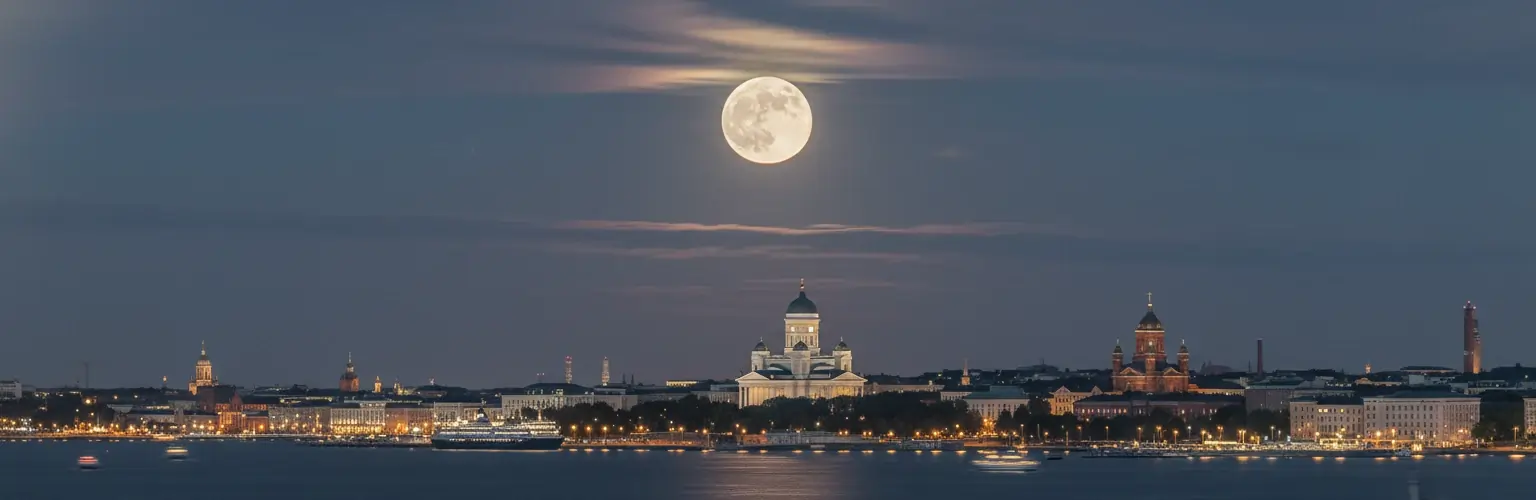
Helsinki sits at 60° North on the granite edge of the Gulf of Finland, an arm of the Baltic Sea defined by neoclassical white architecture and a sprawling archipelago. At this high latitude, the moon behaves differently: in winter, it rides high and fast through a pitch-black Arctic sky; in summer, it skims the southern horizon during the perpetual twilight of the "White Nights." The geography of the coast means moonrise is often an oceanic event, with light shattering over the dark sea and silhouetting the green-domed spires of the Helsinki Cathedral. Helsinki rewards the photographer who positions themselves along the southern shore, where the low-rise horizon allows for exceptionally clean moonrises.
Suomenlinna – King’s Gate & Eastern Cliffs
The UNESCO sea fortress is Helsinki's premier lunar vantage point. From the eastern granite cliffs, the moon rises directly over the open Gulf. With minimal light pollution, the horizon is unobstructed. Logistics: HSL ferries from Market Square run exceptionally late (until approx. 02:20 AM), making late-night return trips easy. Ferries are frequent during the day but move to an hourly schedule late at night.
Kaivopuisto – Observatory Hill
A classic coastal hill near the Ursa Observatory. It offers a panoramic view across the archipelago towards the open sea. The moon rises over the harbor, often silhouetting the massive Silja and Viking Line ferries as they depart for Stockholm or Tallinn. This is the city's favorite stargazing spot, where the granite bedrock provides a natural platform for tripods. Free access 24/7.
Senate Square – Cathedral Steps
For an architectural composition, nothing beats Senate Square. The moon often aligns with the central green dome of the white Helsinki Cathedral. While ambient light is higher here, the white granite neoclassical buildings reflect the lunar glow, creating an ethereal atmosphere. Best visited in winter when the moon sits high above the green-domed towers.
Tervasaari – Waterfront Bridge
Tervasaari island is connected to the Kruununhaka district by a short, photogenic bridge. From the eastern edge of the island, the moon rises over the icebreakers and the Kruunuvuorenselkä bay. The water is often calmer here than at the open sea fortress, providing better mirror reflections. A quiet, intimate spot favored by local landscape photographers.
Allas Sea Pool – Rooftop Terrace
A modern, elevated vantage point right in the Market Square harbor. From the Allas Sea Pool terrace, you can capture the moon rising behind the red-brick Uspenski Cathedral and the historic skyline of Katajanokka. The steam rising from the outdoor pools in winter adds a misty, Nordic texture to the scene. Entrance to the terrace is often free via the café.
Hietaniemi Beach – Western Shore
While most Helsinki spots favor the eastern moonrise, "Hietsu" offers wide-open horizons for western moonsets and the expansive twilight of summer. The sandy shoreline reflects the moon’s path across the Gulf of Finland. In summer, the sky remains a deep cobalt during moonrise, allowing you to capture the moon against the distant archipelago islands.
◉ Best Times for Moon Photography
📷 Quick Photography Tips
Helsinki operates on EET (UTC+2) in winter and EEST (UTC+3) during summer. Clocks go forward on the last Sunday in March (at 03:00 EET) and back on the last Sunday in October (at 04:00 EEST). Because of the high latitude, moonrise times can shift rapidly during seasonal transitions.
The moon phase today in Helsinki is shown in detail above. For the moon phase today in any other location worldwide, visit our Dynamic Moon Phase Calculator on the home page.
◐ What the Experience Actually Feels Like
There is a specific, quiet stillness to moonrise in Helsinki. Standing on the granite bedrock of Suomenlinna, the moon comes up over the open Gulf of Finland. It shimmers over the water, catching the silhouettes of the massive ferries as they glide silently toward Stockholm or Tallinn. At 60 degrees north, the light has a "crispness" to it—a clarity born of the cold sea air that makes the moon appear almost textured.
The architecture of the "White City of the North" was designed for this light. The light-colored granite of the buildings seems to drink in the moonlight. When the full moon clears the roofline of Senate Square, the white walls of the Cathedral reflect that light back, turning the entire plaza into a glowing stage beneath the iconic green domes. In winter, when snow is on the ground, the effect is doubled—the world becomes a study in white, blue, and silver.
During the "White Nights" of June, the magic is different. The sky stays a deep, electric cobalt past midnight. The moon rises into this twilight as a subtle, golden subject within a blue-grey landscape. Standing at the edge of the Gulf, the sky is bright enough to read by, yet the moon is hanging there, low and heavy, above the islands. It is a surreal, timeless experience that defines the Nordic soul.
"The 'White City' is built with light granite that drinks in the moonlight. Under the green cathedral domes, the world becomes a monochromatic study in white, blue, and silver."
✓ Your Helsinki Moon Chase Checklist
Before You Go
- Check moonrise times on this page — at 60°N, the moon's path changes faster than in southern latitudes
- Download the HSL app for the Suomenlinna ferry schedule — they run until 02:20 AM, so you have plenty of time
- Check coastal wind speeds — Helsinki's harbor wind can blur long exposures even on heavy tripods
- Use PhotoPills to align the moon with the green Cathedral domes or the Uspenski spires
- Check the sea ice report in winter — frozen water creates a matte, textured reflection vs. open sea
What to Bring
- Sturdy tripod — The granite cliffs at Suomenlinna are exposed to persistent Baltic winds
- Serious winter layers — Waiting for moonrise in February is an exercise in endurance; wool and wind-breaking shells are mandatory
- Spare batteries — Arctic cold kills lithium quickly; keep them inside your coat until the moment you shoot
- A telephoto lens (200mm+) to "compress" the moon against the white cathedral walls or ferry silhouettes
- Grip pads for tripod legs — The smooth Finnish granite can be slippery when frosted with ice
On the Night
- Arrive 45 minutes early — the Nordic "Blue Hour" is incredibly long and often more beautiful than total darkness
- Walk to the eastern cliffs of Suomenlinna for the darkest, most oceanic view away from city lights
- Shoot RAW — The contrast between the bright moon and the dark, winter landscape is extreme
- Stay for 30 minutes after moonrise — the composition changes as the moon clears the horizon mist
- In summer, don't wait for "darkness" — expose for the twilight sky and use the moon as a golden accent
? Helsinki Moon Phase — Frequently Asked Questions
Q. What is the moon phase today in Helsinki?
The moon phase today in Helsinki is a New Moon with 0% illumination. The next full moon is in 17 days, on Oct 26. Moonrise is at 7:42 AM and moonset at 5:54 PM.
Q. Where is the best place to view the moon in Helsinki?
Suomenlinna's eastern granite cliffs are the city's premier lunar vantage point, with the moon rising directly over the open Gulf of Finland and minimal light pollution. Kaivopuisto's Observatory Hill gives a panoramic archipelago view often silhouetting the Stockholm and Tallinn ferries, Senate Square frames the moon against the Cathedral's green dome, and Tervasaari, the Allas Sea Pool terrace, or Hietaniemi Beach add calmer or western-facing alternatives.
Q. Why does moon visibility change so much in Helsinki through the year?
Helsinki sits at 60° North, so the moon's path changes dramatically with the seasons: in winter it rides high through a pitch-black Arctic sky, while in summer it skims the southern horizon during the perpetual twilight of the "White Nights." Sea fog rolling in off the Gulf can soften moonrises at any time of year, especially in autumn.
Q. Does Helsinki observe daylight saving time?
Yes. Helsinki operates on EET (UTC+2) in winter and EEST (UTC+3) during summer, with clocks changing on the last Sunday in March and the last Sunday in October. Because of the high latitude, moonrise times can shift rapidly during these seasonal transitions.
Q. What's the best time of year for moon photography in Helsinki?
November through February brings Arctic clarity, a high moon arc, and sea ice textures along the shore. June and July offer the opposite experience — the "White Nights" twilight, where the moon rises into a deep cobalt sky that never fully darkens. Year-round, the Stockholm- and Tallinn-bound ferries make a distinctive silhouette against the moon.
Q. Does this page work for cities besides Helsinki?
This page is set up specifically for Helsinki, Finland. For the moon phase in any other city or location worldwide, use the Dynamic Moon Phase Calculator on the moonphase.today home page.
✦ Explore Further
Moon Photography Guide
Camera settings, lenses, and techniques for shooting sharp, well-exposed moon shots.
📐Looney 11 Exposure Calculator
Dial in the exact f-stop, ISO, and shutter speed for a full moon over the Gulf of Finland.
🌆Blue Hour Calculator
Find tonight's exact blue hour window to time your Suomenlinna moonrise shots.
🌍World Moon Phase Directory
Browse the moon phase today in hundreds of other cities and locations around the world.
NASA Moon Phase & Libration Gallery
NASA's Scientific Visualization Studio's daily renders of the moon's exact phase, libration, and orientation, straight from official mission data.