
Moon Phase Espoo
On Sunday, October 4, 2026, the moon in Espoo is a Last Quarter with 45% illumination. Moon age: 22.6 days.
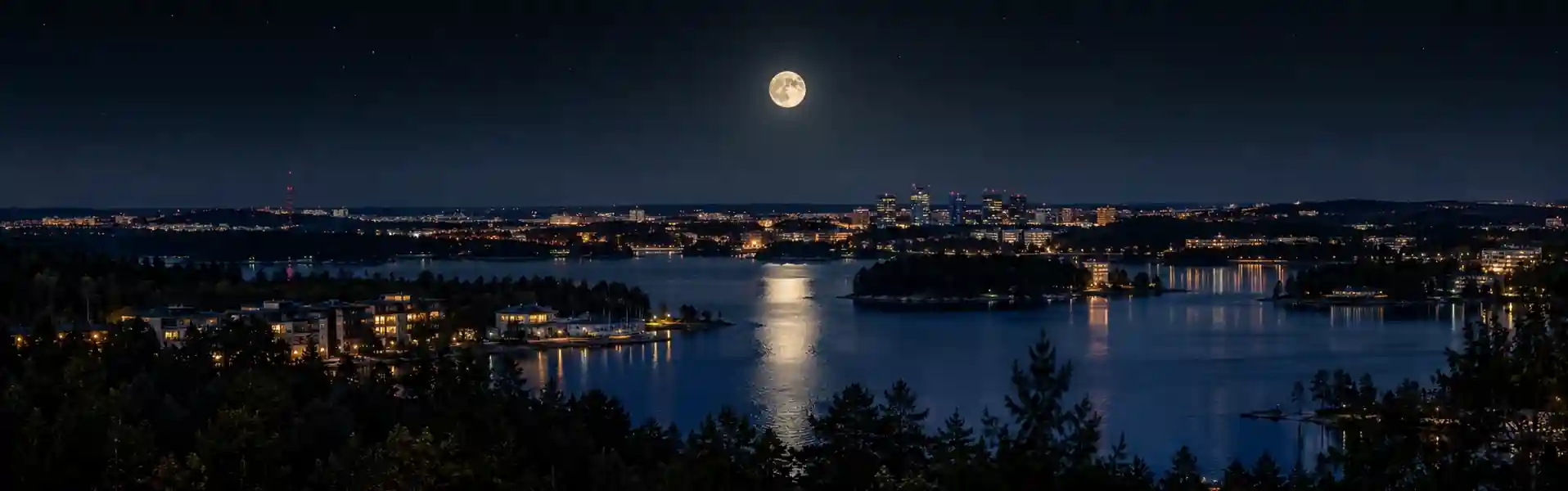
☽ Best Places to View the Moon in Espoo, Finland
Espoo sits at 60.2°N on the northern shore of the Gulf of Finland, Finland's second-largest city and the western half of the Helsinki metropolitan area. It is a city of contrasts rather than one dominant skyline: dense districts like Leppävaara and Tapiola sit only a short drive from Nuuksio National Park, a lake-and-granite wilderness in the city's north-west, and from an archipelago of about 165 islands along the coast to the south. At this latitude the Moon rises between north-east and south-east, and a summer full Moon stays very low, near 6°, while a winter one climbs to about 53°. The sky itself changes with the season: near-continuous twilight around midsummer washes out all but the brightest Moon, while the darker winter months are particularly favourable for Moon watching and night-sky observation, with an occasional chance of aurora. Where to go depends on how far you want to get from the Helsinki area's brightest lights to the east. Exact rise and set times and azimuth depend on the date and your observing position, so check both before planning a specific composition.
Nuuksio National Park – Haukkalampi & Jäniskallio
Established in 1994 and around 30 km from central Helsinki, Nuuksio is one of the largest and most accessible natural areas near the capital for getting away from the metropolitan area's brightest lights. Park at the Haukkalampi entry point and walk in; Jäniskallio, on the western shore of Nuuksion Pitkäjärvi, is a low but commanding rock formation that gives an open, elevated view over the lake and surrounding forest. The trails are unlit, so bring a headlamp.
Kasavuori & Laturinkallio – City Hilltops
Kasavuori, a rocky hilltop in the coastal Soukka district reaching about 44 metres above sea level, opens up in nearly every direction, with Laurinlahti bay in the foreground and Kivenlahti beyond. Because the summit isn't hemmed in by trees the way many of Espoo's forest viewpoints are, it lets you follow the Moon across a comparatively open horizon, from a five-minute walk off residential streets. Laturinkallio is a rocky outcrop in the middle of Leppävaara, one of Espoo's busiest districts, with open views south toward Sello and First World War-era Russian fortification remnants built into the rock. It won't give you a dark sky, but it's the easiest option for a bright, low moonrise over the city on a weeknight.
Kivenlahti Cliffs
The granite coastal cliffs at Kivenlahti, at the south-western edge of Espoo, look out across the Gulf of Finland toward open water. The coast faces south, so the south-eastern and south-western ends of the Moon's range can fall over the sea, which makes it a good spot for watching the Moon rise or set over the Baltic, with its reflection running out across the water. Kivenlahti is also one of the seasonal departure points for the archipelago boats to Stora Herrö, and it is exposed to wind off the Gulf.
Stora Herrö Observation Tower
A roughly 44-hectare recreational island in the Espoo archipelago, reached by seasonal archipelago boat from Kivenlahti or Otaniemi. An observation tower sits at the island's highest point with near-360° sea views and a campfire site alongside it. Its position out in the archipelago gives it a more open maritime horizon and less immediate urban development than the mainland viewpoints. Boat service is seasonal, and camping is permitted under Finland's everyman's right, though there's no drinking water, so bring your own and know your return boat time.
Villa Elfvik & Laajalahti Nature Reserve
The Villa Elfvik nature tower stands in the Laajalahti bay wetlands, close to central Espoo, with an accessible boardwalk path leading out to it. The bay's flat, open wetland gives a wide, low horizon that's well suited to watching a full Moon climb clear of the treeline. It can be reached on foot or by public transport, though the Nature House itself keeps seasonal daytime hours, so check current trail and access conditions before heading out after dark.
Ursa Observatory & Marsio – Telescopes and Talks Nearby
Espoo has no regular public telescope night of its own, but the Ursa Observatory in Kaivopuisto Park in Helsinki, about 17 km to the east, dates to 1926 and is still in active use. Non-members can attend its public shows, which look at solar phenomena in summer and at the starry sky in the darker months. They run to a timetable, only when the weather is clear and the temperature is not below −15 °C, so check its page or call. In Espoo, Aalto University's Marsio building in Otaniemi has hosted open astronomy lectures.
◉ Best Times for Moon Photography in Espoo
📷 Quick Photography Tips for Espoo
🕐 Timezone: Espoo runs on EET (UTC+2), shifting to EEST (UTC+3) for daylight saving time from the last Sunday in March to the last Sunday in October. Double-check your moonrise app is set to Espoo and not carrying over a stale offset across the DST switch.
🔭 Telescope Option: The Ursa Observatory in Kaivopuisto, Helsinki, runs public shows by timetable when the sky is clear and the temperature is above −15 °C: solar phenomena in summer, the starry sky in the darker months. Check its page or call for dates. For the moon phase in any other city, use the calculator on our home page.
The moon phase today in Espoo, Finland is shown in detail above — complete with exact illumination percentage, moonrise/set times, and the best viewpoints to see it. For the moon phase today in any other city or location worldwide, visit our Dynamic Moon Phase Calculator on the home page.
◐ What the Experience Actually Feels Like
Espoo doesn't announce itself the way a single dramatic landmark does — there's no one rim, no one canyon edge. What it has instead is proximity: a tech city built around Aalto University and a cluster of research campuses, sitting close enough to genuine wilderness that you can leave a meeting in Leppävaara and be standing on granite at Jäniskallio, with the Moon rising over a frozen lake, inside forty minutes. That's the character of the place — a national park set aside to protect its forests, lakes, and rocky wilderness, folded into the edge of a city.
In winter, when daylight lasts only around five to six hours, a full Moon over Nuuksio does real work — it lights the snow-covered rock and the ice on Pitkäjärvi in a flat, cold, blue-white that has nothing in common with the golden light photographers chase in summer. Out at Stora Herrö, reached by the archipelago boats that run in the warmer months, the same Moon has open water instead of forest, and the tower at the island's high point turns a short boat trip into something closer to open ocean than a city suburb.
What changes here, more than anything else, is the season itself. Around midsummer the sky never gets properly dark, and a Moon-viewing trip is really a twilight walk instead. By November that flips entirely — the nights are long, the cold sharpens the air, and if you're patient and a little lucky, the Moon isn't the only light in the sky.
"In Espoo the dark isn't at the edge of the city — it's folded into the middle of it, in a park kept wild to protect the forests and lakes that were here long before the city grew up around them."
✓ Your Espoo Moon Chase Checklist
Before You Go
- Check the moonrise time and phase on this page for each night of your stay
- If heading to Stora Herrö, confirm the seasonal archipelago boat timetable from Kivenlahti or Otaniemi before you set out — service doesn't run year-round
- Between late March and late October, remember Finland shifts to EEST — re-verify your moonrise app is using Espoo's current offset
- In autumn or winter, check the aurora forecast alongside the moon phase — Espoo occasionally catches displays during strong geomagnetic activity
- Check the Ursa Observatory's page for its public show timetable if you want a telescope, and current trail and access conditions for whichever park or reserve you're visiting
What to Bring
- Proper winter layers — lows in December to February average around −6°C to −7°C but can occasionally drop below −15°C, and wind off the open Gulf of Finland cuts sharply at coastal and archipelago spots
- A headlamp, ideally with a red-light mode — Nuuksio's trails and the archipelago paths on Stora Herrö are unlit
- A tripod with a weighted hook for wind at exposed spots like Kivenlahti, Kasavuori, and Stora Herrö
- Spare camera batteries kept warm in an inner pocket — cold drains them far faster than the stated rating
- Your own drinking water if visiting Stora Herrö — none is available on the island
On the Night
- Arrive 20–30 minutes before moonrise at open horizons like Kivenlahti; add extra time at tree-lined spots like Nuuksio, where the Moon clears the treeline later than a flat-horizon calculation suggests
- At Nuuksio, stick to the Haukkalampi–Jäniskallio route or the accessible Maahisenkierros viewing platform rather than improvising off-trail in the dark
- On Stora Herrö, know your return boat time before you commit to staying for moonrise, or plan to camp under Finland's everyman's right
- Shoot RAW and bracket exposures — a bright winter Moon over snow and ice needs different handling than the same Moon over dark open water
? Espoo Moon Phase — Frequently Asked Questions
Q. What is the moon phase today in Espoo?
The moon phase today in Espoo is a Last Quarter with 45% illumination. The next full moon is in 23 days, on 26 Oct. Moonrise is at 11:16 PM and moonset at 5:48 PM.
Q. Where is the best place to view the moon in Espoo?
Espoo, Finland's second-largest city and the western half of the Helsinki metropolitan area, sits on the northern shore of the Gulf of Finland, so the best places are its wild edges. Nuuksio National Park, established in 1994 about 30 km from central Helsinki, has Jäniskallio, a low rock formation with an open view over Nuuksion Pitkäjärvi, reached from the Haukkalampi entry point. Kasavuori in Soukka and Laturinkallio in Leppävaara are rocky hilltops among the districts. Kivenlahti's granite cliffs face the open Gulf, and Stora Herrö, an archipelago island with an observation tower, is reached by seasonal boat.
Q. Can I look at the moon through a telescope in Espoo?
Not in Espoo at a regular public night that is advertised. The nearest is the Ursa Observatory in Kaivopuisto Park in Helsinki, about 17 km to the east, which dates to 1926 and is still in active use. Non-members can attend its public shows, which look at solar phenomena in summer and at the starry sky in the darker months. They are run to a timetable, only when the weather is clear and the temperature is not below −15 °C, so check the observatory's page or call for current dates. In Espoo itself, Aalto University's Marsio building in Otaniemi has hosted open astronomy lectures.
Q. Where does the moon rise and set in Espoo, and how high does it climb?
At about 60.2°N, Espoo's moonrise and moonset points swing widely across the horizon each month, from roughly north-east to south-east for rising and north-west to south-west for setting, a wider swing than further south, and wider still in years near a major lunar standstill. A full moon near the winter solstice climbs to roughly 53° in the south, while a full moon near the summer solstice stays very low, peaking near 6°. The coast faces south across the Gulf of Finland, so the south-eastern and south-western ends of the moon's range can fall over open water, as at Kivenlahti. Check the azimuth for your date and exact spot.
Q. Is light pollution a problem for moon observing in Espoo?
The moon is bright enough to observe and photograph from almost anywhere in Espoo, so light pollution rarely limits the lunar disc itself. It does wash out earthshine on a thin crescent and any faint sky detail. Espoo's dense districts, such as Leppävaara and Tapiola, share the glow of the Helsinki area, so Nuuksio and the archipelago are the best places to get away from the brightest lights. The season matters as much as the place: around midsummer the Sun stays within about 6° of the horizon all night, so there is no true astronomical night, and a bright twilight washes out all but the brightest moon.
Q. What camera settings and phases work best for moon photography in Espoo?
For a full moon, start with Looney 11 (f/11, ISO 100, 1/100 s) and refine using your histogram, since it is a baseline rather than a guarantee. Shoot RAW and bracket exposures, because a bright winter moon over snow and ice needs different handling than the same moon over dark open water. A full moon over frozen Nuuksion Pitkäjärvi, shot from Jäniskallio, can make a striking winter composition. Use a tripod with a weighted hook, since coastal and archipelago spots such as Kivenlahti and Stora Herrö are exposed to Baltic wind, and arrive 20 to 30 minutes before moonrise at open horizons, with extra time at tree-lined spots like Nuuksio.
Q. How do cold, wind and the aurora season affect moon viewing in Espoo?
Winter nights in Espoo average around −6 °C to −7 °C from December to February but can occasionally fall below −15 °C, and wind off the open Gulf of Finland cuts sharply at coastal and archipelago spots. Cold drains camera batteries far faster than their rating, so carry spares in an inner pocket. Daylight lasts only about five to six hours in midwinter, which gives long dark nights, and on a clear night with a high Kp index you may catch the aurora in the northern sky alongside the moon. Check the Finnish Meteorological Institute for cloud and wind, and the aurora forecast, before you go.
Q. What time zone are Espoo's moonrise and moonset times shown in?
Espoo runs on Eastern European Time, EET, UTC+2, in winter and Eastern European Summer Time, EEST, UTC+3, in summer. Clocks go forward on the last Sunday in March and back on the last Sunday in October, and moonrise and moonset times on this page follow the local clock in effect on each date, so re-check any moonrise app's offset across the change. Espoo lies at about 24.7°E, west of the 30°E meridian on which Eastern European Time is based, so the sun and moon cross the sky about 21 minutes later on the clock than they would on that meridian.
Q. Can I shoot the moon at Espoo's viewpoints after dark?
Mostly, with care, but check each place. Nature areas can have seasonal closures, icy trails, restricted access or wildlife protections, so check current municipal or park information before visiting after dark. At Nuuksio, stick to the Haukkalampi to Jäniskallio route or the accessible Maahisenkierros viewing platform rather than going off-trail in the dark. Stora Herrö's boat service is seasonal, so confirm the timetable and your return time, and bring your own drinking water, since there is none on the island. The Nature House at Villa Elfvik in Laajalahti keeps seasonal daytime hours.
✦ Explore Further
Moon Phase Today: Helsinki
Check tonight's moon phase in Helsinki, roughly 15 km east of Espoo on the Gulf of Finland.
✈️Moon Phase Today: Vantaa
See the moon over Vantaa, roughly 25 km north-east of Espoo in the Helsinki region.
🌍World Moon Phase Directory
Find the moon phase, rise and set times for cities in every region of the world.
Blue Hour Calculator
Work out when blue hour falls, ideal for waxing gibbous shots over Nuuksio.