
Moon Phase Leipzig
On Sunday, October 4, 2026, the moon in Leipzig is a Last Quarter with 45% illumination. Moon age: 22.6 days.
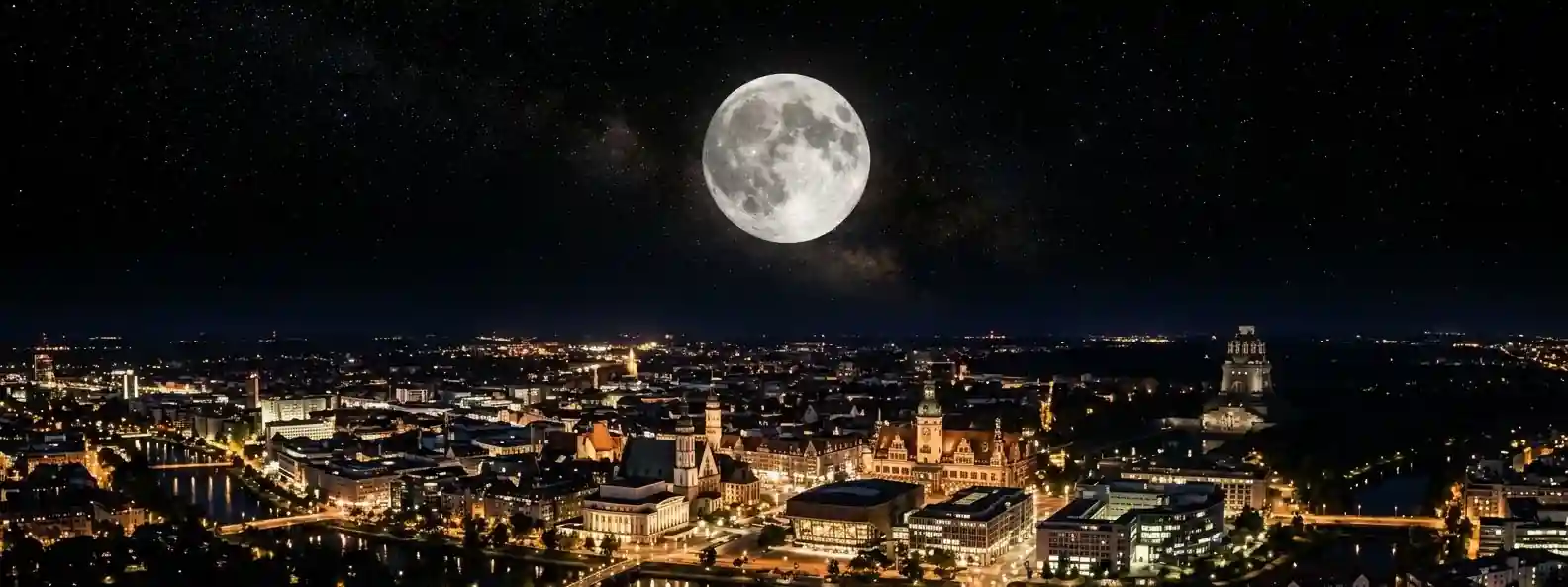
☽ Best Places to View the Moon in Leipzig, Germany
Leipzig offers a useful mix of elevated viewpoints, broad green spaces, open water and astronomical facilities for watching or photographing the Moon. Fockeberg is a hill built up from building rubble that rises almost 50 metres above the Südvorstadt and provides a broad view across Leipzig, while the Rosental Wackelturm offers a 20-metre-high panorama from the city's floodplain forest. South of Leipzig, Cospudener See provides a wide waterside landscape and the 35-metre Bistumshöhe viewing tower. The Völkerschlachtdenkmal is another major landmark with a 91-metre-high viewing platform, although access to the monument itself follows published opening hours. For dedicated astronomical observing, the Astronomisches Zentrum Schkeuditz north-west of Leipzig operates a planetarium and observatory and offers scheduled public observing events. The Moon rises in the east and sets in the west, so the direction you face matters: from Fockeberg the Völkerschlachtdenkmal stands about four kilometres due east, where the Moon rises around the equinoxes, while the city centre lies to the north-north-east, where the Moon never rises or sets. Exact Moonrise direction and altitude always depend on the date and your precise observing position.
Fockeberg
Fockeberg rises almost 50 metres above the Südvorstadt and is a prominent elevated viewpoint. The hill was built up from rubble from old buildings from 1947 and is now a green recreational area with paths, benches, a playground and a broad panorama over the city. The Völkerschlachtdenkmal stands about four kilometres to the east, inside the range of directions where the Moon rises, so on some dates, particularly around the equinoxes, a rising Moon, including the Harvest Moon near the September equinox, can come up beside it. The city centre lies to the north-north-east, so the Moon will mostly be behind you. Address: Fockestraße 60, 04275 Leipzig.
Rosental & Wackelturm
Rosental is a large historic park in Leipzig's Auwald. Its 20-metre-high steel observation tower, built in 1975 on top of a hill and popularly known as the Wackelturm, provides panoramic views across the city and surrounding greenery. The tower is free to access and is listed as open year-round, and works particularly well when you want the Moon above Leipzig's skyline rather than a street-level foreground. The tower is an open structure with no weather shelter, and it sways on windy days, so conditions can be noticeably different from ground level.
Cospudener See & Bistumshöhe
Cospudener See lies on the southern edge of Leipzig and is a large lake, creating a broad waterside landscape with long sightlines. The Bistumshöhe viewing tower on the southwest shore of the lake is 35 metres high and provides views over the lake and the surrounding Neuseenland landscape. The tower is free to access and is listed as open year-round. The lake lies to the north-east and east of the tower, in the direction of Moonrise, so a rising Moon can come up over the water. This location is outside the central city, so it is best described as a Leipzig-region viewing location.
Völkerschlachtdenkmal
Leipzig's 91-metre Monument to the Battle of the Nations is one of the city's defining landmarks and has a viewing platform with a broad panorama over Leipzig and the surrounding region. It can provide a strong foreground for lunar photography when the Moon's position matches the monument, for example from Fockeberg. The monument's published opening hours are currently 10:00–18:00 daily from April through October and 10:00–16:00 daily from November through March, with December 24 and December 31 closed. That means the viewing platform closes before sunset for most of the year, so plan photography around those hours, or from outside the monument, rather than assuming nighttime access.
Clara-Zetkin-Park
Clara-Zetkin-Park is a major central green space connected with Leipzig's wider riverside park and floodplain-forest landscape. Lawns, mature trees, paths and waterways provide natural foregrounds for Moon photography. It is better suited to compositions involving trees, open parkland or water than to completely unobstructed horizons. For a low Moon, check the predicted azimuth from your exact position because trees and nearby vegetation can block the lunar disc.
Astronomisches Zentrum Schkeuditz
For a dedicated astronomical experience, the Astronomisches Zentrum Schkeuditz, about 12 kilometres north-west of Leipzig, combines a planetarium with an 8-metre dome and an observatory with an observation platform, and has existed since 1978. Public planetarium shows are held on the last Sunday of each month, usually at 4pm, and sky observations for everyone take place regularly, often several times a month, with an alternative programme if it is cloudy. Booking is recommended, so check the current calendar before travelling. This is a better choice for telescope-based astronomical observing than the city's landscape viewpoints. Address: Bergbreite 1, 04435 Schkeuditz.
◉ Best Times for Moon Photography
📷 Quick Photography Tips
🕐 Timezone: Leipzig uses Central European Time — CET (UTC+1) in winter and CEST (UTC+2) during daylight saving time. Germany changes its clocks seasonally. PhotoPills, Stellarium or another astronomical planning tool can calculate the Moon's exact rise time, azimuth and altitude for your selected Leipzig location.
🔭 Observatory: The Astronomisches Zentrum Schkeuditz is at Bergbreite 1, 04435 Schkeuditz, about 12 kilometres north-west of Leipzig and reached by S-Bahn line S3 and a bus. Public planetarium shows are on the last Sunday of each month, and sky observations run regularly, weather permitting. Check its events calendar for current dates.
The moon phase today in Leipzig is shown in detail above — complete with exact illumination percentage, moonrise/set times, and the best local spots to see it. For the moon phase today in any other city worldwide, visit our Dynamic Moon Phase Calculator on the home page.
◐ What the Experience Actually Feels Like
Fockeberg changes the experience from a conventional city view into an elevated landscape scene. Rising almost 50 metres above the Südvorstadt, it gives you a relatively open panorama over the city, and with the Völkerschlachtdenkmal standing due east it is the best of the viewpoints for watching a rising Moon beside the monument. The hill itself is a recreational green space, so the foreground can be kept natural rather than dominated by buildings.
At Rosental, the setting becomes greener and quieter. The large park and surrounding Auwald provide opportunities to frame the Moon through trees or above open grassland, while the 20-metre Wackelturm provides a higher viewpoint over the city. The tower is an open steel structure, so wind can make it move slightly while you are on the platform.
Cospudener See feels different again. The lake creates long open sightlines and can introduce reflections into a lunar composition. From the 35-metre Bistumshöhe tower, the view extends across the lake and surrounding Neuseenland, in the direction where the Moon rises. The area is outside central Leipzig, but its proximity makes it a practical regional alternative to the city's more built-up viewpoints.
The Völkerschlachtdenkmal is primarily a landmark composition rather than a late-night observing location. At 91 metres high, it creates a substantial foreground when the Moon is positioned appropriately, but the interior and viewing platform are subject to the monument's published visitor hours. For a dedicated astronomical experience, the Astronomisches Zentrum Schkeuditz provides an observatory and planetarium with scheduled public observing events. That makes it a fundamentally different experience from simply finding an open landscape viewpoint and watching the Moon rise.
"Leipzig's Moon-viewing experience ranges from elevated city panoramas and open lake horizons to historic landmarks and dedicated astronomical observing just outside the city."
✓ Your Leipzig Moon Chase Checklist
Before You Go
- Check the Moon's rise time, altitude and azimuth for your date and exact observing location — the direction can change substantially from one date to another
- If you're photographing Fockeberg, the Wackelturm, Cospudener See or the Völkerschlachtdenkmal, use PhotoPills or Stellarium to determine whether the Moon will actually fall into your intended composition
- Verify Site Access: the Völkerschlachtdenkmal's viewing platform follows published visitor hours and closes before sunset for most of the year, while the Astronomisches Zentrum Schkeuditz operates scheduled observing events rather than unrestricted nightly access
- Check the current programme and any booking requirements if you want to attend an observing event at the Astronomisches Zentrum Schkeuditz
- Check cloud cover and visibility before leaving, particularly if you are planning a precise Moonrise composition
- Allow extra time at elevated viewpoints so you can establish the foreground, tripod position and focal length before the Moon reaches the planned position
What to Bring
- A telephoto lens — 200mm or longer can be useful when you want a relatively large Moon beside a distant Leipzig landmark, depending on your shooting distance
- A warm layer, particularly outside summer — elevated or exposed locations can feel colder than sheltered city streets
- A remote shutter release or a 2-second timer to reduce camera shake on tripod shots
- A small flashlight with a red-light mode can be useful on darker paths while preserving your night vision better than a bright white beam
- A backup viewing location in case cloud, crowds, access restrictions or changing conditions spoil your original composition
On the Night
- Arrive at least 30–45 minutes early when photographing a planned Moonrise composition so you can establish the foreground and camera position
- If autofocus struggles in low light, switch to manual focus and focus carefully on the Moon's edge or another distant subject
- Bracket your exposures — one for the bright lunar disc and another for the darker lake, park or skyline when a single exposure cannot hold both
- If the Moon looks soft or hazy right at Moonrise, consider waiting until it climbs higher above the horizon; the longer atmospheric path at low altitude can increase scattering and distortion
- At the Völkerschlachtdenkmal and Astronomisches Zentrum Schkeuditz, follow the current visitor instructions and published schedules rather than assuming normal nighttime access
Use the tools on this page, pick your vantage point, and catch a Leipzig moonrise for yourself.
? Leipzig Moon Phase — Frequently Asked Questions
Q. What is the moon phase today in Leipzig?
The moon phase today in Leipzig is a Last Quarter with 45% illumination. The next full moon is in 23 days, on 26 Oct. Moonrise is at — and moonset at 4:26 PM.
Q. Where is the best place to view the moon in Leipzig?
Leipzig is flat, so the best places are its raised viewpoints and open water. Fockeberg, a hill built up from building rubble that rises almost 50 m above the Südvorstadt, has a broad view over the city. The 20 m steel Wackelturm in the Rosental, a free tower that sways in wind, looks over the Auwald and the skyline. The free 35 m Bistumshöhe tower on the south-west shore of Cospudener See looks over the lake and the Neuseenland, and the 91 m Völkerschlachtdenkmal is the city's defining landmark, with a viewing platform that keeps daytime hours. Clara-Zetkin-Park has open lawns and water.
Q. Can I look at the moon through a telescope near Leipzig?
Yes, at the Astronomisches Zentrum Schkeuditz, at Bergbreite 1 in Schkeuditz, about 12 km north-west of Leipzig and reached by S-Bahn line S3 and a bus. The centre, which has existed since 1978, has a planetarium with an 8 m dome and an observatory with a viewing platform. Public planetarium shows are held on the last Sunday of each month, usually at 4pm, with booking recommended, and sky observations for everyone take place regularly, often several times a month, with an alternative programme if it is cloudy. Check the centre's events calendar for dates, since observing depends on the weather.
Q. Where does the moon rise and set in Leipzig, and how high does it climb?
At about 51.3°N, Leipzig's moonrise and moonset points swing widely across the horizon each month, from roughly north-east to south-east for rising and north-west to south-west for setting, with an even wider swing in years near a major lunar standstill. A full moon near the winter solstice climbs to roughly 62° in the south, while a full moon near the summer solstice stays low, peaking near 15°. From Fockeberg the Völkerschlachtdenkmal stands about 4 km to the east, and the moon rises almost due east around the equinoxes, so a rising full moon, including the Harvest Moon near the September equinox, can come up beside the monument. The city centre lies to the north-north-east of Fockeberg, where the moon never rises or sets, so the moon will mostly be behind you there. Check the azimuth for your date and exact spot.
Q. Is light pollution a problem for moon observing in Leipzig?
The moon is bright enough to observe and photograph from almost anywhere in Leipzig, so light pollution rarely limits the lunar disc itself. It does wash out earthshine on a thin crescent and any faint sky detail. Leipzig is a large city, so stars are faint in the centre and at the hilltop viewpoints, and the lakes to the south are only a short drive from its edge, not dark-sky sites. For telescope observing, the Astronomisches Zentrum Schkeuditz, outside the city, is the better choice.
Q. What camera settings and phases work best for moon photography in Leipzig?
For a full moon, start with Looney 11 (f/11, ISO 100, 1/100 s) and refine using your histogram, since it is a baseline rather than a guarantee. The moon is much brighter than the landscape, so shoot RAW and bracket or blend exposures to keep both crater detail and the foreground, such as a darker lake, park or skyline. For a moon-and-landmark shot, move farther back and use a longer focal length of 200 mm or more, with a sturdy tripod and manual focus on the moon's edge using magnified live view. The moon illusion makes a low moon look huge, but it is perceptual, not a change in size. Cospudener See can give a reflection when the water is calm.
Q. How do cloud, fog and wind affect moon viewing in Leipzig?
Leipzig sits in a lowland bay on the dry side of the Harz mountains, so it is relatively dry by German standards, but cloud still cuts many nights, and low fog can form over the river meadows and lakes in cool, calm weather. Check cloud cover and visibility as well as the general forecast. The open steel Wackelturm sways in wind and has no shelter, so conditions up there can be noticeably different from ground level, and lakeside viewpoints can be windy and cold.
Q. What time zone are Leipzig's moonrise and moonset times shown in?
Leipzig runs on Central European Time, CET, UTC+1, in winter and Central European Summer Time, CEST, UTC+2, in summer. Clocks go forward on the last Sunday in March and back on the last Sunday in October, and moonrise and moonset times on this page follow the local clock in effect on each date. Leipzig lies at about 12.4°E, west of the 15°E meridian on which Central European Time is based, so the sun and moon cross the sky about 10 minutes later on the clock than they would on that meridian.
Q. Can I shoot the moon at Leipzig's viewpoints after dark?
Mostly at the free ones. The Wackelturm in the Rosental and the Bistumshöhe tower at Cospudener See are listed as open year-round with no admission charge, but take a torch and care on the steps and the swaying tower in the dark. The Völkerschlachtdenkmal's viewing platform follows published hours, 10am to 6pm from April to October and 10am to 4pm from November to March, and is closed on 24 and 31 December, so it closes before sunset for most of the year. The Astronomisches Zentrum Schkeuditz runs scheduled events, not open nightly access. Check current access before an evening visit.
✦ Explore Further
Moon Phase Today: Berlin
Check tonight's moon phase in Berlin, roughly 150 km north-north-east of Leipzig.
🏙Moon Phase Today: Frankfurt am Main
See the moon over Frankfurt, roughly 290 km west-south-west of Leipzig on the River Main.
🌍World Moon Phase Directory
Find the moon phase, rise and set times for cities in every region of the world.
Blue Hour Calculator
Work out when blue hour falls, ideal for waxing gibbous shots over Cospudener See.