
Moon Phase Frankfurt am Main
On Sunday, October 4, 2026, the moon in Frankfurt am Main is a Last Quarter with 45% illumination. Moon age: 22.6 days.
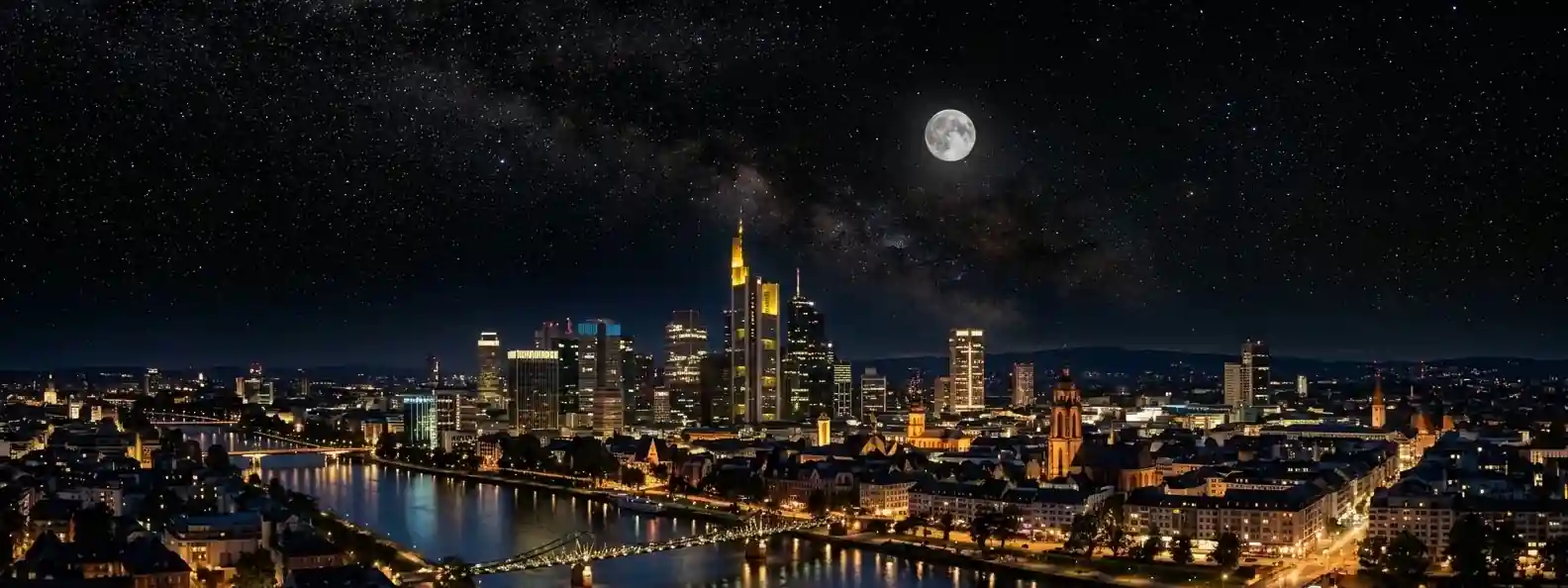
☽ Best Places to View the Moon in Frankfurt am Main, Germany
Frankfurt am Main sits on the flat Main river plain in Hesse, so the best moon viewpoints are its few raised spots and the river itself. The Moon rises in the east, crosses the southern sky and sets in the west, and the banking skyline lies west or north-west of the east-side riverbank and of Lohrberg, inside the range of directions where the Moon sets. On some dates, mostly in the colder months, a setting Moon can drop behind or beside the towers from there. From the Goetheturm the skyline lies to the north, where the Moon never rises or sets. Exact Moonrise and Moonset directions change with the date and your observing position, so check both before planning a specific composition.
Main Tower – Frankfurt's Highest Public Viewing Platform
At about 200 m above the city, Main Tower has the highest public observation platform in Frankfurt. The elevator goes to an enclosed area on the 55th floor, and the open terrace on the 56th floor is reached by stairs. The terrace is open-air and offers panoramic views toward the Taunus and across the Rhine-Main region. The platform is open daily, and in summer it is reported to stay open until 11 p.m. on Fridays and Saturdays, with a ticket of about €9. It can be very windy and can close in strong wind or rain, so check hours before you go.
Lohrberg – Frankfurt's Local Hill
Lohrberg is Frankfurt's Hausberg, rising to about 185 m in Seckbach on the Berger Rücken ridge. It's home to the city's last vineyard, a 1.3-hectare plot that belongs to the Rheingau wine region. The skyline lies to the west-south-west, inside the range of directions where the Moon sets, so a setting Moon can appear over the towers on some dates. Locals often call it Frankfurt's highest hill, but the official highest point is nearby at Berger Warte at 215.6 m above sea level.
Goetheturm – Wooden Tower in the Southern City Forest
43.3 m tall with 197 steps, Goetheturm stands in the southern Frankfurt City Forest in Sachsenhausen. The original tower from 1931 burned in 2017 and was rebuilt and reopened in 2021. It's free to climb and listed as open seasonally from April 1 to October 31, 8:00 until dark, with winter closure. The skyline lies to the north, so the Moon will mostly be behind you here, which makes it better for the forest and the southern sky than for a skyline composition.
Eiserner Steg & the Mainufer – Footbridge and River Promenades
Built in 1868–69, the Eiserner Steg connects the Old Town with Sachsenhausen. The 173 m iron footbridge is a classic viewpoint for the skyline and the Museumsufer, especially at sunset. It's a public pedestrian bridge with no ticket. The promenades on both banks of the Main offer long, open horizons and reflections of the skyline. The skyline lies to the north-west of the bridge, at the far edge of where the Moon sets, so a setting full Moon is possible mainly around midwinter.
Deutschherrnbrücke & Osthafen – Eastern River Views
East of the centre, the Deutschherrnbrücke area and Osthafen give a quieter angle on the skyline away from the main tourist crowds. The towers lie to the west-north-west, inside the range of directions where the Moon sets, so this is the best of the river spots for a Moonset behind the skyline. Public waterfront with open sky, not a formally designated astronomy viewpoint.
Sternwarte Frankfurt – Telescopes in Bockenheim
The Physikalischer Verein's observatory in Bockenheim, opened in 1908 behind the dome of the Senckenberg Museum, holds public observing evenings on Fridays, linked to its Astronomie am Freitag lecture series, with the dome open from 6 p.m. to 10 p.m., and on Saturdays from March. Its refractor, with a 210 mm lens and a 3.1 m focal length, is well suited to the Moon and planets. Observing is usually free and depends on a clear sky, and visits are recommended from age eight. Check the Verein's current programme.
◉ Best Times for Moon Photography in Frankfurt am Main
📷 Quick Tips for Frankfurt am Main
🕐 Timezone: Central European Time (CET) — UTC+1, Central European Summer Time (CEST) — UTC+2 during daylight-saving. Europe/Berlin zone.
🔭 Observatory: The Sternwarte of the Physikalischer Verein is in Bockenheim, behind the Senckenberg Museum's dome. Public observing runs on Friday evenings, 6 p.m. to 10 p.m., and on Saturdays from March, usually free and weather permitting. Check the Verein's current programme.
Access: Main Tower is ticketed, with the terrace closing in strong wind or rain. Lohrberg is a public park. Goetheturm is free and listed as open April 1–October 31 only. Eiserner Steg is a public bridge, and the Mainufer promenades are public.
The moon phase today in Frankfurt am Main is shown above. For moon phase today anywhere else, visit the calculator on our home page.
◐ What It Feels Like
At Main Tower, the open terrace above the city gives sweeping views over the skyline, Main River, Taunus and Rhine-Main region, and it can be very windy up there.
At Lohrberg, Frankfurt's Hausberg with the only vineyard, you get broad views over the Rhine-Main area with the highest terrain point at Berger Warte nearby, and the towers rise to the west-south-west where the Moon sets.
At Eiserner Steg, the iron footbridge between Old Town and Sachsenhausen acts as a panoramic balcony over the river.
At the Sternwarte in Bockenheim, a dome behind the Senckenberg Museum opens on Friday evenings, and visitors queue for a look at the Moon through a refractor that has been in use since 1908.
"Highest platform about 200 m on the 56th floor, Hausberg with vineyard, iron footbridge built 1868–69, and a working observatory in Bockenheim."
✓ Checklist for Lunar Observers
Before You Go
- Check moonrise and moonset azimuth for your chosen viewpoint — from the east-side river and Lohrberg the skyline lies west, where the Moon sets
- Check weather for cloud, haze and visibility
- Confirm access — Main Tower can close in wind or rain, Goetheturm is seasonal, Eiserner Steg is always public but can be crowded
- Check the Sternwarte's current programme if you want to look through its telescope
What to Bring
- Telephoto and wide for skyline and bridge foregrounds
- Tripod for landscape and bracketing
- Lens cloth for dust or dew
- Light jacket for evening temperatures, and a warmer layer on Main Tower's windy terrace
On the Night
- Focus on the Moon with magnified live view for detail, or choose depth of field for landscape compositions
- Bracket exposures to keep both lunar detail and foreground lights
- Stay on designated paths and respect access hours
- Urban river parks provide open horizons as light-polluted locations useful for Moon-over-city rather than dark-sky observing
? Frankfurt am Main Moon Phase — Frequently Asked Questions
Q. What is the moon phase today in Frankfurt am Main?
The moon phase today in Frankfurt am Main is a Last Quarter with 45% illumination. The next full moon is in 23 days, on 26 Oct. Moonrise is at — and moonset at 4:34 PM.
Q. Where is the best place to view the moon in Frankfurt am Main?
Frankfurt sits on the flat Main plain, so the best places are its few raised viewpoints and the river. Main Tower has the highest public observation platform in the city, at about 200 m, with an enclosed level on the 55th floor and an open-air terrace on the 56th. Lohrberg, Frankfurt's local hill in Seckbach, rises to about 185 m and has the city's last vineyard. The Goetheturm, a 43.3 m wooden tower in the southern City Forest, is free to climb in season. The Eiserner Steg footbridge and the riverbank promenades give river-level skyline views, and the Sternwarte in Bockenheim is the place to see the moon through a telescope.
Q. Can I look at the moon through a telescope in Frankfurt am Main?
Yes. The Physikalischer Verein's Sternwarte in Bockenheim, opened in 1908 behind the dome of the Senckenberg Museum, holds public observing evenings on Fridays, linked to its Astronomie am Freitag lecture series, with the dome open from 6pm to 10pm, and on Saturdays from March. Its refractor, with a 210 mm lens and a focal length of 3.1 m, is well suited to the moon and planets, and a separate hydrogen-alpha telescope is used for the sun. Observing is usually free, visits are recommended from age eight, and it depends on a clear sky, so check the Verein's current programme.
Q. Where does the moon rise and set in Frankfurt am Main, and how high does it climb?
At about 50.1°N, Frankfurt's moonrise and moonset points swing widely across the horizon each month, from roughly north-east to south-east for rising and north-west to south-west for setting, with an even wider swing in years near a major lunar standstill. A full moon near the winter solstice climbs to roughly 63° in the south, while a full moon near the summer solstice stays low, peaking near 16°. From the riverbank at the Deutschherrnbrücke and Osthafen, and from Lohrberg, the banking skyline lies to the west or west-north-west, inside the range of directions where the moon sets, so on some dates a setting moon, mostly a waning moon in the morning, can drop behind or beside the towers. From the Goetheturm the skyline lies to the north, where the moon never rises or sets. Check the azimuth for your date and exact spot.
Q. Is light pollution a problem for moon observing in Frankfurt am Main?
The moon is bright enough to observe and photograph from almost anywhere in Frankfurt, so light pollution rarely limits the lunar disc itself. It does wash out earthshine on a thin crescent and any faint sky detail. Frankfurt is a large city in the densely built Rhine-Main region, and central Frankfurt is not a dark-sky location, so stars are faint at every viewpoint, including the hilltop ones. The Sternwarte's telescope is aimed mainly at the moon, the planets and the sun, which light pollution affects far less.
Q. What camera settings and phases work best for moon photography in Frankfurt am Main?
For a full moon, start with Looney 11 (f/11, ISO 100, 1/100 s) and refine using your histogram, since it is a baseline rather than a guarantee. The moon is much brighter than the skyline lights, so shoot RAW and bracket or blend exposures to keep both crater detail and the foreground. A waxing gibbous is useful for blue hour while the foreground is still lit. A telephoto of about 200 to 400 mm on a full-frame camera can isolate the moon against distant towers, with a tripod on the open terraces and promenades and magnified live view for focus on the moon's edge. Haze over the Main plain can lower contrast.
Q. How do haze, wind and fog affect moon viewing in Frankfurt am Main?
Frankfurt has a mild climate, but haze over the Main plain can lower contrast, and fog can gather in the river valley in cool, calm weather. Check cloud cover, haze and visibility as well as the general forecast. The open terrace on Main Tower can be very windy and can close in strong wind or rain, and the hilltop viewpoints can be colder than the streets, so bring a warm layer.
Q. What time zone are Frankfurt am Main's moonrise and moonset times shown in?
Frankfurt runs on Central European Time, CET, UTC+1, in winter and Central European Summer Time, CEST, UTC+2, in summer. Clocks go forward on the last Sunday in March and back on the last Sunday in October, and moonrise and moonset times on this page follow the local clock in effect on each date. Frankfurt lies at about 8.7°E, west of the 15°E meridian on which Central European Time is based, so the sun and moon cross the sky about 25 minutes later on the clock than they would on that meridian.
Q. Can I shoot the moon at Frankfurt am Main's viewpoints after dark?
Mostly yes, with care. Main Tower's platform is open daily, and in summer it is reported to stay open until 11pm on Fridays and Saturdays, with a ticket of about €9, but the open terrace can close in strong wind or rain, so check hours before you go. The Goetheturm is free to climb but is listed as open only from 1 April to 31 October, from 8am until dark, and closed in winter. The Eiserner Steg is a public bridge and the Main riverbanks are public promenades. The Sternwarte's public evenings run on Fridays and Saturdays.
✦ Explore Further
Moon Phase Today: Cologne
Check tonight's moon phase in Cologne, roughly 155 km north-west of Frankfurt on the Rhine.
🏙Moon Phase Today: Stuttgart
See the moon over Stuttgart, roughly 155 km south-south-east of Frankfurt in its valley basin.
🌍World Moon Phase Directory
Find the moon phase, rise and set times for cities in every region of the world.
Blue Hour Calculator
Work out when blue hour falls, ideal for waxing gibbous shots over the Main skyline.