
Moon Phase Berlin
On Saturday, October 10, 2026, the moon in Berlin is a New Moon with 0% illumination. Moon age: 28.9 days.
☽ Best Places to View the Moon in Berlin
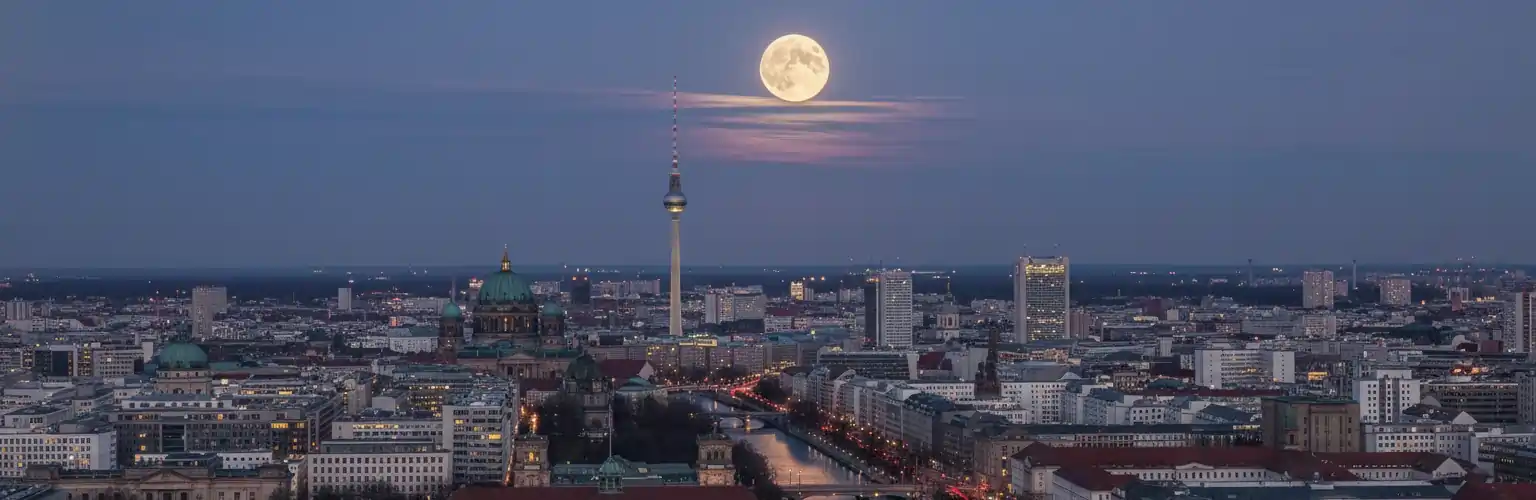
Berlin's flat horizon and eclectic skyline create surprisingly dramatic moonrises, especially with iconic landmarks like the TV Tower in silhouette. The city rewards photographers who understand its unique blend of history and modernity, where the River Spree often acts as a shimmering foreground. Depending on the season, the moon can rise to align directly behind key landmarks like the Oberbaumbrücke or the Fernsehturm — use PhotoPills to plan the exact alignment for your chosen date. All spots are free and accessible 24/7 unless otherwise noted.
Oberbaumbrücke (Oberbaum Bridge – Friedrichshain/Kreuzberg)
The ultimate Berlin moonrise postcard. The moon rises dead-centre behind the red-brick Gothic towers and yellow U-Bahn bridge, with the Fernsehturm (TV Tower) glowing in the distance. Spree River reflections are mirror-perfect on calm nights. Best visited on or around the full moon for maximum brightness. Ideal for both wide-angle and telephoto compositions to capture the bridge's intricate details with the moon.
Märkisches Ufer / Fischerinsel (Spree riverside near Mühlendamm)
A wide-open riverfront with the moon rising straight over the water, silhouetting the TV Tower and Berlin Cathedral domes. This spot offers a classic East Berlin vibe and is great for wide-angle shots that include boat traffic on the Spree. The low horizon provides an unobstructed view, perfect for capturing the moon's ascent against the city's iconic landmarks. Accessible year-round, with good public transport links.
Drachenberg (Teufelsberg area – Grunewald)
A WWII rubble mound (Trümmerberg) standing 99 m tall, offering one of the best elevated and publicly accessible viewpoints in western Berlin. Its unforested summit plateau gives a sweeping 360° panorama, with the TV Tower and Funkturm often visible in the distance. A short hike up steep wooden steps is required, and it's a popular spot for informal full moon gatherings. Note: neighbouring Teufelsberg (120 m) is taller but has restricted access and charges an entrance fee.
Tempelhofer Feld – east entrance (former airport runways)
Vast open fields with zero obstruction, offering one of the cleanest eastern views in the city. The moon rises large and clear over the horizon, with the distant skyline glowing faintly. This expansive park, a former airport, provides a unique sense of scale and darkness within the city. Very dark and spacious — ideal for wide-angle shots that emphasise the moon's grandeur against an open sky. Free admission; opening hours are fixed by season (e.g. 06:00–22:30 in June/July, 07:30–17:00 in December/January — check current times before visiting as entrance gates lock at closing).
Viktoriapark Kreuzberg – waterfall viewpoint
An elevated park hill with the moon rising behind the TV Tower and the charming Kreuzberg rooftops. The picturesque waterfall and National Monument provide a romantic foreground, adding depth and interest to your compositions. This spot offers easy S-Bahn access, making it a convenient and beautiful location for moonrise photography, especially for those seeking a more integrated urban-natural scene.
Rotes Rathaus / Alexanderplatz waterfront (Spree near Nikolaiviertel)
An urban classic: the moon rises behind the striking red Rotes Rathaus (Red City Hall) and the iconic TV Tower sphere. Reflections in the Spree and the Neptune Fountain create stunning symmetry and add dynamic elements to your photos. This central location is easily accessible and offers a vibrant, bustling atmosphere, perfect for capturing the moon in a truly Berlin context.
◉ Best Times for Moon Photography
📷 Quick Photography Tips
Berlin operates on CET (UTC+1) in winter and CEST (UTC+2) during daylight saving time. Clocks go forward on the last Sunday in March and back on the last Sunday in October. Apps like PhotoPills or Stellarium set to Berlin handle the offset automatically — moonrise times shift by several minutes daily, and planning exact alignments with the city's landmarks requires precise local time.
For the moon phase in any other city worldwide, visit our Dynamic Moon Phase Calculator for instant lunar data tailored to wherever you are.
The moon phase today in Berlin is shown in detail above — complete with exact illumination percentage, moonrise/set times, and the best local spots to see it. For the moon phase today in any other city or location worldwide, visit our Dynamic Moon Phase Calculator on the home page.
◐ What the Experience Actually Feels Like
There's a quiet drama to a Berlin moonrise that unfolds across its broad, flat horizon. Imagine standing on the Oberbaumbrücke, the red brick towers casting long shadows, the yellow U-Bahn rumbling overhead. As dusk settles, the Spree River glimmers, and then, slowly, majestically, the moon begins to climb above the eastern skyline. For a few perfect minutes, it aligns with the bridge's arches, and in the distance, the iconic Fernsehturm lights up, its sphere catching the last of the day's glow and the first kiss of moonlight. It's a moment where Berlin's past and present converge under a celestial spotlight.
Berlin's topography, largely flat, means you often have vast, unobstructed views of the eastern sky. From Tempelhofer Feld, the sheer expanse of the former airport runways offers a unique sense of scale, with the moon appearing enormous as it clears the distant tree line, almost untouched by city lights. Along the Märkisches Ufer, the moon glides over the Spree, creating shimmering reflections that dance with the silhouettes of the TV Tower and the stately Berlin Cathedral. Even from Drachenberg — a 99-metre rubble hill built from wartime debris — a short climb up steep wooden steps rewards you with panoramic vistas, placing the moon against a sprawling canvas of urban lights and distant forest. The flatness of the city allows for sweeping, grand compositions that capture the moon's journey across a truly open sky.
Winter is particularly rewarding for moon photography in Berlin. November to February often brings crisp, clear air that cuts through any haze, allowing for incredibly sharp lunar details and vivid contrasts with the city lights. The moon's more southerly path during these months can lead to those coveted alignments directly behind the TV Tower. Autumn offers a beautiful transition, with stable weather and often stunning twilight colors, though the days grow short. Spring and summer bring longer, hazier evenings, where the moon still makes a spectacular appearance, but often with a softer, more diffused light that complements the city's vibrant outdoor life.
"For a few perfect minutes, the moon aligns with the bridge's arches, and in the distance, the iconic Fernsehturm lights up, its sphere catching the last of the day's glow and the first kiss of moonlight."
✓ Your Berlin Moon Chase Checklist
Before You Go
- Check the moonrise time and phase on this page — the moon's alignment with Berlin landmarks is seasonal and needs precise planning
- Use PhotoPills to verify whether the moon will rise near the TV Tower, Oberbaumbrücke, or other key landmarks on your chosen date
- Target the 48–72 hour window before full moon if possible — the moon rises during civil twilight, bathing the city in a soft, balanced light
- Check weather forecasts for clear skies and minimal haze, especially for sharp lunar detail and distant skyline shots
- Scout your chosen location during the day for parking, access points, and potential obstructions, particularly along the Spree riverbanks and at Drachenberg
What to Bring
- Sturdy tripod — Berlin's open spaces and riverfronts can experience strong winds, essential for stable long exposures
- A lens between 200–300mm for tight compression shots — the TV Tower and other distant landmarks frame well at this range from various viewpoints
- Layers and warm clothing — Berlin winters are cold, and even in other seasons, evenings by the water or on hills can be chilly
- A wide-angle lens for Tempelhofer Feld or Märkisches Ufer — the expansive horizons and river scenes reward a 16–35mm range for environmental compositions
- Lens cloth — urban environments and river humidity can cause condensation on cold glass
- A headlamp or flashlight for Drachenberg and Tempelhofer Feld — these areas are minimally lit and require illumination for safe navigation after dark
On the Night
- Arrive at your viewpoint 30–45 minutes before moonrise — the eastern horizon creates a warm glow along the ridgeline before the moon clears
- At Oberbaumbrücke, position yourself to frame both the red-brick towers and the yellow U-Bahn bridge, ideally with the TV Tower in the background
- Shoot RAW — the dynamic range between a bright full moon, the city lights, and the dark sky requires careful exposure blending in post-production
- Stay 20–30 minutes after moonrise — as the moon climbs above the skyline, the compositions shift, and reflections in the Spree become more defined
- Watch for subtle atmospheric effects — Berlin's light pollution, combined with potential haze or crisp winter air, can create unique halos or glows around the moon
? Berlin Moon Phase — Frequently Asked Questions
Q. What is the moon phase today in Berlin?
The moon phase today in Berlin is a New Moon with 0% illumination. The next full moon is in 17 days, on Oct 26. Moonrise is at 7:16 AM and moonset at 6:00 PM.
Q. Where is the best place to view the moon in Berlin?
Oberbaumbrücke is Berlin's signature moonrise spot, with the moon rising behind its red-brick Gothic towers and the Fernsehturm glowing beyond. Märkisches Ufer and Drachenberg in Grunewald offer wide river or elevated panoramas, Tempelhofer Feld gives one of the cleanest, most open eastern horizons in the city, and Viktoriapark or the Rotes Rathaus waterfront add further alternatives.
Q. Why does moon visibility change so much in Berlin through the year?
Berlin's flat horizon keeps most viewpoints clear year-round, so it's mostly the weather and the moon's path that shift things: November through February brings a more southerly moon path and generally crisper, clearer air, while autumn (September–October) tends to bring stable weather after summer haze.
Q. Does Berlin observe daylight saving time?
Yes. Berlin runs on CET (UTC+1) in winter and switches to CEST (UTC+2) for Central European Summer Time, from the last Sunday in March to the last Sunday in October. The times shown on this page are already adjusted for whichever period applies today.
Q. What's the best time of year for moon photography in Berlin?
November through February offers the clearest skies and a moon path that aligns most tightly with the TV Tower from the city's classic viewpoints. Calm evenings on the Spree give the sharpest reflections whatever the season, so it's worth checking wind alongside cloud cover.
Q. Does this page work for cities besides Berlin?
This page is set up specifically for Berlin, Germany. For the moon phase in any other city or location worldwide, use the Dynamic Moon Phase Calculator on the moonphase.today home page.
✦ Explore Further
Moon Photography Guide
Camera settings, lenses, and techniques for shooting sharp, well-exposed moon shots.
📐Looney 11 Exposure Calculator
Dial in the exact f-stop, ISO, and shutter speed for a full moon — the same rule used in our Oberbaumbrücke tips.
🌆Blue Hour Calculator
Find tonight's exact blue hour window to time your Oberbaumbrücke moonrise shots.
🌍World Moon Phase Directory
Browse the moon phase today in hundreds of other cities and locations around the world.
NASA Moon Phase & Libration Gallery
NASA's Scientific Visualization Studio's daily renders of the moon's exact phase, libration, and orientation, straight from official mission data.