
Moon Phase Cologne
On Sunday, October 4, 2026, the moon in Cologne is a Last Quarter with 45% illumination. Moon age: 22.6 days.
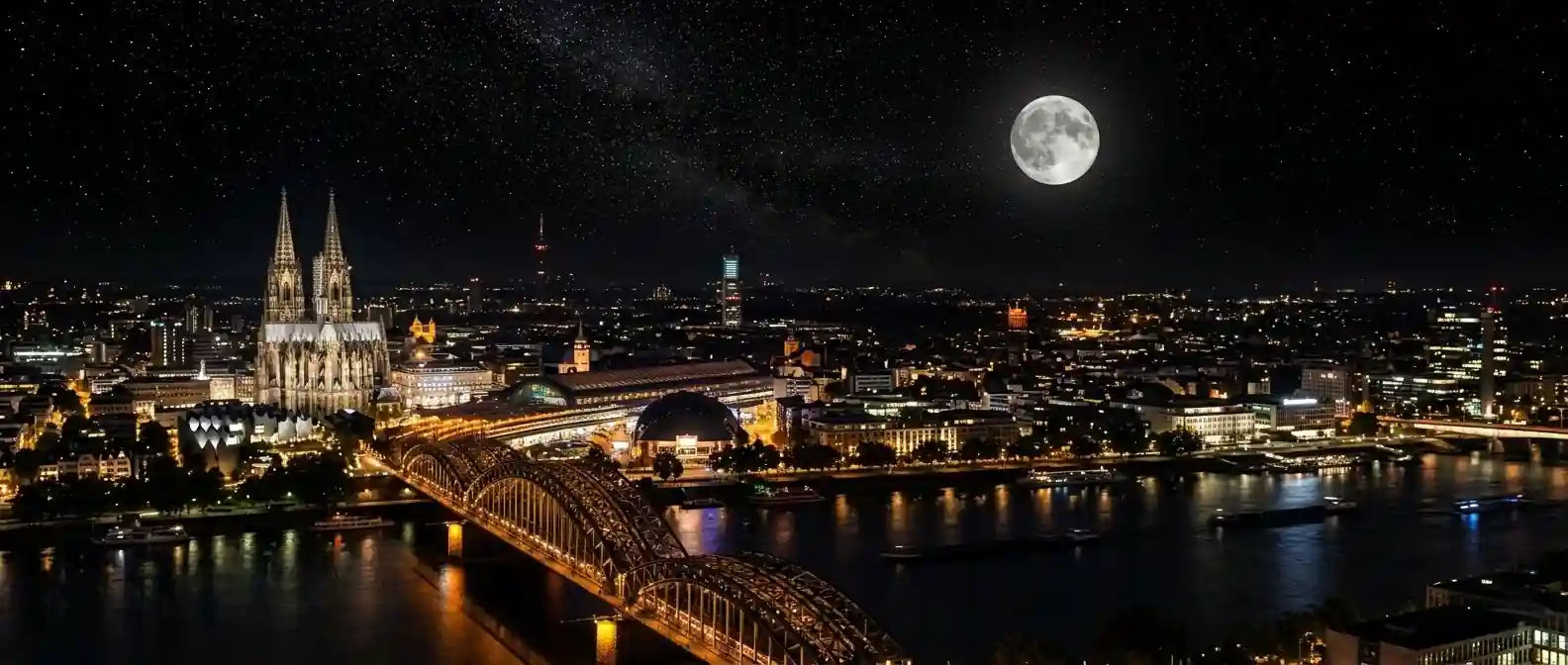
☽ Best Places to View the Moon in Cologne, Germany
Cologne is built around a bend in the Rhine, with the twin spires of Cologne Cathedral visible from nearly every riverside spot in the city. Most of the strongest viewpoints sit along the river itself, split between the historic Altstadt on the west bank and the more modern Deutz district on the east bank. Which bank you choose matters, because the Moon rises in the east and sets in the west. From the Deutz bank the cathedral lies to the west, inside the range of directions where the Moon sets, so on some dates a setting Moon, mostly a waning Moon in the morning, can fall near its towers, while a rising Moon will be behind you. From the Altstadt bank the Deutz skyline lies to the east, so a rising Moon comes up over it. As always, the Moon's exact rise time and direction shift with the date and your observing location, so check both against whichever riverbank you're planning around. Here are six useful moon-viewing options in the area, each suited to a different kind of visit.
Hohenzollernbrücke
Cologne's famous railway and pedestrian bridge, its railings covered in thousands of padlocks, with an excellent view of the cathedral from the Deutz side. From the Deutz end the cathedral lies to the west, the direction the Moon sets. Free, no tickets or gates — it's a public thoroughfare open 24 hours a day, though it does vibrate as trains cross. Address: connects Cologne Hauptbahnhof to Deutz.
Domplatte (Cologne Cathedral Square)
The wide pedestrian plaza surrounding Cologne Cathedral, Germany's most-visited landmark, with the illuminated twin towers visible at any hour from the square itself. The cathedral has been accessible for prayer from 6 a.m. to 8 p.m., but since July 2026 a ticket is required for tourist visits to the interior, reported at €12 (€6 reduced), while prayer and services remain free. Tourist visiting hours and the south tower's seasonal hours may change under the new visitor concept, so check the Cathedral's own website. Address: Domkloster 4.
Rheinboulevard (Deutz)
A roughly 500-metre open-air staircase opened to the public in 2015 along the Deutz riverbank between the Hohenzollern and Deutzer bridges, purpose-built as a place to sit and look back at the Altstadt skyline across the water. The steps face west toward the cathedral, the direction of Moonset, so a rising Moon is behind you. Free, generally accessible as an open public promenade; check current signage for any posted hours. Address: Deutz riverbank, between the two bridges.
Rheinpark
A 40-hectare park on the Deutz side of the river, laid out for the 1957 federal garden show, with wide lawns and a clear view of the cathedral across the water, which lies to the south-west. Free to visit. An open public park; check current posted access information before an evening visit.
Rheinauhafen
A former harbour turned architectural showcase on the west bank, anchored by the striking Kranhäuser (crane houses) and a riverside promenade with cafés and restaurants. It looks east across the Rhine to Deutz, so a rising Moon comes up over the far bank. The riverside promenade is publicly accessible, while individual businesses and facilities within it keep their own hours. Address: Rheinauhafen, 50678 Köln.
Volkssternwarte Köln
Cologne's public observatory, at Nikolausstraße 55, 50937 Köln, holds evening events, mostly on Fridays, with a lecture followed by sky observation through a telescope, or a dome visit if it is cloudy. A lecture on the Moon is listed for 20 November 2026 at 8 p.m., with tickets of about €3 to €10. Public events need tickets booked online, and it is closed during school holidays. Free solar observing runs on weekend mornings in clear weather.
◉ Best Times for Moon Photography
📷 Quick Photography Tips
🕐 Timezone: Cologne runs on Central European Time — CET (UTC+1) in winter and CEST (UTC+2) in summer, since Germany observes daylight saving time. PhotoPills or Stellarium will handle the moon's exact rise azimuth for any of these spots automatically.
🔭 Observatory: The Volkssternwarte Köln is at Nikolausstraße 55, 50937 Köln. Public events, mostly on Friday evenings, need tickets booked online, and it is closed during North Rhine-Westphalia's school holidays. With a combination ticket, a lecture is followed by telescope observation in clear weather, or a dome visit in cloud. Check its programme for current dates.
The moon phase today in Cologne is shown in detail above — complete with exact illumination percentage, moonrise/set times, and the best local spots to see it. For the moon phase today in any other city worldwide, visit our Dynamic Moon Phase Calculator on the home page.
◐ What the Experience Actually Feels Like
The Hohenzollernbrücke carries well over a thousand trains a day, so the pedestrian walkway has a faint, constant vibration running through it. The view back toward the illuminated towers from partway across the bridge is one of the city's well-known photographic views.
The Domplatte stays busy well into the evening with street performers, cafés, and people simply passing through, since it doubles as the main pedestrian route between the cathedral and the Hauptbahnhof. Whatever the cathedral's own visiting hours are on a given day, the square around it and the exterior view remain part of the public streetscape.
Rheinboulevard's tiered steps face directly across the river at the Altstadt skyline, making it a popular spot to sit rather than just pass through. Because the steps were purpose-built as a viewing platform, the sightline toward the cathedral is a notably clean, open one compared with most riverside spots.
The Volkssternwarte Köln offers something the river can't: a guided look through a telescope. On a clear Friday evening a lecture is followed by observation of the Moon, planets and stars, and when it is cloudy the evening moves into the dome and planetarium instead.
"Because Rheinboulevard's steps were purpose-built as a viewing platform, the sightline toward the cathedral is a notably clean, open one compared with most riverside spots."
✓ Your Cologne Moon Chase Checklist
Before You Go
- Check the moon's rise time and azimuth for your date and observing location — alignment with the cathedral, a specific bridge, or the Deutz skyline depends on both, and on which bank you stand
- Check both the moon's rise time and each site's current hours — the cathedral interior and its south tower keep more limited hours than the surrounding square or the riverbanks
- Verify Site Access: a ticket has been required for tourist visits to the cathedral interior since July 2026, reported at €12 (prayer and services remain free) — check current booking requirements if that's part of your plan
- Use PhotoPills or Stellarium to check whether the moon will align with a specific landmark on your date
- Check the forecast for river fog, particularly in autumn and winter, in addition to general cloud cover
- Book Volkssternwarte Köln tickets online ahead of time, and check its closure during school holidays
What to Bring
- A telephoto lens — 200mm or longer can be useful when you want a relatively large moon beside a distant landmark, depending on your shooting distance
- A warm layer, even in summer — river air can make an evening feel cooler than the daytime temperature suggests
- A remote shutter release or a 2-second timer to avoid shake on tripod shots, where tripods are permitted
- Comfortable shoes — several of these spots are best experienced by walking between two or three of them along the river
- A backup viewing location in case your first choice is crowded, fogged in, or hosting an event
On the Night
- Arrive at least 30–45 minutes early for a planned moonrise or moonset composition, or before a scheduled event
- If autofocus struggles in the low light, switch to manual focus and focus carefully on the moon's edge
- Bracket your exposures — one for the bright lunar disc, one for the darker river or cathedral silhouette below
- If the moon looks soft or hazy right at moonrise, consider waiting until it climbs higher above the horizon; the longer path through the atmosphere at low altitude increases scattering and distortion
- At Rheinpark or Rheinauhafen, plan around each site's current posted hours rather than assuming unrestricted late-night access
? Cologne Moon Phase — Frequently Asked Questions
Q. What is the moon phase today in Cologne?
The moon phase today in Cologne is a Last Quarter with 45% illumination. The next full moon is in 23 days, on 26 Oct. Moonrise is at — and moonset at 4:46 PM.
Q. Where is the best place to view the moon in Cologne?
Most of the best spots are along the Rhine, and which bank you choose decides what you see. On the Deutz bank, the Rheinboulevard, a riverside promenade of open-air steps opened in 2015 between the Hohenzollern and Deutzer bridges, faces the cathedral and the Altstadt skyline across the water, as does the Rheinpark, a large park with lawns. The Hohenzollern Bridge walkway gives a view of the cathedral from the river. On the west bank, the Rheinauhafen, a former harbour with the Kranhäuser crane houses and a riverside promenade, looks east across the Rhine to Deutz, and the Domplatte surrounds the cathedral itself.
Q. Can I look at the moon through a telescope in Cologne?
Yes. The Volkssternwarte Köln, at Nikolausstraße 55, holds public evening events, mostly on Fridays, with a lecture followed, on a combination ticket, by sky observation through a telescope, or a dome visit if it is cloudy. A lecture on the moon, called Der Mond – Unser Begleiter voller Überraschungen, is listed for 20 November 2026 at 8pm, and tickets cost roughly €3 to €10. Public events need tickets booked online, the observatory closes during North Rhine-Westphalia's school holidays, and free solar observing is offered on weekend mornings in clear weather. Check the observatory's programme for dates.
Q. Where does the moon rise and set in Cologne, and how high does it climb?
At about 50.9°N, Cologne's moonrise and moonset points swing widely across the horizon each month, from roughly north-east to south-east for rising and north-west to south-west for setting, with an even wider swing in years near a major lunar standstill. A full moon near the winter solstice climbs to roughly 62° in the south, while a full moon near the summer solstice stays low, peaking near 16°. The bank you stand on decides what the moon does near the cathedral: from Deutz the cathedral lies to the west, inside the range of directions where the moon sets, so on some dates a setting moon, mostly a waning moon in the morning, can fall near its towers, while a rising moon is behind you. From the Altstadt bank the Deutz skyline lies to the east, where the moon rises. Check the azimuth for your date and exact spot.
Q. Is light pollution a problem for moon observing in Cologne?
The moon is bright enough to observe and photograph from almost anywhere in Cologne, so light pollution rarely limits the lunar disc itself. It does wash out earthshine on a thin crescent and any faint sky detail. Cologne is a large city, and the floodlit cathedral and bridges add to the glow, so stars are faint along the river. The Volkssternwarte Köln even runs a talk whose title, in German, says that Cologne has a real problem with galaxies. For darker skies you need to leave the city.
Q. What camera settings and phases work best for moon photography in Cologne?
For a full moon, start with Looney 11 (f/11, ISO 100, 1/100 s) and refine using your histogram, since it is a baseline rather than a guarantee. The moon is much brighter than the river and the city, and brighter than the cathedral's floodlighting, so shoot RAW and bracket or blend exposures to keep both crater detail and the foreground. A full moon is not always the best phase for showing surface relief. For a moon-and-cathedral shot, move farther back and use a longer focal length of 200 mm or more, with a sturdy tripod where allowed and manual focus on the moon's edge using magnified live view. The moon illusion makes a low moon look huge, but it is perceptual, not a change in size.
Q. How do river fog, haze and cold affect moon viewing in Cologne?
Cologne has a mild, changeable climate, but the Rhine valley can develop low fog and mist in cool, humid, calm weather, including in autumn and winter, and it can linger into the morning and dim or hide a low moon. Check the forecast for fog as well as cloud cover. River air can feel colder than the daytime temperature suggests, and bridges and promenades can be windy, so bring a warm layer.
Q. What time zone are Cologne's moonrise and moonset times shown in?
Cologne runs on Central European Time, CET, UTC+1, in winter and Central European Summer Time, CEST, UTC+2, in summer. Clocks go forward on the last Sunday in March and back on the last Sunday in October, and moonrise and moonset times on this page follow the local clock in effect on each date. Cologne lies at about 7.0°E, west of the 15°E meridian on which Central European Time is based, so the sun and moon cross the sky about 32 minutes later on the clock than they would on that meridian.
Q. Can I shoot the moon at Cologne's viewpoints after dark?
Mostly yes along the river. The Hohenzollern Bridge walkway, the Domplatte and the Rhine promenades are public spaces, though check current signage for any posted hours at the Rheinboulevard and Rheinpark. Cologne Cathedral's interior is different: since July 2026 tourist visits need a ticket, reported at €12, while prayer and services remain free, and its visiting hours are limited. The Volkssternwarte Köln's public events need online tickets. Take care on the steps and promenades in the dark.
✦ Explore Further
Moon Phase Today: Düsseldorf
Check tonight's moon phase in Düsseldorf, roughly 35 km north-north-west of Cologne on the Rhine.
🏙Moon Phase Today: Dortmund
See the moon over Dortmund, roughly 75 km north-north-east of Cologne in the Ruhr region.
🌍World Moon Phase Directory
Find the moon phase, rise and set times for cities in every region of the world.
Blue Hour Calculator
Work out when blue hour falls, ideal for waxing gibbous shots over the Rhine.