
Moon Phase Stuttgart
On Sunday, October 4, 2026, the moon in Stuttgart is a Last Quarter with 45% illumination. Moon age: 22.6 days.
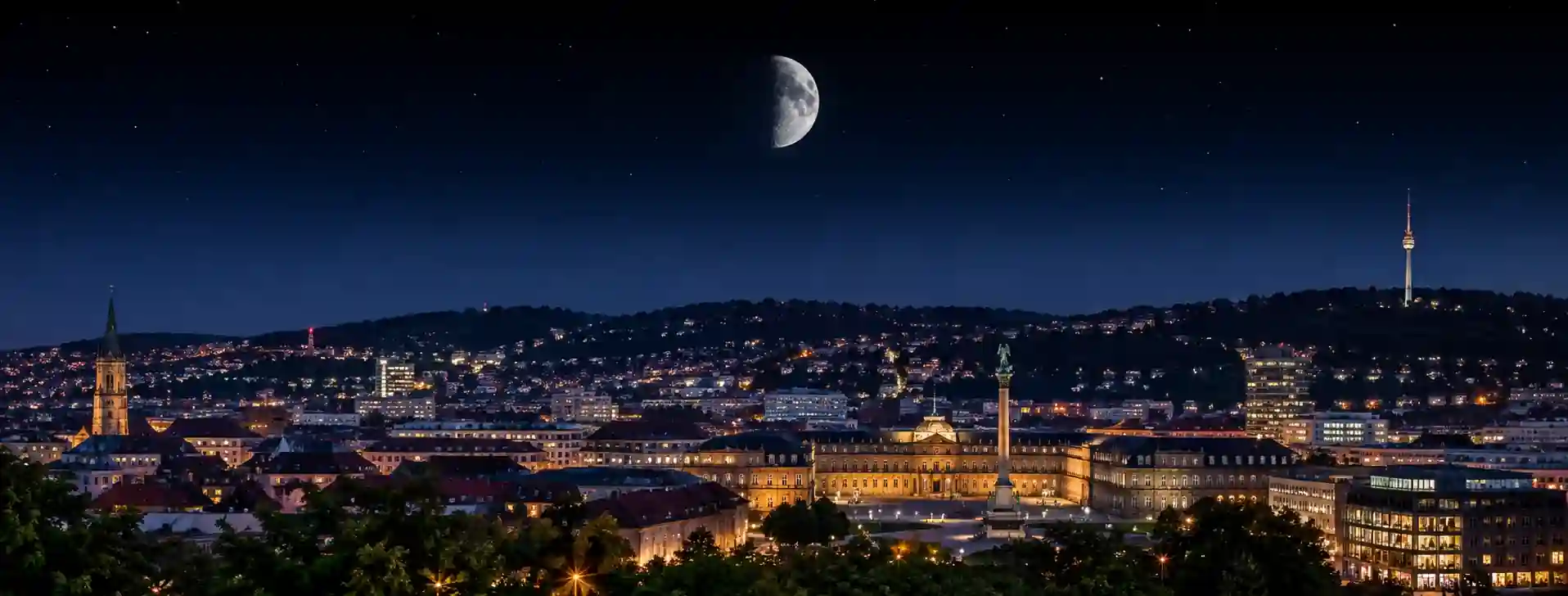
☽ Best Places to View the Moon in Stuttgart, Germany
Stuttgart is particularly interesting for lunar viewing because the city sits in a valley basin surrounded by wooded hills, vineyards and elevated viewpoints. This topography creates many places where the Moon can be framed against the city, vineyards, surrounding hills or distinctive landmarks. Uhlandshöhe combines a city viewpoint with the Stuttgart Observatory, while Birkenkopf and Karlshöhe provide elevated panoramas over the urban basin. Schloss Solitude and the Grabkapelle auf dem Württemberg provide more open settings and distinctive historic foregrounds. The Moon rises in the east and sets in the west, and crosses the southern sky between them, so the side of the basin you stand on decides what you see: from Birkenkopf, on the south-western rim, the city centre lies to the east-north-east, inside the range of directions where the Moon rises, while from Karlshöhe, which looks north across the basin, the Moon will mostly be behind you. These are urban or suburban observing locations rather than dark-sky sites, so city light pollution remains significant. The Moon itself, however, is bright enough to photograph successfully from Stuttgart. Exact Moonrise direction and altitude change with the date and observing position, so check both before planning a specific composition.
Uhlandshöhe & Stuttgart Observatory
Uhlandshöhe combines a small public viewing platform with the Stuttgart Observatory in the surrounding green space. The viewpoint looks toward eastern Stuttgart, with views including the Mercedes-Benz Arena and vineyards, which lie east-north-east, inside the range of directions where the Moon rises. The observatory, opened in 1922, offers guided telescope sessions of about an hour through its Zeiss dome, and daytime solar tours, but only under a clear sky. Evening sessions are listed for Monday and Wednesday to Saturday, starting from about 9pm with seasonal changes, and it is closed on Tuesdays and public holidays. Address: Zur Uhlandshöhe 41, 70188 Stuttgart.
Birkenkopf — Monte Scherbelino
At 511 metres, Birkenkopf is the highest point in Stuttgart's inner-city area and provides a broad panorama over the surrounding city and landscape. From the summit the whole city centre can be seen, and on a clear day the view extends to the Swabian Alb and the Black Forest. The city centre lies to the east-north-east and the television tower to the east-south-east, both inside the range of directions where the Moon rises, so on some dates a rising Moon can appear near them. Check the azimuth for your date. Address: Birkenkopf, 70197 Stuttgart.
Karlshöhe
Karlshöhe rises above Stuttgart-Süd and is one of the city's established viewpoints. Its ridge combines vineyards, gardens and public green space with a panoramic view over Stuttgart South and Central. The terrace and surrounding park provide useful foreground elements for urban twilight photography. Because the view looks north across the basin and the Moon crosses the southern sky, it will mostly be behind you here, so use Karlshöhe for city light and a high Moon over your shoulder rather than a Moonrise over the skyline.
Schloss Solitude
West of central Stuttgart, Schloss Solitude occupies an elevated setting with broad views over the surrounding landscape. State Palaces and Gardens Baden-Württemberg says the outdoor grounds are always freely accessible, while the palace interior and its dome viewing platform keep visiting hours and the palace is closed on some days, such as 31 December. For Moon photography, the forecourt and grounds can provide historic architecture and open landscape as foreground elements, but check conditions on the day.
Grabkapelle auf dem Württemberg
The Grabkapelle sits on the Württemberg above the Neckar Valley and among Stuttgart's vineyards, providing a distinctive historic foreground and wide landscape views. The chapel itself is closed to visitors in the winter months, and the grounds remain freely accessible only during the day. This makes the site particularly useful for daylight, twilight and early-evening lunar photography when it is still light. Check current access times before visiting.
Württemberg Vineyards & Rotenberg
The vineyard slopes around Rotenberg and the Württemberg provide a different perspective from Stuttgart's hilltop parks. Public paths and viewpoints in the area offer vineyard terraces, the Neckar Valley and the surrounding hills as natural foregrounds. These locations are especially useful for landscape-style lunar photography, where the Moon forms part of a wider composition rather than filling the frame.
◉ Best Times for Moon Photography in Stuttgart
📷 Quick Photography Tips
🕐 Timezone: Stuttgart uses Central European Time — CET (UTC+1) in winter and CEST (UTC+2) during daylight saving time. Germany changes between standard and daylight-saving time seasonally. For an exact Moonrise composition, use PhotoPills, Stellarium or another astronomy planning tool with the precise Stuttgart viewpoint selected.
🔭 Observatory: The Stuttgart Observatory is located at Zur Uhlandshöhe 41, 70188 Stuttgart. Public telescope sessions are held in the evening on Monday and Wednesday to Saturday, only when the sky is clear, and it is closed on Tuesdays and public holidays. Check the observatory's website for the current start time. The Stuttgart Planetarium in the Schlossgarten is an indoor alternative when it is cloudy.
The moon phase today in Stuttgart is shown in detail above — complete with exact illumination percentage, moonrise/set times, and useful local viewing information. For the moon phase today in any other city worldwide, visit our Dynamic Moon Phase Calculator on the home page.
◐ What the Experience Actually Feels Like
Uhlandshöhe provides one of Stuttgart's clearest combinations of an elevated city viewpoint and a dedicated astronomical facility. The lookout has views toward eastern Stuttgart, including the Mercedes-Benz Arena and vineyards, while the Stuttgart Observatory offers scheduled public telescope sessions when the sky is clear. It is therefore a natural place to combine ordinary Moon watching with a formal astronomical experience.
Birkenkopf changes the experience completely. At 511 metres, it stands above the surrounding inner-city landscape and offers a broad panorama over Stuttgart. Rather than treating the Moon as a small detail beside one building, you can work with the wider city basin and surrounding hills as the foreground. The summit is particularly useful for wide landscape compositions with a substantial amount of open sky, and with the city centre to the east-north-east it is the best of the hilltops for watching the Moon come up over the skyline.
Karlshöhe offers a closer urban perspective. The ridge above Stuttgart-Süd combines vineyards, gardens and public green space with a panoramic view over Stuttgart South and Central. This makes it useful for combining rooftops, hills, vineyards and the city's illuminated landscape with a high Moon over your shoulder. It also connects naturally with the surrounding Stuttgart hillside walking routes.
Schloss Solitude and the Württemberg vineyards provide more open landscape settings and distinctive historic foregrounds. Solitude offers elevated views over the surrounding countryside, with its outdoor grounds always freely accessible, while the Grabkapelle stands above the Neckar Valley among Stuttgart's vineyards. The Grabkapelle's chapel is closed to visitors in winter and its grounds are open only by day, so plan that site around daylight and early evening rather than assuming it is available throughout the night.
"Stuttgart's Moon-viewing experience ranges from a working observatory on Uhlandshöhe to elevated city panoramas, vineyard slopes and open views across the Neckar Valley."
✓ Your Stuttgart Moon Chase Checklist
Before You Go
- Check the Moon's rise time, altitude and azimuth for your exact date and viewpoint — Stuttgart's hills mean that the visible horizon differs from place to place, and a low Moon can appear later than its calculated rise time
- If you're planning a skyline composition from Birkenkopf or Uhlandshöhe, use PhotoPills or Stellarium to check the Moon's predicted position relative to the landmark you want in the frame
- Verify Site Access: the Grabkapelle's chapel is closed in winter and its grounds are open only by day, and Schloss Solitude's palace interior and dome platform keep visiting hours even though its outdoor grounds are always accessible
- Check the Stuttgart Observatory's current schedule — evening sessions run Monday and Wednesday to Saturday, clear sky only, and it is closed on Tuesdays and public holidays
- Check cloud cover, visibility and transparency before leaving, particularly when attempting a precise Moonrise composition
- Allow extra time at your chosen viewpoint to walk around and identify a foreground that works with the Moon's actual position
What to Bring
- A telephoto lens — 200mm or longer can be useful when you want a relatively large Moon beside a distant Stuttgart landmark, depending on shooting distance
- A warm layer, particularly outside summer — elevated viewpoints such as Birkenkopf and the vineyard slopes can feel colder and windier than sheltered streets in the city
- A remote shutter release or a 2-second timer to reduce camera shake during tripod exposures
- A small flashlight with a red-light mode can be useful when walking darker paths without unnecessarily brightening your surroundings
- A backup viewpoint in case cloud, access restrictions, crowds or an obstructed horizon interfere with your planned composition
On the Night
- Arrive 30–45 minutes early for a planned Moonrise composition so you can establish your camera position before the Moon reaches the horizon
- If autofocus struggles in low light, switch to manual focus and carefully focus on the Moon or another distant subject
- Bracket your exposures — one for the bright lunar disc and another for the darker Stuttgart skyline, vineyards or surrounding landscape
- If the Moon appears soft or strongly coloured immediately after rising, consider waiting as it climbs higher; the longer atmospheric path near the horizon can increase scattering and distortion
- Respect posted opening and closing times at managed locations, especially around the Grabkapelle, the interior of Schloss Solitude and other historic sites
Use the tools on this page, check access conditions, choose your vantage point, and catch a Stuttgart moonrise for yourself.
? Stuttgart Moon Phase — Frequently Asked Questions
Q. What is the moon phase today in Stuttgart?
The moon phase today in Stuttgart is a Last Quarter with 45% illumination. The next full moon is in 23 days, on 26 Oct. Moonrise is at — and moonset at 4:25 PM.
Q. Where is the best place to view the moon in Stuttgart?
Stuttgart sits in a valley basin ringed by wooded hills and vineyards, so the best places are on the rim. Uhlandshöhe, on the eastern side of the city, combines a viewpoint over eastern Stuttgart with the Stuttgart Observatory. Birkenkopf, at 511 m the highest point in the inner-city area, has a broad panorama over the whole city centre. Karlshöhe above Stuttgart-Süd has vineyards and a view over the basin, and Schloss Solitude, west of the centre, has open views over the surrounding landscape. The Grabkapelle auf dem Württemberg stands above the Neckar Valley among vineyards in Rotenberg.
Q. Can I look at the moon through a telescope in Stuttgart?
Yes. The Stuttgart Observatory, one of Germany's first public observatories, opened in 1922 at Zur Uhlandshöhe 41. In clear weather the moon, planets and stars can be viewed after dark through a telescope in its Zeiss dome with an expert explanation, in a session of about an hour. Evening sessions are listed for Monday and Wednesday to Saturday, starting from about 9pm with seasonal changes, and the observatory is closed on Tuesdays and public holidays. Daytime solar tours are also offered, and special tours run for events such as lunar eclipses. Sessions go ahead only under a clear sky, so check the observatory's website before you go. The Stuttgart Planetarium in the Schlossgarten is an indoor alternative.
Q. Where does the moon rise and set in Stuttgart, and how high does it climb?
At about 48.8°N, Stuttgart's moonrise and moonset points swing widely across the horizon each month, from roughly north-east to south-east for rising and north-west to south-west for setting, with an even wider swing in years near a major lunar standstill. A full moon near the winter solstice climbs to roughly 65° in the south, while a full moon near the summer solstice stays low, peaking near 18°. Because the city lies in a basin, the surrounding hills can hide a low moon, so it can appear later than its calculated rising time. From Birkenkopf the city centre lies to the east-north-east and the television tower to the east-south-east, both inside the range of directions where the moon rises, so on some dates a rising moon can appear near them. Check the azimuth for your date and exact spot.
Q. Is light pollution a problem for moon observing in Stuttgart?
The moon is bright enough to observe and photograph from almost anywhere in Stuttgart, so light pollution rarely limits the lunar disc itself. It does wash out earthshine on a thin crescent and any faint sky detail. Stuttgart is a large city in a densely built region, and the basin traps its glow, so stars are faint at every viewpoint, including the hilltop ones. For darker skies you need to leave the city, for example to the Welzheim observatory, about 40 km away.
Q. What camera settings and phases work best for moon photography in Stuttgart?
For a full moon, start with Looney 11 (f/11, ISO 100, 1/100 s) and refine using your histogram, since it is a baseline rather than a guarantee. The moon is much brighter than the city, vineyards and hills, so shoot RAW and bracket or blend exposures to keep both crater detail and the foreground. A waxing moon in the evenings before full gives convenient after-sunset shooting, while a full moon is not always the best phase for showing surface relief. For a moon-and-landmark shot, move farther back and use a longer focal length of 200 mm or more, with a sturdy tripod and manual focus on the moon's edge using magnified live view. A low moon looks huge above the hills, but the moon illusion is perceptual, not physical.
Q. How do fog, haze and cold affect moon viewing in Stuttgart?
Stuttgart has a mild climate, but the basin can hold fog and haze in still, cold weather, so a viewpoint on the rim can sit above the murk, or inside it. Check cloud cover, visibility and transparency, not just a general forecast. Hilltop viewpoints such as Birkenkopf and the vineyard slopes can be colder and windier than the streets, so bring a warm layer, and paths on the slopes can be wet and slippery after rain.
Q. What time zone are Stuttgart's moonrise and moonset times shown in?
Stuttgart runs on Central European Time, CET, UTC+1, in winter and Central European Summer Time, CEST, UTC+2, in summer. Clocks go forward on the last Sunday in March and back on the last Sunday in October, and moonrise and moonset times on this page follow the local clock in effect on each date. Stuttgart lies at about 9.2°E, west of the 15°E meridian on which Central European Time is based, so the sun and moon cross the sky about 23 minutes later on the clock than they would on that meridian.
Q. Can I shoot the moon at Stuttgart's viewpoints after dark?
Mostly yes, but check each site. The Stuttgart Observatory's public sessions run in the evening, clear sky only. State Palaces and Gardens Baden-Württemberg says the outdoor grounds of Schloss Solitude are always freely accessible, though the palace and its dome viewing platform keep visiting hours. The Grabkapelle auf dem Württemberg is closed to visitors in winter, and its grounds are freely accessible only in the daytime. Uhlandshöhe, Birkenkopf and Karlshöhe are public hilltops, but check for any local closures, take a torch, and watch your footing on paths in the dark.
✦ Explore Further
Moon Phase Today: Frankfurt am Main
Check tonight's moon phase in Frankfurt, roughly 155 km north-north-west of Stuttgart on the River Main.
🏔Moon Phase Today: Munich
See the moon over Munich, roughly 190 km east-south-east of Stuttgart, with the Alps to its south.
🌍World Moon Phase Directory
Find the moon phase, rise and set times for cities in every region of the world.
Blue Hour Calculator
Work out when blue hour falls, ideal for waxing gibbous shots from Birkenkopf and Uhlandshöhe.