
Moon Phase Düsseldorf
On Sunday, October 4, 2026, the moon in Dusseldorf is a Last Quarter with 45% illumination. Moon age: 22.6 days.
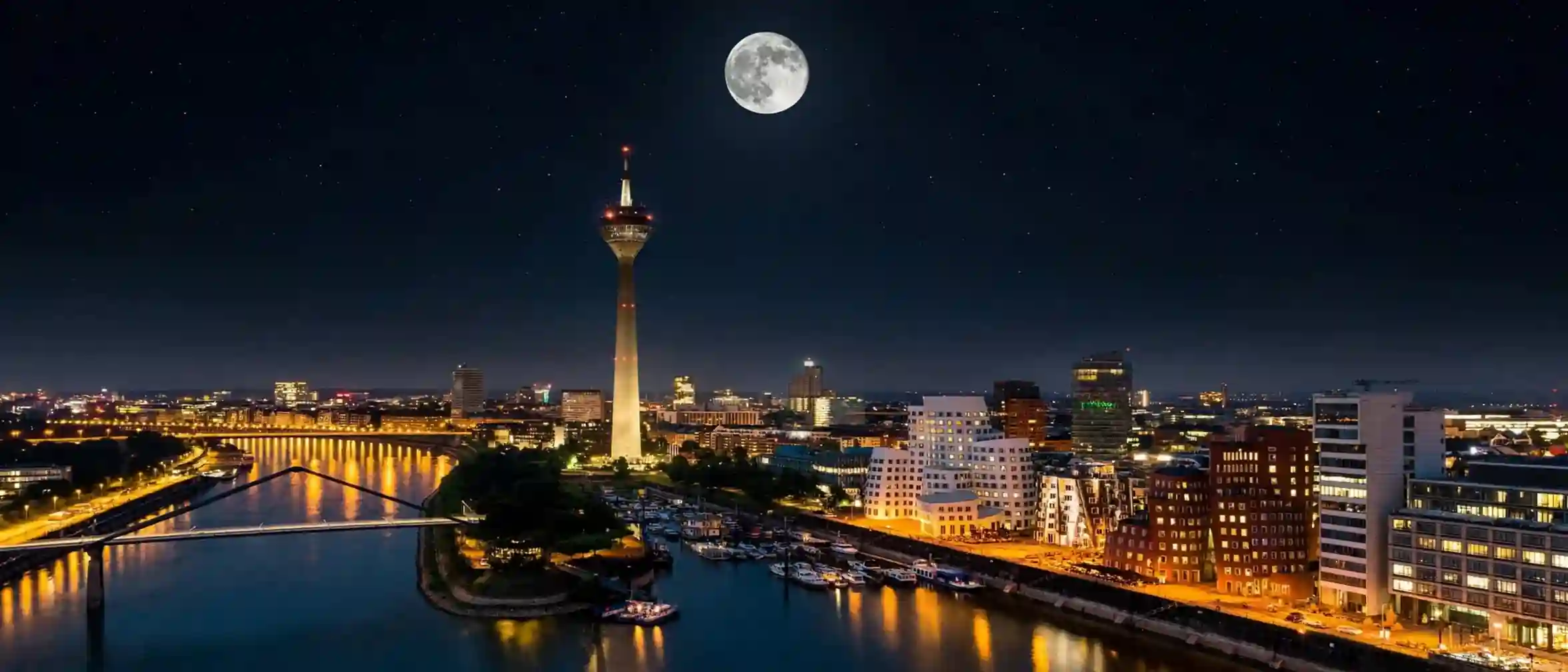
☽ Best Places to View the Moon in Düsseldorf, Germany
Düsseldorf offers a different kind of lunar-viewing landscape from hillier German cities. The city is relatively low and open, but the Rhine, broad riverside parks, formal gardens and distinctive architectural landmarks create many opportunities for Moon photography. The Rheinturm provides an elevated 360-degree view from 168 metres, while the Rheinuferpromenade and Rheinpark Golzheim provide open horizons along the Rhine. Schloss Benrath combines palace architecture, ponds and a large historic park, and for a more historic riverside setting, Kaiserswerth provides the ruins of the Kaiserpfalz above the Rhine. Which bank you stand on matters, because the Moon rises in the east and sets in the west. The Rhine runs roughly north to south and the Altstadt is on the east bank, so the Rheinuferpromenade and the east-bank parks look west across the river, the direction the Moon sets, while the left bank at Oberkassel looks east at the Altstadt skyline and the Rheinturm, the direction the Moon rises. These are urban or suburban locations rather than dark-sky sites, so Düsseldorf's artificial light remains part of the environment. The Moon itself, however, is bright enough to photograph successfully from the city. Exact Moonrise direction and altitude change with the date and observing position, so check both before planning a specific composition.
Rheinturm — Rhine Tower
Düsseldorf's most elevated public viewpoint is the Rheinturm, with the M168 viewing platform at 168 metres and a 360-degree panorama over the Rhine, MedienHafen, Altstadt and surrounding city, and in good weather as far as Cologne Cathedral. The official tower currently lists the viewing platform as open daily from 10:00 a.m. to midnight, although private events can affect access on individual dates, and tickets are cashless. This makes it one of the few elevated Düsseldorf viewpoints that can remain available well into the evening. Address: Stromstraße 20, 40221 Düsseldorf.
Rheinuferpromenade & Burgplatz
The Rheinuferpromenade runs along Düsseldorf's Altstadt on the east bank and provides open views across the Rhine, with the Burgplatz and historic Schlossturm forming distinctive foreground elements. The promenade looks west across the river, the direction of Moonset, so a setting Moon, mostly a waning Moon in the morning, can drop over the Rhine and the opposite bank, while a rising Moon is hidden behind the Altstadt. The Freitreppe at Burgplatz also provides a recognizable Düsseldorf foreground. Address: Burgplatz / Rheinuferpromenade, 40213 Düsseldorf.
Rheinpark Golzheim
Rheinpark Golzheim is a large open riverside park on the right bank of the Rhine, north of the central city. Its lawns and riverfront position provide broader sightlines than many central streets, making it useful for landscape-style Moon photography. Like the promenade, it looks west across the river, so the Moon can be photographed setting over the Rhine, passing boats and the opposite riverbank. Address: Robert-Lehr-Ufer / Cecilienallee, Düsseldorf.
Oberkassel Riverbank — Left Bank
The left bank of the Rhine at Oberkassel looks east across the river at the Altstadt, the Rheinturm and the Rhine bridges, which is the direction the Moon rises, so a rising Moon can come up over the skyline from here. The riverside meadows and promenade are open public space, but check any posted rules or hours before an evening visit. This is the bank to choose when you want a Moonrise composition, rather than a Moonset. Location: the Rhine's left bank at Oberkassel, opposite the Altstadt.
Schloss Benrath & Palace Park
Schloss Benrath provides one of Düsseldorf's strongest architectural settings for lunar photography. The more than 61-hectare palace park, which is free to enter and runs down to the Rhine bank, contains formal gardens, wooded areas, the Palace Pond and Reflecting Pond, creating multiple foreground and reflection possibilities. The park is officially open throughout the year, although the palace forecourt is listed as closed nightly from 10:00 p.m. to 6:00 a.m. The palace interior is visited by paid guided tour, and the buildings have separate visitor hours. Address: Benrather Schloßallee 100–106, 40597 Düsseldorf.
Kaiserswerth & Kaiserpfalz
Kaiserswerth is a historic Düsseldorf district on the Rhine, best known for the ruins of the Kaiserpfalz. The ruined medieval complex provides a distinctive foreground while the nearby Rhine opens the scene toward the surrounding landscape. Düsseldorf Tourism describes the Kaiserpfalz as offering panoramic views of the Rhine and surrounding countryside. This makes the area particularly interesting when the Moon's position allows it to be framed above the river or historic ruins, which on this bank means a setting Moon to the west. Address: Burgallee, 40489 Düsseldorf.
◉ Best Times for Moon Photography in Düsseldorf
📷 Quick Photography Tips
🕐 Timezone: Düsseldorf uses Central European Time — CET (UTC+1) in winter and CEST (UTC+2) during daylight saving time. Germany changes between standard and daylight-saving time seasonally. For an exact Moonrise composition, use PhotoPills, Stellarium or another astronomy planning tool with the precise Düsseldorf viewpoint selected.
🔭 Astronomy Option: Düsseldorf has no public observatory in the city today; its historic Bilk Observatory, founded in 1843, was destroyed by bombing in 1943. For a formal observatory experience, the Sternwarte Neanderhöhe Hochdahl in Erkrath-Hochdahl, just east of Düsseldorf, has an observatory and the Stellarium Erkrath planetarium at Sedentaler Straße 105, and in good weather the Moon can be observed there even in daylight. Check its current public-program schedule before making a dedicated observing trip.
The moon phase today in Düsseldorf is shown in detail above — complete with exact illumination percentage, moonrise/set times, and useful local viewing information. For the moon phase today in any other city worldwide, visit our Dynamic Moon Phase Calculator on the home page.
◐ What the Experience Actually Feels Like
The Rheinturm provides the most dramatic change in elevation. From the M168 viewing platform at 168 metres, Düsseldorf, the Rhine and surrounding cityscape spread out below you through a 360-degree panorama. Because the viewing platform is currently listed as open until midnight, it can also be used for evening and nighttime lunar viewing, subject to occasional private-event closures. The height changes the Moon from a distant object in the skyline into part of a much wider aerial city panorama.
The Rheinuferpromenade and Burgplatz offer the classic Düsseldorf riverside experience. The Rhine provides a broad, unobstructed visual corridor to the west, while the Schlossturm, Oberkasseler Brücke and opposite riverbank can become foreground or background elements depending on the Moon's position. The large Freitreppe at Burgplatz also provides a recognizable urban setting for evening photography.
Rheinpark Golzheim feels more open and spacious. The park's lawns run alongside the Rhine and provide room to work with a low Moon, passing boats, reflections and the opposite bank. It is particularly useful when the goal is a landscape photograph rather than a tightly framed architectural composition.
Crossing to the Oberkassel bank turns the picture around. From the left bank you look east at the Altstadt and the Rheinturm, and a rising Moon can climb above that skyline, which the east-bank promenade can never show you. Schloss Benrath provides a more controlled visual environment, combining the palace architecture with ponds, avenues, gardens and wooded areas. Because the Benrath park is open throughout the year, it can remain useful for lunar photography even when the palace buildings are closed, although individual areas and events can have additional restrictions.
Kaiserswerth offers a more historical riverside setting. The Kaiserpfalz ruins overlook the Rhine and surrounding landscape, giving photographers a way to combine the Moon with medieval masonry rather than a modern skyline. As with any historic site, check the current access conditions and remain within areas open to visitors.
"Düsseldorf's Moon-viewing experience ranges from a 168-metre viewing platform to open Rhine parks, a Moonrise bank across the river and medieval riverside ruins."
✓ Your Düsseldorf Moon Chase Checklist
Before You Go
- Check the Moon's rise time, altitude and azimuth for your exact date and viewpoint — the Rhine corridor, buildings and bridges can produce very different horizons from different locations, and on which bank you stand
- If you're planning a skyline composition from the Rheinturm, Burgplatz, Oberkassel or another waterfront location, use PhotoPills or Stellarium to check the Moon's predicted position relative to the landmark you want in frame
- Verify Site Access: do not assume that monuments, palace buildings, managed gardens or viewing facilities remain accessible throughout the night
- If using the Rheinturm, check the current opening hours and any listed private events before travelling; the official tower currently lists the M168 viewing platform as open daily from 10:00 a.m. to midnight
- Check cloud cover, visibility and transparency before leaving, particularly when attempting a precise Moonrise composition over the Rhine
- Allow extra time at your chosen viewpoint to identify a foreground that works with the Moon's actual position
What to Bring
- A telephoto lens — 200mm or longer can be useful when you want a relatively large Moon beside a distant Düsseldorf landmark, depending on shooting distance
- A warm layer — exposed Rhine viewpoints can feel colder and windier than sheltered streets, especially outside summer
- A remote shutter release or a 2-second timer to reduce camera shake during tripod exposures
- A small flashlight with a red-light mode can be useful when walking darker paths without unnecessarily brightening your surroundings
- A backup viewpoint in case cloud, access restrictions, crowds, events or an obstructed horizon interfere with your planned composition
On the Night
- Arrive 30–45 minutes early for a planned Moonrise composition so you can establish your camera position before the Moon reaches the horizon
- If autofocus struggles in low light, switch to manual focus and carefully focus on the Moon or another distant subject
- Bracket your exposures — one for the bright lunar disc and another for the darker Düsseldorf skyline, Rhine or surrounding landscape
- If the Moon appears soft or strongly coloured immediately after rising, consider waiting as it climbs higher; the longer atmospheric path near the horizon can increase scattering and distortion
- Respect posted opening and closing times at managed locations, especially the Rheinturm, Schloss Benrath and historic sites such as the Kaiserpfalz
Use the tools on this page, check access conditions, choose your vantage point, and catch a Düsseldorf moonrise for yourself.
? Düsseldorf Moon Phase — Frequently Asked Questions
Q. What is the moon phase today in Düsseldorf?
The moon phase today in Düsseldorf is a Last Quarter with 45% illumination. The next full moon is in 23 days, on 26 Oct. Moonrise is at — and moonset at 4:49 PM.
Q. Where is the best place to view the moon in Düsseldorf?
The Rhine runs roughly north to south through Düsseldorf, with the Altstadt on the east bank, and which bank you choose decides what the moon does. The Rheinuferpromenade and Burgplatz on the east bank look west across the river, the direction the moon sets, while the left bank at Oberkassel looks east at the Altstadt skyline and the Rheinturm, the direction the moon rises. The Rheinturm's M168 viewing platform, at 168 m, is the highest public viewpoint. Rheinpark Golzheim has open riverside lawns, the free park of Schloss Benrath has ponds and formal gardens, and the Kaiserpfalz ruins in Kaiserswerth overlook the Rhine.
Q. Can I look at the moon through a telescope near Düsseldorf?
Yes, just east of the city. The Sternwarte Neanderhöhe Hochdahl in Erkrath-Hochdahl has an observatory and the Stellarium Erkrath planetarium at Sedentaler Straße 105, with a dome of about 10 m. The district's museum-night leaflet says that in good weather the moon can be observed there even in daylight. Check the Sternwarte's current programme for public observing evenings and planetarium shows, since observing depends on the weather. Düsseldorf's own historic Bilk Observatory, founded in 1843, was destroyed by bombing in 1943.
Q. Where does the moon rise and set in Düsseldorf, and how high does it climb?
At about 51.2°N, Düsseldorf's moonrise and moonset points swing widely across the horizon each month, from roughly north-east to south-east for rising and north-west to south-west for setting, with an even wider swing in years near a major lunar standstill. A full moon near the winter solstice climbs to roughly 62° in the south, while a full moon near the summer solstice stays low, peaking near 15°. From the east-bank promenade the Rhine and the opposite bank lie to the west, so a setting moon, mostly a waning moon in the morning, can drop over the river, while a rising moon is hidden behind the Altstadt. From the left bank at Oberkassel the Altstadt lies to the east, where the moon rises. Check the azimuth for your date and exact spot.
Q. Is light pollution a problem for moon observing in Düsseldorf?
The moon is bright enough to observe and photograph from almost anywhere in Düsseldorf, so light pollution rarely limits the lunar disc itself. It does wash out earthshine on a thin crescent and any faint sky detail. Düsseldorf sits within the Rhine-Ruhr urban area, so stars are faint at every viewpoint, including the Rheinturm. For telescope observing, the Sternwarte Neanderhöhe in Erkrath-Hochdahl is the better choice.
Q. What camera settings and phases work best for moon photography in Düsseldorf?
For a full moon, start with Looney 11 (f/11, ISO 100, 1/100 s) and refine using your histogram, since it is a baseline rather than a guarantee. The moon is much brighter than the river and the city, so shoot RAW and bracket or blend exposures to keep both crater detail and the foreground. A full moon is not always the best phase for showing surface relief. For a moon-and-landmark shot, move farther back and use a longer focal length of 200 mm or more, with a sturdy tripod where allowed and manual focus on the moon's edge using magnified live view. The moon illusion makes a low moon look huge, but it is perceptual, not a change in size.
Q. How do river fog, haze and wind affect moon viewing in Düsseldorf?
Düsseldorf is low and open, which gives wide skies, but the Rhine can bring low fog and haze in cool, calm weather, and low cloud or haze over the river can hide a low moon. Check cloud cover, visibility and transparency rather than relying only on a general forecast. Exposed riverbanks and the Rheinturm can feel colder and windier than sheltered streets, so bring a warm layer.
Q. What time zone are Düsseldorf's moonrise and moonset times shown in?
Düsseldorf runs on Central European Time, CET, UTC+1, in winter and Central European Summer Time, CEST, UTC+2, in summer. Clocks go forward on the last Sunday in March and back on the last Sunday in October, and moonrise and moonset times on this page follow the local clock in effect on each date. Düsseldorf lies at about 6.8°E, west of the 15°E meridian on which Central European Time is based, so the sun and moon cross the sky about 33 minutes later on the clock than they would on that meridian.
Q. Can I shoot the moon at Düsseldorf's viewpoints after dark?
Mostly yes, with care. The official Rheinturm site lists the M168 viewing platform as open daily from 10am to midnight, though private events can restrict access on individual dates, and tickets are now cashless. The Rheinuferpromenade and the Rhine parks are public spaces, but check for any posted hours. The park of Schloss Benrath is free, though the palace forecourt is listed as closed overnight and the palace interior is visited by guided tour. Check access at the Kaiserpfalz in Kaiserswerth before an evening visit.
✦ Explore Further
Moon Phase Today: Cologne
Check tonight's moon phase in Cologne, roughly 35 km south-south-east of Düsseldorf up the Rhine.
🏙Moon Phase Today: Dortmund
See the moon over Dortmund, roughly 58 km north-east of Düsseldorf in the Ruhr region.
🌍World Moon Phase Directory
Find the moon phase, rise and set times for cities in every region of the world.
Blue Hour Calculator
Work out when blue hour falls, ideal for waxing gibbous shots over the Rhine.