
Moon Phase Dortmund
On Sunday, October 4, 2026, the moon in Dortmund is a Last Quarter with 45% illumination. Moon age: 22.6 days.
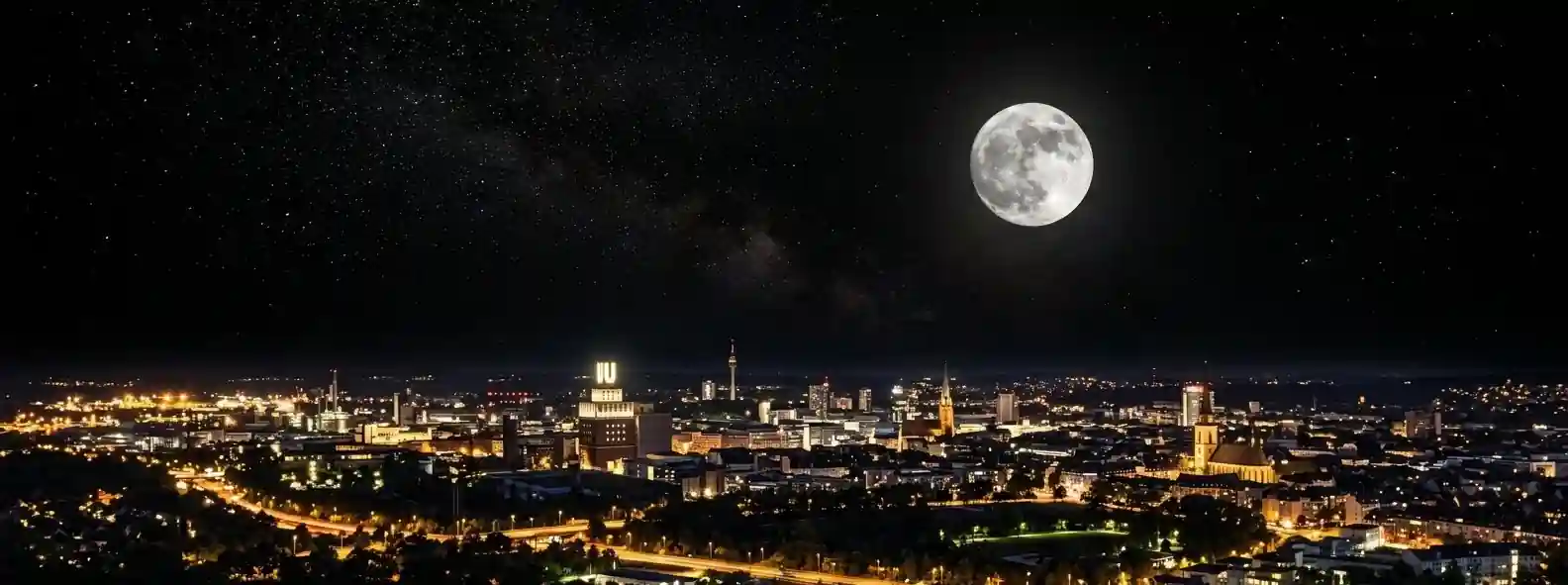
☽ Best Places to View the Moon in Dortmund, Germany
Dortmund offers a useful mixture of elevated viewpoints, water, parks and industrial landmarks for Moon watching and photography. The Florianturm provides a high panorama over Westfalenpark and the city, while Hohensyburg has two official viewing platforms overlooking the Ruhr valley, Hengsteysee and the surrounding hills. PHOENIX See provides a 3.2-kilometre network of walking and cycling paths around the lake, while Rombergpark offers a large botanical garden whose outdoor grounds are listed as open around the clock. The Dortmunder U provides a central urban setting, and the PHOENIX West Skywalk offers an elevated industrial view during guided tours. The Moon rises in the east, crosses the southern sky and sets in the west, so the direction you face matters: from Hohensyburg, which looks south over the Ruhr valley, the Moon is in front of you, while from the Florianturm the city centre lies to the north, where the Moon never rises or sets. The Moon's exact rise time, altitude and direction change with the date and observing location, so check the astronomy data for your specific composition before visiting.
Florianturm & Westfalenpark
Dortmund's most prominent elevated urban viewpoint. The Florianturm's observation platform is 141.88 metres above ground and provides a broad panorama over Westfalenpark and Dortmund. The City of Dortmund lists the platform as closed on Mondays and Tuesdays, with a 2026 single ticket of €4, and holiday hours also apply. Your notes list Wednesday and Thursday from 14:00–18:00, Friday and Saturday from 12:00–23:00, and Sunday and public holidays from 12:00–20:00, but seasonal and school-holiday changes are common, with longer hours in the autumn holidays, so check the current schedule before planning a Moonrise visit. The lift is not open to people with mobility impairments, and dogs and pushchairs are not allowed. The city centre lies to the north, and the Signal Iduna Park stadium lies to the west-south-west, in the direction where an evening crescent Moon sets.
Hohensyburg
An elevated Dortmund viewpoint with two official viewing platforms. The platform at the Kaiser-Wilhelm-Denkmal is at about 240 metres above sea level and looks toward Hengsteysee, the Klusenberg, Hagen, the Ruhr and Lenne rivers and the Sauerland hills. A second platform near the casino provides views toward the Sauerland, Hohenlimburg, parts of Hagen and the Ruhr-Lenne confluence. Because these views look south and west, the Moon, which crosses the southern sky, appears in front of you here. The area also contains historic Hohensyburg and wooded slopes above the Ruhr valley. Check current access before an evening visit.
PHOENIX See
A large urban lake in Dortmund-Hörde with approximately 3.2 kilometres of pedestrian and cycling paths around the water. The lake and surrounding green areas provide open sections of sky, while the promenade and waterfront development can supply foreground elements for Moon photography, and a calm evening can give a reflection. The city provides several access routes and parking areas around the lake, including access from Am Kai and the Kaiserberg side.
Botanischer Garten Rombergpark
A large botanical garden and park south of central Dortmund, with mature trees, landscaped areas, paths and water features that can provide natural foregrounds. The outdoor grounds are listed as accessible around the clock every day of the year, making Rombergpark one of the more flexible locations for Moon watching, although trees can block a low Moon. The plant display houses have separate opening hours and should not be confused with the access hours for the outdoor grounds.
Dortmunder U
A central Dortmund landmark and cultural centre housed in the former Union brewery tower. The 70-metre building is open to visitors on scheduled days and provides an urban architectural setting for Moon photography. Current regular opening hours are listed as Tuesday and Wednesday 11:00–18:00, Thursday and Friday 11:00–20:00, and Saturday, Sunday and public holidays 11:00–18:00; it is closed Mondays. Check the venue's current information before planning a visit.
PHOENIX West Skywalk
A distinctive industrial viewpoint on the former PHOENIX West blast-furnace site. The Skywalk reaches about 26 metres above ground and is accessed by 99 steps, with no lift. It is not an unrestricted public walkway: the City of Dortmund says it is experienced only on a guided tour, now offered year-round. Evening Sundowner tours are listed from 15 March to 19 December 2026, at about €35 per person, meeting at Phoenixplatz 2a, which makes it a specialized option for a planned Moon-and-industrial-landscape composition at dusk.
◉ Best Times for Moon Photography
📷 Quick Photography Tips
🕐 Timezone: Dortmund uses Central European Time — CET (UTC+1) in winter and CEST (UTC+2) during daylight saving time. Germany changes between standard time and daylight saving time seasonally. PhotoPills, Stellarium or another reliable astronomy calculator can provide the Moon's exact rise time, azimuth and altitude for your chosen Dortmund location.
🔭 Astronomy Option: Dortmund has no widely advertised public telescope night. The nearest options are in Bochum, about 18 kilometres west: the Planetarium Bochum, which shows the night sky on a large dome, and the Sternwarte Bochum, known for its 40-metre radome, which hosts regular public events on space topics. Check each programme for any Moon-observing evenings.
The moon phase today in Dortmund is shown in detail above — complete with exact illumination percentage, moonrise/set times, and the best local spots to see it. For the moon phase today in any other city worldwide, visit our Dynamic Moon Phase Calculator on the home page.
◐ What the Experience Actually Feels Like
Hohensyburg provides one of Dortmund's broadest official elevated viewpoints. The Kaiser-Wilhelm-Denkmal platform sits at about 240 metres above sea level and looks across Hengsteysee, the Ruhr and Lenne rivers, Hagen and the Sauerland hills. A second viewing platform near the casino provides another direction for landscape compositions. The surrounding green area and wooded slopes make the setting quite different from central Dortmund, and with the views facing south, the Moon rides across the sky in front of you.
At the Florianturm, the experience is much more urban. The observation platform is 141.88 metres above ground and provides a broad panorama over Westfalenpark and Dortmund. The tower operates on a scheduled timetable, so a Moonrise composition should be matched to the current platform hours rather than assuming that the tower is available throughout the night.
PHOENIX See offers a different type of composition. The lake is surrounded by approximately 3.2 kilometres of walking and cycling paths, with green areas, promenades and modern development around the water. A low Moon can therefore be photographed as part of a wider lake-and-city scene rather than as an isolated lunar close-up.
Rombergpark provides a greener setting, with botanical collections, mature plantings, paths and landscaped outdoor areas. The city lists the outdoor grounds as accessible around the clock every day of the year. The site remains within Dortmund's urban environment, however, so it should be treated as a city park rather than a dark-sky location.
For a distinctly industrial Dortmund composition, PHOENIX West places the Moon against preserved blast-furnace infrastructure. The Skywalk reaches approximately 26 metres above ground and is reached via 99 steps. Access is through guided tours, so this location requires more advance planning than an ordinary public park or waterfront viewpoint.
"Dortmund's Moon-viewing experience ranges from high city panoramas and Ruhr valley viewpoints to lakeside reflections, botanical parkland and the industrial landscape of PHOENIX West."
✓ Your Dortmund Moon Chase Checklist
Before You Go
- Check the Moon's rise time, altitude and azimuth for your date and exact Dortmund observing location — the direction can change substantially from one date to another.
- Use PhotoPills, Stellarium or another reliable astronomy planner if you want the Moon to line up precisely with the Florianturm, Hohensyburg, PHOENIX See or another Dortmund landmark.
- Verify Site Access: The Florianturm, Dortmunder U and PHOENIX West Skywalk have scheduled access arrangements rather than unrestricted all-night public access.
- Remember that the outdoor grounds of Rombergpark are listed as accessible around the clock every day of the year, while the plant display houses have separate opening hours.
- If you are planning a PHOENIX West photograph, check the current Skywalk tour schedule and book the appropriate guided visit in advance.
- Check cloud cover, visibility and local conditions before leaving, particularly if you are planning a precise Moonrise composition.
What to Bring
- A telephoto lens — 200mm or longer can be useful when you want a relatively large Moon beside a distant Dortmund landmark, depending on your shooting distance.
- A warm layer, particularly outside the summer months. Elevated or exposed locations such as Hohensyburg can feel cooler than sheltered city streets.
- A remote shutter release or a 2-second timer to reduce camera shake when shooting from a tripod.
- A small flashlight with a red-light mode can be useful on darker paths, especially around less illuminated viewpoints.
- A backup viewing location in case cloud, crowds, temporary restrictions or scheduled access problems affect your original composition.
On the Night
- Arrive at least 30–45 minutes early when photographing a planned Moonrise composition so you can establish the foreground and camera position.
- If autofocus struggles in low light, switch to manual focus and focus carefully on the Moon's edge or another distant subject.
- Bracket your exposures — one for the bright lunar disc and another for the darker cityscape, lake, park or skyline below.
- If the Moon looks soft or hazy immediately after rising, consider waiting until it climbs higher. The longer atmospheric path near the horizon can increase scattering and distortion.
- At scheduled-access locations such as the Florianturm, Dortmunder U and PHOENIX West, follow the current visitor and photography rules rather than assuming late-night access is permitted.
Use the tools on this page, pick your vantage point, and catch a Dortmund moonrise for yourself.
? Dortmund Moon Phase — Frequently Asked Questions
Q. What is the moon phase today in Dortmund?
The moon phase today in Dortmund is a Last Quarter with 45% illumination. The next full moon is in 23 days, on 26 Oct. Moonrise is at — and moonset at 4:47 PM.
Q. Where is the best place to view the moon in Dortmund?
The Florianturm in Westfalenpark has a viewing platform 141.88 m above ground with a panorama over the park and the city, but it keeps scheduled hours. Hohensyburg, on the southern edge of the city, has two official viewing platforms over the Ruhr valley and Hengsteysee, and because the moon crosses the southern sky, its southward views put the moon in front of you. PHOENIX See has about 3.2 km of paths around the lake, and Rombergpark, a large botanical garden, has outdoor grounds listed as open around the clock. The Dortmunder U gives a central urban setting, and the PHOENIX West Skywalk can be visited only on a guided tour.
Q. Can I look at the moon through a telescope near Dortmund?
Dortmund has no widely advertised public telescope night, so the nearest options are in Bochum, about 18 km to the west. The Planetarium Bochum shows the night sky on a large dome, and the Sternwarte Bochum, known for its 40 m radome and its satellite ground station, hosts regular public events on space topics. Check each organiser's programme for any moon-observing evenings, since observing depends on the weather.
Q. Where does the moon rise and set in Dortmund, and how high does it climb?
At about 51.5°N, Dortmund's moonrise and moonset points swing widely across the horizon each month, from roughly north-east to south-east for rising and north-west to south-west for setting, with an even wider swing in years near a major lunar standstill. A full moon near the winter solstice climbs to roughly 62° in the south, while a full moon near the summer solstice stays low, peaking near 15°. From the Florianturm the city centre lies to the north, where the moon never rises or sets, but the Signal Iduna Park stadium lies to the west-south-west, inside the range of directions where the moon sets, so an evening crescent moon can drop toward it. Check the azimuth for your date and exact spot.
Q. Is light pollution a problem for moon observing in Dortmund?
The moon is bright enough to observe and photograph from almost anywhere in Dortmund, so light pollution rarely limits the lunar disc itself. It does wash out earthshine on a thin crescent and any faint sky detail. Dortmund is part of the Rhine-Ruhr urban area, so stars are faint at every viewpoint, including the hilltop ones. Rombergpark and Hohensyburg are green but still within the urban glow.
Q. What camera settings and phases work best for moon photography in Dortmund?
For a full moon, start with Looney 11 (f/11, ISO 100, 1/100 s) and refine using your histogram, since it is a baseline rather than a guarantee. The moon is much brighter than the cityscape and the lake, so shoot RAW and bracket or blend exposures to keep both crater detail and the foreground. A full moon is not always the best phase for showing surface relief, and a waxing moon suits evening shooting. For a moon-and-landmark shot, move farther back and use a longer focal length of 200 mm or more, with a sturdy tripod and manual focus on the moon's edge using magnified live view. The moon illusion makes a low moon look huge, but it is perceptual, not a change in size.
Q. How do cloud, haze and wind affect moon viewing in Dortmund?
Dortmund has a mild, changeable climate, and cloud is common, so a precise moonrise composition can disappear behind it even when the wider forecast looks favourable. Low cloud and haze can soften or hide a low moon, and PHOENIX See and the hilltop viewpoints can be windier and colder than sheltered streets. Check cloud cover and visibility, not just the general forecast, and bring a warm layer.
Q. What time zone are Dortmund's moonrise and moonset times shown in?
Dortmund runs on Central European Time, CET, UTC+1, in winter and Central European Summer Time, CEST, UTC+2, in summer. Clocks go forward on the last Sunday in March and back on the last Sunday in October, and moonrise and moonset times on this page follow the local clock in effect on each date. Dortmund lies at about 7.5°E, west of the 15°E meridian on which Central European Time is based, so the sun and moon cross the sky about 30 minutes later on the clock than they would on that meridian.
Q. Can I shoot the moon at Dortmund's viewpoints after dark?
Only at some of them. The city's 2026 schedule lists the Florianturm's platform as closed on Mondays and Tuesdays, with later hours on Fridays and Saturdays, and a €4 ticket, so check the current schedule, including extended holiday hours, before planning a moon visit. The Skywalk at PHOENIX West is visited only on guided tours, including evening Sundowner tours listed through 19 December 2026. The outdoor grounds of Rombergpark are listed as open around the clock, though its plant houses keep separate hours, and the Dortmunder U keeps scheduled opening hours. Check access at Hohensyburg before an evening visit.
✦ Explore Further
Moon Phase Today: Düsseldorf
Check tonight's moon phase in Düsseldorf, roughly 58 km south-west of Dortmund on the Rhine.
⛪Moon Phase Today: Cologne
See the moon over Cologne, roughly 73 km south-south-west of Dortmund, with its cathedral by the Rhine.
🌍World Moon Phase Directory
Find the moon phase, rise and set times for cities in every region of the world.
Blue Hour Calculator
Work out when blue hour falls, ideal for waxing gibbous shots over PHOENIX See.