

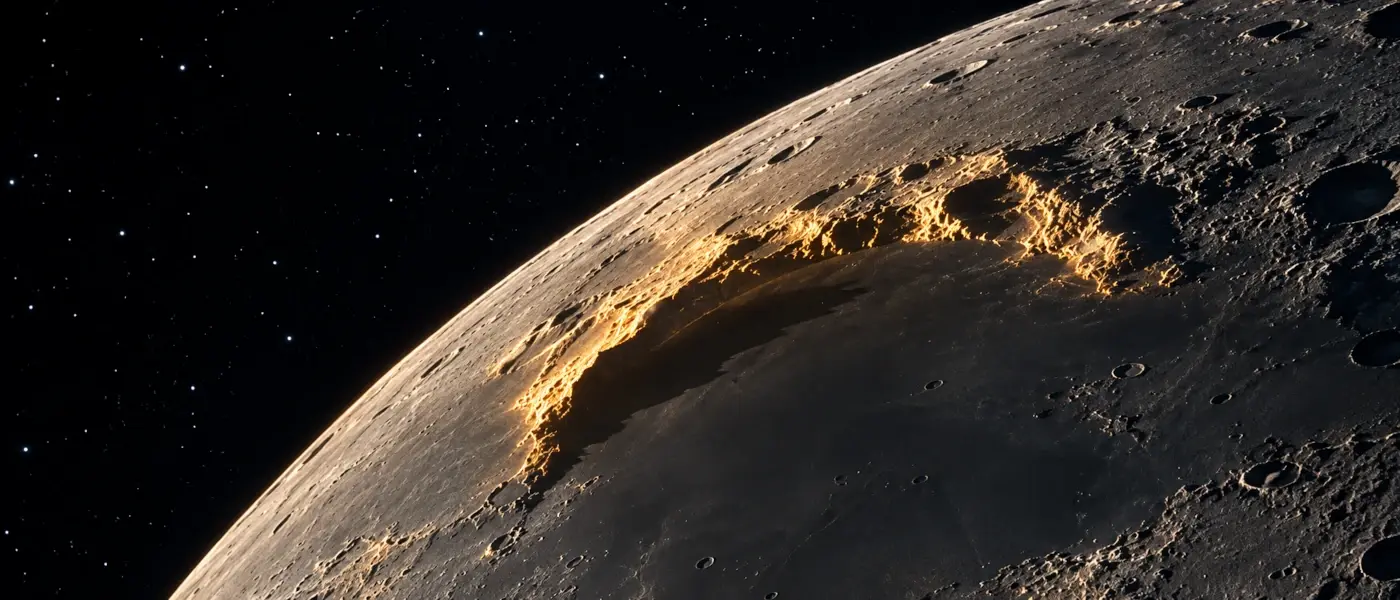
Once a month, sunlight reaches the Montes Jura before it reaches the bay they surround, and a thin curve of gold appears to float above the dark. Here is why it happens, when to look, and what you need to see it.
The Golden Handle is visible on the waxing Moon, about 10 to 11 days after New Moon, for a few hours. Look at the upper left of the Moon (upper left from the Northern Hemisphere) along the terminator, where the Montes Jura rim of Sinus Iridum is lit and the bay floor is still dark.
- What the Golden Handle is
- Why the peaks light up first
- When to look
- How to see it
- What else to look at nearby
- The Moon Maiden in history
- Photographing it
- Frequently asked questions
- Sources and further reading
What the Golden Handle is
Sinus Iridum, the Bay of Rainbows, is the remains of a large impact crater on the northwestern shore of Mare Imbrium. Later lava flows associated with Mare Imbrium flooded the southern part of its rim, leaving the prominent arc of mountains known as the Montes Jura curving around a smooth, dark floor. Our L14 Sinus Iridum field guide covers the feature itself in detail.
The Golden Handle is not a separate object. It is a lighting effect. When the sunrise terminator sits across the bay, the Jura summits are already in sunlight while the bay floor is still in shadow. The lit summits form a bright, curved line against the dark, shaped like a handle. The low Sun is what creates the sharp contrast and long shadows, but sunlight on the Moon is not inherently golden. The warm look comes from the contrast itself and from conditions on your end: how high the Moon sits, how clear the air is and, in photos, camera processing. Some observers also call the effect the Jewelled Scimitar.
Why the peaks light up first
The terminator is the line where the Sun is exactly on the horizon. The Moon is a sphere, so ground beyond that line curves away below the grazing sunlight. A tall mountain on that far side still pokes up into the light, while the low ground around it stays dark.
Simplified side view. Heights are greatly exaggerated, and the real range is an arc, not a single peak.
A simplified check with the Moon's radius R of 1,737.4 km shows the scale. A peak of height h above its surroundings catches sunlight while it is about the square root of 2Rh away on the dark side of the terminator. An assumed round 3 km gives roughly 100 km. Published heights use different reference levels, so they are not interchangeable. The Cambridge Photographic Moon Atlas gives about 2.6 km for Promontorium Laplace and about 1.7 km for Promontorium Heraclides, measured against the surrounding surface, which work out to roughly 95 km and 77 km by the same formula. Other sources put the highest Jura summits near 3.8 km above the bay floor. At the Jura's latitude the terminator sweeps across the ground at around 11 km per hour, so the lead is measured in hours, which fits the "several hours" observers report. Treat these numbers as geometric estimates from the stated heights, not as measurements of how far sunlight reaches on any given night.
When to look
Sinus Iridum sits at about 32°W, so the sunrise terminator reaches it roughly two to three days after First Quarter. That is a waxing gibbous Moon, about 10 to 11 days after New Moon. A common cross-check is the crater Copernicus: the terminator reaches Sinus Iridum roughly a day after it passes Copernicus, though the interval varies with the illumination geometry of each lunation. To plan ahead, find First Quarter in our 2027 Moon Calendar and add two to three days.
Golden Handle Countdown
When to look for the Montes Jura arc glowing above the dark Bay of Rainbows
...
Red ring marks Sinus Iridum
Check it for your sky
Upcoming Golden Handle windows
| Date | Window | Moon lit | Your sky | Clouds |
|---|---|---|---|---|
| Calculating... | ||||
Times are approximate estimates of the sunrise terminator's passage across the Montes Jura region, using a reference latitude of about 45°N and longitudes between 33°W and 37°W. Actual visibility varies with lunar libration, terrain and observing conditions. Times are shown in your location's timezone. A good view means the Moon is more than 5° above the horizon while the Sun is more than 6° below it. Searching for a city or using your location sends the coordinates only to Open-Meteo for the cloud forecast, which covers about 16 days. Your choice is saved in your browser. Location search and cloud data by Open-Meteo.com.
The window is short, and it can fall while the Moon is below your horizon or in daylight. Add your location to the countdown above to see when the Moon is actually up and the sky is dark. If you miss it one month, the next lunation brings another chance, and you can always check the current Moon phase.
The effect belongs to the waxing side. As the Moon wanes, the terminator returns to Sinus Iridum as a sunset line, and the wrinkle ridges and Jura shadows are good targets then, but the floating-arc look does not mirror itself.
How to see it
| Equipment | What you can expect |
|---|---|
| Naked eye | The overall gibbous Moon, with the bay as a notch in the dark mare's edge. Most observers need binoculars to see the handle clearly, though very sharp-eyed observers may catch a faint extension of light beyond the terminator under good conditions. |
| Binoculars | The bright arc of summits along the terminator. Handheld 7x50 or 10x50 can show it under good conditions, and a magnification near 15x on a tripod makes it much easier to hold. |
| Small telescope | Individual peaks and capes, and the smooth dark floor behind them. Higher magnification is not automatically better: steady air and careful focus matter more. |
| 6-inch or larger | Detail in the Jura, wrinkle ridges as the light angle lowers, and the headlands Heraclides and Laplace. |
Observers in the Southern Hemisphere see the lunar features in a different orientation from observers in the north, and the handle's apparent position depends on your latitude and where the Moon sits in the sky. The timing is the same everywhere on Earth where the Moon is up.
What else to look at nearby
The Jura end in two capes. Promontorium Laplace in the northeast is the sharper of the two, and Promontorium Heraclides in the southwest carries the famous nickname. Around the same phase, some observers see a woman's head in profile at Heraclides, the "Moon Maiden", a classic case of pareidolia, the mind's habit of finding familiar faces in unrelated shapes. The illusion is fragile and works best with low magnification and slightly soft seeing.
The bay floor is smooth, but low light picks out the wrinkle ridges, and the small crater Laplace A is a useful marker on the eastern side. To find your way around the surrounding region, see the Lunar 100 map and field guide and our list of lunar craters to spot with a telescope.
The Moon Maiden in history
The Moon Maiden has a long record. She appears on Giovanni Domenico Cassini's 1679 lunar map, and the timing of the observations behind it matches the same window as the Golden Handle, around the tenth and eleventh days of the lunar cycle. Historians disagree about whether Cassini or his engraver is responsible for the detail, and the origin of the profile is not settled. What is well documented is the feature itself and its long observing history.
Photographing it
The lit arc is bright and the floor is dark, so expose for the bright part and let the shadow side fall away. Set exposure and focus manually: a phone's automatic exposure tends to wash out the bright arc, and overexposure erases the fine detail along the ridge. Use a tripod, a short exposure and a low ISO.
Unsteady air is the main limit. Record a short video or many frames and stack the sharpest ones, which averages out the turbulence. A phone held to the eyepiece can work, but a remote shutter or timer keeps the image steadier.
- Find the Moon about two to three days after First Quarter.
- Locate Sinus Iridum at the terminator in the northwest of the near side.
- Confirm the Jura arc is lit while the bay floor is still dark.
- Look for Heraclides and Laplace at the two ends of the arc.
- Come back the next night to watch the light spread across the bay.
Frequently asked questions
What is the Golden Handle on the Moon?
The Golden Handle is a lighting effect along the lunar terminator. When the Sun rises over the Montes Jura, the mountain arc around Sinus Iridum (the Bay of Rainbows) catches sunlight while the bay floor beside it is still dark, leaving a thin bright curve that looks like a handle.
When is the Golden Handle visible?
Once a month, on the waxing Moon, about 10 to 11 days after New Moon. That is a waxing gibbous phase, roughly two to three days after First Quarter. The terminator reaches Sinus Iridum roughly a day after it passes the crater Copernicus, although the interval varies with lunar illumination geometry.
Can you see the Golden Handle without a telescope?
Most observers need binoculars to see the handle clearly, although very sharp-eyed observers may catch a faint extension of light beyond the terminator under good conditions. Binoculars on a tripod or a small telescope show it clearly.
How long does the Golden Handle last?
Several hours. The effect fades as the terminator moves on and sunlight spreads across the bay floor. Because the window is short, it can fall while the Moon is below your horizon in some months.
Is the Golden Handle visible from the Southern Hemisphere?
Yes. Southern Hemisphere observers see the lunar features in a different orientation from northern observers, and the apparent position of the handle depends on your latitude and the Moon's orientation in the sky. The timing is the same.
Is the Golden Handle the same as the Moon Maiden?
No, but they are neighbors. The Golden Handle is the lit mountain arc of the Montes Jura, while the Moon Maiden is a profile some observers see at Promontorium Heraclides on the southwestern edge of the bay, around the same phase.
Sources and further reading
- Sky & Telescope, Diving into the Moon's Bay of Rainbows, on the lit Jura arc and the dark bay floor.
- Stephen James O'Meara, Sinus Iridum stirs the imagination, Astronomy magazine, on the Jeweled Handle name and the lava flooding of the rim.
- Space.com, See the moon's Golden Handle shine on Saturday, an observing guide for the 2022 window.
- Wikipedia, Golden Handle and Montes Jura, for timing, naming and range dimensions.
- USGS Astrogeology, Gazetteer of Planetary Nomenclature: Montes Jura.
- The Cambridge Photographic Moon Atlas, for the Promontorium Laplace and Heraclides heights quoted above.