
Moon Phase Today Hialeah
On Friday, October 9, 2026, the moon in Hialeah is a New Moon with 0% illumination. Moon age: 28.9 days.
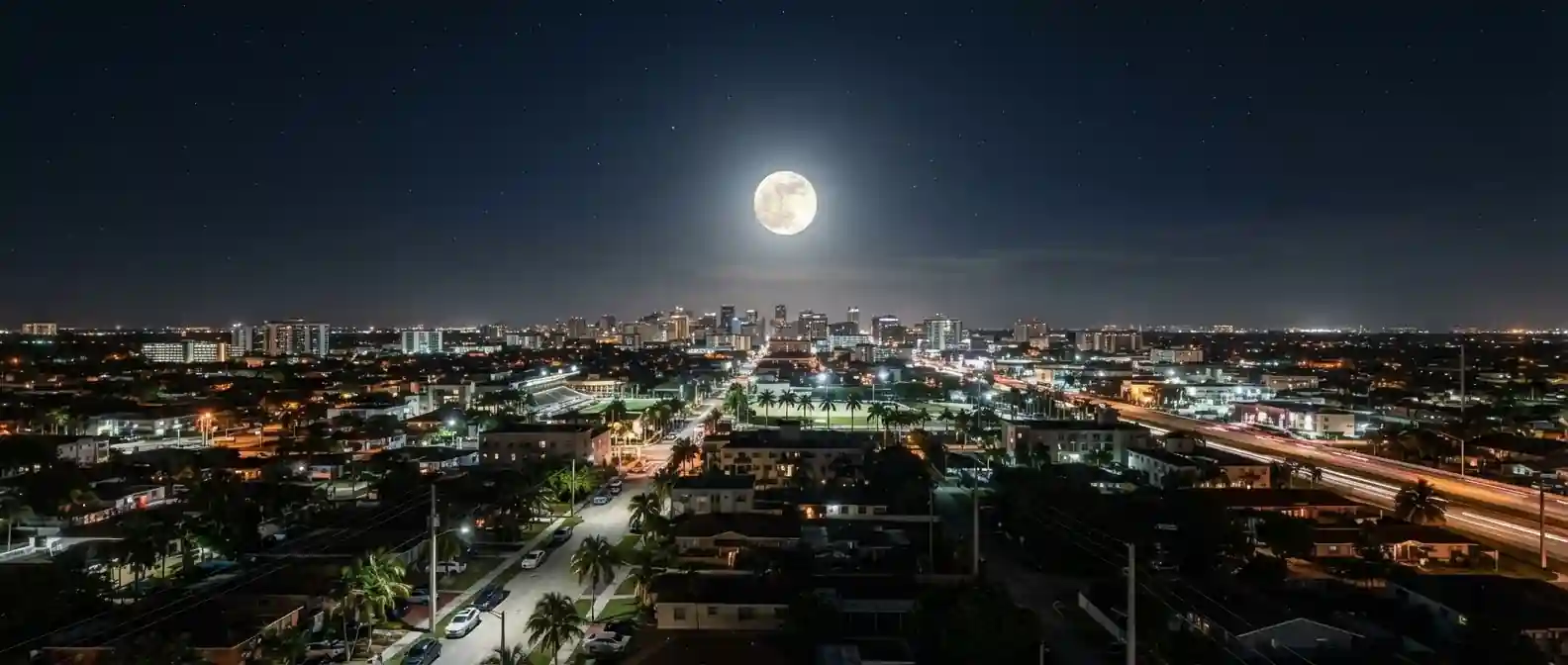
☽ Best Places to View the Moon in Hialeah, FL
Hialeah sits in northwest Miami-Dade County, just north of Miami, covering about 22 square miles, with roughly 21.58 square miles of land on essentially flat terrain near sea level. Within 2 miles of the city the elevation changes by only about 13 feet, with an average around 3 feet above sea level, so the best local viewpoints come from large parks with lakes and open fields rather than any elevated vantage point. The date and your observing location together determine the moon's rise time and direction; your viewpoint determines how much of that horizon is actually unobstructed. Here are six Hialeah locations that offer different ways to experience or photograph the moon.
Amelia Earhart Park
A 515-acre park just south of Opa-locka Airport serving the Hialeah community, with five lakes, a bark park, fishing, eight miles of mountain biking trails, disc golf, Tom Sawyer's Play Island, and the Miami Watersports Complex on a 90-acre freshwater lake. Open sunrise to sunset. Address: 401 E 65th St.
Milander Park
A 19.2-acre recreational facility with Ted Hendricks Stadium, which the city documents as seating up to 7,500 spectators, plus the Milander Center for Arts & Entertainment, basketball courts, a playground, and a recreation building. Named for Henry Milander, mayor 1941–1945 and 1947–1974. Posted hours run 2–9 p.m. on weekdays and 9:30 a.m.–5:30 p.m. on weekends, so this is not a late-night location. Address: 4700 Palm Ave.
Hialeah Park Race Track
A thoroughbred racetrack opened January 15, 1925, with a greyhound track on the site in 1922. Listed on the National Register of Historic Places in 1979 and determined eligible for National Historic Landmark designation on January 12, 1988. The landscaped grounds include a man-made infield lake famous for the flamingos introduced in the 1930s. It is an active entertainment complex, so check current visitor and event information before planning a visit.
Babcock Park
An 18.5-acre park with seven lighted youth baseball fields, a seasonal community pool at 651 E 4th Ave, a fenced playground, and a recreation building adjacent to a police substation and e-library. Check current hours before an evening visit. Address: 531 E 5th St.
Goodlet Park
A 28-acre facility, described by the city as its largest recreational facility, with lighted baseball fields, basketball, tennis, pickleball, and racquetball courts, a running track, soccer fields, a playground, a dog park, a theater, and a recreation building. Posted hours are 7 a.m.–9 p.m. on weekdays and 8 a.m.–6 p.m. on weekends, so it is not a nighttime location. Address: 4200 W 8th Ave.
Bucky Dent Park
A 25-acre park with four lighted youth softball fields, a basketball gym, a playground, a gazebo, a recreation building, an outdoor fitness area, and a skate park. The Bucky Dent Water Park is a separate nearby facility. Check current hours before an evening visit. Address: 2250 W 60th St.
◉ Best Times for Moon Photography
📷 Quick Photography Tips
Hialeah runs on Eastern Time — EST (UTC−5) in winter and EDT (UTC−4) in summer, following the standard U.S. daylight saving schedule. PhotoPills or Stellarium will handle the moon's exact rise azimuth for any of these spots automatically, as long as your device's clock is correct.
The moon phase today in Hialeah, Florida is shown in detail above — complete with exact illumination percentage, moonrise/set times, and the best local spots to see it. For the moon phase today in any other city worldwide, visit our Dynamic Moon Phase Calculator on the home page.
◐ What the Experience Actually Feels Like
At Amelia Earhart Park, trails through pine groves circle five lakes, with the watersports complex on its 90-acre freshwater lake opening up the sky. It's the largest and most open setting on this list, and the best place to pair a moonrise with water.
At Milander Park, stadium seating and the Milander Center for Arts & Entertainment frame a wide-open 19.2-acre complex — more of a daytime and early-evening spot given its posted hours.
At Hialeah Park, the 1925 grandstand faces the infield lake where flamingos have been present since the 1930s, giving the city its most historic foreground, though access depends on current visitor and event information.
"A 515-acre park with lakes, a 19.2-acre complex with a stadium and arts center, and a 1925 racetrack with an infield lake famous for its flamingos — three very different foregrounds for the same moon."
✓ Your Hialeah Moon Chase Checklist
Before You Go
- Check the moonrise time and rise azimuth for your date — the lakes and the stadium face different directions, and your viewpoint determines how much of the horizon is unobstructed
- Verify Site Access: Amelia Earhart Park is open sunrise to sunset, Milander Park 2–9 p.m. on weekdays and 9:30 a.m.–5:30 p.m. on weekends, and Goodlet Park 7 a.m.–9 p.m. on weekdays and 8 a.m.–6 p.m. on weekends — check visitor information for Hialeah Park
- Use PhotoPills or Stellarium to check whether the moon will align with a specific landmark on your date
- Check the forecast for cloud, haze, and storms
- Confirm current rules on tripods and photography at your chosen venue, especially for anything beyond personal use
What to Bring
- A telephoto lens, often 200mm or longer, plus a wide lens for the lakes and the historic track
- A lens cloth for humidity
- Bug spray for the evening near the lakes
- A remote shutter release or a 2-second timer to avoid shake on tripod shots
- Spare batteries, particularly for long sessions or extended time outdoors
On the Night
- As a general recommendation, arrive at your viewpoint at least 30–45 minutes early, especially for twilight shots
- Focus manually on the moon's surface detail using magnified live view — park and sports-field lighting can confuse autofocus at dusk
- Bracket your exposures — one for the bright lunar disc, one for the darker lake, field, or grandstand below
- If the moon looks soft or hazy right at moonrise, consider waiting until it climbs higher above the horizon, when atmospheric effects are often less pronounced
- Respect posted hours — not every location on this list is accessible at night — and check visitor information for Hialeah Park
? Hialeah Moon Phase — Frequently Asked Questions
Q. What is the moon phase today in Hialeah, Florida?
The moon phase today in Hialeah is a New Moon with 0% illumination. The next full moon is in 17 days, on Oct 26. Moonrise is at 6:21 AM and moonset at 6:26 PM.
Q. Where is the best place to view the moon in Hialeah?
The best open sky is in the large parks. Amelia Earhart Park is a 515-acre park with five lakes and the Miami Watersports Complex on a 90-acre freshwater lake, which suits moon-over-water and reflection shots, and it is open sunrise to sunset. Milander Park has stadium grounds and the Milander Center for Arts & Entertainment, and the historic Hialeah Park Race Track has a man-made infield lake famous for its flamingos, though it is an active entertainment complex. Neighborhood parks like Babcock, Goodlet and Bucky Dent provide additional open fields.
Q. Where does the moon rise and set in Hialeah, and how high does it climb?
At about 25.9°N, Hialeah's moonrise and moonset points swing across the horizon each month, from roughly northeast to southeast for rising and northwest to southwest for setting. A winter full moon passes almost directly overhead, to roughly 88° above the horizon, while a summer full moon stays lower, peaking near 41°. Hialeah is essentially flat, with an average elevation around 3 feet above sea level, so very flat terrain can provide broad sky views, although buildings, trees and lighted sports facilities can obstruct individual sightlines. Check the azimuth for your date and exact viewpoint, since the lakes and the stadium face different directions.
Q. Is light pollution a problem for moon observing in Hialeah?
The moon is bright enough to observe and photograph from almost anywhere in Hialeah, so light pollution rarely limits the lunar disc itself. It does wash out earthshine on a thin crescent and any faint sky detail. City parks are not dark-sky locations, so a new moon is favorable astronomically but not practical for dark skies here. Lighting varies by location, with lighted sports fields at parks like Babcock, Goodlet and Bucky Dent, and park and sports-field lighting can confuse autofocus at dusk, so focus manually on the moon's surface detail using magnified live view.
Q. What camera settings and phases work best for moon photography in Hialeah?
For a full moon, start with Looney 11 (f/11, ISO 100, 1/100 s) and refine using your histogram, since it is a baseline rather than a guarantee. The moon is much brighter than the foreground, so shoot RAW and bracket to keep both crater detail and the lake, field or grandstand below. A full moon rises near sunset, and a waxing gibbous moon is often useful for evening and twilight photography. A 200–400 mm lens can isolate the moon over the lakes, stadium structures or distant foregrounds, and a sturdy tripod helps for lake reflections and bracketing.
Q. How do Florida humidity, summer storms and mosquitoes affect moon viewing in Hialeah?
Check the forecast for cloud, humidity and storms, since haze and summer storms reduce contrast, and check for tropical weather during hurricane season, from June through November. Bring a lens cloth for humidity, and bug spray for evenings near the lakes, where mosquitoes are active. If the moon looks soft or hazy right at moonrise, wait until it climbs higher above the horizon, when atmospheric effects are often less pronounced.
Q. Can I visit Hialeah's moon viewpoints after dark?
Access varies by site, and not every location is open at night. Amelia Earhart Park is open sunrise to sunset. Milander Park keeps posted hours of 2–9 p.m. on weekdays and 9:30 a.m.–5:30 p.m. on weekends, and Goodlet Park 7 a.m.–9 p.m. on weekdays and 8 a.m.–6 p.m. on weekends, so neither is a nighttime location. Hialeah Park is an active entertainment complex, so check current visitor and event information. Check hours at Babcock and Bucky Dent Parks before an evening visit, and respect posted hours.
✦ Explore Further
Moon Phase Today: Miami
Check tonight's moon phase in Miami, just south of Hialeah in Miami-Dade County.
🌴Moon Phase Today: Fort Lauderdale
See the moon over Fort Lauderdale, north of Hialeah on Florida's southeast coast.
🇺🇸Moon Phase in the United States
Browse moon phase pages for cities across the United States, from Seattle to Miami.
🌍World Moon Phase Directory
Find the moon phase, rise and set times for cities in every region of the world.