
Moon Phase Today Charleston
On Friday, October 9, 2026, the moon in Charleston is a New Moon with 0% illumination. Moon age: 28.9 days.
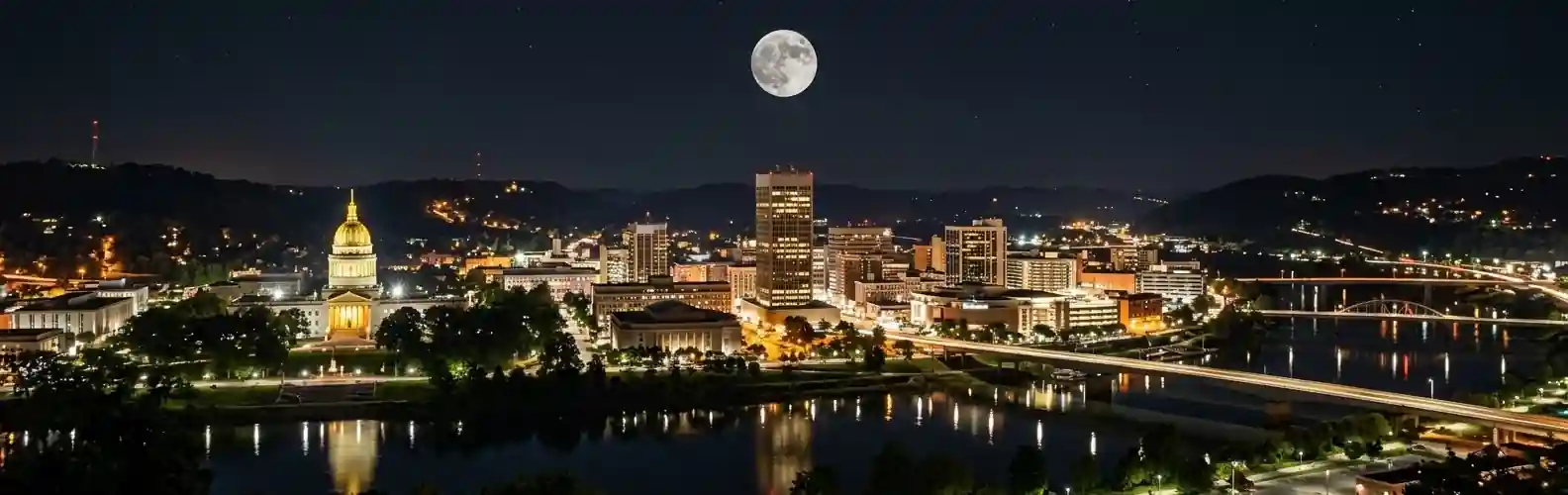
☽ Best Places to View the Moon in Charleston, West Virginia
Charleston sits in a river valley at the confluence of the Kanawha and Elk Rivers, within the Allegheny Mountains and surrounded by rugged, undulating terrain. The Kanawha flows westward toward the Ohio River. Ridges and trees can block low horizons, and most city parks close at dusk, so plan around posted hours and choose a moon that is already up before closing.
Haddad Riverfront Park – Downtown Kanawha Riverfront
Major downtown park beside the Kanawha River, with open lawns, picnic areas and a public garden, and the site of events such as Live on the Levee. It is the most open central horizon for moonrise and twilight. Listed as daylight to dusk, so check event schedules and closing times.
Magic Island – Elk and Kanawha Confluence
Park at the point where the Elk River meets the Kanawha, with a playground, picnic areas and walking trails. The river junction makes good water and skyline compositions, with some open views along the shoreline. The sandy area known locally as Rockaway Beach is part of the island. Listed as daylight to dusk.
Daniel Boone Park – Kanawha Riverfront
City riverfront park along the Kanawha, with a boat ramp, fishing and picnic facilities. It is a useful spot for a moon rising over the river. Listed as daylight to dusk.
Coonskin Park – Northeast of Downtown
County park with hiking and biking trails, a fishing lake, a golf course, playgrounds and picnic areas. Occasional open areas give wider sky views. Currently listed as 8 AM to 8 PM, though hours can change, so it suits moonrise and early-evening viewing.
Kanawha State Forest – South of Charleston
State forest with more than 60 miles of hiking and biking trails, including 14 hiking trails and nine trails permitted for mountain biking. Its forest settings are more secluded and away from downtown lighting. Currently listed as 10 AM to 6 PM, with a bridge closure affecting access to some areas, so it is a daytime location. Check current access before you go.
Cato Park – West Side
City recreation site on the West Side with park facilities. Details on its hours and amenities are limited, so check the city listing and use it for moonrise or twilight within posted hours.
◉ Best Times for Moon Photography in Charleston
📷 Quick Tips for Charleston
🕐 Timezone
Eastern Time – EST UTC-5, EDT UTC-4 during daylight-saving. America/New_York.
📍 Geography Note
Charleston lies within the Allegheny Mountains in a river valley at the junction of the Kanawha and Elk Rivers. The Kanawha flows westward toward the Ohio River and splits the city into northern and southern sections, with the southerly flowing Elk converging with the Kanawha.
For evening moon photography, check park closing times carefully. Major city parks generally close at dusk, so they are best suited to moonrise, twilight and early-evening compositions when the Moon is above the horizon before closing. For later-night observing, use a location where nighttime access is explicitly permitted.
Forested areas to the south and large county parks to the north provide trail clearings and more secluded settings away from downtown lighting. Ridges and trees can obstruct low horizons, and the surrounding terrain is rugged and undulating. Check current hours, event schedules and any bridge or trail closures before planning.
◐ What It Feels Like
At Haddad Riverfront, open lawns and a public garden line the Kanawha with river breezes and downtown lights.
At Magic Island, the junction of the Elk into the Kanawha creates interesting water and skyline compositions with some open views along the shoreline.
In Kanawha State Forest south of the city, forested trails offer more secluded settings away from downtown lighting.
"Within the Allegheny Mountains in a river valley at the Kanawha and Elk confluence, with downtown riverfront lawns best for moonrise and twilight before dusk closing."
✓ Checklist for Lunar Observers
Before You Go
- Check Moonrise azimuth — river bends and foothill ridges face different directions
- Check park closing times — major city parks are daylight to dusk, forest is 10 AM to 6 PM currently
- Confirm current hours, event schedules and any bridge closures
What to Bring
- Telephoto and wide lenses for river and mountain compositions
- Tripod for bracketing and reflections
- Lens cloth for humidity
- Bug spray for evening near water
On the Night
- Check exact azimuth — varies through the month
- Bracket for lunar detail and park lights during twilight window
- Stay on marked trails and respect posted closing times
? Charleston Moon Phase — Frequently Asked Questions
Q. What is the moon phase today in Charleston?
The moon phase today in Charleston is a New Moon with 0% illumination. The next full moon is in 17 days, on Oct 26. Moonrise is at 6:31 AM and moonset at 6:23 PM.
Q. Where is the best place to view the moon in Charleston?
Haddad Riverfront Park, a downtown park beside the Kanawha River with open lawns and a public garden, is the best central spot for moonrise and twilight. Magic Island, at the confluence where the Elk River meets the Kanawha, gives water and skyline compositions with some open views along the shoreline, and Daniel Boone Park offers a riverfront boat-ramp setting along the Kanawha. Coonskin Park, a county park northeast of downtown, has occasional open areas with wider sky views. Kanawha State Forest, south of the city, has more secluded forest trails away from downtown lighting, but it keeps daytime hours. Most of these parks close at dusk, so plan around posted times.
Q. Where does the moon rise and set in Charleston, and how high does it climb?
At about 38.3°N, Charleston's moonrise and moonset points swing across the horizon each month, from roughly east-northeast to east-southeast for rising and west-northwest to west-southwest for setting. A winter full moon culminates high in the south, at roughly 75° above the horizon, while a summer full moon stays lower, peaking near 28°. Charleston sits in a river valley within the Allegheny Mountains, so ridges and trees can block low horizons, and the moon can clear the skyline well after its listed moonrise time. The Kanawha flows roughly east to west through the valley, so a moon rising in the east or setting in the west can line up with the river corridor on some dates. Check the azimuth for your date and exact spot.
Q. Is light pollution a problem for moon observing in Charleston?
The moon is bright enough to observe and photograph from almost anywhere in Charleston, so light pollution rarely limits the lunar disc itself. It does wash out earthshine on a thin crescent and any faint sky detail. Downtown has urban lighting, and the riverfront parks carry some of it, so the centre is a light-polluted site rather than a dark-sky one. The forested areas to the south and the large county parks to the north offer trail clearings and more secluded settings away from downtown lighting, but they keep daytime or early-evening hours.
Q. What camera settings and phases work best for moon photography in Charleston?
For a full moon, start with Looney 11 (f/11, ISO 100, 1/100 s) and refine using your histogram, since it is a baseline rather than a guarantee. The moon is much brighter than the riverfront foreground, so shoot RAW and bracket or blend exposures to keep both crater detail and the lit foreground. A waxing gibbous, already up in the afternoon, is the best target for parks that close at dusk, while a full moon rises around sunset and, in a valley, may clear the ridges after the parks close. A 200–400 mm lens helps isolate the moon over river bends and hill ridges, with a tripod for bracketing and reflections over water and manual focus on the moon using magnified live view.
Q. How do valley haze, humidity and insects affect moon viewing in Charleston?
Charleston lies in a river valley surrounded by rugged terrain, where cloud, haze and humidity can change conditions quickly and soften lunar contrast near the horizon. Humidity can leave condensation on lenses, so carry a cloth. Check cloud, haze and wind forecasts before heading out, and bring bug spray for evening viewing near the rivers.
Q. Can I shoot the moon at Charleston's viewpoints after dark?
Access varies by site, and major city parks are generally open daylight to dusk. Haddad Riverfront Park, Magic Island and Daniel Boone Park are listed as daylight to dusk. Coonskin Park is currently listed as 8 AM to 8 PM, though hours can change. Kanawha State Forest is currently listed as 10 AM to 6 PM, with a bridge closure affecting access to some areas, so check current access rules and treat it as a daytime location. Check current hours, event schedules, such as Live on the Levee at Haddad, and any bridge or trail closures, and for later-night observing use a location where nighttime access is explicitly permitted.
Q. Does this page work for cities besides Charleston?
This page is set up specifically for Charleston, West Virginia. For the moon phase in any other city or location worldwide, use the Dynamic Moon Phase Calculator on the moonphase.today home page.
✦ Explore Further
Moon Phase Today: Columbus
Check tonight's moon phase in Columbus, northwest of Charleston in central Ohio.
🐎Moon Phase Today: Lexington
See the moon over Lexington, west of Charleston in Kentucky's Bluegrass region.
🇺🇸Moon Phase in the United States
Browse moon phase pages for cities across the United States, from Seattle to Miami.
🌍World Moon Phase Directory
Find the moon phase, rise and set times for cities in every region of the world.
Moonrise Tonight
Check tonight's moonrise time; ridges around Charleston can delay when the moon actually clears the skyline.