
Moon Phase Today Fife UK
On Friday, October 9, 2026, the moon in Fife is a New Moon with 0% illumination. Moon age: 28.9 days.
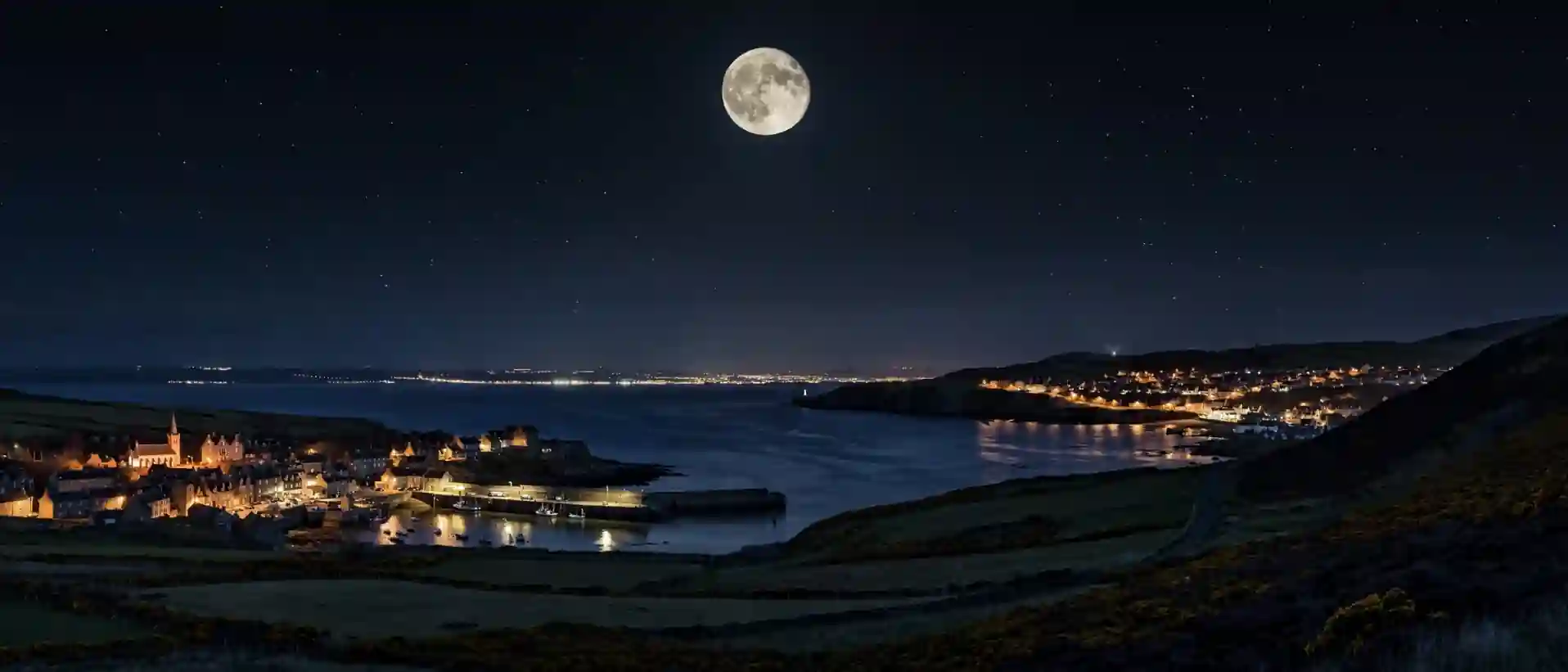
☽ Best Places to View the Moon in Fife, UK
Fife is a peninsula in eastern Scotland, bounded by the Firth of Forth to the south, the Firth of Tay to the north and the North Sea to the east. That gives it something most inland places lack: sea horizons in three directions, so a moon rising in the east or south-east can come up over open water. It also has the Lomond Hills for height, a loch in a former coalfield, and one historic park that is open around the clock. A belt of towns lies along the Forth, so the best dark ground is in the north and east.
Lomond Hills Regional Park – Highest Ground in Fife
A regional park of hills, moors, reservoirs and lochans. West Lomond, at 522 m, is the highest point in Fife, with East Lomond at 434 m. The open ridges give wide sky views, but the tops are exposed, cold and often in cloud. Plan hill routes in daylight.
Lochore Meadows Country Park – Loch Ore
Over 1,200 acres of meadows, woodland and paths around Loch Ore, on land that was once coalfield. The loch gives open water, and a still evening can hold a reflection of the moon. Check current access and opening times before an evening visit.
Pittencrieff Park – The Glen, Open 24 Hours
A 76-acre historic park to the west of Dunfermline city centre, bought by Andrew Carnegie in 1902 and gifted to the town. Fife Council lists it as open all year, 24 hours, with free parking at the Pittencrieff Street entrance. It sits in a glen, so it suits a moon that has already climbed rather than a low horizon.
Beveridge Park – Kirkcaldy
A 104-acre park in Kirkcaldy with formal gardens, woodland and a lake, dating from 1892 when Michael Beveridge bequeathed the land. The lake can hold a reflection of the moon, and the park is a Green Flag park. Check council opening times before an evening visit.
Tentsmuir National Nature Reserve – North Sea Coast
A National Nature Reserve managed by NatureScot, in three parts: Tentsmuir Point, Tayport Heath and Morton Lochs, with forest, dunes, beach and lochs. Tentsmuir Point faces the North Sea at the north-eastern tip of Fife, so a rising moon can come up over open water. Check tide times, and stay on marked routes to protect the dunes.
Ravenscraig Park – Firth of Forth
A 78-acre park between Kirkcaldy and Dysart on the shore of the Firth of Forth, with woodland walks that link to the coastal path. The ruined 15th-century Ravenscraig Castle stands just beside the park. The Forth lies to the south and south-east, so a summer full moon, which rises in the south-east, comes up over the water.
◉ Best Times for Moon Photography in Fife
📷 Quick Photography Tips for Fife
🕐 Timezone: Fife runs on Greenwich Mean Time (GMT, UTC+0) in winter and British Summer Time (BST, UTC+1) in summer.
Horizons: Fife has sea to the south, east and north. Much of it is low and rolling, with the Lomond Hills rising in the middle, so buildings and trees are the main obstacles at street level.
Light: Dunfermline, Kirkcaldy and Glenrothes form a belt of towns along the Forth, with Edinburgh's glow across the water to the south and Dundee's across the Tay to the north. The north and east, especially the East Neuk coast, are noticeably darker.
Access: Pittencrieff Park is open all year, 24 hours. Check Fife Council for the other parks, plan hill routes in daylight, and check tide times and marked routes at Tentsmuir.
The moon phase today in Fife is shown above. For the moon phase today anywhere else, visit the Dynamic Moon Phase Calculator.
◐ What the Experience Actually Feels Like
On the Lomond Hills, Fife feels high and exposed. The wind picks up, the county falls away below, and the moon has the whole sky to itself.
At Lochore Meadows, Beveridge Park and Pittencrieff Park, it feels quiet and parklike: a loch, a lake and a glen, each good for a reflection or an easy early-evening moon.
At Tentsmuir and Ravenscraig, it feels coastal. Dunes and beach on the North Sea at one end, a castle ruin and woodland on the Forth at the other, and a moon that lifts straight out of the water.
"The moon rises out of the North Sea and the Firth of Forth, with the Lomond Hills behind and a glen that never closes."
✓ Your Fife Moon Chase Checklist
Before You Go
- Check the moonrise time and azimuth for your date — a rising moon appears between north-east and south-east, so see which stretch of sea it will use
- Check access — Pittencrieff Park is open 24 hours, and the other parks need a council check
- Check tide times at Tentsmuir, and the Met Office for cloud, wind and haar
What to Bring
- A telephoto lens of 200mm or longer for a tight Moon, and a wider lens for sea and loch compositions
- A tripod, and a remote shutter or 2-second timer
- A lens cloth for sea spray and damp air
- A warm, windproof layer and water-resistant footwear for the hills, dunes and woodland paths
On the Night
- Focus manually on the Moon's edge
- Bracket exposures — one for the bright disc, one for the darker land, loch or sea
- Stay on marked routes at Tentsmuir to protect the dunes
- Plan hill routes in daylight, and take care on the exposed Lomond Hills
? Fife Moon Phase — Frequently Asked Questions
Q. What is the moon phase today in Fife?
The moon phase today in Fife is a New Moon with 0% illumination. The next full moon is in 17 days, on Oct 26. Moonrise is at 6:07 AM and moonset at 5:51 PM.
Q. Where is the best place to view the moon in Fife?
The Lomond Hills Regional Park has the highest ground in Fife, with West Lomond at 522 m and East Lomond at 434 m, and wide open sky over the moors and reservoirs. Lochore Meadows Country Park, over 1,200 acres of meadows, woodland and Loch Ore, gives open water for reflections. Pittencrieff Park in Dunfermline, a 76-acre historic park known as The Glen, is listed as open 24 hours, and Beveridge Park in Kirkcaldy has a lake and woodland. On the coast, Tentsmuir National Nature Reserve faces the North Sea, and Ravenscraig Park sits on the Firth of Forth between Kirkcaldy and Dysart, with the ruined Ravenscraig Castle beside it.
Q. Where can I watch the moon rise over the sea in Fife?
Along Fife's east-facing and south-facing coasts. The East Neuk and St Andrews Bay look east across the North Sea, and Tentsmuir Point, at the north-eastern tip, faces the North Sea too, so a moon rising between north-east and south-east comes up over open water. From Ravenscraig Park and the Kirkcaldy shore, the Firth of Forth lies to the south and south-east, so a summer full moon, which rises in the south-east, rises over the Forth. Check the azimuth for your date to see which part of the horizon the moon will use. Tide times matter on Tentsmuir's beach, and its dunes are protected, so stay on marked routes.
Q. Where does the moon rise and set in Fife, and how high does it climb?
At about 56.2°N, Fife's moonrise and moonset points swing widely across the horizon each month, from roughly north-east to south-east for rising and north-west to south-west for setting, with an even wider swing in years near a major lunar standstill. A full moon near the winter solstice climbs to roughly 57° in the south, while a full moon near the summer solstice stays very low, peaking near 10°, so it barely clears the southern horizon and needs a clear view south. Much of Fife is low and rolling, with the Lomond Hills rising in the middle, so buildings and trees are the main obstacles at street level, and the coast and the hills give the longest sightlines. Check the azimuth for your date and exact spot.
Q. Is light pollution a problem for moon observing in Fife?
The moon is bright enough to observe and photograph from almost anywhere in Fife, so light pollution rarely limits the lunar disc itself. It does wash out earthshine on a thin crescent and any faint sky detail. A belt of towns, including Dunfermline, Kirkcaldy and Glenrothes, lies along the Firth of Forth, with Edinburgh's glow across the water to the south and Dundee's across the Tay to the north, so those areas are light-polluted. The north and east of the county, especially the East Neuk coast, are noticeably darker, but none of it is an official dark-sky site, and for the darkest skies you need to travel north to the Cairngorms Dark Sky Park.
Q. What camera settings and phases work best for moon photography in Fife?
For a full moon, start with Looney 11 (f/11, ISO 100, 1/100 s) and refine using your histogram, since it is a baseline rather than a guarantee. The moon is much brighter than parkland, hills and the sea, so shoot RAW and bracket or blend exposures to keep both crater detail and the foreground. A waxing gibbous is useful for blue hour while the foreground is still lit. For a moon-and-landmark shot, move farther back and use a longer focal length of 200 mm or more, with a sturdy tripod on windy hills and coasts and manual focus on the moon's edge using magnified live view. A moon rising over the North Sea or the Forth can leave a reflective track on the water, and Loch Ore can give a reflection when it is still.
Q. How do haar, wind and short summer nights affect moon viewing in Fife?
Fife has a cool, changeable maritime climate. Haar, a cold sea fog, can roll in off the North Sea with little warning, especially in spring and summer, and can hide the moon along the coast while inland stays clear. The Lomond Hills and coastal headlands are exposed, windy and often cold, and the hill tops can sit in cloud. In midsummer the nights are very short and the sky never gets fully dark at this latitude, and the full moon stays very low. Check the Met Office forecast for cloud, fog, wind and visibility before heading out.
Q. What time zone are Fife's moonrise and moonset times shown in?
Fife runs on Greenwich Mean Time, UTC+0, in winter and British Summer Time, UTC+1, in summer. Clocks go forward on the last Sunday in March and back on the last Sunday in October, and moonrise and moonset times on this page follow the local clock in effect on each date. Fife lies at about 3.2°W, west of the Greenwich meridian on which GMT is based, so the sun and moon cross the sky roughly 13 minutes later on the clock than at Greenwich.
Q. Can I shoot the moon at Fife's viewpoints after dark?
Mostly, with limits. Fife Council lists Pittencrieff Park as open all year, 24 hours, with free parking at its Pittencrieff Street entrance, so it is the most dependable park for a night session. Check current access and opening times with Fife Council for Beveridge Park, Lochore Meadows Country Park and Ravenscraig Park before an evening visit. Plan hill routes on the Lomond Hills in daylight, and check tide times and access at Tentsmuir National Nature Reserve, where you should stay on marked routes to protect the dunes.
✦ Explore Further
Moon Phase Today: Edinburgh
Check tonight's moon phase in Edinburgh, roughly 28 km south of Glenrothes across the Firth of Forth.
🏙Moon Phase Today: Glasgow
See the moon over Glasgow, roughly 77 km west-south-west of Glenrothes on the River Clyde.
🇬🇧Moon Phase in the UK
Browse moon phase pages for cities across the United Kingdom, from Edinburgh to Bath.
🌍World Moon Phase Directory
Find the moon phase, rise and set times for cities in every region of the world.
Blue Hour Calculator
Work out when blue hour falls, ideal for waxing gibbous shots over the Forth and the North Sea.