
Moon Phase Today Edinburgh
On Friday, October 9, 2026, the moon in Edinburgh is a New Moon with 0% illumination. Moon age: 28.9 days.
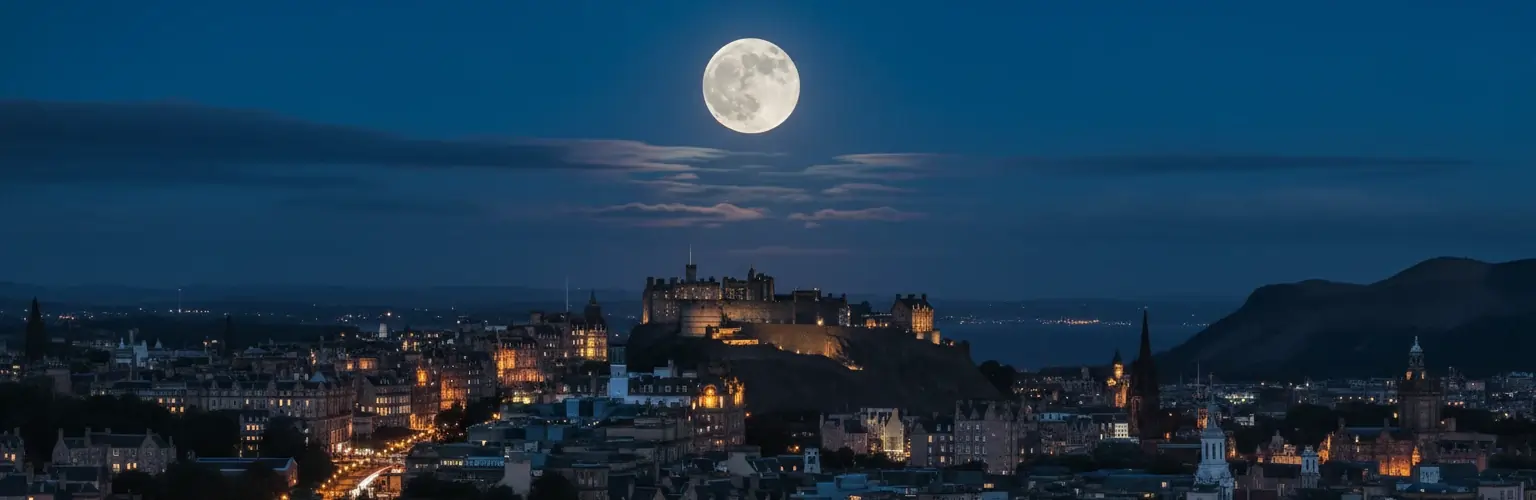
☽ Best Places to View the Moon in Edinburgh
Edinburgh sits at 55.9° North, a city carved from ancient volcanic rock and weathered sandstone. Its dramatic topography—defined by the jagged "Crags" and the monolithic Castle Rock—creates a prehistoric skyline that seems purpose-built for celestial drama. Often called the "Athens of the North" for its neoclassical monuments, Edinburgh offers moon-chasers a unique perspective: the ability to watch the moon rise over the Firth of Forth or track behind the Gothic spires of the Royal Mile. From the elevated pillars of Calton Hill to the wild, windswept ridge of Salisbury Crags, the city rewards those who don their walking boots with views of the moon illuminating the medieval Old Town and the 18th-century New Town alike.
Calton Hill (Nelson Monument)
The absolute #1 Edinburgh moonrise classic. This elevated hilltop offers panoramic views where the moon rises behind the columns of the National Monument or the Dugald Stewart Monument. Its Acropolis-like silhouette makes it the most popular spot for full moon photography. Accessible 24/7, it provides a clean eastern horizon toward Leith and the sea.
Edinburgh Castle Esplanade
A location for dramatic architectural foregrounds. While the moon typically rises in the east (opposite the main castle entrance), positioning yourself on the Esplanade allows you to frame the moon as it tracks behind the castle’s floodlit towers and crown spire. On calm nights, puddles on the ancient cobbles can create striking "rock pool" reflections of the lunar light.
Salisbury Crags (Arthur’s Seat)
Part of the Holyrood Park volcanic complex. Hiking to the ridge of the Crags (~150m) provides a wild, dark foreground. From here, you can watch the moon rise over the Firth of Forth or align it with the distant Old Town skyline. It offers darker skies and fewer crowds than Calton Hill, though the path requires sturdy footwear and care after dark.
Blackford Hill
Located on the south side near the Royal Observatory, this hill (~164m) offers a noticeably darker sky. The moon rises over the city, allowing for "compression" shots where the Castle and Old Town spires are aligned in the distance. It is a favorite for local astronomers and offers a softer, more natural foreground compared to the hard urban edges of the city center.
Inverleith Park Pond
A premier lowland viewing spot opposite the Royal Botanic Garden. The park’s north shore pond provides a massive "mirror" for moonrise photography. As the moon rises over the city, the entire Edinburgh skyline—including the Castle silhouette—is reflected in the still water. It is a flat, easy-to-access location that rewards wide-angle lens users.
Cramond Beach & Causeway
A coastal escape where the moon rises over the open waters of the Firth of Forth. The tidal causeway and concrete pylons create a graphic, minimalist foreground. **Caution:** Access to Cramond Island is strictly tidal; never attempt to cross the causeway if the tide is coming in. The beach itself provides a safe, expansive view of the lunar track across the northern sky.
◉ Best Times for Moon Photography
📷 Quick Photography Tips
Edinburgh operates on Greenwich Mean Time (GMT, UTC+0) in winter and British Summer Time (BST, UTC+1) in summer. Clocks go forward on the last Sunday of March and back on the last Sunday of October. Modern apps like PhotoPills handle this UK shift automatically for exact moonrise times.
The moon phase today in Edinburgh, Scotland is shown in detail below — featuring illumination data, rise/set times, and the top local spots to see it.
◐ What the Experience Actually Feels Like
There is a haunting beauty to an Edinburgh moonrise that feels tied to the city's "Jekyll and Hyde" history. As the sun sets over the Pentland Hills, the sky over the Firth of Forth transitions into a cold, northern violet. Standing on the pillars of Calton Hill, you watch the moon ascend behind the unfinished National Monument, turning the "Athens of the North" into a silver-lit ruin that feels thousands of years older than it actually is.
On the wilder slopes of Salisbury Crags, the experience is more primal. The sound of the city fades into a distant hum, replaced by the wind whistling through the volcanic basalt. As the moon tracks high over the Old Town, its light catches the dark stone of the Royal Mile, making the "closes" and wynds look like deep, ink-black shadows. In the winter, when the haar (sea mist) rolls in from the coast, the moon becomes a diffused, glowing orb that gives the city its true "Auld Reekie" atmosphere—mysterious, moody, and undeniably atmospheric.
"The moon rises over the volcanic ridges of Arthur's Seat, casting a silver light that turns the medieval battlements of the Castle into a ghost-lit crown."
✓ Your Edinburgh Moon Chase Checklist
Before You Go
- Check the "Haar" forecast — sea mist from the Firth of Forth can roll in quickly and completely obscure the moon at the horizon.
- Monitor wind speeds — Calton Hill and Salisbury Crags are exposed; winds over 20mph make long-exposure photography nearly impossible.
- Confirm Cramond Tides — If visiting the beach, check the local tide tables to ensure you are safe from the rising Firth of Forth.
- Check the moon's azimuth — ensure the moon will rise behind the monuments on Calton Hill from your specific tripod position.
What to Bring
- Telephoto lens (200mm to 400mm) — essential for "compressing" the moon against the Castle or the Dugald Stewart Monument.
- Headlamp or torch — essential for descending Salisbury Crags or Blackford Hill safely after the moon has risen.
- Windproof clothing — the temperature on Edinburgh's hills is always lower than at street level; bring layers.
- Weighted tripod — use a bag hook to steady your camera against the persistent gusts typical of the Scottish coast.
On the Night
- Arrive at Calton Hill early — the best spots near the monuments are often taken by other photographers 30 minutes before moonrise.
- Use a remote trigger — even a slight touch on the camera shutter will cause blur in the high-wind conditions of the Crags.
- Balance your exposure — the Castle floodlights are much brighter than the moon; bracket your shots to capture the full dynamic range.
- Stay for the "Blue Hour" — the balance between the deep blue sky, the warm castle lights, and the silver moon is the ultimate Edinburgh shot.
? Edinburgh Moon Phase — Frequently Asked Questions
Q. What is the moon phase today in Edinburgh?
The moon phase today in Edinburgh is a New Moon with 0% illumination. The next full moon is in 17 days, on Oct 26. Moonrise is at 6:07 AM and moonset at 5:52 PM.
Q. Where is the best place to view the moon in Edinburgh?
Calton Hill is the city's classic moonrise spot, with the moon rising behind the columns of the National Monument on a clean eastern horizon toward Leith and the sea. Salisbury Crags and Blackford Hill give darker, wilder alternatives with fewer crowds, Inverleith Park's pond offers a flat, mirror-like reflection of the skyline, and Cramond Beach trades the city view for open water over the Firth of Forth.
Q. Is it safe to visit Cramond Beach or Salisbury Crags for a moonrise?
Cramond Island's causeway is strictly tidal, so it's essential to check the local tide tables before crossing and never attempt it if the tide is coming in — the beach itself, however, is a safe, open vantage point at any tide. Salisbury Crags and Calton Hill are both exposed to strong wind, so a weighted tripod and a headlamp for the walk down after dark are worth bringing.
Q. Why does moon visibility change so much in Edinburgh through the year?
Edinburgh sits at roughly 55.9° N, so the moon's path shifts noticeably with the seasons, riding highest and most southerly in winter — November through February tends to bring the clearest skies overall. Coastal "haar" (sea mist) rolling in from the Firth of Forth can obscure the moon at any time of year, so it's worth checking the local haar forecast before heading out.
Q. Does Edinburgh observe daylight saving time?
Yes. Edinburgh runs on Greenwich Mean Time (GMT, UTC+0) in winter and switches to British Summer Time (BST, UTC+1) from the last Sunday in March to the last Sunday in October. All times shown on this page already account for the correct offset.
Q. What's the best time of year for moon photography in Edinburgh?
November through February offers the clearest winter skies and the most southerly moon path, giving the tightest alignments with Calton Hill's monuments. Whatever the season, check the wind forecast before heading to an exposed spot like Salisbury Crags — gusts over 20 mph make long exposures nearly impossible.
Q. Does this page work for cities besides Edinburgh?
This page is set up specifically for Edinburgh, Scotland. For the moon phase in any other city or location worldwide, use the Dynamic Moon Phase Calculator on the moonphase.today home page.
✦ Explore Further
Moon Phase Today: Glasgow
Check tonight's moon phase in Glasgow, about 45 miles west.
📷Moon Photography Guide
Camera settings, lenses, and techniques for shooting sharp, well-exposed moon shots.
📐Looney 11 Exposure Calculator
Dial in the exact f-stop, ISO, and shutter speed for a full moon — the same rule used in our Calton Hill tips.
🌆Blue Hour Calculator
Find tonight's exact blue hour window to time your Calton Hill moonrise shots.
NASA Moon Phase & Libration Gallery
NASA's Scientific Visualization Studio's daily renders of the moon's exact phase, libration, and orientation, straight from official mission data.