
Moon Phase Today County Durham UK
On Friday, October 9, 2026, the moon in County Durham is a New Moon with 0% illumination. Moon age: 28.9 days.
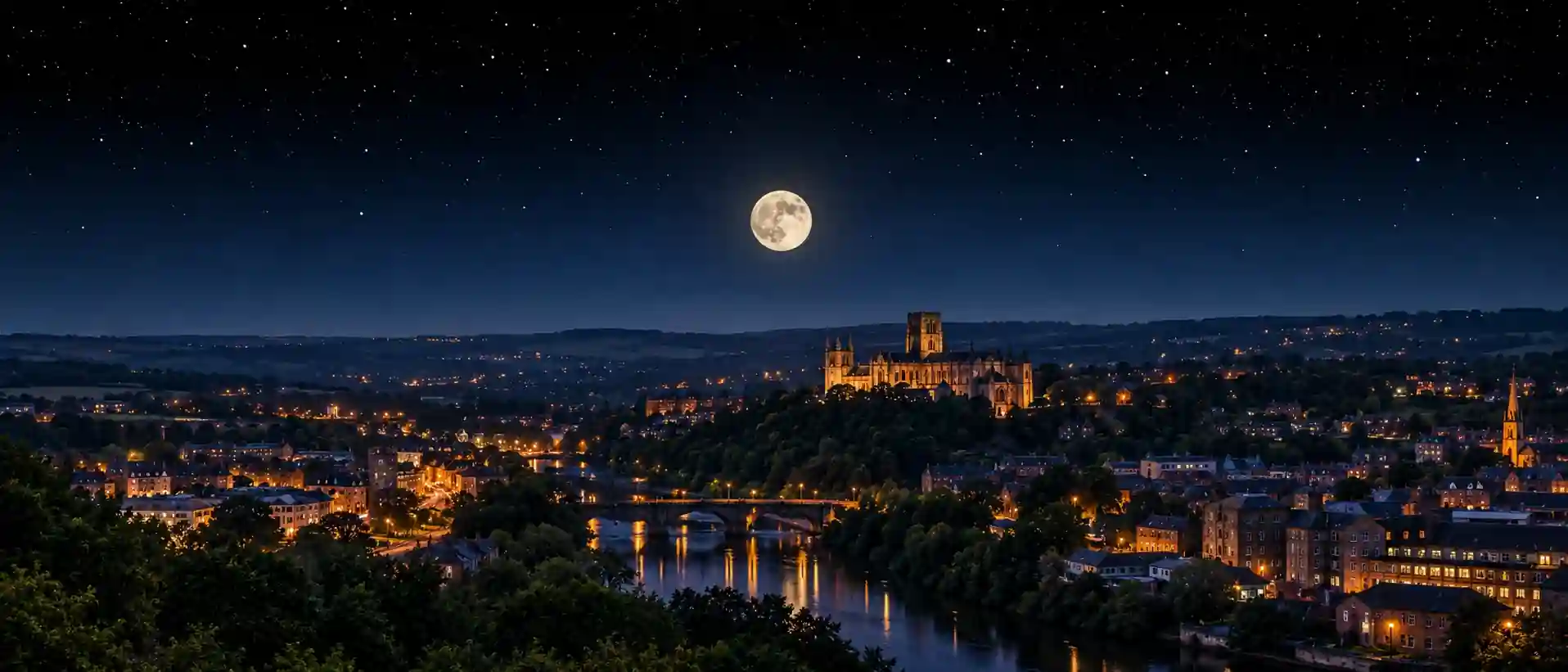
☽ Best Places to View the Moon in County Durham, UK
County Durham is a large county of three very different landscapes: a cathedral city on a bend of the River Wear, a coast that faces east across the North Sea, and the remote North Pennines moorland to the west. The city and the coast are good for moonrises and landmark shots, and the dales are where you go for dark sky.
Wharton Park – Cathedral View from the Battery
A Victorian park created by William Lloyd Wharton and opened to the public in 1858, where the first Durham Miners' Gala was held in 1871. The Battery, a Grade II listed lookout, gives one of the finest views over Durham, looking south over the railway viaduct, the city, and the Cathedral and Castle. A low summer full moon passes across that skyline. Check council opening times.
Durham Cathedral and Castle – World Heritage Peninsula
Building of the Cathedral began in 1093, and with Durham Castle it has been a UNESCO World Heritage Site since 1986, on a peninsula formed by a bend in the River Wear. Frame it from a distance with a long lens, from Wharton Park or the riverbanks, rather than from the narrow lanes around Palace Green.
Hamsterley Forest – Dark Sky Discovery Site
The county's largest forest, run by Forestry England on the edge of the North Pennines. A Dark Sky Discovery Site sits by the bridge below the café near the visitor centre, where the trees block much of the nearby light. Forestry England lists opening hours as dawn to dusk and says overnight parking is not permitted, while some tourism listings describe 24-hour access on foot, so confirm before a night visit.
Grassholme and Cow Green – North Pennines Dark Sky
The Durham Dales and North Pennines National Landscape, also a UNESCO Global Geopark, has 16 Dark Sky Discovery Sites, 12 of them in County Durham. Grassholme Reservoir's site is in the car park, signed from the B6277 north of Mickleton, and Cow Green Reservoir is signed from Langdon Beck. From remote sites the Milky Way is visible. Grassholme Observatory runs events and workshops.
Hardwick Park – Georgian Landscape at Sedgefield
A Grade II* registered 18th-century landscaped park near Sedgefield, with a lake and garden buildings. The open water gives a reflection when it is still, and the park sits well east of the Pennines. Check Durham County Council for current opening times before an evening visit.
Durham Heritage Coast – North Sea Moonrise
The Heritage Coast runs from Seaham to Crimdon, with magnesian limestone cliffs, and it faces east, so a rising moon can come up over the North Sea. Blast Beach near Seaham has cliff-top views year-round, and there is free parking at Nose's Point south of Seaham. Keep well back from the cliff edge.
◉ Best Times for Moon Photography in County Durham
📷 Quick Photography Tips for County Durham
🕐 Timezone: County Durham runs on GMT (UTC+0) in winter and BST (UTC+1) in summer.
Horizons: The Heritage Coast faces east over the North Sea. Wharton Park looks south over the city and the Cathedral, and the North Pennines to the west are high, open moorland.
Light: Durham city, the former coalfield towns and the coast carry urban glow. The North Pennines are remote, with little development, and have 12 of the 16 Dark Sky Discovery Sites in the National Landscape within County Durham.
Access: Hamsterley Forest is listed as dawn to dusk with no overnight parking, so confirm before a night visit. Check Durham County Council for Wharton Park and Hardwick Park, plan routes to the reservoirs in daylight, and keep well back from coastal cliff edges.
The moon phase today in County Durham is shown above. For the moon phase today anywhere else, visit the Dynamic Moon Phase Calculator.
◐ What the Experience Actually Feels Like
At Wharton Park, County Durham feels historic. The viaduct, the city and the Cathedral lie below you to the south, and a low summer moon crosses the skyline above the towers.
On the Heritage Coast, it feels open and windy: limestone cliffs, a wide horizon over the North Sea, and a moon that lifts out of the water.
In the North Pennines and at Hamsterley Forest, it feels dark and remote. The towns fall away, the reservoirs go quiet, and on a clear new-moon night the Milky Way is there for the taking.
"A cathedral skyline from Wharton Park, a moonrise over the North Sea, and the dark dales of the North Pennines to the west."
✓ Your County Durham Moon Chase Checklist
Before You Go
- Check the moonrise time and azimuth for your date — a rising moon appears between north-east and south-east, so see whether it comes up over the sea
- Confirm access — Hamsterley Forest is listed as dawn to dusk with no overnight parking, and the parks need a council check
- Check the Met Office for cloud, visibility, wind and ice, and for sea fret on the coast
What to Bring
- A telephoto lens of 200mm or longer for a tight Moon, and a wide lens for the coast and the cathedral skyline
- A tripod, and a remote shutter or 2-second timer
- A red torch for the Dark Sky Discovery Sites, and a lens cloth for sea spray and Pennine mist
- A warm, windproof layer — the Pennines and the coast are exposed
On the Night
- Focus manually on the Moon's edge
- Bracket exposures — one for the bright disc, one for the darker stone, cliffs or moorland
- Keep white light to a minimum at the dark-sky sites, and keep well back from cliff edges
- Plan routes to the remote reservoirs in daylight
? County Durham Moon Phase — Frequently Asked Questions
Q. What is the moon phase today in County Durham?
The moon phase today in County Durham is a New Moon with 0% illumination. The next full moon is in 17 days, on Oct 26. Moonrise is at 5:59 AM and moonset at 5:46 PM.
Q. Where is the best place to view the moon in County Durham?
Wharton Park in Durham city has the best urban viewpoint, a Victorian park whose Battery lookout, a Grade II listed viewing structure, looks south over the viaduct, the city and Durham Cathedral and Castle, a UNESCO World Heritage Site. On the east coast, the Durham Heritage Coast, between Seaham and Crimdon, has limestone cliffs facing the North Sea. Hamsterley Forest, the county's largest forest, and the reservoirs of the North Pennines give the darkest sky, and Hardwick Park near Sedgefield is a Grade II* registered 18th-century landscape with a lake.
Q. Where are the darkest skies in County Durham?
In the North Pennines, the Durham Dales and North Pennines National Landscape, which is also a UNESCO Global Geopark. It has 16 Dark Sky Discovery Sites, a UK network of recognised, publicly accessible dark places, and 12 of them are in County Durham, including Cow Green Reservoir, Grassholme Reservoir, Hamsterley Forest and Pow Hill Country Park. From the more remote sites the Milky Way can be seen with the naked eye. Grassholme Observatory runs events and workshops with astronomers, so check its listings. Dark skies suit new-moon nights, while a bright full moon washes out the stars and is better shot from Wharton Park or the coast.
Q. Where does the moon rise and set in County Durham, and how high does it climb?
At about 54.8°N, County Durham's moonrise and moonset points swing widely across the horizon each month, from roughly north-east to south-east for rising and north-west to south-west for setting, with an even wider swing in years near a major lunar standstill. A full moon near the winter solstice climbs to roughly 59° in the south, while a full moon near the summer solstice stays very low, peaking near 12°, so it needs a clear view south, and from Wharton Park it passes over the cathedral skyline. The Heritage Coast faces east, so a rising moon can come up over the North Sea. Check the azimuth for your date and exact spot.
Q. Is light pollution a problem for moon observing in County Durham?
The moon is bright enough to observe and photograph from almost anywhere in County Durham, so light pollution rarely limits the lunar disc itself. It does wash out earthshine on a thin crescent and any faint sky detail. Durham city, the former coalfield towns and the coast carry the county's street lighting and urban glow, so stars are faint there. The west of the county, in the North Pennines, is remote, with little development and some of the darkest skies in England, so for the faintest detail, head up the dales on a new-moon night.
Q. What camera settings and phases work best for moon photography in County Durham?
For a full moon, start with Looney 11 (f/11, ISO 100, 1/100 s) and refine using your histogram, since it is a baseline rather than a guarantee. The moon is much brighter than cathedral stone, limestone cliffs and moorland, so shoot RAW and bracket or blend exposures to keep both crater detail and the foreground. A waxing gibbous is useful for blue hour over the cathedral skyline from Wharton Park while some daylight remains. For a moon-and-landmark shot, move farther back and use a longer focal length of 200 mm or more, with a sturdy tripod on the exposed Pennines and the coast and manual focus on the moon's edge using magnified live view. At the dark-sky sites, use a red torch to keep your night vision.
Q. How do Pennine weather and sea fret affect moon viewing in County Durham?
County Durham has a cool, changeable climate, and the weather can differ sharply between the coast, the city and the high Pennines. The North Pennines are exposed and weather can change quickly, with cold, wind and low cloud, and upland roads can be affected by snow and ice in winter. On the coast, sea fret, a cold mist off the North Sea, can roll in with little warning and hide the moon, and cliff tops are windy. Check the Met Office forecast for cloud, visibility, wind and ice before heading out.
Q. What time zone are County Durham's moonrise and moonset times shown in?
County Durham runs on Greenwich Mean Time, UTC+0, in winter and British Summer Time, UTC+1, in summer. Clocks go forward on the last Sunday in March and back on the last Sunday in October, and moonrise and moonset times on this page follow the local clock in effect on each date. County Durham lies at about 1.6°W, close to the Greenwich meridian on which GMT is based, so clock times track the sun and moon closely.
Q. Can I shoot the moon at County Durham's viewpoints after dark?
It depends on the site, so check current times first. Hamsterley Forest is a Dark Sky Discovery Site, but Forestry England lists its opening hours as dawn to dusk and says overnight parking is not permitted, while some tourism listings describe 24-hour access on foot, so confirm before a night visit. Grassholme and Cow Green reservoirs have car-park-based Dark Sky Discovery Sites, and the roads up to them are remote, so plan your route in daylight. Check Durham County Council for opening times at Wharton Park and Hardwick Park, and on the coast, free parking is available at Nose's Point south of Seaham, but keep well back from the cliff edge.
✦ Explore Further
Moon Phase Today: Manchester
Check tonight's moon phase in Manchester, roughly 150 km south-south-west of Durham across the Pennines.
🏰Moon Phase Today: Edinburgh
See the moon over Edinburgh, roughly 165 km north-west of Durham in the Scottish capital.
🇬🇧Moon Phase in the UK
Browse moon phase pages for cities across the United Kingdom, from Edinburgh to Bath.
🌍World Moon Phase Directory
Find the moon phase, rise and set times for cities in every region of the world.
Blue Hour Calculator
Work out when blue hour falls, ideal for waxing gibbous shots over Durham Cathedral from Wharton Park.