
Moon Phase Today Cornwall
On Friday, October 9, 2026, the moon in Cornwall is a New Moon with 0% illumination. Moon age: 28.9 days.
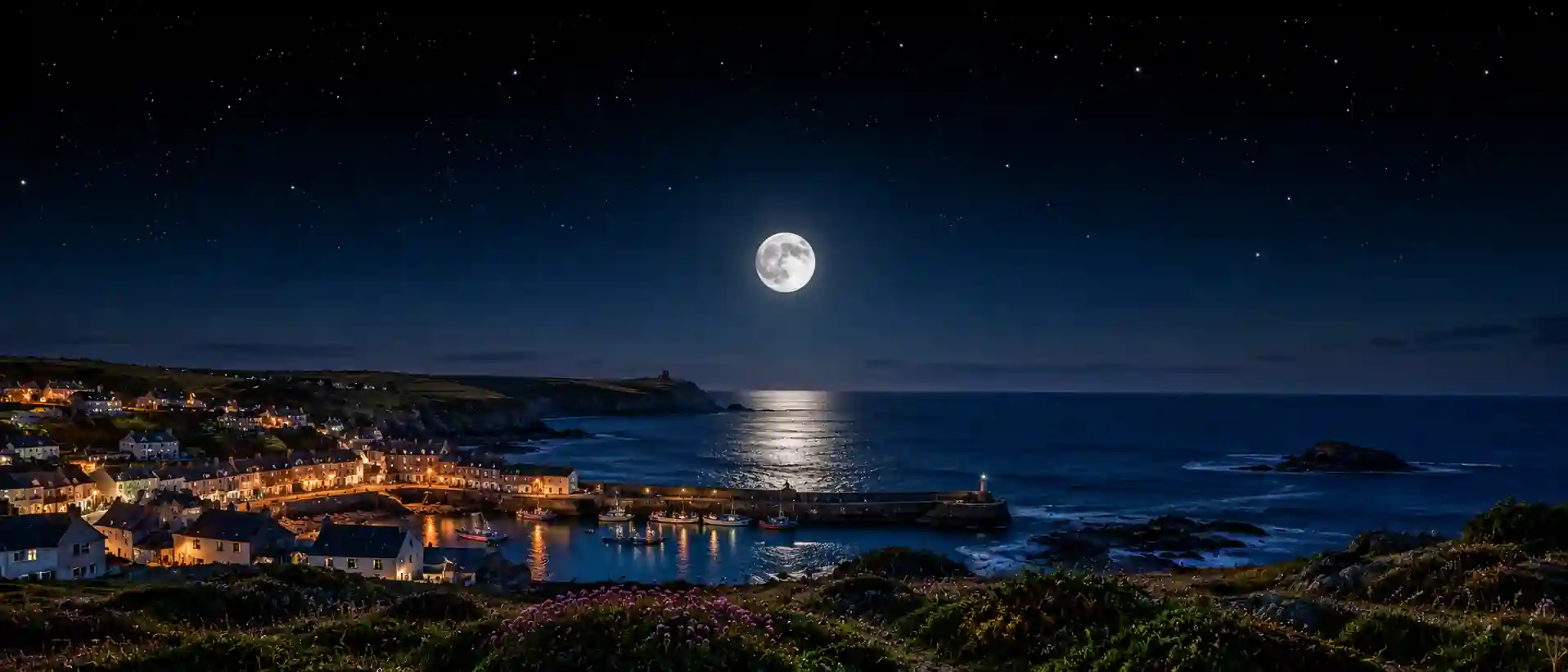
☽ Best Places to View the Moon in Cornwall, UK
Cornwall is a predominantly rural peninsula with a deeply indented coastline and 3,563 km² of open moorland, coastal heath and granite coves. A unitary authority since 2009 with its centre at Truro, it has two International Dark Sky designations and broad sea horizons at almost every headland.
Bodmin Moor – Dark Sky Landscape – 434 km²
Remote upland granite moorland, the largest unit of the Cornwall National Landscape. Designated as a Dark Sky Landscape in July 2017 — the first National Landscape to receive IDA accreditation. Working agricultural landscape with open-access land, wide horizons over granite tors, and exceptionally dark skies. Brown Willy at 420m is Cornwall's highest point.
West Penwith – Dark Sky Park – 135.84 km²
Awarded Dark Sky Park status in December 2021 — the second in Cornwall after Bodmin Moor and the seventh in the UK. Covers 135.84 km² of the westerly section of the Cornwall National Landscape. Naturally dark with minimal light pollution, including coastline around Cape Cornwall, Land's End, Porthcurno and Pendeen. Broad western horizon over coastal heath.
Godrevy Point & St Ives Bay – Lighthouse & Open Bay
Elevated headland at the northern end of St Ives Bay overlooking Godrevy Island and its lighthouse. The National Trust describes the sandy beach here as three miles from Hayle to Godrevy Cove. Open bay horizon for moon photography — check moonrise azimuth for the date. Dog restriction at Godrevy / Hayle Towans is 1 July–31 Aug, 10am–6pm.
Lizard Point – Most Southerly Point of Mainland Britain
The most southerly point of mainland Great Britain. Dramatic scenery with elevated views toward the western horizon, benches in the visitor area and parking with a short walk to viewpoints. Headland and cliffs obstruct parts of the horizon — not a 360° sea view from every spot. Check exact moonrise direction for your date.
St Michael's Mount & Marazion – Tidal Island
Tidal island in Mount's Bay off Marazion linked by a granite causeway that appears at low tide. Access on foot is at low tide only — about four hours around low tide per National Trust — boat at high tide. Check tide tables, the causeway is submerged outside the low-tide window and granite setts are slippery.
Porthcurno & Minack Theatre – Granite Cove & Cliff Theatre
Granite cove on the Penwith Peninsula with a National Trust car park, set within the West Penwith Dark Sky Park area with low artificial light. Minack Theatre is an open-air theatre perched high above the Atlantic per Historic England. Dramatic coastal setting, but south-facing does not mean every moonrise is over the cliffs — azimuth varies with date.
◉ Best Times for Moon Photography in Cornwall
📷 Quick Photography Tips for Cornwall
🕐 Timezone
Cornwall runs on GMT (UTC+0) in winter and BST (UTC+1) in summer.
📍 Geography Note
Area & Light: Cornwall covers 3,563 km² — a rural peninsula with deeply indented coastline that gives 180°+ sea horizons at headlands like Lizard and Godrevy. Low population density and distance from cities support dark skies inland and in the far west.
Dark Sky Designations: Two International Dark Sky areas, both inside the Cornwall National Landscape (formerly AONB). Bodmin Moor Dark Sky Landscape — 434 km² designated July 2017, first National Landscape to achieve IDA accreditation. West Penwith Dark Sky Park — 135.84 km² designated December 2021, second in Cornwall and seventh in the UK, covering the westerly section including Land's End and Porthcurno.
Horizons & Elevation: Brown Willy at 420m on Bodmin Moor is Cornwall's highest point. Lizard Point is the most southerly point of mainland Great Britain with elevated western views but cliffs that block parts of the horizon. Godrevy Head overlooks its lighthouse island and the three-mile beach from Hayle to Godrevy Cove. Porthcurno is a granite cove with Minack Theatre perched above the Atlantic.
Access: St Michael's Mount causeway is low-tide foot access only — about four hours around low tide, boat otherwise. Always check tide tables. Godrevy / Hayle Towans dog restriction is 1 July–31 Aug, 10am–6pm. Bodmin Moor and West Penwith are open moorland and coastal heath — check National Trust / Cornwall Council parking, use a red torch and stay on designated paths.
The moon phase today in Cornwall is shown above. For the moon phase today anywhere else, visit the calculator.
◐ What the Experience Actually Feels Like
On Bodmin Moor and in West Penwith, Cornwall feels truly dark — 434 km² of granite moorland and 135 km² of coastal heath with minimal light pollution and wide horizons over tors and heather.
At Godrevy and Lizard Point, it feels open and windy — a three-mile sandy bay with a lighthouse island offshore, and the most southerly point of mainland Britain with benches and a short walk to western-facing viewpoints.
At St Michael's Mount and Porthcurno, it feels tidal and dramatic — a granite causeway that appears for about four hours at low tide leading to a tidal island, and a granite cove with an open-air theatre perched high above the Atlantic.
"Dark sky moorland and heath, open bay and headland horizons, and a tidal causeway and granite theatre above the Atlantic."
✓ Your Cornwall Moon Chase Checklist
Before You Go
- Check moonrise azimuth — south at Lizard vs west at West Penwith vs inland at Bodmin changes alignment
- Verify access — Bodmin Moor open-access moorland, West Penwith open coastline, Godrevy / Hayle Towans dog restriction 1 July–31 Aug 10am–6pm, Porthcurno car park, St Michael's Mount causeway low-tide ~4 hours foot only
- Check Met Office and tide tables — sea mist, granite spray, Lizard and Land's End windy, causeway submerged outside window
What to Bring
- Telephoto 200mm+ for tight Moon, wide for Godrevy Lighthouse and St Michael's Mount
- Red torch for Bodmin Moor and West Penwith Dark Sky areas, remote shutter
- Lens cloth for sea spray and moorland mist
- Warm layer — peninsula exposed, granite setts slippery when wet
On the Night
- Manual focus on Moon's edge — more reliable with no artificial lighting
- Bracket exposures — one for bright disc, one for darker cliffs, causeway and lighthouse
- Stay on paths — Bodmin is working agricultural landscape, West Penwith and Porthcurno cliffs sensitive
- Dark Sky = two designated areas, not only two places to see dark skies — use Cornwall National Landscape term, not AONB
? Cornwall Moon Phase — Frequently Asked Questions
Q. What is the moon phase today in Cornwall?
The moon phase today in Cornwall is a New Moon with 0% illumination. The next full moon is in 17 days, on Oct 26. Moonrise is at 6:13 AM and moonset at 6:04 PM.
Q. Where is the best place to view the moon in Cornwall?
Bodmin Moor, a remote granite moorland with wide horizons over the tors and exceptionally dark skies, is Cornwall's best inland option, and Brown Willy at 420 m is the county's highest point. In the far west, West Penwith has a broad western horizon over coastal heath, including the coast around Cape Cornwall, Land's End, Porthcurno and Pendeen. Godrevy Point on St Ives Bay looks out over Godrevy Island and its lighthouse, and Lizard Point, the most southerly point of mainland Britain, has dramatic cliff scenery, though headlands block parts of the horizon. St Michael's Mount and Marazion give a tidal island and granite causeway as a foreground, and Porthcurno and the Minack Theatre give a granite cove and a cliff-top open-air theatre above the Atlantic.
Q. Where are the darkest skies in Cornwall?
Cornwall has two International Dark Sky places, both inside the Cornwall National Landscape. Bodmin Moor was designated an International Dark Sky Landscape in July 2017, the first International Dark Sky Place in a protected landscape of its kind in the UK. West Penwith followed in 2021 as an International Dark Sky Park, the seventh in the UK and the second in Cornwall. Bodmin Moor is working farmland with much of it open-access land, and both areas keep artificial light very low, so they suit new-moon stargazing and the Milky Way, while a bright full moon washes out the stars. Use a red torch, stay on designated paths, and check parking and access before a night visit.
Q. Where does the moon rise and set in Cornwall, and how high does it climb?
At about 50.3°N, Cornwall's moonrise and moonset points swing widely across the horizon each month, from roughly northeast to southeast for rising and northwest to southwest for setting, with an even wider swing in years near a major lunar standstill. A full moon near the winter solstice climbs to roughly 63° in the south, while a full moon near the summer solstice follows a low southern path, peaking near 16°. The north and west coasts face the Atlantic, so headlands such as Godrevy Point and West Penwith give open sea horizons for a setting moon, while the south coast faces the Channel and suits the low path of a summer full moon, which rises in the south-east. From Penzance's seafront, St Michael's Mount lies roughly due east across Mount's Bay, the direction of an equinox moonrise. Headlands and cliffs block parts of the horizon, as at Lizard Point, so check the azimuth for your date and exact spot.
Q. Is light pollution a problem for moon observing in Cornwall?
The moon is bright enough to observe and photograph from almost anywhere in Cornwall, so light pollution rarely limits the lunar disc itself. Cornwall is a largely rural peninsula with much less artificial light than England's big cities, and the low population density and distance from cities keep skies dark inland and in the far west. Towns still have local lighting, which matters more for earthshine and faint detail than for a bright full moon, and Bodmin Moor and West Penwith are the darkest areas.
Q. What camera settings and phases work best for moon photography in Cornwall?
For a full moon, start with Looney 11 (f/11, ISO 100, 1/100 s) and refine using your histogram, since it is a baseline rather than a guarantee. The moon is much brighter than granite cliffs, sea and moorland, so shoot RAW and bracket or blend exposures to keep both crater detail and the foreground. A waxing gibbous is useful for blue hour over Godrevy Lighthouse and the St Michael's Mount causeway while the foreground is still lit. A 200 mm or longer lens helps frame the moon against the lighthouse island or the Mount, with a sturdy tripod for exposed moorland and windy headlands and manual focus on the moon's edge using magnified live view. Save new-moon nights for stars at Bodmin Moor and West Penwith, and full-moon nights for the causeway and coves.
Q. How do sea mist, wind and Atlantic weather affect moon viewing in Cornwall?
Cornwall has a mild, maritime climate with frequent Atlantic weather, so cloud, rain and wind can change quickly. Sea mist can roll in with little warning on the coast, spray and damp air affect lenses, and exposed headlands such as Lizard Point and Land's End are windy. Bodmin Moor is exposed granite moorland where mist and cloud can settle on the tors, so bring a warm layer. Check Met Office forecasts for cloud, mist and wind, and check tide times before heading to St Michael's Mount.
Q. What time zone are Cornwall's moonrise and moonset times shown in?
Cornwall runs on Greenwich Mean Time, UTC+0, in winter and British Summer Time, UTC+1, in summer. Clocks go forward on the last Sunday in March and back on the last Sunday in October, and moonrise and moonset times on this page follow the local clock in effect on each date. Cornwall lies at about 5°W, so sunsets and moonrises come roughly 20 minutes later on the clock than in London, and a little later again at Land's End.
Q. Can I shoot the moon at Cornwall's viewpoints after dark?
Access varies by site. Bodmin Moor and West Penwith are open moorland and coastal heath, with much of Bodmin Moor open-access land, so stay on designated paths and check National Trust and Cornwall Council parking before a night visit. St Michael's Mount's granite causeway is passable roughly from mid-tide to low water, about two hours either side of low tide, with boats at high tide, so check the tide tables and take care on the setts, which are slippery when wet. Porthcurno has a National Trust car park, and the Minack Theatre is an open-air theatre above the Atlantic with its own opening times, so check them before an evening visit.
✦ Explore Further
Moon Phase Today: Glastonbury
Check tonight's moon phase in Glastonbury, roughly 190 km east-northeast of Truro in Somerset.
🛁Moon Phase Today: Bath
See the moon over Bath, roughly 225 km east-northeast of Truro on the River Avon.
🇬🇧Moon Phase in the UK
Browse moon phase pages for cities across the United Kingdom, from Edinburgh to Bath.
🌍World Moon Phase Directory
Find the moon phase, rise and set times for cities in every region of the world.
Blue Hour Calculator
Work out when blue hour falls, ideal for waxing gibbous shots over Godrevy Lighthouse and St Michael's Mount.